25 Years of Design • Build • Use | A Presentation @ the San Francisco Institute of Architecture | April 13, 2000 • Part 1 of 3 | Note: These notes were compiled in support of a presentation that Fred Stitt asked me to make at the school. I subsequently added to the notes after the presentation. Fred’s theme was the future of Architecture and how the Internet will augment and effect architectural practice. I decided to talk about the last 25 years of MG Taylor, from the perspective of my practice of architecture. I did this because we deliberately set in motion, years ago, ideas and solutions that we projected would form the foundation of a 21st Century, postindustrial, economy. We did not set out to build for the 1980s 0r 90s - we build, then as we do now, for a new reality - a reality that is just coming into being. Because of this, the story of these years is really a story about a future that is just beginning to unfold. The past “as prolog” is the theme of this presentation. This, then, is an experienced-based story that comes from the past and informs the future - a round about way of addressing Fred’s questions which I dealt with, directly, at the very end of the evening. | | | | I had nearly 20 years of work behind me before this story began. During these years, I predominately invested my time learning to design and to build. Since then, I have worked to pass these skills on and to institutionalize a processes that enable individuals and organizations to do the same. | | The story itself, is divided into four phases: The nascent stage: 1975 to 1985; The capacity building stage: 1985 to 1995; The business building stage: 1995 to 2000; And now, the proliferation stage. | | This is the story of several different threads coming together: The idea of designing and building - and creating a closely coupled feedback between the two; The idea of flexible, adaptable workplaces and why they are necessary to a whole new way of working; The idea of compact, multi-use spaces that make more economic sense; The idea of Rapid Prototyping and Lean Production and how to get the 30% to 70% of the non-value-added waste out of the production process; The idea of sustainable life-cycle economics - and Earth-friendly economics; The idea of very rapid time-to-value design-build-use process and factoring the value of time into the cost equation; The idea of personal creativity and collaborative design becoming Group Genius and “lifting” the result to a much higher “emergent” order; The idea of a global-village marketplace and the “Brand Called You” resulting in ad-hoc ValueWebs that ebb and flow with opportunity and work; The idea of the tight integration between environment, tooling and work-processes to make engines of creation - workplaces that are healthy, exciting, productive and sustainable; The idea of fusing physical and virtual places with intelligent agents and technologies so that time and distance are a positive factor - not a detriment - in both personal and collaborative work. The idea of building mind-like processes into everyday environments and tools. | | The sum of all this makes environments where transformation is the norm - because that will be the reality of the 21st Century - no matter what specific focus, product or service a workplace is about. | | There have been many punctuation points along this path of discovery. Some of these are highlighted in the text that follows. The story, itself, weaves in and out of these “moments” and involves many people. These players are an integral part of this story, and in another way, have a story of their own that is larger and different than my own. Their part of the story is one that they have to tell themselves. | | The story draws experience from product design, research, architecture, building, manufacturing, education, business, retailing, consulting, invention, intellectual property protection and licensing, software development, technology configuration, futures research - all fields that I, and our various organizations, work in on a daily basis. | | The main idea is how all of these become - together - a new way of working that changes the rules of how things are designed, built, transported, accounted for and used. | | Starting 20 years ago, with the creation of MG Taylor Corporation, we undertook several tightly integrated efforts: The development and marketing of environments that were specifically designed to augment creativity and Group Genius. We organized ourselves to do this as a self-financed for-profit organization to design, develop, manufacture and operate all the necessary components that make up these environments, as well as, provide support technology configuration and new work processes. In short, we set out to create the environments required to make the environments we envisioned. A bootstrap process. | | In addition, we took on the task of being an exemplar of this new way of organizing and working. We organize our business, our own environment and way-of-doing business as if we were already in the imagined future-state. This is, of course, a dangerous path but the only one that leads to our goal. | | This experience has been one of moving from: | | We started with no affiliations, customers or capital - We had a vision, some experience that supported it and many ideas of how to bring it about. | | Now, several hundred people use our environments and employ our way-of-working every day. Over the last 20 years, thousands have. | | We have over 20 years of Documentations of groups of people, from 25 to 150, working in our environments, using work processes and technology configured by us. This is, perhaps, one of the most comprehensive archives of the creative process that exists. | | How environment effects productivity and the creative potential of individuals, teams and groups is not a theory with us - it is a practice. | | Philosophy to Practiced System and Method | | A philosophy, and some processes useful for applying it, is often confused with a System and Method - which it is not. | | And, even a System and Method has to be transferred to recreated and practiced by a Community of Work. | | Otherwise is is just a body of ideas - good ideas, perhaps, but of limited utility and range of use. | | One reason for writing a Patent is that the entire work has to be codified in systematic language. In our case, we even had to invent a language to describe, accurately, many of the aspects of the process. | | Techniques, skills and knowledge are prerequisites to making a formal Method. However, if that Method is not embodied in a System and “installed” in a working community, it will never become robust and what is made real will fade with time. | | In this context, what we have done is invent an “OS” for the process of taking ideas and transforming them into useful Intellectual Capital of an organization’s ValueWeb. | | Our starting position was one of total customization. Everything had to be designed and built from scratch. Personal computer systems and media equipment were expensive and primitive. We were absolutely delighted when we were able to buy a special card that, when inserted into our first computer, an Apple II, gave us upper and lower case! | | We can build an environment, today, floor-to-ceiling, wall-to-wall entirely out of manufactured goods. We can equip it - off-the-shelf - with sophisticated computer and multimedia capability. | | We can do in days what used to take months. Yet, we have, in practical terms, more variety of solutions at our disposal than when we started. | | Our clients have always liked our environments and processes and they have always been fascinated with the technologies we employed. Nevertheless, they did not consider them mainstream. Most, who at first came to visit, could not understand: “what do you do here?” | | This work is now accepted. It is no longer strange. It is desired. The procurement system of large organizations still makes getting it, however, very difficult. The battle has shifted from selling the idea to easing the acquisition path. | | The market has been created but it is not mature. The “architecture” is liked and desired because of the productivity it provides when coupled with Technology and new work-processes. | | When users first come into our environments they regard them as special and different. In a matter of hours, their perspective shifts. They soon regard these workplaces as normal - which they are! | | They start to regard their existing environments as abnormal and unnecessarily restricting - which they are! | | Today, the response is very binary: most “get it.” Some do not. Those that do not cannot be convinced. There is still a hard core that regards the environment as having nothing to do with human values, health, productivity or sense of well being. | | The vast majority that are exposed to it, however, want this kind of work environment to be their normal experience. | | This work is still not inexpensive but it is no longer cost prohibitive. It is affordable if life-cycle costs are considered and if productivity and the quality of the work is factored in. | | There are not, yet, good measures for this. However, the differences are so blatant that simple observation serves. | | The old financial paradigm still owns the territory and it takes careful thinking for decision makers to understand how upside down and inside out their traditional financial models are. | | Architecture, as a process, has no systematic R&D program. It also has virtually no IP protection. This drives a practice economics based on the labor of producing the work instead earning from the value of it. This makes a positive feedback loop that eliminates the possibility of money for R&D. The lack of real IP reinforces this because there are no financial returns for Trade Dress, most inventions and work processes. Time is the only criteria - not value. | | We have bucked this trend and created a strong foundation of IP. With this, and with our participation in the complete design-build-use process, we have established an economy more conducive to a long-term systematic development of affordable alternatives. | | The IP of the entire ValueWeb is what has to be protected - not just of MG Taylor and the various affiliate Business Units. | | This creates a basis of a different economy for the practice of architecture. | | Well... Maybe it is still rare but the idea-of-it is fairly broadly distributed and the movement toward ubiquity is now at a rapid pace. | | Our society implements quickly once an idea gains acceptance. The ValueWeb necessary to do this is yet to be fully developed on the necessary scale. There are issues of very-large-scale that have to be worked out. Ubiquity has been part of the mission from the very beginning. | | At MG Taylor, we set out to change the way people work. We set out to do this on a very large scale. We believed - and still do - that it was inadequate work processes that drove poor decisions - not bad people. In a different environment, with different work-processes, supported with a different tool-kit, people make different results - better results. We see this over and over. Until the work is ubiquitous, however, the accumulative effect will not be adequate to facilitate the scale of transformation required if our society is to avoid. | | Working for clients to Partnering with them | | We consider clients/users to be part of the ValueWeb. We consider the traditional producer-client relationship roles to be passive-aggressive in nature and basically unproductive. | | We do not work “for” anyone. We seek to “partner” with all members of the ValueWeb. This is a different model and one that has been difficult to bring about because of in-place habits and the existing contractual environment which is adversarial in nature and practice. | | It is coming about and, in the last two years, we have experienced a remarkable shift in the nature of our “client/user” relationships. Again, we find the response binary - there are those who will not form an equal-to-equal relationship for any possible gain. There are those who seek this kind of relationship. We choose to work with those who are willing to change the game. | | We find that this is what determines our “sales” far more than the general acceptance of our work. It is interesting to note that those who choose to play the old “who is on top” game say that we are “impossible” to work with. | | Slow realization to fast implementation | | We started out building very fast because the projects were small and everything was custom and within our own “production” capability. Then, over time, the projects became larger and more complex. They involved a greater number of the “traditional” design-build producers. The costs and time-to-value increased greatly. | | Now, the trend is going the other way. This varies from project to project. We can - and do - get the users working much faster than the typical build out. This is key to effectiveness in today’s work environment. | | You are not adaptable if you cannot reconfigure your work environment - quickly and economically - to fit the specific work you are doing. Existing systems and build processes do not allow this. | | It takes lean production methods to do it. | | Centrally located Teams (only) to RemoteCollaboration | | Of course a big part of our work is creating environments for Teams to work in. This has been the easier “half” of the task. We are just getting the tool kit in place for effective remote work. | | Our own organization is highly disbursed. The 15 or so that make up our core team live and work in seven cities and - right now - two countries. Our NetWork of several hundred is even more spread out. | | Today we use various combinations of F2F and virtual techniques. Soon, our own products will be facilitating our work processes in a fuller expression of Remote Presence and Collaboration. | | There is a false notion that there is a basic difference between the physical work environment and the virtual. Nonsense. Every virtual hub is somewhere. When you are talking “virtual” you are talking about how you connect physical places - even if some of those places are moving. The processes, however, required to do this are different. | | | Each step along this path involved passionate commitment to the idea of a fundamentally new working environment. As I look back on it, I am of two minds. One is wonderment that it took so long to do what was so clearly needed - and obvious. The other is that we managed to to get it done at all. | | This was not, and still is not, the task of finding out what the market wanted and providing it - we had to create the requirements, design the solutions, deliver the products and services and make the market for them. Then, we had to learn how to turn it into a profitable business - this part we have learned how to do in the last couple of years. In the end, it is not about making a market in the conventional sense at all - it is about building ValueWeb organizations that are a market. | | It is a strange feeling to look back on a quarter of a century with such a mixture of pride and loss. Pride of what has been done and a sense of failure that so little has be accomplished when so much more is possible. Level I, that point when the full System and Method is working - as a system - on a continuous basis - is still before us. It is now within sight, but still some steps down the road. | | The projects that follow are “places” along the path - they are moments, snapshots, to remember; they are times when something happened that made value for that present and referenced the future still ahead. They do not make up the whole story - they are one telling of it. They are only the beginning of the path that is still ahead. | | 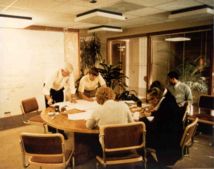 | 1980
Anticipatory Management Center Boulder, Colorado | | | Our first environment was put together in less than two weeks. We used it for nearly three years. It was here that we established the basis for the work we are doing today. In many respects, it is one of the best environments we have ever built. | | It was about 3,500 square feet of open space that was divided by several long floor-to-ceiling overlapping WorkWalls with no doors between the spaces. Sort of a wood version of the Barcelona Pavilion by Meis. It was built in on a shoe string in Boulder, Colorado - just off the Boulder Mall - a great place to start a new venture. Our design-manufacture-build Business Unit, AI, is still centered in Boulder although it now manufactures in Kentucky. Reflecting the Internet age, four the of five of us, who presently make up the AI core design team, live in different cites in the United States and Mexico. This is not how we started although we imagined RemoteCollaboration and Presence from the beginning. | | At the Anticipatory Management Center, the DesignShop process was invented and refined, the Modeling Language created, our technical systems vision designed, our first client NavCenter conceived and built, the first RDS deployed. Virtually everything we do now at MG Taylor, AI and the KnOwhere Stores emanated from this one space in less than a three year period. It was a period of raw invention. | | Over 20 years later - of the 7 members of this first team - four are still working with the Enterprise. This was a seminal experience and one that lives with us to this day. | | Build fast and take the design through several iterations of upgrade. Multiple iterations amplify results and out perform lengthy cycles of work. | | Use time and economic constraints as a stimulus to creativity not a barrier. | | Use “run-walk-run” - find some way to do (in “walk” mode) what is beyond present technology. This simulation will give you practical experience about what you want to become - not what you are. | | If you want to lean how to ski go where there is snow. Don’t go where it is merely convenient or affordable if that does not provide experience about your goal. In the conventional definition, there is nothing “practical” about this. | | Start now - not when you are ready. Your are never ready. | | Don’t get seduced with the idea that you can take any work which takes you away from your goal. Too many do this with the intent to get back to the vision when they have money - “show me one” - Jubal Troop. Make all the work you get include your “End State” - be willing to stretch and risk but have the connection to your vision firmly in your mind. | | | | What made this environment work so well was it’s clarity of message. Two steps in the door and you knew that this was a different kind of space based on a different way of working. The message was not confused with a lot of architectural tricks and distractions. It was not trying to be anything other than itself. Too often, a false drive for originality forces a result that self-consciously draws attention to itself rather than to the life lived and the work done inside the place. | Designer
| Matt Taylor | | Sponsors | Matt Taylor, Gail Taylor, Langdon Morris | | Design Team | Matt Taylor, Langdon Morris | | User/Owner | Taylor Associates, Inc. - Now MG Taylor Corporation | | Architect | none | | Builder | self | | PM | Langdon Morris | | System | none | | Location | Boulder, Colorado off the Mall | | Year | 1980 | | | | We continued to develop this space the three years we were in it. This is where we learned that no matter how will you conceive and build a space it takes a few years of extensive use before the many latent opportunities can be found and developed. At the end, the AMC supported DesignShop events of over 50 participants and 15 KnowledgeWorkes - and between events - a team of 12. A lot going on in 3,500 feet. | | 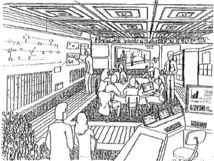 | | | This illustration is the cover of our 1982 Business Plan. | | Jim Toohey threw this sketch together in less than a couple of hours. We keep it because it still represents the “THERE” that is now becoming technically possible we are just beginning to build today. | | This is our vision of environment, technology and work processes working in harmony. Built today, it would be one of the most sophisticated work environments on the planet. We have built, since 1982, about 20 environments that were - to the best of our ability and our client’s capability - aimed at facilitating and accomplishing the kind of work shown in this sketch. Each of these projects have progressively achieved more of this vision and each has progressively increased our ability to make these kinds of environments cost less in capital required and design-to-move-in time. | | This concept sketch shows two teams working together remotely. We call this RemotePresense which goes far beyond video-conferencing - it implies a full time, full size, high fidelity living presence one site to the other. Just go up to the wall and start talking as is happening at the back of the room in the sketch. The tool kit is composed of large read-write walls, wireless laptop computers and PDAs. There is a documentor’s station that performs the 10 Step Process using the CyberCon Intelligent Agent system. It can run on automatic or in concert with and augmenting a Human partner. | | The import thing about this sketch is to note that everyone is working together but each are parallel processing and working in many different modalities. It can be inferred that there are others “joining” and leaving the teams on an ad-hoc basis. As they work through the Creative Process, they are moving their work product through iterations of the Design Formation Model. They are receiving feedback from appropriate “Nodes” in the ValueWeb system. They are self-documenting - with help from CyberCon - as they move through iterations of creativity. They are in a habitat that practices creative habits. | | In this scenario, work progresses freely - and systematically - through multiple complete cycles that becomes product that is “shipped,” real time, each work session. This is not your father’s meeting. | | This drawing illustrates what I call “Level I.” Level I is the minimum scope of the work that constitutes the full expression of an Invention process that goes back to the early 1960s. | | Create an archetypal “THERE” and bring some part of it to each “HERE” that you build. Every time. | | Always build a balance between the environment, tools and the work processes. It does not help to have one far in advance of the other. In fact, it creates a distortion and sets you back. The function of architecture is to shelter, provide appropriate utility and express human values. These attributes have to be kept in harmony. | | Practice, on yourself, the system and enviornments you are providing your ValueWeb members. You can only produce what your are - and, what you do produce determines what you become. | | Push the state-of-the-art. Environments are far behind the demand curve in regards productivity, affordability and sustain-ability - and beauty. Few, built today, meet the criteria necessary for human habitation. | | Remember, all media is multimedia. This means pencil and paper, white boards, film, CD disks, tape, sound, even smell, computers graphics - everything. Each has a special character and place. There is a tendency to think of multimedia as a Power Point sit-and-get presentation. All these media can be mixed and displayed on walls, in pda hand-helds, on projection screens, in computers. All media modes are biased - there is no such thing as a neutral technology. Each brings out a special aspect of potential reality. | | | Designer
| Matt Taylor | | Sponsor | Matt Taylor | | Design Team | Matt Taylor, Bill Blackburn | | User/Owner | Taylor Associates, Inc. - Now MG Taylor Corporation | | Architect | Jim Toohey | | Builder | none | | PM | Matt Taylor | | System | Taylor System and Method | | Location | generic | | Year | 1982 | | | | 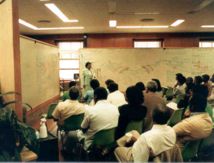 | 1984
Acacia Management Center Washington, DC | | | In late 1983 we were purchased by one of our clients who wanted our undivided attention for a few years - which they got. The deal was that we were to concentrate on their transformation and they would then take us to the market to achieve our own development - this part never happened and we reestablished our independent enterprise in late 1985. | | However, the Acacia years were seminal in the development of our work. They provided financial stability and an “in house” large corporate client which provided challenging work. | | We created a wonderful 5,000 square foot environment across the street form the US Capital in Washington DC. From the 7th floor the work areas looked out over Congress and the Mall. The space we had was an old Masonic room built of sold teak planking and joinery. We preserved the room as it was and built within it. Not one nail went into the existing structure. Our system sat inside - integrated but completely independent. | | Gail and I lived in a turn-of-the-century 4 story just a few blocks behind the Library of Congress where we would go to read and hear concerts. | | This gave me the experience of what it was like to be a Vice-president of a large Financial Institution - an experience that everyone should have once - but not for too long. | | Part of our business, which is now AI, stayed in Boulder and continued the development of the environmental systems. | | We built our environment at Acacia in about 6 weeks and launched its use with a 30 day DesignShop process that took several hundred members of the organization (in groups of 40 to 50 and two to four day segments) through a complete redesign of the Company - strategy to systems to field implementation. Years later this was called “re-engineering.” | | Many of the documentation processes we use today were developed in support of those 30 days. The print version of the documentation stretched over 12 feet. The hottest piece of technology available was the first iteration of the IBM pc, and shortly thereafter, the 128k Mac. By 1984, we shipped our first real-time documentation of a DesignShop (for the FAA). We made our first InfoLog system data base which completely pushed the PC and D-Base 2 beyond their limits. | | The FAA DesignShop event was the first large-scale systemic problem that our process was applied to. Notes from my Notebook, made the week before this event, describe the Management Center environment/system as an Information Factory. | | It was an environment of invent invent invent - for us, and for our corporate client. | | Take big bites. Not so big that it is totally impossible to get someplace solid but big enough to force innovation. Make the challenge compelling. | | Go where the work is. We did not want to move to Washington DC but that was where our next best opportunity was found. | | Always, keep your ideas focussed in the real word of organizations and people as they are - and in concert with how they are changing. Do not let it become an abstract dialog with a few and a practice for even fewer. Develop architecture that solves real world problems (not accepts them) and houses real word activities - do this and make it art. | | Respect the work prior to your own. Employ it without compromise to it or what you are doing. Innovation does not mean tearing down everything that came before. The best architecture is based on deep patterns that serve for a long time - technologies, materials, viewpoints and individual expression evolve - essence remains. | | | Designer
| Matt Taylor, Jim Toohey | | Sponsor | Matt Taylor , Gail Taylor | | Design Team | Jim Toohey, Matt Taylor, Bill Blackburn | | User/Owner | Acacia Mutual Life | | Architect | Jim Toohey | | Builder | | | PM | | | System | Early prototypes of AI (then Iris) WorkWalls and WorkFurniture | | Location | Orlando, Florida | | Year | 1984 | | | | Matt Taylor
San Francisco
April 13, 2000 | 
SolutionBox voice of this document:
VISION • STRATEGY • EVALUATION |
posted: April 13, 2000 revised: Februrary 13, 2003
• 20000413.162817.mt • 20000417.806433.mt •
• 20000425.164951.mt • 20000508.125722.mt •
• 20000514.211689.mt • 20000602.141309.mt •
• 20000611.719262.mt • 20000629.153213.mt •
• 20000715.180584.mt • 20000716.184713.mt •
• 20000719.101221.mt • 20000731.101221.mt •
• 20000923.531426.mt • 20030213.239800.mt• (note: this document is about 95% finished) Copyright© Matt Taylor 2000
Aspects of the work shown and described are patented and patent Pending by iterations IP Statement and Policy | |
|