• dot.bubble passive/aggressive game •
• 12 Aspects of UpSideDown Economics •
UpSideDown Economics
 For almost three decades I have been thinking about the structure of our economic system, the deep effects (and often unintended consequences) it has on many aspects of our lives, and how this drives the decision processes and life-choices of most individuals. About 15 years ago, I started to outline a book. This has remained, largely, a “gotta do” although many pages of notes have been filled and hours of thought have been consumed. In DesignShop after DesignShop - and in the many ins and outs of starting an enterprise - I have watched the “workings” of an economic system based on the assumption of fundamental scarcity. This leads to the desire (of many) to over control the work process and spoil the commons which, in turn, creates more sacristy. It is a closed-loop system. A positive feedback loop - self fulfilling and reinforcing until there is a system break and the system fails, resets or leaps to another order.
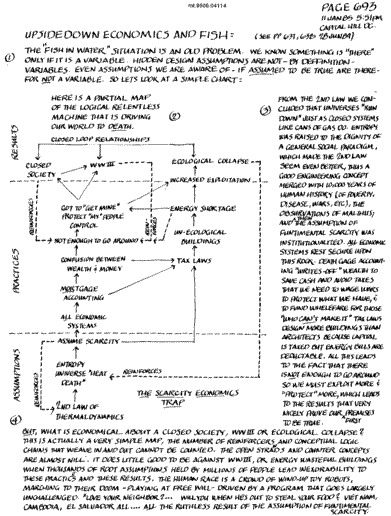
The following Chart shows one way this works.
 |
Page 693 - Matt Taylor Notebook - 11 Jan 85
diagram of the “SCARCITY ECONOMICS TRAP”
Driving an economic system from the assumption of fundamental sacristy will inevitably lead to war - time and again. It will also, with the same certainty, lead to the unnecessary exploitation - and destruction - of the planet. There is a “logic” to this, essentially, closed loop response, that overwhelms good intentions and fosters unintended consequences.
Even now, as a new economy is starting to emerge, the “Scarcity Trap” dominates. This is distorting the new economy and it’s potentially great economic benefit is being subordinated. We are not yet seeing a new economy although some parts are emerging. We are witnessing the old economy on steroids.
Notes from Matt Taylor Notebook, January 1985 - Pages 693 to 695:
| “UPSIDEDOWN ECONOMICS AND FISH:” “1 - The fish in water situation is an old problem. We know something is there only if it is a variable. Hidden design assumptions are not - by definition - variables. Even assumptions we are aware of - if assumed to be true are therefore not a variable. So lets look at the simple chart: (above) “2 - Here is a partial map of the logical relentless machine that is driving our world to death. “3 - From the 2nd Law (of Thermodynamics) we concluded that Universes ‘run down’ just like closed systems like cans of gas do. Entropy was raised to the dignity of a general social Paradigm, which made the 2nd Law seem even better; thus, a good engineering concept merged with 10,000 years of Human history (of poverty, disease, wars, etc.), the observations of Malthus; and then, the assumption of fundamental scarcity was institutionalized. All economic systems rest secure upon this rock. Death-gage accounting ‘writes-off’ wealth to save cash and avoid taxes that we need to wage wars to protect what we have and to fund welfare for those ‘who can’t make it.’ Tax laws design more buildings than architects because capital is taxed but energy bills are deductible (as expenses). All this leads to the fact that there is not enough to go around so we must exploit more and ‘protect’ more, which leads to the results that very nicely prove our first premises to be true. “4 - But, what is economical about a closed society, WWII or ecological collapse? This is really a very simple Map, the number of reinforcers and conceptual logic chains that weave in and out cannot be counted. The open strands and counter concepts are almost nil. It does little good to be against WWII, or energy wasteful buildings when thousands of root assumptions held by millions of people lead inexorably to these practices and these results. The Human Race is a crowd of wind-up toy robots, marching to their doom - playing at free will - driven by a program that goes largely unchallenged. ‘Love you neighbor?... Will you when he’s out to steel your food? Viet Nam, Cambodia, El Salvador all... all the ruthless result of the assumption of fundamental scarcity. “5 - Just to make it more fun are the paradoxes: The ecologist who argues to protect the Earth, use less because of limited resources, is working against himself. He is actually encouraging people to go out and grab more while it’s there. The businessman who blindly exploits ‘free’ resources, maintaining that we will invent our way out of the resulting mess of pollution and corrupt 3rd world governments, is in a left-handed way advocating ‘unlimited’ resource. Both are right and wrong - one is on the right side for the wrong reason, the other visa versa. “If short term exploitation kills the the living system, we all will die - if the system is allowed to live and is intelligently co-designed it will be ‘unlimited.’ There are two kinds of societies that can be ecologically stable long term: Very simple ones, or very advanced. Our present primitive technology is in-between. ‘Advanced’ nations are just killing off the Planet a little faster than the ‘backward.’ The difference is: 50 years or a few hundred. “The wasteful, high metabolism US economy is primed to become the first recyclable economy. Few of us can go on the way we are. “6 - The most obtuse argument of all is that we can’t afford to change. If we can afford what we are doing, we can afford anything. “7 - I call this UpSideDown Economics because, literally, that’s what it is. Look at the Chart on the right hand page (above). We spend billions preparing for WWIII and billions more trying to stop it. This is what is known as being ‘results’ oriented. “Sometimes we even get down to wondering if our practices might be related to the conditions we face. This promotes cries for more love, more understanding, or - at least - energy efficient buildings - all very good ideas, all powerless to stop a 10,000 year juggernaut. We have to turn that Chart right side up and look at our assumptions... challenge what we think is real. We must, as individuals, and together, think clear, re-conceive our society, re-image our world... or die. “8 - We have always sensed the relationship between economics and morality. Adam Smith sat the Chair of Moral Philosophy at Edinburgh University. Now we face the ultimate moral crises: a species systematically committing global suicide. “World War III, which we are fighting now, is the last 100 years war. It is a global civil war being fought for control over the worlds ‘scarce’ resources. In the process of waging this war we are destroying our right to be. “We are today - everyday - raping the Earth and turning it into a huge cosmic garbage can. In the name of economics we are decimating thousands of animal species and committing unspeakable horrors on our fellow Humans. We hide from the reality of our mindless acts behind reams of statistics and input/output tables hoping that, a little more accuracy in our figures, and it somehow will not be true.
“9 - Do we have to die? Must we allow - by default - this wondrous force, that was once so creative, destroy the very culture it nearly built? No, of course not. But to survive and prosper we must pay a terrible price: we must challenge the very assumptions upon which our technology, our power, our society, our very language is based. “Don’t smile and say ‘is that all?’ You can do anything to a man but this; millions have been killed for nothing more than the color of some one’s skin, her way of praying to God, his belief about the nature of the Universe, or to keep the price of harvesting coffee paid to a disenfranchised, starving peasant less than 4 cents a pound (Time 1/14/85). “No, lets not underestimate the work that we have to do, together. If you are holding this book in you hand, you are a privileged member of a powerful elite. An elite that is, statistically, an anomaly in the course of Human history. You have been told that the economy that supports your privilege is fundamentally sound, that the basis of our system is Honor, Justice, Equality and Freedom. If you are educated, you can appreciate - even revere - the culture that has created so much prosperity, opportunity, brilliance and beauty. If you are industrious, you helped build that culture. “I am a member of the same elite as you. I earn more money, by lunch time, in one day of intellectual work than half the people on this planet can earn in a year of backbreaking labor - where, for most, there is no lunch. “Like you, when I break from this manuscript to snack on a banana, I am supporting a barbarous tyranny in Central America. Like you - I hope - I have enormous respect and love for the civilization of which I am a part. “I have chosen - with this book - to attack that civilization at its base. I am not doing this out of anger, frustration, hate or malice - I am not pointing a finger at anyone. I do not write this out of guilt - I don’t believe in guilt, it is substitute for action. I do not wish to destroy anyone, any institution, nor any idea. I am starting a dialog about some patterns of thought and action that has trapped us all in an experience I do not believe anyone wanted. The purpose of this dialog is to examine the basic assumptions that underlay our economic reality so that we can take action... within a new framework. “This is not an attack on our economic system - to the extent that it is free enterprise - but a criticism of how all of us have chosen to use this system and the unprecedented power it has given us. It is a warning that the systems power has been turned against itself - and us; and, it is now destroying what it once created. “This is not a technical book on economics; that is not my interest nor my ability. It is a book about ideas, people, technologies, cultures and systems - and, how these become forged into a dynamic that no one created, can understand, can be responsible for - or can change. This is a story of what happens when a society gives too little thought to too much “success.” This is a social criticism of a classic kind - and as such - it is charged with finding what is good about us as it is responsible for discovering what is wrong. “This is a fishy tale - for I am a fish in water trying to understand water. It took me nearly 30 years to develop the perceptions from which this book views the world. I am an optimist - I believe that Humankind can make it to “graduation day” as Bucky Fuller called it. If I were not an optimist, I would crawl under some rock and wait dying rather than disturb what peace you and I have. “Let us begin and let us spend our time well. If the assumptions behind this book are false, little is lost in pausing now and then to examine our culture - if they are true, we have a lot of work before us.
“The human ability to ‘get in’ the game and play with passion is both a great asset and liability. Without it, there certainly would be no creativity, and without it we also would be without the principle means by which we ‘get lost’ in trivia and damaging closed loops. There is positive and negative entrainment. Distinguishing between them is difficult. Entrainment, or the act of it, is the state of all human joy. “The entire subject of objectivity is raised because of the possible traps of and the ‘lost-ness’ of the entrainment phenomena. Objectivity is the feedback loop that come out of the entrainment experience and looks at it. Entrainment cannot be escaped because it is a function of physical reality. It is a basis - a necessity - a how physical reality holds together. “This brings up the issue of scale. On one scale a system will appear harmonious - on another, it will appear to have conflicts and discontinuities; from a third, again, harmonious. The communication of the differences shown by the ‘views of scale’ is feedback. Without discontinuities, without difference, there can be no intelligence - no self-awareness. A ‘perfect’ system cannot think, change, grow, improve. “Understanding this is going to be one of the ‘missing links’ to both a workable model of management and to a framework in which a real artificial intelligence phenomena will self-generate. The ‘secrete’ is that you can not make something think. Nor, can you manage those that do think. It is our attempt to eliminate error that is at fault - all we do is scale it ‘up’ or ‘down,’ usually where we can’t see it. It then ‘bites’ us to our eternal surprise. “The very tacit meaning we hold of the concept ‘control’ is a cause of much of our confusion... and misdeeds. We yet have not discovered a true science and art of cybernetics. “We have not learned what walking is (‘controlled’ falling). The 19th Century - industrial paradigm - imperialist-definition of control is setting the limits of our theory and practices from boardroom to robotics labs -from child raising practices to U.S. foreign policy. The issue of control is closely linked with entrainment - when it happens or does not (at a given scale or view) when and how ‘the drive to entrain’ become distorted and, thus, evil. “Our best examples examples of proper control are given to us in music and athletics. What we see here is that control is never exercised on the (same) scale as the performance. One ‘lets go’ the performance - gives in to it. You control the scale ‘below:’ practice and preparation; and the scale ‘above:’ interpretation and strategy. That is, this is what a master does - or anyone at that total timeless moment of entrainment and joy. “The same is true for the audience when the ‘get in.’ Yet, always, management wants to control the game. What allows a DesignShop (process) to work is the discrimination of what to control and what we don’t control. “The new management style will not be occupied (controlled) with deciding and controlling, but with establishing the organism (organization-system) that can decide and control. It will intervene when the organization gets ‘lost in trivia and damaging closed loops.’ Even here the focus will be on different. Only the minimum attention will be spent on the ‘what's (only as required to prevent unacceptable organism damage); the focus will be on discovering the missing feedback loops, the want of which, allowed the whole category of problem(s). Then, on installing those feedback mechanisms. Then, on asking some hard questions about itself. As can be seen, ‘management’ is another scale of the organization providing objectivity to the rest.” |
The main theme of this inquiry is the question of what happens when an economy (or system) starts to turn against itself and create the opposite effect it was designed to facilitate - my sense is that the U.S. economy, and the system we presently practice, started to do this in the mid 70’s. While still producing enormous wealth for some - and with disregard for long term consequences - the system itself seems to be under increasing strain.
It is my conviction that the existing system of value measurement and trade does not sufficiently map, facilitate nor account the economy we have - let alone - the economy that is emerging. This has many consequences - the most costly are those where the wrong policy or decision is logically driven by as set of essentially flawed economic assumptions. We have some wealth we can “see” yet we have many negative consequences we cannot account. We take actions that destroys nearly as much as is produced. People structure their lives around a set of activities that makes no intrinsic sense involving actions that most of them do not enjoy.
The reason that this economic “engine” (shown in the diagram) works as it does is that Humans are “rule-based” systems. They are self programmable (Lilly, Jaynes). To the limits of the system, they follow the “commands” generated by their beliefs. If there is fundamental sacristy, if others will kill and steal to get what is mine, if I must protect myself and my tribe, what choices do I have in a given set of circumstances? What actions will I take? How will I treat you, other life and the planet? The range of these actions are not infinite and fairly predictable in mass (Psycho History).
...1988 Chapter Outline of the Book:
The following is a Chapter by Chaper outine that I made in 1988. While not necessarily the best way to organize the book, in today’s context, it does present some content elements that are important and can focus a lively dialog.
I have placed links for this outline to other parts of my web site that explore similar issues, as well as, reference my earlier work related to this project.
A general explanation of the outline follows and is linked from the Chapter numbers.
| UpSideDown Economics 1 - UpSideDown Economics
2 - Brother, Can You Spare a Paradigm?
3 - The Relentless Machine
4 - CapitalSchism
5 - Economy - Ecology: A House Divided
6 - The Collapse That Nobody Came To
7 - The Last 100 years War
8 - The Global Dimension
9 - Whole System or Hole System?
10 - The Monkey’s Paw
11 - The Automated Paradox
12 - Proposal: A New Set of Game Rules for Accomplishing the 21st Century
|
It is time to put our house together. This HOUSE is our planet, the armature by which to manufacture and trade goods and services and the mental framework by which the economic organization of our society is pursued.
Sacristy economics drives competition of the wrong kind. Not the competition of goods in a fair marketplace of buyers, but the competition for position, privilege and resource control. Abundance economics recognizes that creativity is the source of economic growth not the resources or people you control. This is a fundamental shift in awareness. Sacristy and abundance are two non compatible propositions. They lead to opposite outcomes. (return to Chaper Outline)
A societies Paradigm is, in effect, its collection of “hidden design assumptions” about how the world works. Economics is still trapped in the cause and effect, linear, thing-focused paradigm of the late 19th and early 20th Centuries. Yet, we are now starting to apply late 20th and 21st Century tools, ideas and organizational capacities. This is like putting a 400 horse power engine in a go-cart. Something is going to break.
Increasing returns is a natural mechanism of an economy - the important question is increasing returns of what. If we do not think our way into the consequences of what we are making, we will increasingly get huge self-reinforcing, unintended consequences that are not to our liking. It is not that the emerging economy can be understood or controlled - it is not about these old ways. It has to be, however, co-created - and it can be. (return to Chaper Outline)
The modern industrial corporation is the last remnant of the feudal society. People “enjoy” less freedom inside these organizations then in the social-political realm. These organizations, as Drucker pointed out in the 60s (and again in the 80s and 90s), are not capable of dealing with the rise of the knowledge worker.
Much of our economy, today, is composed of producing worthless “goods” in a push market to employ people to “earn a living” so they can buy more (often worthless) goods that give them little utility or pleasure. On and on. Round and round. Are we robots?
Yet, it will not be easy to get off the track of this “relentless machine” and even trying can destroy the economy itself. We are on a drunken positive feedback bash with no clear way out.
Yet, inside this, a new economy is emerging. We put it at risk, however, when we insist on measuring and “regulating” it based on models from the old system. We put both it and ourselves at risk when we attempt to use this social tool as we did the old economy. (return to Chaper Outline)
The struggle between Capitalism and Communism was but a morality play based on the old soul-body dichotomy doctrine - the cold war is gone but the dichotomy is not. Until it is gone, it will find another expression - one more dangerous than the last.
There exists individual wealth and common wealth and both are necessary for the existence of the other.
Most of which passes for economic information to the “average” person is propaganda designed to keep the old gang in power - and their hand in the till. Do the SEC rules protect, more, little old ladies in tennis shoes from unscrupulous investors or investment houses from startups raising their own money on the Internet without letting the old gang in the game with the resulting distortions typical of the present funding process?
Meanwhile, where are the stockholders? Absentee “landlords” only interested in maximum short term yield. (return to Chaper Outline)
In board rooms and in the political dialog, we assume that there is some intrinsic conflict between Spotted Owls and the ability of people to earn a living. What are they going to earn when the last tree is gone? What will they have when the unique viewpoints of other species are gone?
Profit is necessary to every living system - this is true for Spotted Owls and General Motors. This, they have in common. A sustainable system, ecological or economic, has the requirement that profit must be generated and enjoyed. Traditional economic systems intrinsically depended on ecological systems to work. Future, complex (it is simple now) systems will be ecologies and they will work by ecological principles. There is not conflict here - only, now, a great deal of ignorance and a fixation of short term “thinking.”
Planet Earth, now, is an artifact. Actually, it has been for a long time. How we think about and engage with this evolving system is important beyond description. If we get it wrong the results will be deadly. We have to “rebuild” Planet Earth as a work of ART. (return to Chaper Outline)
October 1988 was a watershed. The market crashed and the economy went right on chugging. This was the beginning of the “new” economy. It continues to befuddle - and excite. I don’t know if it is safe to exploit it, however.
Since then, an unbelievable amount of value has been created by the markets which are oscillating in wider and wilder cycles. New jobs, new markets, new technologies, new everything. You would expect people to be relaxed and happy. Look around you. What happened? (return to Chaper Outline)
For a hundred years, the Industrial Nations have been fighting a global civil war. We know some aspects of this by name: WWI, WWII, Vietnam, the “Cold” War. This is a struggle of scarce resources and who controls them. In the mean time, the real resource turned out to be organized Human intellect. The “fall” of the Soviet Union signaled the beginning of the end of a very old idea. The Soviet Union lost economically. This does not mean that we now think of as Capitalism is the BIG idea. It means that it was maginally better than a really bad idea.
Humans have spend centuries thinking the good was the elimination of the bad: Health, the elimination of disease; prosperity, the elimination of poverty; freedom, the elimination of despots. Well, many of these “bads” are being eliminated - does this add up to good? (return to Chaper Outline)
It is not too hard to destroy a planet. We are well on our way to learning how. Another decade or two and we will have the power. In the meantime, we are putting the habits in place that will inevitably lead to that result as soon as we do get the power.
I have never met anyone who actually wants to do this, it is strange, then, to see so many acting like they must.
We cannot “push” today into becoming a successful tomorrow. Us versus them is not going to lead to a sustainable social system - not when everybody has the power of gods. The first time a terrorist group blows away a major city this will be clear.
It is a global village and has to be treated as such.
Whose vision are we in pursuit of? (return to Chaper Outline)
There are several questions we must answer - or at least ask: What is a complex system and how do you participate in it’s governance function? What are we doing with this system? What will be the future consequences if we keep on doing what we are doing today?
With longevity, we may be the first generation to leave the consequences to ourselves. I am sure we will call this “bad luck.”
How do we simulate the “World Game?” (return to Chaper Outline)
The story of the Monkey’s Paw is our story. We are developing the power, do we understand the consequences? (return to Chaper Outline)
We can choose to live in harmony will all life forms including our own. We can make our technology lifelike. We can live in a Cybernetic Meadow. Or, our technology can evolve on its own like a child left in the street to grow up as s/he can. What will it really be like to live with semi-smart, powerful, pissed-off, disenfranchised, free-ranging technology that evolved without a moral base? The closest thing to it I can think of is living under a modern, vicious dictator with lost of wealth and modern war-making technology. It won’t happen? Are you willing to bet your life on it? Your are.
Or, do we fear life, success and sustainable wealth? (return to Chaper Outline)
We need a new set of Game Rules. And, many more feedback loops of the right kind.
Whatever, this is one game Humanity will win - or lose - together.
The next 25 years will be exciting and critical for humanity. In this time period, more change will take place than the entire prior history that Humanity has experienced. In this time period, the power to redesign almost anything will be in our hands. In this time period, economics as we know it will completely disappear. Most of what we think of a “normal” human experience will disappear. (return to Chaper Outline)
...From Philosophy to Action:
My thinking about this subject has not been entirely philosophical. Declaring that we “really” live in “abundance” will not get it done. A new economy with new means of transacting has to be created. There are many mechanical and process issues related to how the economy runs today that limits its ability to evolve to something else. I have addressed a number of these in our Patent. Some aspects of these are outlined (below) in the Rutgers conference notes.
This work involves the creation of intelligent agents who know their condition that can execute agreements that are built in to the agents themselves - contract and money become the same thing.
...The One Exposure of These Ideas:
This work stimulated a number of dialogs with Mike Bednarek (our patent attorney between 1997 and 2000) including discussion about the entire area of Intellectual Capital (a process for which is covered in the Patent).
Mike has been writing and speaking on this subject, and in due course, an opportunity to address some aspects of it materialized, by his efforts, at a conference held at Rutgers University in January 1999.
“A Systematic Approach to Structuring and Facilitating Value Exchange ....Including a solution to the problem of valuing intangible assets” is the first publication of these notes, material from the Patent Application and the dialogs that Mike and I have had over the last several years.
The conference was on the valuation of intangible assets and this material was received in a mix of disbelief and shock. I am sure it was mostly dismissed but a couple of seeds were planted here and there. I was surprised that the majority of the attendee's - academic and practicing economists - were almost totally naive about what is going on in computing today. Mike and I had a hard time convincing them that everything we were talking about was, in fact, being developed somewhere by someone. Their tacit assumption was that governments would maintain control of money and the economy and that there was no technical system that would wire around this ability. I question this assumption.
...Steps To Develop the Thesis:
Over the years, I thought that much of the material that I had envisioned for the book would become moot as others published on the subject. Surprisingly, it has not. In a way this is disappointing. Much of what has been published in the last several years, however, does lay a good base for the book’s central ideas. Perhaps it needs to be written after all.
It is my intention to gather old and to develop new raw materials for the book on this page. By the beginning of 2001, a page will be set up on the iterations site that will start the systematic expansion of these ideas. It is the intention to establish a by-invitation, interactive web site and publish electronically first, then later in print media. If sufficient energy builds up, iterations can host a number of Virtual and face-to-face events related to the subject. This way, the book can be developed as an “open source” document and reach some distribution while being “written.”
It may be feasible to approach the development of the technical systems and agents in the same way. Russ White and Yolke Incorporated is working on this aspect. Jeff Johnston took the lead with iterations starting the second quarter of last year (2000) and Vlasta Pokadnikova is taking on the research, co-authoring and organizational aspects of the UpSideDown Economics project.
Matt Taylor
Hilton Head
February 2, 1999

SolutionBox voice of this document:
VISION • STRATEGY • EVALUATE
posted February 2, 1999
revised February 5, 2001
• 20000121.73423.mt • 20000125.81229.mt • 20000211.103415.mt •
• 20000212.201626.mt • 20000219.81916.mt • 20001111.651231.mt •
• 20010205.452988.mt •
note: this document is about 35% finished
Copyright© 1985, 1988, 1999, 2000, 2001 Matt Taylor
update to Matt’s Notebook
Certain aspects of the system described are patent pending by iterations