iterations

Intellectual Property
Note: some links from this page are password protected. Contact me by e-mail or by phone if you require access.
We have created a complete System and Method of work that addresses many aspects of idea creation through the making of Intellectual Capital in a ValueWeb (market). This system and method is delivered by a suite of products and services offered by the Taylor Business Units and ValueWeb members.
 Iterations is the IP and research company owned by Matt and Gail Taylor. Most of the presently existing Intellectual Property associated with the “Taylor” organization’s, System and Method is held by iterations. MG Taylor is Licensed to develop and market certain expressions of this IP in the form of specific services and products including: DesignShops, NavCenters, CyberConn I, PatchWorks Design, WorkFurniture, and, 7 Domains, Weak Signal and CHOICE Work Shops. AI, KnOwhere Stores Inc. and Yolke Incoporated, presently Business Units of MG Taylor, are Licensed by MG Taylor to provide a mix of products and services that stem from this IP. In addition, they have certain expressions of it, in various service/product mixes, for their own exclusive use. Certain Trade and Service Marks associated with these products belong to AI, KnOwhere Stores and Yolke respectively.
AI retains ownership of specific WorkFurniture designs and related methods, Trade Marks and design and utility Patents. KnOwhere, Incorporated, has ownership in certain products and services and Yoke (CyberConn) in certain computer programs and applications.
AI and KnOwhere, Incorporated, are in the process of becoming independent organizations. At present, MG Taylor holds the majority stock in both - this is expected to be diluted over time as new, outside, capital is invested into these Business Units. Yolke is in formation and will be independent from the beginning. Iterations has an arms length relationship with the Enterprise Business Units and does not own stock in any of them.
MG Taylor has Licensed the DesignShop process to E&Y for commercial application and NavCenters to a variety of client organization for internal use. Other product/service Licenses with various organizations are in progress.
This Intellectual Property is protected by a variety of means:
Persona...
The Persona of Matt and Gail Taylor and CAMELOT, the sailing vessel, are established and protected. MG Taylor has certain right of use to this Persona by contract.
It is expected that other human and artifact persona will emerge within the ValueWeb. In fact, this is already happening. Having many strong personas within one organization or web is rare. To accomplish this is a goal of the Enterprise and one measure that it is truly a different kind of organization.
Trade Dress...
The look, sense, touch and feel - the Trade Dress - of Taylor environments, processes and subsystems are established in the “mind of the customer” and protected by “unfair competition.” MG Taylor, AI and the KnOwhere Stores have certain right of use of this Trade Dress. E&Y has right of use of the Trade Dress, for the development and use of DesignShops in certain applications.
Explicit Trade Dress elements are being established for each environment, product and service - as example, DesignShop events, the Foundation Series WorkFurniture, the KnOwhere Stores and NavCenters. Every Brand will have its own distinct Trade Dress - all within a family of Trade Dress.
Documentation is underway to establish a defensible basis that MG Taylor, and the various Business Units, have established a strong Trade Dress that a large number of ValueWeb members associate with our products and services.
Trade Secret...
All processes related to this IP and its use except where publicly disclosed is held in Trade Secret. This includes processes related to facilitation, design, fabrication, building, installing and the use related to physical environments, work processes, computer systems, technical infrastructures, work augmentation tools, language means, mediums of networking and exchange, transportation of physical and virtual goods, operation of value webs and supply chains etc.
A System and Method Manual is in progress that describes both Patent and Trade Secrete materials. This Manual will be used as the basis for all Licenses, capability transfer, education and training processes. The Manual will be made available to Licensed users on a nondisclosure basis. All levels of public disclosure of this IP will be made on our web sites.
Trade and Service Marks...
25 plus Marks are registered with an equal number in process. These Marks protect key nomenclature related to products, services and processes that make up the Taylor System and Method and their various product expression as delivered by License holders.
For a listing of all Marks see the IP Policy Statement on the iterations web page.
A Mark must represent a specific offering to the marketplace. This is not always understood. A Mark can be lost by becoming common usage or by being misrepresented - it can be challenged if it fails to be directly related to an active product/service offering.
Patents (Pending)...
A Patent is in pending related to 6 subsystems of the System and Method. This patent involves several levels of language and a process-architecture based on iteration, recursion and feedback of agents acting in an environment of agents. The patent involves a language that describes and operates the processes and is, itself, in patent pending.
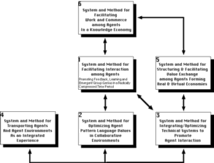
Patent Subsystem Architecture - 1998
In total, this IP strategy is comprehensive and aggressive. In the area of the patents, it is at the state-of-the-art (which, itself, is changing). The purpose it not to attempt exclusive use or dominance over some future section of the knowledge-economy - the purpose is to establish a way to steward a body of ideas into useful products and services while legally protecting the emerging ValueWeb (and its members) that invests, develops and employs them. At present, the Patent is unopposed after initial review and it is expected that certain aspects of it will be issued within the coming year.
In addition to this high level Patent, a number of Functional Patents on specific aspects of our work are under way. Also, a number of Design Patents have been filed. Most of this is being done at the Business Unit level of the Enterprise.
Copyright
Copyright protection is straight forward, strongly protected, and the least ambiguous and controversial of all IP. All original written material is automatically copyrighted. In addition, material can be registered. MG Taylor and the Business Units have, together, over 10,000 pages of materials directly related to our System and Method and the marketing material related to it.
Copyright provides good protection of an expression but not of content.
General Notes...
 Philosophically, we have a strong leaning toward “open source” development. In many realms that we work, however, there is question if the culture and operational traditions are in place (yet) for this to work in the short term. As IP protection is becoming a strategic process in many fields, we intend to have it and then act differently in regards what we do with it. Open Source is well covered by Eric Raymond in “The Cathedral and the Bazaar” - his web page is: http://www.tuxedo.org/~esr
 It is the intention of iterations, MG Taylor, AI, KnOwhere to partner with each other and individual ValueWeb members (and organizations) to develop our IP into a number of products, services and organizations by a systematic process of Intellectual Capital creation (Subsystem 6). The primary strategy for doing this will be the employment of the system and method itself in the creation and facilitation of these enterprise opportunities.
 Each form of IP has its own set of rules by which the IP is created and held. What can be protected has undergone a radical change in scope in the last few years and is the subject of much controversy. Many business processes can now be patented, for example. Persona and Trade Dress protection has become quite strong. Some IP is established by government franchise: Patent, Trade Mark, copyrights are examples. Other IP has to be established in the market place: Persona, Trade Dress are this way. These never exist by a certificate of “ownership” - they are established first in the minds of the public and, then, in the successful litigation of “unfair” competition. Trade Secret is assumed as long as an organization exercises diligence in protecting it.
 No one form of IP will protect a complex product or service adequately. It is necessary to employ a number of IP devices, in combination with intelligent business tactics, that makes you less likely a candidate for getting “picked off” - this includes being a willing and competent issuer of Licenses. To us IP protection to maintain exclusivity is not a strong course of action except in rare situations. It is also a questionable practice.
 What is across the board different about all IP - from other kinds of law - is that ownership has the burden of protecting it. Ownership cannot be passive. Extreme diligence is required. IP is hard to get and easy to lose. For this reason, MG Taylor exercises a high level of diligence in protecting the IP. This is sometimes misunderstood. It can be seen as harassing and nit picking. However, how a Trade Mark is presented on a page can lead to loosing that Mark. A insignificat violation unresolved can be used later, by a powerful competetor, as a basis of challenging ownership. A undervalued Licence can be used as the basis of value in the case of a Litigation reward. This is just the way it is.
 The paradox of knowledge-work is that it creates intangible products. These can take years to develop and can be “taken” in minutes once demonstrated. Science has certain hard-won traditions that protects its members form exploitation. Stealing research credit gets you kicked out of the club. Failing to publish lowers your status. Faking results leads to complete isolation from the community. No such tradition exists, yet, in the marketplace. A knowledge economy is not yet in place. Today, it is necessary to be effective in the old economy in a way that does not hinder or block the creation of the new economy.
 We believe a new way will ultimately emerge and we intend to be part of it. In the mean time, we also intend not to be excluded from the very game we have invented. This new way will reflect a significant change in our present culture. There are many signs that this happening. This is a significant transition management issue and one that will require a great deal of organizational and social innovation.
 Many firms, today, process Patents, register Trade Marks and the like and think that they are exercising robust IP. This is rarely adequate in today’s environment. Few firms are up to date on the subject and fewer have a comprehensive IP strategy. Intellectual Property is likely to be one of the most competitive arenas as we enter the 21st. Century. One thing is sure, if you have it you can always give it up. If you do not have it you are unlikely to recover it in the future. The traditional model of IP and its protection is being re-conceived.
 An organization’s IP strategy has to be closely linked with its Brand management and its product/service development process. It is no longer adequate to invent and develop, and then decide how to sell and protect it. Knowledge-intensive products and services must have IP and brand-essence designed-in as an integral aspect of each expression and initiative. In addition, the core of the IP may have many applications outside of any one product/service or line. There may be applications outside of the field and expertise of the company. In today’s financial landscape, few organizations and individuals can afford to throw these often hidden assets away.
 The social policy behind IP protection is that it allows the originator’s to share what they know with reduced risk. The Government wants disclosure and the decimation of knowledge and is willing to provide limited protection for a limited amount of time in order to promote this social value. Surprisingly, many do not understand this and still try to keep IP “hidden.” They rely on nondisclosure and non-competition agreements. Culture that do this often show little respect or regard to an individual’s contribution. This often becomes a control and power begets more control and power situation. This is not sustainable in the dynamic world being born.
 The beauty of good IP is that, once it is secured and protected with ongoing management, it can be freely disclosed and shared. An individual, or organization, can hold the core IP and License it, or even make it available for “open source” development, in a specific application environment, without losing the IP itself. This has exciting possibilities that just need some good detailed engineering.
 This is our strategy. We hold the core IP in iterations. MG Taylor has the exclusive License, for several distinct expressions of it, to develop and further License this IP. iterations is paid a royalty on a diminishing scale design to become, upon maturity, about 1% of MG Taylor’s cash flow. MG Taylor licenses the Business Units and ValueWeb Partners to further develop and market products and services derived from the IP. The majority of the wealth that is created stays with the organizations that created it and is shared with their ownership. License fees and royalties are used discreetly to balance out the financial equation. Each Business Unit can focus on it’s own market segment and unique brand-expression.
 As IP is created, it is determined BU by BU and on an Enterprise level, what is exclusive, what is shared, what is open source, what is patented, what is held as Trade Secrete. This is done from a stewarding perspective and by a method that is described in our Patent Pending (Subsection 6).
In terms of defending our IP, we will do it. However, our purpose is not to reducing competition nor withhold what we do and how we do it from wide distribution. It is our mission to make our way-of-working ubiquitous. Our approach has been and will continue to License freely, to facilitate quality of products and services related to our IP and to work to create an effective marketplace for them. Litigation is the course of last resort. Collaboration is the first choice. Co-competition is fine. Knockoffs and rip-offs are not.
Business Unit Links:
AI Patent Pending for ScribeCaddy.
AI Patent Pending for WorkWalls.
Ai Patent Pending for MagicWindow.
Matt Taylor
Palo Alto
April 4, 1999

SolutionBox voice of this document:
INTENT • POLICY • PROGRAM
Posted April 5, 1999
revised January 14, 2000
19991227.9501.mt • 19991227.104826.mt • 20000523.70441.mt •
• 20000602.210240.mt • 20000619.204415.mt • 20010114.375926.mt •
(note: this document is about 75% finished)
Copyright© Matt Taylor 1999, 2000
Matt Taylor 650 614 1192