|
| ||
| Final |
• Matt Taylor Studio Project •
• Pattern Language •
• Xanadu Project •
• My Palo Alto Workspace •
An Introduction to Basic Architectural Practice
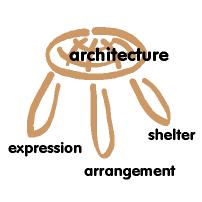
@ The San Francisco Institute of Architecture
by Matt Taylor
This course is about the entire design, build, use process in architecture.
It is open to anyone who wishes to function in an architectural ValueWeb - in any of the Investor, Customer, Producer or System Integrator roles.
The course is open to those with no prior experience and practice to those of extensive experience - the structure of the course and nature of the content is such that - whatever your starting level - you will be able to materially extend your competency.
In terms of class interaction, participants from many different places in the total process of creating and using architecture - as well as - different degrees of understanding it, will actually enhance the learning experience for all.
There are 9 formal sessions that make up the Course - each is outlined in the Notes linked to this page. These sessions take about three hours. Each, involves presentation and dialog. Assignments will be given at each session, all of which, will make up your final delivered work. You are encouraged to read ahead. The more that this is done, the more time we will have to move beyond the basics and explore the many ramifications of our subject.
There will be some informal sessions for more dialog and skill building in the areas of design, document production and web publishing. A field trip or two is desirable based on everyone’s schedule.
Completing this Course means designing a work based on your recreation of the materials presented, offering your work for peer review by all class members and, in turn, providing the same feedback to your classmate’s project. Your work will be presented on a web page of your design.
Course Outline:
| 1) Course is about the entire design/build/use process in architecture. 2) Course involves a project, selected by each each of you in a category set by me (Matt Taylor). This way all projects will be same in terms of type but radically different in terms of program and solution (see below). The basic category is to design an environment, for yourself, in which to conduct the practice of architecture as you see it. 3) I will do the same project - all projects will be put up for peer review, at the end of the class, according to Eliot's 4 rules of criticism - this peer review process will be augmented by the participation of other working professionals and prior graduates of the class. 4) I will present a matrix of criteria for judging an architectural piece (technical, idiom, style, historical context, Pattern Language, utility and so on). This will be augmented with the study of historical examples. You will be tasked to respond to this material but create your own formulation in preparation of your design work. 5) As part of my presentation, I will provide a set of principles and rules in reference to the problem-solving, creative process - for individuals and teams. Again, examples will be given. 6) I will also provide a model of design/build that stresses rapid prototyping, iteration and reduced time-to-value. This will include practical commentary on the creation of working documents useful in the field. 7) About one-third of the course time will be spent on defining architecture, it’s criteria, the role of criticism and feedback, the scope and kinds of architectural practices, life cycle economics, and the creative process. This will be done with lecture, dialog and independent research and study. At the end of this period you will be asked to outline the program of your project. 8) The second third of the course time will be spent covering the design-build-use model, practice barriers, the strengths and weaknesses of practice-types, and the development of your projects. The entire process will be covered: program, design, engineering, design development, contract documents. 9) The remaining time will be spent on exploring different graphic and modeling options for communicating architecture, web site construction, building ValueWeb systems, the economics of a sustainable architectural practice and peer review of all our projects.
You will be required to produce the following:
In your production of this work, new methods of drawing, modeling and display - i.e. web-publishing will be stressed. This is a time compressed experience and a blending of art-ful-ness and efficiently is required In every regard, your project will be treated as a real-world project would be: constrained by time and demanding great clarity and power of communication to a divergent group of people. The objective is to take the you through the entire process (short of actual construction), in a time compressed period, stressing design/build/use, the criteria for good work (reinforced by peer and expert feedback) and rapid prototyping (requiring the entire scope of work to be accomplished in a fraction of the “normal” time). All of this to be done while studying the Matrix of practice options, their relationship to architectural building types and the basics of ValueWeb systems as a means of accomplishing projects.
In other words, what would you live and work in, today, to pursue a practice of architecture - whatever ValueWeb role that practice be (see above). With this problem, the economic constraint of the client's (you!) financial resources are real and an integral part of the problem. The objective is to demonstrate through your own experience that great environments have little to do with budget, per se - but with design imagination (and discipline) and the ability to construct a practical financial package and build well. It is contemplated that the projects, as a set, will range from large to small - from new construction to remodels. No matter the scale and scope - the same criteria will be applied to each.
On the Design Formation Model, the entire Design, Build, Use process will be taken to the level of the Preliminary Design stage ready for Design Development. This requirement will act as feedback in regards to the level of complexity and scope that you select for your work. DELIVERY STYLE: The course will be taught at the SFIA and Palo Alto knOwhere Store environments with a field trip or two (which will be non-mandatory and additional to regular scheduled course time). you will be provided access to a computer and other media so that there can be dialog with me when I am traveling. This will be treated as part of the course learning - remote work is a reality now. |
 a - Build a description (model) of the principles, rules you select from the dialogs to use (explicitly) in the development of your project (Pattern Language, idiom, style, design principles, and so on). Provide documentation from history to support your selection.
  b - Provide a program statement of the specific life/work style problem to be solved, including the economic criteria, for your personal practice project. Design a concept that expresses an architectural solution consistent with the program objectives and values.
 c - Drawings and/or models and/or multimedia of the design solution. Anything is acceptable as a source document, however, it is a course requirement that the end result end up on the web and accessible via a standard Browser. This also includes an analysis of how engineering issues will be resolved.
 d - Description and/or demonstration of the building method with indication how the construction process will be conducted with sample documents (complete documents are not possible in the time frame - a sample of each type showing a system of communication is the objective).
 e - Strategy of how the work will be financed including an economic analysis indicating affordability, etc. with an outline of the proposed process of building the work. Demonstration how this environment actually would augment your individual life and practice.
 g - Feedback on feedback. A final statement of what was learned and how feedback was used (or will be) in the next iteration of the project. This will include a commentary on what you learned about your own creative process.
 h - Maintain a Notebook (hand or electronic) Journal of your experience - this can be shared - or not - as you choose. The purpose of this is to document your journey and learning and to relate this experience to your life and the larger context of the society in which this class is experienced.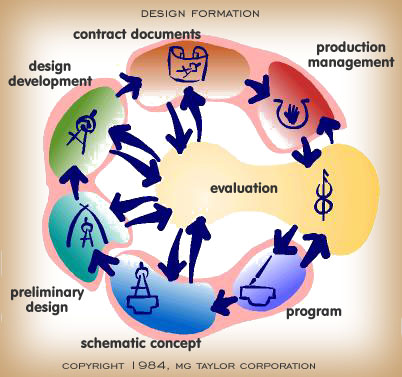
Additional Notes:
There have been some questions related to the use of computers, HTML training and if we had enough hardware at SFIA to provide enough access for everyone.
In addition, the question has been asked if we should devote some of the first course days to specific media training and general architectural orientation for less experienced participants.
We are expanding our computer capability at SFIA but it still is limited. This course is open to those with virtually no computer skills and those with a great deal of experience. The following is my response to these questions and, in addition, thoughts that clarify the attitude of this course:
| This course is divided the course into thirds: Criteria, Design, Execution and Evaluation (Scan Focus Act). My position is that there is nothing special here that needs distinct treatment. Everybody “designs” their own environment now, uses a process to do so and uses media of some sort to describe it, communicate it and document the process. There is fundamentally no difference between the design professional or the user in this regard. The way I have outlined the course, means it does not matter where a person is starting. The assignment involves selecting their own project and its complexity. The only constraint is that the project is an environment for “practicing” architecture. This is the common thread. Practice can be as a prime producer, a critic, an end user - whatever. It can be a new space or fixing one you have. It only has to be affordable. For this to work you have to go through the basics which is not selecting your problem (this will happen organically) not by worrying about HTML and architectural techniques. All I want each of you to do is commit to using new media. How you do this will also evolve naturally with each student setting their own level of ambition and learning pace. The issue around media should be a freeing thing not an additional burden. For example if someone wants to draw this is fine. They can do this and us various simple ubiquitous methods to make it electronic. Is there a Kinko's near by? They can model. Or work all electronically with no hand drawings at all (or even a “drawing” in the traditional sense). As long as it communicates what has to be communicated to show that the work can be executed. For a simple project this may be nicely done hand sketches and notes (these can be faxed - thus digitized - and set into a simple HTML program at the end). What you DO have to DO is effectively communicate your concept sufficiently for an affordable design/build/use process to happen - you have to do this via Internet space which is becoming the only practical way to maintain sufficient day-to-day contact, with a broad network, to get things done. As you can see, this is entirely in the spirit of SFIA - it just takes a different form. We ASSUME, at SFIA, that everyone can think, design, build. We are helping you do it better with more tools. We seek to break out of the professional mysticism of architecture and make it a natural process. We are going to REMIND you that you already know how to SHELTER. Art, engineering and tooling support this natural process. Someday, you will have to “remind” your clients and associates of the same thing. One way or another, each of us has access to far more then enough expertise, and tools to complete our work. We often forget this as we get trapped in habits. Freedom is essential. Expressing an idea is the key thing. This approach allows happy learning for both a seasoned professional and a novice. The important thing to remember is that you are DOING IT NOW. EVERY DAY YOU ARE CREATING YOUR ENVIONMENT - YOU USE A PROCESS TO DO SO. I hope to provide you with some tools to do it better. This is where we start and we will build, together, from where we are. I will help you make this a self-aware, practiced process not a lay-persons accident nor a professional’s habit. |
This course is demanding and rigorous - and it is open-ended. It does not assume one way of achieving a goal. There are some requirements in common so that the works can be taken through a legitimate peer review process.
As instructor, I will be doing the same work as each of you and submitting my work to the same review process.
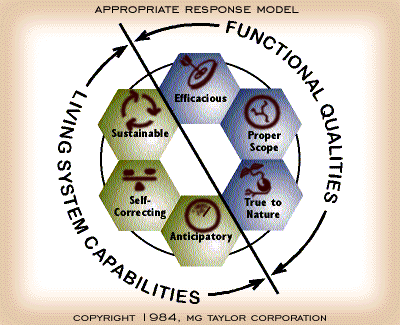
In the end you determine your “score.” As is the tradition at SFIA you cannot fail. You complete or not. Completion means producing what as outlined in and submitting your result to the “marketplace” of your peers who have shared your experience and are doing the same in return. You set your own Appropriate Response to the challenges offered up by the course content.
Why I am Teaching This Course
 I believe that “professionals” in any field should focus on three things: defining their art, building leading edge examples of it, teaching others how to do it.
Doing repetitive work, over and over, keeping clients dependent while turning the organization into a factory and, ultimately, kills a practice.
The present method of practice that makes up the architectural profession and the whole assemblage of organizations necessary to producing a work is not working well. It is neither sustainable nor affordable. This is the major cause of very little good architecture being build - not the lack of potentially good designers nor the desires of many architects
This course will start to get under the covers of this broken method and suggest new pathways for participating in the making of great environments. This course is about many things and it will cover many aspects of architectural theory and practice. At the root, however, it is about creating a new kind of practice - something that effects us all.
The architectural practice model cannot be separated from architectural theory or practice intent. Each sets the terms of the other. Each constrains or augments the other.
My Goals
 To make the case, in practical terms, that the design of practice is integral to the design of environments. That the practice elements of architecture promote or hinder the production of good architecture far more than “design” as an isolated activity.
To demonstrate that good design is not esoteric but the systematic application of known criteria and rules - it is a process that can be learned.
To demonstrate and transfer certain principles of group process as essential to accomplishing a complex work.
To advance new media methods as a serious means to communicate, coordinate and collaborate across time and distance.
To employ examples from my own 44 year career in a two fold way. First how the kind of work I wanted to do lead me to an alternative practice path and, second, how this path opened up alternatives that have in turn effected my concept and practice of architecture.
Sessions Outline and Schedule:
| Session | Description | Date This Series | |
| Introduction
| A general introduction which varies according to the participants. Prior Students commentary and work. | Sept 19, 2000 | |
| Session One
| Review of the role of Criticism and Feedback. A definition of Architecture that avoids the traditional split between utility and art. A matrix of Criteria for producing and evaluating Architecture. | Oct 03, 2000 | |
| Session Two
| Review architectural criteria. Scale and scope of Architecture. Matrix of architectural practice elements. Life Cycle economics. | Oct 10, 2000 | |
| Session Three
| Review of Practice types and Matrix. 4 Step Recreation Model. 10 Step Process Model. Design/Build, FasTracking Methods - Swimming Pool Story. NASA Story. Review of Projects. | Oct 24, 2000 | |
| Session Four
| Design•Build•Use Model. Practice barriers. Removing the waste in the total process. The ValueWeb Model and the issue of Requisite Variety. | Oct 31, 2000 | |
| Session Five
| Review of my work and methods. Focus on current projects. Detail of 4 Step Recreation Model Summary of the materials presented to date. How it works as a system. | Nov 07, 2000 | |
| Session Six
| A tour of the Palo Alto KnOwhere Store. Review of your projects. Web practices and structures. Review of my Bay Area Studio project. | Nov 14, 2000 | |
| Session Seven
| The act of communicating Architecture: “the right information to the right person at the right time.” New drawing and media tools. Employing the Internet and www - practices and methods. | Nov 28, 2000 | |
| Session Eight
| Build ValueWeb networks and systems. The SFIA architectural practice model. Sustainable economics (and ecology). | Dec 05, 2000 | |
| Session Nine
| Peer review of all projects. Review the Criteria Matrix - how was it used? | Dec 12, 2000 | |
| Final
| Final review of your projects and Internet posting. Introduction of the Course to next semester students. | January 2001 To be scheduled |
This Course is evolving. Changes will be made each cycle. Prior students can repeat the Course - or any part of it - at their own desecration.
Proper feedback and Criticism is a key to an effective Design•Build•Use Method and System.
There are many criteria that have to be used to effectively critique a work. This has to be known, articulated and used by the Community-of-Practice that is involved in the creation of a work.
Criticism in Architecture, today, is poorly practiced. It, generally, employs too narrow criteria and is too often used to promote a specific school of design rather than to support a feedback process aimed at improving results.
 There are many different kinds of criteria by which an architectural work can be evaluated: design technique, Pattern Language, utility, economy, building quality, building method, idiom, style, historical reference and meaning and so on. Each of these have different standards, method of proof and importance to a given work. They represent a historical KnowledgeBase, a mental tool-kit available for use in the process of producing architecture. Knowing them and employing them will not, by itself, create a great work. It should prevent stupid mistakes. A great piece requires integration of these elements and ART.
Art, is that deep unique expression that comes from an individual, a Community of Practice and a historical time and place - all working together. This, also has criteria and we will talk about this along with all the rest.
Criticism in Architecture, today is fragmented, biased and spits the profession. It adds little to the process of making better environments. It is dived into “schools” that are more interest in promoting their agenda than promoting Architecture and its practice.
Proper criticism is part of the feedback loop that promotes improvement of a breed. Feedback is “the message to the controller of a system, from a sensor of a system, of the difference between between performance and expectation.
For feedback to happen the message has to be to someone or something that can act on the message. For the message to be a legitimate message, it has to come from someone or something that is accepted as a sensor and it has to be rendered by criteria that is accepted as valid. To be useful at all, it must address the difference between what was expected and what happened.
Most for what passes as criticism and feedback is not that at all.
And, CRITICISM should demonstrate, as an integral aspect of its own process, how to make the art (in question) better.
In this course we will practice criticism and feedback in this spirit. It will be an integral aspect of the entire design process. And, we will do feedback on feedback which is, according to Norbert Weiner (the father of Cybernetics) FEEDBACK of a complex kind.
| “We have already indicated that effective behavior must be informed by some sort of feedback process, telling it whether it has equaled its goal or fallen short. The simplest feedbacks deal with gross successes or failures or performance, such as whether we have actually succeeded in grasping and object that we have tried to pick up, or whether the advance guard of an army is at the appointed place at the appointed time. However there are many other forms of feedback of a more subtle nature. “It is often necessary for us to know whether a whole policy of conduct, a strategy so to say, has proved successful or not. The animal we teach to transverse the maze in order to find food or to avoid electric shocks, must be able to record whether the general plan of running through the maze has been on the whole successful or not, and it must be able to change this plan in order to run the maze efficiently. This form of learning is most certainly a feedback, but a feedback on a higher level, a feedback of policies and not of simple actions. It differs from more elementary feedback in what Bertrand Russell would call its ‘logical type.’” Nobert Weiner “The Human Use of Human Beings” |
 One of the things wrong with traditional architectural education, by the way, is that one can get an advanced degree never ever having heard of Norbert Weiner or a host of others who established the present foundations of science (let alone Business) - this Course will address this situation.
A Short Rant On Habits That Don’t Make Sense
Well... while I am on this subject, I will also note the curiosity that one can get a Master’s Degree in Architecture never have ever built a building. Imagine going to a surgeon who has a doctorate in the field but who has never actually touched a body or performed an operation. You go first! I place things like this in a the category of “has anybody noticed?” Like down spouts and gutters.
With the overwhelmingly common application of down spouts and gutters several things are accomplished. After some effort to produce a pleasing elevation, the down spouts and gutters are put on in the most ugly manner possible with (I suppose) everybody playing “lets pretend they aren’t there.” Then, to add insult to injury, down spouts and gutters take a generalized problem (distributed water runoff) and make a specific, chronic problem out of it: high volume, concentrated water runoff focussed where you most do not want it on the foundations of the building! Thus, insult (an ugly “solution”) is added to injury (accelerating the destruction of the building) in one brilliant architectural stroke.
The pattern language of the down spouts and gutters logic (!?) is common and repeats itself over and over becoming a habitual practice of otherwise well meaning and intelligent people.
Walk around the block and look for foundation cracks. Then locate the down spouts.
It seems that we can do better than this.
One reason, besides creating a strong sense of shelter, that Mr. Wright used large roof overhangs was to get the water away from the building. Warren Callester used to dump the runoff into a nice 12 inch wide gravel strip that ran the perimeter of the building. How rational! These are good examples where art, practical engineering results from straightforward thinking.
Well, end of rant - however it is the pattern of the thinking behind these things that we want to discover and change for the better. This is only a small example of the habits that need to be challenged.
And yes, there is a way to do down spouts without these negative consequences.
Internet delivery is an essential tool for an effective modern practice.
Unless you intend to stay in a physically specific Boutique Practice, a modern practice is, by definition, geographically dispersed. No amount of travel - even staying permanently mobile as I do - will be sufficient for you to meet your minimum commitments.
You have to accomplish effective VIRTUAL presence.
There are many (still nascent but powerful) tools available to help you do this. They, however, do not by themselves add up to a method of work adequate for you to be successful.
 Here is a test: I am not suggesting that you should do this but... if you could sit in a 20 foot by 20 foot room and conduct a successful $50,000,000 design/build practice by yourself, never leaving the room - this would mean that you have a practice method that employs the now-available tool kit and meets the present market demands.
Now, think about having that ability and being able to get out of the room and employ all the other tools and methods...
There is more to it, of course, than delivery. The www is inherently a multimedia experience - and more importantly - it employs (however rudimentary) Hypertext. This means that a browser can be used to access a vast variety of documents that can be linked in a way that provides an organized yet freeing, user controlled, documentation of any project.
A server, web Browser and publisher combined with a database system and interactive dialog space can combine to make a powerful practice tool that can be afforded by anyone. Between five to ten thousand dollars and a hundred or so a month will equip a knowledge worker with a powerful multimedia, computing and communication tool-set. In my mind, lacking this tooling is not an option. It is taking a careless risk. It is opting out of the emerging global society. It is equivalent to breaking your legs and then trying to run a marathon.
 This course will show you one way to employ these new tools. Please, do not convince yourself that you cannot afford this level of tooling or that you can “learn it later.” It is a way of working. The learning curve will get steeper and steeper even as the tools get more powerful and easier to use.
Look at CadCam. The profession resisted it for years. Now, as it is being adapted, wholesale, to make documents in a style driven by 100 year old ideas and methods. Its present use means the net product is inferior to the old hand drawings, the drawing process is no longer in the hands of the architect (more shrinking of practice) and the real power of the tool is rarely used. About the sole benefit gotten is that revisions are less expensive than redrawing would be. This CadCam use is a classic example of adapting new technology to old ways of working for marginal economic improvement while missing the opportunity for a quantum leap in practice.
Few architects use the tool to design building that they cannot draw. Few us the materials handeling and cutting potential. Frank Gehry is a rare exception.
One challenge of this Course is to think of the way of transferring an architectural concept to the many necessary to design, build and use it in a way that speaks their language and addresses the conditions and challenges that they face at the time they face them. Given today’s tools, and challenging yesterdays conventions, how would you communicate architecture today?
Palo Alto
December 4, 1999

SolutionBox voice of this document:
IDENTITY • PHILOSOPHY • CONTRACT DOCUMENT
revised May 17, 2000
1999124.74646.mt • 1999125.55414.mt •1999125.94740.mt • 1999128.184434.mt 19991211.70015.mt • 19991211.122620.mt • 20000102.153657.mt • 20000131.123518.mt •
• 20001001.636268.mt • 20001111.237129.mt • 20010517253419.mt •
This document is 85% finished
Copyright© 1999, 2000 Matt Taylor
|
| | |
| Final |
• Matt Taylor Studio Project •
• Pattern Language •
• Xanadu Project •
• My Palo Alto Workspace •