Information Factory
Transcribed hand written notes
from the Notebook of Matt Taylor...
| Page 642
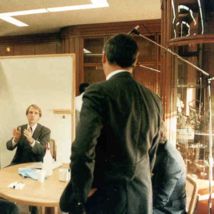
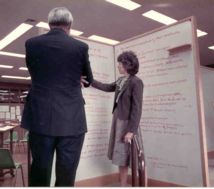
The Management Center In introducing the Center to clients during DesignShops, I often refer to Management Centers as “Information Factories.” This is not intended to be taken metaphorically; I mean to be understood literally. And following the principles of the 7th Domain, Venture Management, every scrap of information is to be used and reused - combined, added to - stored, retrieved - analyzed, synthesized, AND made available to each user “at the right time and place, in the right amount of detail.” The use of information becomes itself an item of information. The information connected with human action becomes knowledge; the sum becomes - knowledge industry, (i.e. the industry of knowledge). The procedures and facilitation methods utilized in Management Centers are the factories’ process engineering (using this term as it is meant in industrial engineering). Throughout this factory, process ideas and data are refined until a product is developed. This is not a dry mechanical process as the factory “image” usually congers up; that image and reality of the factory are ready for the scrap heap of history. To understand the idea of Management Centers as information factories, is also to build in one's mind a new image of the industrial factory, and of that 19th century factory now called "the office." These old ideas must be recreated, generalized, (seeing present practices as special cases) and placed into a new humanistic context. A new Art and Science is being developed - that of information processing. The core of this is a unique concept of information management and of the human creative process. At the center of this is a unique organization presently called the “Knowledge Center” (Domain 1, Body of Knowledge). The Knowledge Center had it's first expression in the Renascence Library (Kansas City 1974-1980); and was further developed in my concept of Earth Library (Boulder, 1979-81). The Earth Library concept deals with issues related to a network of Knowledge Centers located in Management Centers throughout the globe and the use of CyberConn to link, synthesize, communicate a new cultural paradigm. Central to all this work over the last decade is the idea of a new level of human tooling to meet transformational demands.
Page 643
The time has come to explicitly reincorporate the ideas and practices of the Renascence Library and Earth Library into the Knowledge Center function of the Management Center. This re-incorporation will deal directly with the user issues now facing the Knowledge Center; it will also “broaden” the focused narrow outlook that has been necessary during the early formative years of Management Centers. The Management Center concept is totally built on an international premise; it’s practice up to now has been provincial. From 1979 to 1982 the work was local, after that our work has been more national in scope; this is still provincial. When Gail and I left Washington in August of 1979 we deliberately turned our backs on the work and contacts we have made up to that time. We focused our entire efforts and resources of forging a tool for transformation rather than on the current issues of transformation itself. However, the tool itself always was built from the perspective of a global view. One of the Knowledge Center's role now, is to bring that view back into the forefront of our work. Any organization today that builds its assumptions, intents and plans on local or national basis is doomed to failure. For ourselves, for Acacia, our users and clients, the ability to bring a global perspective into the “local” work and synthesize it by a method of “process engineering” is of first importance. If we cannot do this, we are not an information factory, we are a local job shop. AT THE SAME TIME, the flavor and uniqueness of the specific, local circumstance must be kept (the blending of local and universal is an old issue in Architecture). This idea of information factory (and Fuller’s definition of "industrial" & craft tooling) has to be, through practice, synthesized with older ideas of craft and intellectual/educational traditions. We are building the basis of a new culture and tradition. The people working in Management Centers are participating in an experiment and design process of which they are both experimenters and subjects. Every work procedure and definition of productivity is challenged. Page 644
Every idea about the nature of information and its use is challenged. The nature and use of work teams is challenged. The Management Center “factory” is re-engineered, re-equipped, and reorganized on a near continuous basis. Meanwhile, higher and higher levels of standards and productivity are reached monthly. This internal process of transformation is itself a product - and knowledge gained - from the very existence of the enterprise; if nothing else was gained, the current level of investment in Management Centers is worth it as a case history alone. As new methods are learned and employed, tested and applied; they then can be mass produced. We have two products: we are turning out our model “T” and we are inventing a new production method - a general method that can and will be applied in many environments. The end result: a new definition and practice of work. The “information factory” of the new information economy will provide a quantum leap in humanities' understanding of an ability to produce and manage wealth. It will do this proportionally greater to today's standards as the industrial factory did in its time; it will do this in a much shorter period of time. This means all existing assumptions about capacities are false - the economics of scarcity is dead. All economic systems until now have been based on scarcity. Mortgage = death gage. To stay "locked on" to the old economy will destroy civilization as we know it; it will prove as deadly as building a space ship based on pre-industrial engineering knowledge. Management Centers are practicing (and developing) the methods on which a new economic order can be built (see pp294 and 294.1.h Jan '82). New economic capacities create new social realities - new forms of work, play, art and politics. These in turn create new assumptions, new technologies which create new economic capacities. This is not new - what is new is the speed of the cycle. Society may be entering into a period of permanent transformation - a constant discontinuous process. With the development of space, the unity of human experience can be broken - new species may appear. These are the kinds of challenges we face (along with the more mundane one of learning how to run a planet). What tools do we need?
Page 645
At the base of any information system that works has to be a new theory and practice of what information is. The industrial paradigm approach to information management, by nature, adds to the condition of information overload. Today, as computers and media, and information networks and research projects, and governments and business, produce greater-and-greater amounts of data, we “solve” the overload problem by more publications and more computer outputs. Because the pattern of information processing remains the same, we most often just add to the overload. The collective result is an electronic Tower of Babel that gets higher and higher. Added to this confusion is the lack of a social covenant of how information should be treated - information today is seen as something to be manipulated and distorted for one's advantage. In any public debate (today), agreement can rarely be accomplished on the “facts,” let alone rightness, reasons, etc. Further confusion results from the circumstance that a major aspect of the paradigm shift that the entire society is moving through, is centered around the questions of: “What is organization, facts, information, proof, etc?” ... i.e. the nature of reality and the human mind is being re-challenged. In short, just as the environment becomes information dense, the basis for understanding is shattered; the strategy to cope with the circumstance - more computers & information adds to the problem. There is no simple solution. There is no mechanical solution. There is no “parts” solution. There is no linear solution. The problems are embedded in how the entire social system - its education, philosophies and tools - functions as a system. It is within this context that Management Centers - as information factories - were conceived and must be viewed. Management Centers are designed to remove the blocks to human creativity - as such, they are complex social and technical institutions. They function as a complete world around the client for a period of time. They provide a framework in which to think and work, and a method with tools, with which to work. They embody - in everything - a new epistemology. Think of manufacturing in the wilderness without methods or tools. The industrial factory systematically eliminated the blocks of working in a wilderness. The “knowledge worker” is working in a wilderness of another kind and is seeking a new order.
Page 646
Ideas have a life of their own, for good or "bad." They cannot be stopped once the have built up a certain momentum. An idea can be blocked, and often is - in it's early stages; it can be and often is distorted in it's later stages. Ideas can be developed on too narrow a basis or they can be applied way beyond their inherent scope. Very often ideas get deflected without any apparent rational reason - on a casual turn of a conversation. Ideas get “ill bred” and become mixed with one another in unhealthy combinations. Rarely are ideas recognized as a "life form" - to be dealt with accordingly. Ideas have a life of their own but they can be mutilated and destroyed. They also can be given proper birth and stewardship. Many people have allowed themselves to become robots driven by sets of ideas they do not understand or even recognize. They are slaves to others' ideas while “thinking” of themselves as independent. This “meta-programming” determines the vast majority of the decisions they make and the actions they take. Whole societies get swept along on wave after wave of ideas for which no one is aware of the source nor of the implications. The House of Intellect (Brazan) is thus destroyed. Mental pollution prevails. Fuller said that pollution is just a resource out of place- mental pollution is the result of ideas - useful ones - out of place; poorly mixed. The best of food, in the wrong mixtures and in improper amounts, can make the healthiest individual ill. The proper cure is a fast, then self-awareness of eating until new habits are formed. This organic example points at how a Management Center must function as an information factory. The essence of the manufacturing process is: organized selectivity for a specific purpose. An axiom of the Western esoteric tradition is: "so above, so below." In other words the big can be found in the small and vice versa, "there is no out there." It is no accident that the sky above a major city matches the process taking place in the board rooms below. Most corporate officers would fire in a minute a member of their technical staff for functioning in the material realm the way they (the officers) do in the intellectual realm. A Management Center must be designed and maintained as a healthy space - physically and metaphysically. It must be a temple of the human body/mind in contemplation and action.
Page 647
The DesignShop process illustrates, in a compressed time frame, the basic model from information management by which the Management Center functions. The process is recursive (see "Godel, Escher, Bach" by Douglas Hofstadter) and self-referencing. It is feedback driven (see “The Human Use of Human Beings” by Norbert Weiner) and synergistic (see “Synergetics” by Buckminster Fuller. Each DesignShop is DESIGNED to produce a specific product; theory and practice are integrated, a multidisciplinary practice is maintained. The emergence and growth of an idea is facilitated; the participants focus is kept on the value of a successful creative effort; there are no losers. Distractions and blocks to creative work are eliminated. The group mind is nurtured until it can begin to sense itself; a new way of working is practiced until new awareness and habits are formed. Every element effecting the participant is accounted for and “managed.” Ideas are worked, like a piece of ore - sorted, mixed, sifted, fused, heated, cooled, shaped - until the desired alloy is achieved. This alloy is then combined with others, shaped into instruments to accomplish a design. During this process a synergy emerges, a sum greater than the parts, an idea unique to a time and place and group of people, yet broad in significance and application - this idea is the finished manufactured product of the design session. Ideas have a life of their own - so do organizations. DesignShops are explicit and compressed experiences that facilitate the growth of that life. DesignShops fit within a larger framework in the Management Center concept. The same process goes on in between DesignShops in smaller groups over an extended time period. This takes as much facilitation and management as the DesignShop itself. Only a special environment is required to do a DesignShop - a Management Center is required to carry the work through to completion - to bring it to full life and expression. Ideas and organizations, like children, require a time of protected growth and learning - a time when habits are shaped (“give me the child until he is six and I give you the man”). This comes from a deliberate educative process - "to lead out," a process of organized selectivity until only the desired result is left. “Creativity is the process of eliminating options.” Management Centers will birth a new order.
Page 648
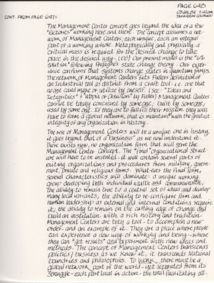
The Management Center Concept goes beyond the idea of a few “factories” working here and there. The concept assumes a network of Management Centers; each unique, each an integral part of a working whole. Metaphysically and physically a critical mass is required for the desired change to take place in the desired way. Our present model is the “6% solution” following Prigogine’s state change theory. Our experience confirms that systems change states in quantum jumps. The network of Management Centers fits Buckminister Fuller’s definition of an Industrial tool as distinct from a craft tool: i.e. one that no one could make or utilize by oneself (see “Ideas and Integrities” and “Utopia or Oblivion” by Fuller). Management Centers cannot be totally conceived by someone; built by someone; used by someone. If they are to fulfill their mission, they will have to form a global network that is maintained with the greatest integrity of any organization in history. The role of Management Centers will be a unique one in history, it goes beyond that of a 'business' as we now understand it. There exists now, no organization form that will serve the Management Center concept. The “final” organizational structure will have to be invented - it will contain several parts of existing organizations and procedures from military, government, private and religious forms. Whatever the final form, several characteristics will dominate: a unique working group developing both wealth and commonwealth, the ability to remain true to a central set of ideas and develop many local variants; the ability to reconfigure and form human leadership as external and internal conditions require it; the ability to remain on the cutting edge of change and build an institution with a rich history and tradition. Management Centers are both a tool - to accomplish a new order - and an example of it. They are a place where people can experience a new way of working and being - where they can “get results” and experiment with new ideas and methods. The concept of Management Centers transcends politics/business as we know it. It transcends national boundaries and philosophies. For it to work, there must be a global network - part of the world - yet separated from its struggle - each part local in action - the total facilitating all.
Page 649
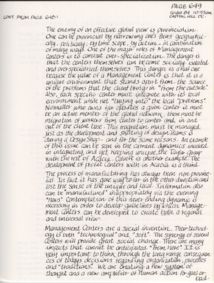
The process of manufacturing has always been non-provincial. In fact it has gone way to far in the other direction and lost the sense of the unique and local. Information also can be “manufactured” inappropriately via the evening “news.” Contemplation of this never ending dynamic is necessary in order to develop guidelines by which Management Centers can be developed to create both a regional and universal view. Management Centers are a social invention. Their technology is both “technological” and “soft.” The synergy of several Centers will provide great social change. There are many impacts that cannot be anticipated “from here.” It is very important to think through the long range consequences of today’s decision regarding organization, processes and “traditions.” We are creating a new system of thought and a new amplifier of human action for good or bad.
|
|