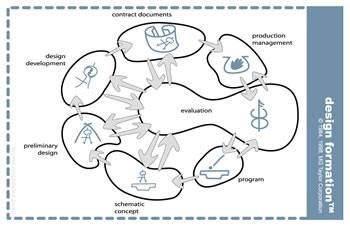
| I have been fortunate to know and work with a number of exquisitely creative people. In addition, I have studied numerous biographies with the intent of understanding specifically what creative people actually do, in contrast to what they say they do, or how others report the process. | | There are many competing models and explainations of creativity; most are, in my mind, too simple in their structure to account for the true nature and scope of the topic. It has been my obsevation, however, that the habits of creative people are remarkably simple and uniform across time and cultures. Bringing these habits to an environment of work is a systematic and rigorous process that can, if performed well, result in a high incident rate of individual and group genius. I have done this by translating these “habits” into rules of the environment and process which generates what we have come to call the Zone of Emergence. These rules and the application of the rules evolved, interactively and through multiple iterations of Design/Build/Use, to the point where today they constitute a reliable knowledge base regarding human creativity and the practice of it. | | Part one of this article outlines these habits. Part two, suggests ways to make them operational in work environments of many kinds. This is the process of moving an individual work strategy to a group scale practice - what we designate as the rL4 level of recursion in the Taylor System and Method. | | At present, there are two “meta-threading” processes of the Taylor System that have been transferred into selected, licensed MG Taylor environments. These processes can be used at all recursion levels above the base level rL1 of the system and can be applied directly to a broad range of circumstances and design opportunities. | | These processes are direct translations of observed phenomena to the creation of a rule-based system of work. One is how memory works in a dynamic system and the other is this topic of creative habits. Most of the techniques and means of this translation of phenomena to practice are proprietary; the focus here is on the broader philosophical implications and insights. | | The design method of translation is an intrinsic foundational processes of organic architecture. This is the act of observing how something functions and making that an embedded RULE in a specific design (application). This rule-making is the translation process from PROGRAM to SCHEMATIC DESIGN in the Design Formation Model. It is a key way that IDEA manifests in concrete form. It is important that the rule does not get expressed and concretized on too “high” a level and become a fixed aspect of the system. Doing so can lead to dogma and the abuse of style. The Program Statement of a design project identifies the basic ideas that are “chosen,” in the first iteration of design, to become embedded in the next iteration of work. Two examples of a program statement in the realm of architecture are seen in the Bay Area Studio and Gail’s Nest projects. The Program Statement phase is important in projects of all types though it is seen mostly used in architectural projects. This step has great utility and would improve work in other fields. Even in architecture, the program phase has degenerated into a list of requirements (mistakenly called functions) to the oversight of much that is important, especially at that time in the project. |  | | The Design Formation Model describes discrete and useful stages that an idea FORMS in a document and/or work process (as expression). | | | It should be remarked that this is why we classify our methods and processes as DESIGN processes, for this is what they are. Much of what goes on in the name of design is hardly that. Above all else, design is a discipline. It is a means; at heart, a transformational process. Through Design (and Build/Use), ideas take form and therefore can change form. This can manifest in a DesignShop, in a work of architecture, in a product, in a work process, etc. There is no limit of application or form. Whatever the form, design embodies ideas into structure and processes, making those ideas operative in the pursuit of some objective. | | Creative Habits, translated into rules, properly encoded, can be a key aspect of a functional operational system (OS) for an individual, team or group in the execution of creative work. Meta-threads are important because they are direct means by which a system can be improved, transparently, with minimal effort and intervention-generated risk. | | In recent years, “Biomimicry” has been proposed in the pursuit of science. The idea is to study nature and to apply Her solutions directly to science and technology. How does a spider produce a thread that, considering weight and strength, is stronger than steel and is produced on demand and at “room temperature?” Compare this to a steel plant and or technology is revealed as the crude thing that it is. Biomimicry [rbtfBook] is much like what I mean when I discuss the process of organic architecture. | | | Not all “creative” people practice all of these habits all the time. Across time and cultures, however, the majority of those recognized as creative manifested the majority of these habits as tacit or conscious “rules” no matter how they described their process or how others viewed it. These primary habits are stated below as rules and supplemented with comments rendered on the descriptive level of the System and Method; in addition, a quote and glyph are added. These three elements: comment, quote and glyph, do not define the rule; they inform thinking about it. The glyph is linked to a Taylor Model which provides an appropriate “voice” to the commentary. While reviewing these rules, it may be useful to recall your own creative successes and failures and think about what rule-set you were running in both circumstances. | 1 
Use feedback with skepticism, craft and deliberation “It is often necessary for us to know whether a whole policy of conduct, a strategy so to say, has proved successful or not. The animal we teach to transverse the maze in order to find food or to avoid electric shocks, must be able to record whether the general plan of running through the maze has been on the whole successful or not, and it must be able to change this plan in order to run the maze efficiently. This form of learning is most certainly a feedback, but a feedback on a higher level, a feedback of policies and not of simple actions. It differs from more elementary feedback in what Bertrand Russell would call its ‘logical type.’” Nobert Weiner
1950
The Human Use of Human Beings | | More likely than not, the initial feedback on an innovative idea is negative. Specifically, however, the core content is likely to be true or utility buried within. Technically, the initial message is probably not true feedback. Sorting through noise and extracting value takes discrimination and time. To be sure, the natural desire to be “right” before one’s peers, and liked, rewarded and promoted (as example) is a block to creativity. Creativity requires the ability to hold to a course against almost total evidence to the contrary and knowing when to change tactics while always evolving the idea/goal. This requires a sophisticated, albeit often tacit, understanding of feedback and knowledge management. The trail to new knowledge often leads through realms of dubious veracity. In this case “too much” knowledge (or knowledge improperly applied) can be a liability. “Everyone” knows this is a false path. Yet, the history of invention is strewn with examples where assumptions that turned out to be “wrong” led to new and wonderful discoveries and useful results. Bringing a new idea into tangible existence requires the ability to know the right voices to listen to at each major phase of actualization. Designing the right feedback loops and using the resulting feedback correctly is but one a requirement for proper stewardship of the burgeoning innovation. Often, social feedback will change over time (sometimes from from strongly negative to unduly positive); and, that taking either extreme too seriously can destroy the effort, is a mission critical discrimination. | 2 
Focus intensively during the incubation period of an idea or design to the exclusion of all else | Creativity requires blocking meaningful time periods and the matching of these periods to the intrinsic work and recreation requirements driven by the specific phase of the creative effort. The 8 to 5, five day a week, 48 week/year work structure with virtually no discrimination among work types is debilitating to creative effort. It forces creative people to make unnecessary, negative tradeoffs in order to even attempt accomplish their innovative work. Today, this appears to be the only social solution-set, and it is being imposed on processes too complex for this simplistic approach. the incubation of an idea, or major phase of its development requires intense focus, uncluttered time and the exclusion of unrelated competitive distractions. Every phase of the creative process requires a different matrix of time, tools, mental modalities and physical environment. Each “location” along this path has its own language, tool kit and veracity test. | 3 
Let passion drive you and express it appropriately | Our society, as innovative as it now is, compared to other cultures, and the past, seems to express a deep fear and suspicion of passion and its uninhibited expression in the “serious” world. Being too passionate is the easiest ways to get thrown out of the club. Each sector, business, government, non-profit, academic (and so on) has its own “rule-set” in this regard, further defined by each particular organization. This is the “how we do it here” and “who we are” aspects of their culture. These philosophical and cultural identities, over time, become translated into operating rules that “run” in each organization, and hence through each individual working within that organization. Some of these rule-sets are recognized, and thus liked or disliked. Many become so entrenched as to become invisible; hidden design assumptions in the mind of the organization. Negative, overreaction to a passionate commitment is one of the more universal constraints to an individual’s - or team’s or organization’s - free cognitive functioning. This is one major reason why work in institutions is rarely fun. And, those institutions where work is fun are the few that allow free cognitive function to flourish. Thus the creative personality invariably risks censure. Too often, as a consequence, passion becomes bottled and ultimately expressed in an unproductive way, creating the very circumstance that the institutional “policy” was “designed” to prevent. If passion cannot come out, so will very little else. Passion compels and brings focus to energy; it powers the system. | 4 
Execute with high
levels of process control and precision “Although modern technology has given us new materials and new tools, Japanese carpenters still use a very special term for their instruments, even their electric tools. No Japanese carpenter refers to his instruments as mere ‘tools,’ but instead calls them Dogu, which really has no equivalent in another language but roughly means the ‘instruments of the way’ (of carpentry... “Carpenter’s tools came to be called Dogu because for carpenters there is a carpentry Do, or way of carpentry; and carpenters... considered their implements Dogu, or instruments of their way. To a Japanese carpenter, his Dogu have a significance far removed from that of mere tools that craftsman might use. Nowadays, however, the carpenter’s Dogu are not so highly respected and valued as they once were, perhaps because the most highly skilled traditional carpenters are quite aged and so many younger carpenters lack the spirit and devotion that are the bedrock of fine workmanship. In the old days, for example, if an apprentice stepped over a saw, it was only natural for his master to strike him soundly for showing such disrespect for his Dogu. The apprentice would accept his punishment without complaint, knowing how gravely he has erred. Perhaps we could even say that formerly the carpenter’s Dogu were invested with a degree of divinity.” Kiyosi Seike
1977
The Art of Japanese Joinery | | Everything is the result of a process that has been designed. Designing processes is an act of pure engineering. Sequencing matters a great deal. The difference between a well-put-together process and a sloppy one can be orders of magnitude in the resulting value. Whatever the arena of work, craft in the process is key to success. Of all processes, the creative process, itself, is one of the most critical to get right. The “creative person (or team, group, enterprise, network...) that does not function and work with craft will ultimately lose its creative edge. Modern perceptions are generally detrimental to the concept of true craftsmanship. Creativity is a discipline and a way of working; a way of living. It cannot be separated; ends and means are one. Execution is not the afterthought of the “real” creative work - it is creation. The artist dreams and sees a vision, develops great skill through endless practice with the knife, then the artist’s intent, the knife and wood engage... what emerges is art. Great effort and practice goes into the prepartion for creativity; the act, itself, is timeless and without effort. The process is more than just an engineering of the most efficient path through a maze of work. The process is a ritual that embodies the wisdom of the art; it encodes it. The act of doing good work is discounted in most of our society. Because of this, quality has escaped the everyday workplace which has become flat and devoid of energy and magic; meaning has been lost. In this environment, efficiency is worshiped as a god while we practice processes that, on the system level, are often wasteful and without significant purpose. Sub-optimization reigns while the creative spirit wanes. Remove craftsmanship and rigorous process from our work lives and the creative spirit collapses from within like a tiger in a zoo. | 5 
Employ eclectic learning methods (modes); periodically explore a broad content range; and bring this content to carefully selected subject areas related to your work “Consensus is rare in psychology, but there is one area of general agreement: the characteristics of the creative thinker. “The creative person is playful. He entertains wild ideas and feels no need to pass immediate judgment on them. He is a one-man brainstorming session. He asks questions unceasingly. He is not satisfied with pat answers and has minimal respect for ‘established facts.’ Offered two alternatives, neither of which seems quite satisfying, he may devise a third. Even if he is a painter, poet, or composer, he does not think of his work as invention but rater as discovery. Drawing indiscriminately from chance observation and from outside his field, he is eclectic, always synthesizing and integrating. “His sensory perception is unusually keen. He spends a lot of time in reverie and is inclined to be somewhat mystical. Often, he says ideas come to him in dreams or idle fantasy. He enjoys surprises and challenges. In the light of the great value placed upon creativity, a stranger to our planet might infer that it is rare indeed. Yet nearly all the characteristics of the creative mind are present in young children! the child explores the environment, coins words, synthesizes phrases. He relishes surprises and cope with challenge. He daydreams, discovers, asks questions unceasingly. His perceptions are fresh, strictly his own. Marilyn Ferguson
1973
The Brain Revolution | | The best ideas are often sparked by the intersection of different vantage points and information - even opposing ones. Information and solution patterns that are ubiquitous in one field can be missing entirely from another. Different fields of study and work promote different models, modes of thinking and work and require special tool-kits. They may have great applicability to other fields but this is not often appreciated. These are all good reasons for exploring broadly; exposure to variety promotes variety. The compelling reason, however, is much simpler. Creative people and organizations (and cultures) are curious. Developing (or redicovering, to be more accurate) curiosity is a key step to promoting creativity. Integrating broad learning with a lazar-like focus enhances meaning, provides context and promotes putting knowledge to work. Learning is enhanced when it is brought to focus by the design process; conversely, design is highly dependent on continuous learning. We say that “learning is design aimed inward at personal development and design is learning aimed outward set to the task of making an object.” They are the same process employed in different ways. Both are what most people mean, usually, when they use the word THINKING. Somewhere along the way learning became a task and a utility. It became divided into grades and subject areas. It became a way to get somewhere rather than a destination. Intellect suffered and so did creativity. The way that work is organized today tends to drive even the naturally curious to ever greater degrees of focus in some specialized area. This is necessary, of course, to get things done; however, it should be modulated with periods of scanning and open-ended search. Otherwise, even the brightest become dulled by their mundane existence. When describing those they consider creative, people will use the terms “youthful,” “child-like” and “energetic.” Why is this? Why is this such a distinction? Are they not, in reality, describing a natural state that so many have somehow lost? How did this happen? Creativity is lost not made. It is restored by doing what creative people do. | 6 
Sustain high physical energy levels; focus this energy during intense work periods; punctuate work periods with appropriate
re-creation | The creative enterprise on all levels of recursion - individual, team, group, enterprise, network, society, has to be stewarded as a whole. Creative people insist on doing this on a personal level; they do not accept the social default. This is why they are considered nonconformist and eccentric. Their issues, as individuals, are no different, in principle, than those working in (the recursion levels of) teams, enterprises and so on. It is just that organizations (to their hurt) provide less freedom to protest and change the existing conditions of work. Energy has to be managed, focused brought to bear at appropriate times, the mind left free to wander at others. Some individuals realize this and develop conventions and ritual to keep their creative energy high. Groups rarely do. Recreation is as important to creativity as “work” is; in fact, there is no real distinction between the two. However, most of our societies’ recreational habits tend to take creative energy “off track.” This is one reason why many creative people do not engage in many forms of social play. The facilitation of physical, emotional and spiritual energy, the modulation between keen focus and open-ended exploration and play; the narrowing to topic-based content and the expansion to non-directed search for new information and stimulus - all these have to be carefully facilitated else the creative moment passes by and fades away. When lightning strikes, you have to be there to catch it. | 7 
Practice a technical discipline at state-of-the-art levels “The philosopher should be a man willing to listen to every suggestion, but determined to judge for himself. He should not be biased by appearances; have no favorite hypothesis; be of no school (of thought); and in doctrine have not master, He should not be a respecter of persons, but of things. Truth should be his primary object. If to these qualities be added industry, he may indeed hope to walk within the veil of the temple of nature.” Mikhael Faraday
1870
The life and letters of Faraday | | I have said that I do not believe that one can become fully developed without having a MASTER as guide. I also believe that mastering at least one disciple is a requirement for the full development of creativity. Creativity requires the knowledge and practice of CRAFT. This has to be learned. It has to be practiced. It has to be loved, for itself, by the practitioner. A craft is a means to an end that has to be practiced as an end in itself. This practice grounds experience which otherwise can get lost in layers of mental abstractions. THE creative practice is fundamental to all crafts, disciplines and professions; the methodology of each is a variation of it. It is better - even necessary - to learn a craft well and then generalize the experience to the skill of all skills. Neither creativity nor most professions are taught this way. | 8 
Follow your Intuition Real art creates myths a society can live instead of die by, and clearly our society is in need of such myths. What I claim is that such myths are not mere hopeful fairy tales but the products of careful and disciplined thought; that a properly built myth is worthy of belief, at least tentatively; that working art is a moral act; that a work of art is a moral example; and that false art can be know for what it is if one remembers the rules.” John Gardner
1977
on Moral Fiction | | Creativity is a heuristic process; it is fueled from many sources and it is inherently complex. Complex in the sense that many threads lead to its proper practice and execution. A specific creation is a weaving, a fabric which is made up of many concrete sources. Rational processes and rules are important - they regulate; objectify; provide precise feedback. But they cannot do the job alone. INTUTION is all that is available to you from the totality of past experience from all the channels reality provides. Creative people know they do not make from nothing - they discover; they work hard and engineer well and practice their craft with dilligence... yes. But what they seek to make... they are given. They, once having “accepted” the assignment, have to discover how to make it. They study reality and listen to the muses and then grab the fleeting moment; and, they do not let it go. | 9 
Document your progress | “If it ain’t documented, it ain’t science” is an often repeated Robert heinlein quote. Documentation is like “dead reckoning” navigation; the whole process falls apart if accurate real-time notations are not kept. Documentation is a means of bringing consciousness - self awareness - to ones heuristic search. Without documentation, you will get lost; without documentation, those joining the journey will have no means to history and context; without documentation, iteration is impossible and products made along the they way fail to make it to future value. Without documentation it is beyond difficult to switch to the observer role and self-monitor your progress. Without it, writing history in the future is made nearly impossible and society looses the learning opportunity. The act of documentation is a step out of self; an act of making internal mind objective “outside” so it can become feedback to an internal process too complex to hold. Documentation promotes self-awareness. It is the mirror of the self and the raw data for others. | 10 
Practice work-living integration and 24/7/365 work-flow | Continuity is the great challenge to creativity in the modern era. How did Bach write so much music in a time of candles, quill pens and paper? This is answered by looking at his habits of productivity and understanding what he did not do. There is no question that Bach lived music. And, because he did, his music lives today as it is replayed by dedicated musicians. It is a profound thought to realize that Bach can reach down through the centuries and touch your soul; an example of re-creation. Everybody and every work grouping has to solve this problem of life-work style. There are no easy answers. The step cannot be avoided and the “social default” of the work form-factor prevalent in our culture today will not do. Until recently, the industrial model of work was to take variety out of the equation and this effort was outstandingly successful. Unfortunately, variety was also taken out of people. Our modern life is packed with choices and this is a good thing; lots of variety on this level of the system. Each of us, however, has to carve out our own social reality and choose those things which lead to happiness and productivity for us - individually. This selection process is perhaps the most creative act each of us will make; the rest follows. Of course it is not as simple as a one time selection - it is a feedback driven process over time that is always in adjustment. What is “one time” is the realization that this act is of supreme importance. Many go through life never having been aware of the choice. As we combine our efforts with others - to make and employ organizations that are meant to augment our personal capacities - this life-work style issue becomes even more complex. It is interesting to note that little about organizational theory starts with this issue which in my mind is the primary issue of organization. When it is realized that organizations need to work for people instead of visa versa then we may begin to make progress. Creative people, traditionally, deal with this by getting out of organizations or dominating the ones they are in - both poor options. | 11 
Rule out failure as an option; know when to retire from the field; keep the long view “The best thing for being sad, replied Merlyn, beginning to puff and blow, is to lean something. This is the only thing that never fails. You may grow old and trembling in your anatomies, you may lie awake at night listening to the disorder of your veins, you may miss your only love, you may see the world about you devastated by evil lunatics, or know your honor trampled in the sewer of baser minds. There is only one thing for it then - to learn. Learn why the world wags and what wags it. That is the only thing which the mind can never exhaust, never alienate, never be tortured by, never fear or distrust, and never dream of regretting. Look at what a lot of things there are to learn - pure science, the only purity there is. You can learn astronomy in a lifetime, natural history in three, literature in six. And then, after you have exhausted a milliard lifetimes in biology and medicine and theocriticism and geography and history and economics - why, you can start to make a cartwheel out of the appropriate wood, or spend fifty years learning to begin to learn to beat your adversary at fencing. After that you can start again on mathematics, until it is time to learn to plough.” T.H. White
1958
The Once and Future King | | An idea, innovation or project that is OK to fail at is not worth doing. It fails the worthy-test. The first step of the process (Identity) is intended to find out what is important and needs doing. Steps may fail; specific ideas and approaches may fail; the thing itself may fail commercially or even prove to have inherent flaws. These, however, are not necessarily FAILURE. Failure is to not complete; failures is to do a sloppy job; or to quit. True creativity does not fail; it learns, moves on and preserves value; it grows, even mutates - it prevails. The creative act is not provisional; it is not tentative; it is not faint-hearted; it does not play in the margins. Creativity is the act of making new values manifest; it is enterprise making and universe disturbing. You do not control - or even understand - a great idea. It plays you. Any great idea, anything worth doing, has generations of precepts and will play out for millennia to come. You and I get to steward things along for awhile. What we do - or not - is important; it matters in time and space; in flesh and blood. The IDEA has a life of its own. The creative life integrates the “do or die” intensity of the moment with the perspective of a thousand years; both are true, both have to be felt; both inform the moment. The creative act is mind-less; after years of preparation, you disappear into a fusion of what surrounds you; you, the object, the means, the “problem” that brought you to the party, all the other players - protagonist and antagonist - MERGE. What happens is creation. What happens is different because you where present. | 12 
Develop and use your “reset” button “Man talks carelessly and ignorantly of such words as chaos.... turbulence.... turmoil and (the popular modern) pollution.... where nothing but absolute order is subvisibly maintained by nature and her transformation arrangements unfamiliar to man. Universe does not have any pollution. All chemistries of Universe are always essential to the integrity of eternal transformation and eternal self-generation. Physicists invent nothing. ....They find out what nature does from time to time, learn something of what her laws of rearrangement may be, and fortunate humans employ those rules to cooperate consciously with nature’s evolution.” R. Buckminster Fuller
1975
Synergetics | | In the process of bringing an idea to market - be it the marketplace of ideas or goods - many things will go wrong. In fact, most things will go wrong. Many false paths will be followed. Error is where the most intense learning is experienced. The ability to RESET is key both to psychological sanity and organizational health. “When to hold them and when to fold them” is the great discrimination in any entrepreneurial venture. Creativity is emergent; is entrepreneurial; it is the management of risk. It brings forth strong emotions and requires high levels of commitment. Abrupt changes in strategy or approach are often necessary. Defeat has to be turned into opportunity. In the creative enterprise, vision has to see across decades, tactics have to adjust with the moment. True values persist, ideas must turn on a dime. This cannot happen if the mind of the individual or the mind of the organization cannot reset to certain stable KEEPS from which new iterations can sally forth. There is an art and science to knowing these places and being able to return to them with certainty. | 13 
Employ a “hands on” approach to product creation ”I knew a mechanic who was out of work and broke in the worst of the depression, with a family to support. He picked up from the dumps in Wyoming enough sound structural iron and good steel cables to build a suspension bridge across Snake River, a bridge that the county could not afford to build at the estimated public cost of $50,000. He and his nine-year old son built it, using a dragline-rig that he made entirely from junk. It more than satisfied county inspection. The farmers who needed the bridge gladly paid $2,500 for it, and my friend, after paying for cement and gasoline, cleared about $2,000 for his labor. Who plans the American economy? American do.” Rose Wilder Lane
1943
The Discovery of Freedom | | Stuart Kauffman says “the algorithm is incompressible” and that is true of any complex invention. The operation cannot be performed by supervising from the balcony. Without a Design/Build/Use fast-tracked process employing rapid prototyping, the feedback to the would-be innovator is rarely rich enough and specific enough to facilitate a full cycle of work. The subtle cues are lost or show up too late to make a difference. Formal communication cannot compete with real-time dialog and emersion in doing. Modern organization runs contrary to this reality and imposes hidden costs that largely cancels out the tremendous leverage provided by the concentration of capital, tooling and economies of scale. Creativity is too often though of as just pertaining to the conceptual phase of an idea or work while the doing of it is considered mundane or only marginal in its demands on intellect and talent. This simply is not true, of course; it is, however, the tacit assumption of most organizational design; a few creating and leading, the many performing rote work. Creativity lives equally in the mind and the hands. | 14 
Challenge
Convention “Freeman Dyson has expressed some thoughts on craziness. In a Scientific American article called Innovation in Physics, he began by quoting Niels Bohr. Bohr had been in attendance at a lecture in which Wolfgang Pauli proposed a new theory of elementary particles. Pauli came under heavy criticism, which Bohr summed up for him: ‘We are all agreed that your theory is crazy. The question which divides us is whether it is crazy enough to have a chance of being correct. My own feeling is that is not crazy enough.’ To that Freeman added: ‘When a great innovation appears, it will almost certainly be in a muddled, incomplete and confusing form. To the discoverer, himself, it will be only half understood; to everyone else, it will be a mystery. For any speculation which does not at first glance look crazy, there is no hope!’”
Kenneth Brower
1979
The Starship and the Canoe
| | Convention is the creature of what is. Convention represents great value and should be respected. It is, however, the meta-program - the story - by which present values are maintained. New value requires new paradigms, ideas and actions. These cannot be created from inside the old model. All aspects of convention have to be challenged; often the tried and true, the “proven,” are based on solutions that were optimal for their time - new models, information, tools processes and social economic conditions can render a totally new solution possible. This is not always readily apparent as the underlying causes may be long buried. Challenging convention is the act of mental and social archeology. Finding the hidden design assumptions of any idea, field or project is the fundamental creative challenge. These, of course, will be defended - and legitimately so - by the “keepers” of the bodies of knowledge and practices involved. This sets up a dynamic tension - a dialog - that must play out. How this process is conducted is critical to the outcome as the process, itself, will become embedded in the outcome. Different fields of study and work, in our society, have different meta-processes for dealing with the conflict between new and old ideas, models and practices. How they do so exercises a heavy influence on their ability to change and innovate. These meta-processes are embedded in the way the field it defined, taught and practiced. Those learning a field are rarely taught that they are learning one rendering of THE creative process. This can be unfortunate. | 15 
Work in rapid
iterations - ship a product - again and again; produce a rapid series of working prototypes “Exemplary performers use the constant flow of information to shape products and services. In contrast, other performers use only initial information.
They tend to present their initial product or service as final and often have an aversion to producing or reproducing the product or service.
Exemplars, on the other hand, use the flow of information as inputs to engage in productive iterations of product development: the exemplar, given
the time constraints, will repeat the process as many times as necessary in order to produce a ‘perfect product.’
For most products or services, the exemplar engages in six iterations of
production. Each of these iterations emphasizes further shaping of the
product because of new information feedback. Each iteration becomes a more and more efficient resource investment – perhaps half of the previous phase. In turn, each iteration doubles the quality of the product or services. The
exemplar becomes increasingly more efficient in resource investments and
effective in results outputs.”
Robert Carkhuff
1984
The Exemplar
| | Studies have shown that teams that go through multiple rapid iterations of work out perform teams which move slowly, once through the creative process, trying to get each linear step perfect as the go. the difference in performance between these two strategies is not trivial - it can be as much as a 1,000 percent. The issue, of course is communication, feedback, learning and stimulation. “markets” are extremely efficient at “voting” and sorting through options. When a product is “shipped,” even internally to a tight group, it is subject to these market forces. Not only is “shipping” useful in making an idea, it also help shape the market itself. New ideas and innovations are rarely perfectly timed right out of the box. A “dialog” is necessary between the new thing and the existing way until understanding and accommodation can be reached. This is often not seen as “part” of the creative process but an obstacle to it - it is, in fact, the most important step. This is equally true in the realm of ideas as it is in the making of products and services. Not working interactively but trying to get the product done “right” in one extended cycle of work is one of the most common “bad” habits of individuals and teams and often the biggest factor in their failure to reach a level of high performance. Even in those cases where it looks like the "lone genius” worked years and years in isolation, a close study will reveal time and again great awareness of the state of the art and highly selected dialog going on among a tight but effective group of correspondents. In today’s world of rapid change and increasing complexity, iterative work habits are essential. | 16 
Create a language around your field of interest and creative work | “In the beginning was the word.” the history of creativity is the history of changing language. By language, in this context, I mean in the broadest sense of the term. the evolving technology of language - and all the media that support it - establishes the primary tool-kit of thought. A new idea, technique, artifact, product or service requires new language to make it and “sell” it and to use it. the craft brought to this process is critical to success. Notice that at the beginning of a process the arguments that prevail around the use of words. Ever wonder why? S/he who controls the words (and sets the agenda) determines the scope and nature of the outcome. | 17 
Hold context and keep goals intact on a lifetime scale; employ ritual; maintain the “observer” “To hold an unchanging youth is to reach at the end the vision with which one started.” Ayn Rand
1958
Atlas Shrugged | | The creative act is intensely selfish and outrageously giving at the same time. It is ruthless and unforgiving; it consumes all that is in its path. It is life giving; it breaths life into what is being made. To survive here you have to be “in the game but not of it.” Perspective is necessary both for good work and survival. Every specific act has to come from a lifetime perspective. Ritual reminds; it is the meta-program that bring forth the necessary magic. The observer is your program that views you from a higher recursion level and keeps you from doing stupid things. | 18 
Invest everything “Everyone seems to be waiting until they know it all; until the are the world ‘experts’ before they can can speak up or act up to a situation. Yet no one ever seems to become that world ‘expert.’ Therefore, we are kept from creativity by our own pride, fear, jealousy and competitiveness. Creativity is blocked by: | of being misused or ‘raped’ | | of disturbing traditions and making changes | | of being associated with taboos | | of losing the security of habit | | of losing the love of the group | Koberg and Bagnall
1974
The Universal Traveler
| | The creative ACT is total. It is not qualified by those things we too often consider to be the practical aspects of living. It is necessary to leap from existing solid ground to find a new place that is fundamentally different. You cannot leap the abyss and hold on at the same time. The mental attention required to discover and make a great idea real is total. It can be worked and put a side, from time to time, as the natural phases play out, but there is a piece of the mind that can never let it go until the work is done. There are often times in the maturation of an idea when all has to be bet to advance its cause. These times have to be approached carefully and the appropriate response executed quickly; the risk, then, being framed and minimized. The real investment, of course, is the investment of self. All that that you are and all that you summon up becomes the the creative effort. Living a creative life means moving beyond a single effort to a sustained one. Our society, as much as it worships creativity after the fact is not, yet, designed to support this way of being. These are the facts of the matter. It is a choice that everyone faces when they confront their own genius and the implications of it to the world they live in. It is equally faced by every team, every organization, every society at large; for group genius is not the simple extension of individual genius; nor, does it scale. These issues have to be grappled with time and again at every level of social organization. Every new team has to deal with it. Every new project raises the issues. There are systems that support the creative process; it is, however, a choice to employ them - or not. Each iteration of work, a conscious decision has to be made to “work a new way” else the default system-in-place will prevail. Creative people have always set their own rules and employed their own work processes. Unfortunately, this has tended to set them further apart from the rest of humanity. What is needed is a way of working based on creative principles that a large population can embrace. | 19 
Message broadly; communicate intensely with peers; build functional networks | By definition, the resources required for any significant innovation do not exist where needed “ready-to-go.” A worthy idea or project is alway bigger than anyone. Broad messaging is required to get the word out; to recruit energy to the project. This is equally true in a community, and organization and on the broader scale of a civilization. At the same time, this messaging can create high levels of noise. Both an attractor and a filter are necessary. These have to be modulated and tuned as conditions change. In time, a community of practice emerges. This community, by definition is made up of peer-relationships between, perhaps, otherwise divergent groups. Intensive communication/learning and collaborative design leads to the formation of purpose-focused networks. It is at this point a new level and cycle of creativity begins. | 20 
Serve a higher cause | To be creative requires getting out of self. It requires context and a super-ordinate mission. In the value-web of the mind cause is the integrating vision that compels action. On the scale of a work-team, community of practice or ValueWeb, it is the integration function that holds an effort, extended by time and place, together. A CAUSE can also be the seed of self-destruction; great care has to exercised in its stewardship. Finding the true mission-within is a primary step in the development of creativity and, indeed, the creation of a human life. It takes strong convictions and will to bring a cause to reality; it takes submission to accept a cause. Causes are discovered not made; they are accepted not invented. | 21 
Create a community | The hidden story of creativity is the story of community. Innovation does not occur in a vacuum - it never has; it is the result of intense dialog within a single mind, between individuals and among carefully chosen (filtered) communities of practice. This dialog leaps centuries as documentation from the past (books, art, architecture, media) continue to impact the present. Human society as a whole sets a context and forms the environment of all creative efforts. While creative people are not always the most gregarious and usually work diligently to protect their time, history shows creatives have an uncanny ability to know each other and be where the action is. They both find and follow the Weak Signals and create them. This bouncing back and forth of ideas in rapid iterations is the single most important practice of the creative process. | 22 
Organize your workplace so that it works for you ”It is the birthright of every human being to live in a world of beauty: a world that is concordant with the needs and aspirations of the innermost and highest elemental powers in humankind and is expressive of the supreme intelligence and spiritual powers manifest in nature.” Eugene Tsui
1999
Evolutionary Architecture
Nature As a Basis For Design
| | Most workplaces are not designed to promote creativity; they reflect 20th century accountancy far more than 21st century creativity. A sense of PLACE promotes creativity; employees symbol and promotes ritual; it augments work processes; and, provides an effective arrangement of space and tools to facilitate productive work. All this is essential if the creative impulse is to find its way into the everyday workplace. Most institutional workplaces are the embodiment of old work habits attenuated by budget and imposed on work processes; they fail to recognize individual requirements, team functions and new social symbols. They lack adaptively and individualization. Contrast these environments with the environments creative people have made for themselves when they have the means and the distinction become abundantly clear. | | | It should be clear that every one of these habits can become destructive if taken to an extreme as a chronic modality; as a fixed habit. If a system or process is to be stable and evolving, there must be rules about the rules that operate from other recursion levels. | | It should be equally clear that the major barriers to individual and group creativity are socially cultivated habits that are “designed” to promote conformity and what is considered to be social/economic stability. We have a social paradox today. People are being asked “suddenly” to be “creative” while conforming to a social landscape that largely promotes and rewards conformity. The existing pervasiveness of so-called individually-focused eccentric behavior should not obscure this fact. The Roman mob was even more effectively ruled with the Roman Circus in place. What passes today as individualism is not the wellspring of true, sustainable and useful creativity; it is a distortion and distraction. | | The creative life springs from a lifestyle practice very different from the consumer society now dominate and growing globally. This is true despite the fact that this very consumer society is providing many avenues for product/service differentiation and, thus, change and innovation on a sub-system and products level. This is, in a way, a liberation from the past; a phase between two eras; it is practice for what may come. It is also dangerous and inherently self-destructive; it will consume itself all on its own. It is OK to experience it, use it and enjoy it but not get lost and trapped in it. | | | When we started our work it was broadly held that creativity was rare, group genius non-existent and collaboration outside of a few unique communities of little utility. We asked a different question: “what if these assumptions were not true and creativity was represented throughout the entire human population?” “What if this creativity was being blocked by the architecture of formal ideas, the structure of the physical workplace, 2nd Wave work processes and organizational hierarchy?” “What if people would act differently in an environment deliberately created for creative people?” So, we created a different environment, and in doing so, produced a different result; the old assumptions were demonstrated to be inadequate; they were “true” only in their own limiting paradigm. | | DesignShops, NavCenters, PatchWork Design processes are not the Taylor System and Method; they are expressions of it. The system is iterative, recursive and is transferable, as determined by the users’s condition, by employing many different levels of language and experience, means and methods. Each “installation” of this OS is different even as it is based on the same principles and methods. | | How to translate creative person’s habits into embedded rules of a system or process - as a system of work - follows in part two of this document. | | These habits are stated as rules in this document for a reason. On one level, words are commands to the human body-mind system (Lilly [rbtfBook], Janes [rbtfBook]). Up to the limits of the system, it will directly respond to clear declarative statements. It will, as best it can, sort out contradictory statements by a process of voting (Minski). The creative process is a factor of intention. Intention is the net-out vector of the mind. Work habits are learned processes that are embedded and “automatic;” they “trigger” cascades of thought/action (stimulated by appropriate conditions) and have an increasing returns (positive feedback loop) tie (meta threading) to this net vector; each reinforces, expresses and releases the other. Strong memory is built by the practice of these habits creating an efficient machine. This capacity is the outstanding characteristic of creative people and organizations (communities of practice) capable of sustained innovation. | | Understanding the meta-threading aspects of the Taylor System and Method, and knowing how to apply it, provides a “short cut” to system design. By simply building in the characteristics of creative-habits (and strong-memory) into an agent, process, artifact, or system level OS, a more flexible, adaptive, learning system will result. In a transition period, beset by complexity and the need for time-compression, this is a useful addition to the Transition Manager’s tool-kit. | | Matt Taylor
Elsewhere
November 28, 2002 | 
SolutionBox voice of this document:
INSIGHT • POLICY • PROGRAM |
posted November 28, 2002 revised June 17, 2005
• 20021128.412398.mt • 20021129.763210.mt •
• 20021130.558888.mt • 20021203.222201.mt •
• 20021216.387890.mt • 20021219.333309.mt •
• 20050617.980912.mt • (note: this document is about 92% finished) copyright© Matt Taylor 1975, 1979, 1998, 2001, 2002, 2005
note: aspects of the processes described in this document are patented and patent pending by iterations | |
|