| Frank Lloyd Wright 
“So long...
Frank Lloyd Wright... “I can’t believe your sing is gone...” | | 40 years ago, today, Frank Lloyd Wrght died. | | Those who knew him were shocked. How can I explain a 92 year old man who had more life in him than most 21 year olds ever do? How can I explain the way I “feel” his presence - to this day - every time I design a building? How his work still reaches out to me in a demanding, personal way? How can a relationship like this conveyed to anyone who was not there? | | It seems like yesterday - and, it seems like forever. | | Genius can be a tired and overworked word. Frank Lloyd Wright was a genius. He was born a few year after the Civil War - he died within a decade of us going to the moon. He practiced his architecture for over 70 years. When he died, he was a few years into his fourth cycle of artistic recreation. At the end of his time, his buildings were are fresh and relevant as ever - they are today. | | I did not know him long nor did I know him well in the conventional sense of the word. We had, perhaps, a few hours of personal one-on-one dialogs between us. But I knew Frank Lloyd Wright as I believe few have. With him, I avoided two mistakes that many made: I neither lost myself to him, nor did I try to make him into something that he was not. I took him as he was - and let him be what he was. | | Frank Lloyd Wright was my master. He remains my master. | | I do not believe that you can ever find your true voice without a master. It is questionable if you can ever learn how to make a human being without the experience. The relationship embodies a process that is essential to the development of any great art - and to the art of living. Mind-stuff and soul-stuff emerges from this kind of experience. | | This is almost entirely lost in this noisy, superficial, impatient world we have all made and now live in. And, of course, our “educational” system continues to churn out product like sausage - the expression of the industrial model at its worst. It does not “lead out” - it stuffs. | | He lived his work. He provoked learning. He connected the lesson to results. He took joy in the process. He was a force that you had to react to. When people engaged him and lived in his buildings, they changed. And always the mischief - the trickster - was just below the surface. | | He was, of course, one of the most misunderstood persons that I know of. But what was missed most - by almost everyone - was the humor. If you did not see the twinkle in Wright’s eye - you saw nothing. | | Before applying the tag “genius” to someone it should be understood for what it is - and is not. It is seen as a gift. And, in a way it is. It is received not made. It is, however, more like a curse. The issue of genius is not the issue - the issue is how do people respond to it. Generally, very poorly. | | Genius may be given - accomplishment is earned. In many ways, accomplishment is much harder for a genius - think about it. A genius is given a challenge - s/he has to make something of it. S/he has to do it in a world that was not made of it. 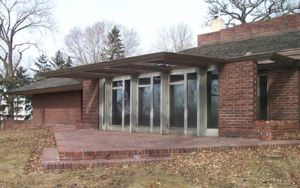
Willey House built around 1932 to 1934
Photo by Lisa Piazza February 2000 Mr. Wright built the Willey House after many dry years with little work. It has always been a favorite of mine. It represented a new departure of his work (although you can “see” it in the Roberts House) and leads to the Usonian Houses soon after. At this time in his life, Wright was written off, presumed dead or irrelevant. He was in his 60's. After this came the Usonians, Johnson Wax, Falling Water and almost half his executed works. | | If you want to understand one dimension of genius, study this “comeback.” Of course to him it was not a comeback, he never left. | | I knew Frank Lloyd Wright late in his life. By then, he had come to terms with himself. He had constructed this persona that the world saw as him. Just beneath the surface peered out a mischievous child that was indeed having a very good time of it all. | | If you wanted to talk to Frank Lloyd Wright all you had to do was directly, honestly, address that child. This was also true, by the way, with Ayn Rand. I expect it is common with the breed. | | Genius is not to be confused with talent. Genius has and develops talent if it is to “come out.” Talent does not always have genius. The gift of genius is a given, its manifestation is in the hands of the genus and those few (around him or her) that take on the somewhat thankless task of being a midwife to the event. | | Group genius, by the way, is an entirely different thing. This is not what I am talking about here. It is not individual genius “added up.” Group genius works on another scale and does not require individual genius - this is good news. Nature is clever and redundant. | | This essay is not about group genius. It is about Frank Lloyd Wright and how he dealt with his own genius. It is about what it was like to brush against this genius when it was in full bloom. The thing about genius is that it blooms late in life. Talent becomes genius actualized under the proper circumstances. That is if it is not killed off along the way. | | The extraordinary thing about Wright was that he did not let it die. | | Indeed, he grew it to the end. | | The problem, you see, with the “gift” of genius is that it is not yours to do with what you want. It is a responsibility. It is a mission that may, in fact, take you places were you do not want to go. It may put you in circumstances that you do not like. And once it possesses you, it can kill you if you do not learn how to manage a life that gives into it. One reason why genius is so “rare” is that few are willing to accept its terms. As a society, we do a poor job in preparing for it. It is dangerous. | | One reason why it is necessary for a young person to have a master is to apprentice to this energy we call genius. There is no other way to learn it except from someone who has a measure of success with it. Without this guidance the would-be genius is likely to turn away in frustration, burn out or self-destruct. The master both teaches a path and infuses the spirit of it. This is the way. | | Matt Taylor
Palo Alto
April 9, 1999 | 
SolutionBox voice of this document:
VISION • STRATEGY • EVALUATION |
posted April 9, 1999 revised December 19, 2000
• 20000301.9301.mt • 2000002.123917.mt • 20000402.8116.mt •
• 20000527.214853.mt • 20011219.342222.mt • (note: this document is about 65 % finished) Copyright © Matt Taylor 1999, 2000, 2001 |