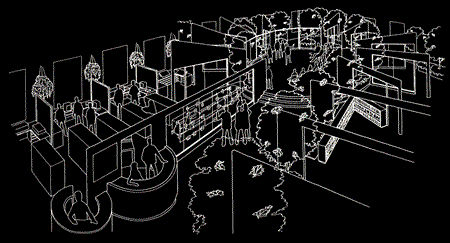
Facilitating the Executive Routine | Acacia NavCenter - 1982
Jim Toohey, Architect | How Is Executive Augmentation Done? | | This question has been front and center in our work for 25 years. The sketch, above, was developed in 1982 for a company in Washington DC in conjunction with the Taylor CyberCon Executive System. It illustrates the basic augmentation processes we have been developing, testing and deploying in parts since the founding of MG Taylor. | | In 2001, the maturity of our business, the evolution of Internet technology and new market/user demands will see the emergence of the full system for the first time. And, in a timely manner, our Patent will be issued. Convergence 20 years later. Not really bad when you think of the myriad of processes, technologies, environment components and market trends that had to be developed. | | The focus of this piece is the issue of executive augmentation. What is the requirement? What constrains executives? What have we discovered in a thousand multi-day sessions and the management of a dozen NavCenters about how executives really work? What is the technology state-of-the-art? What SYSTEM can be put in place today? What would a full “Level I” system cost? How can a modern enterprise employ it? | | As background, the follow links are useful: | | First, a description of what has not been done. We have expedience in nearly all the components and dimensions that make up a Level I executive augmentation environment. There are a few technology pieces that cannot yet be produced but there functionality can mostly be covered. What has not happened is that the full range and scope of the tool kit, process and application has not been applied over a continuous and lengthy period of time. We have simulated this for short periods of time in our own environments. To date, most client NavCenters had chosen to employ a limited tool kit, process venue and application focus. However, there has been enough diversity in these field tests that, combined with our own experiments and applications, we have a robust confirmation of the overall system that makes up Level I. | | The reasons we have never ourselves built out the full Level I system is capital constraints and the requirements of our client/customer base. It accomplishes little to build too far ahead of your market. | | There is strong evidence now that the pressures on organizations today are pushing them to look at the next level of creative, collaborative and work augmentation environments. Recent advances in technology have brought many essential tools into the realm of affordability and a new generation of leading edge software and media to the demonstration level. Our own work has exposed over 50,000 people, largely in the last 5 years, to our present generation of environment. The time is right to finally accomplish our founding concept. | | What is the difference between Level I and current practices? Very little on the surface and a great, great deal in terms of the final result. A quantum difference in performance over time is the expected result. Level I - the first full implementation of our System and method - is predicted to be as much advance on human productivity as our present environments are to the standard ways of working. | | With this background in mind, the following comments describe the scope of the full system in the concrete terms of what is possible today. | | First off, we do not confine the concept of executive augmentation to“EXECUTIVES” as they are defined today. The focus is on the executive routine - not a position within a corporate structure. This is an important distinction. The executive routine exists in all species and in many layers of recursion that makes up their natural and built organizations. | | Also, the executive routine is closely aligned with consciousness. Another aspect of this approach is to materially broaden the range of what is considered an executive routine. It generally is thought to be limited to decision making, command and control, and so on. I argue that this is a highly truncated view. Designers, for example, make literally thousands of decisions on the way to a finished idea or work. Design is not often though of in this way. Nor is design often included in concepts of the executive routine. But what is the development of strategy if it is not design? These are important distinctions as will be revealed later as we get deeper into the system specifications. | | Both the executive and the executive routine as exercised by everyone though a variety of personal, work and organizational contexts, has been to narrowly approached. In addition, the work processes that have been employed in the name of the executive function have become a straight jacket. They lack scope, range and variety. | | Matt Taylor
February 14, 2001
Palo Alto 
SolutionBox voice of this document:
ENGINEERING • STRATEGY • PRELIMINARY | |
posted: February 14, 2001 revised: March 15, 2003
• 20010214.282335.mt • 20030315.222209.mt • (note: this document is about 10% finished) Matt Taylor 615 525 7053 me@matttaylor.com Copyright© Matt Taylor 1982, 1984, 2001, 2003 | |
|