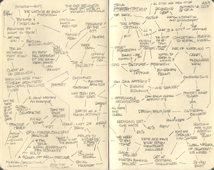
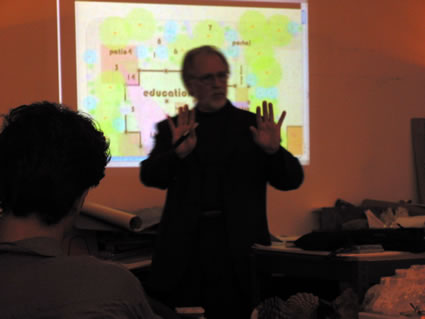
Redefining the Urban Work Landscape | Notes to commpliment my presentation
at SFIA October 16, 2003 link: mind-map of this presentation
links to annotations - indicated by [1], [2], etc. in text
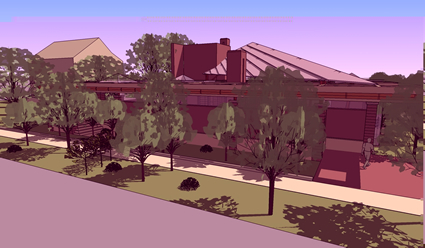
links to ReBuilding the Future 500 books indicated as: [rbtfBook] | | The opportunity exists to rethink and re-make the work habitat. In particular, how we work in the urban setting. This is long overdue, however, there are several merging trends [1] that can build to a step function of sufficient direction and force capable of generating the energy necessary to shift the mind-set [2] that dominates workspace design today and overcome the inertia that exists. Step functions are matters of timing - it is only if these trends come together in certain ways that real progress can be accomplished. In addition, good fortune comes to those who act appropriately in these moments of opportunity. How this can be done is the focus of this talk and subsequent article - and its many links. | | A new integration is required. Although many positive trends [3] in architecture have unfolded in the last 20 years, old habits still prevail. It will take a focused effort to launch a significant alternative to the present default mode which leads to the compromise - and if it were to continue unchecked - the destruction of both the human and the planet as we know it [4]. At the present rate, the entire planet will be a human artifact within the next 25 years [link]. There is most likely no alternative to this [5]. The legitimate alternatives are in the realm of what kind of artifact we will make. In this we must choose wisely. | | The effort to which I refer will require that we re-think what architecture is, how we practice it, and how humans both conceive of their planet [6] and collaborate with Gaia [link] [rbtfBook] in co-evolution. The model of real estate development has to be re-thought [link] - how we measure progress, reconsidered [7]. Unchanged, present approaches - even the “good” ones - lead to a single, predictable disaster [8]. | | At the root, this is not a problem of architecture in the simple technical sense - and certainly not in the sense that architecture has been traditionally defined (a definition [link] and scope we should challenge). Our buildings result from our generic makeup and our social habits and they, in turn, reinforce these habits [9]. Our habits reflect our philosophy of life, our sense of life, and our concept of work. The quality we bring to our building reflects the quality we bring to our lives. Architecture is built philosophy - it is outer development. It cannot be anything but honest. A building is the inevitable result of thousands of minute value judgments, each small, all adding up to an almost unstoppable circumstance [10] [rbtfBook]. | | This circumstance can be positive - or negative. When negative it is kept in place by the creed of utilitarianism [11] voiced in the disguise of “being practical.” It is argued, at each incremental step alone the way to making a building, that this or that is or is not practical, affordable, doable. This misguided application of pragmatism [12] adds up to a result that few like, that no one controls and often simply does not work by any standard - in the end, the accumulative built environment is heading for disaster. This is why a new architecture requires a new way of working; a new way of building; a new way of financing; a new way of insuring; a new way of organizing the effort. A new system has to be put in place [link]. The existing process is failing [13]. | | In the day-today effort to get the work done - to get things built, it is not easy to perform the task successfully and change the whole way of working that drives how the profession and industry functions in its entirety. This takes extraordinary effort, some measure of extra risk and an intimate knowledge of the many tasks that span the entire process of making places for people to live and work [14]. By combining certain aspect of SFIA, as a school, with SFIA-Master Builders, as a practice, we are seeking the integration and critical mass necessary to implement, at significant scale, new, effective architectural process models [15]. | | Accomplishing this dual task has been my work for over 46 years. There are few jobs in the entire process of developing, designing, building and using environments that I have not performed [link]. The perspective I have gained from this experience makes the task-at-hand look very different to me than to the majority who work in some facet of these now separate fields. Naturally, upon hearing my point of view on these issues, this majority usually assumes that I don’t know what I am talking about. What I am saying runs contrary to their experience with their piece of it. Architecture - as a totality - has not been addressed in context of our modern situation which is the creation or possible destruction of an entire planet [16]. All architecture is now planetary architecture. | | This means the layers of context surrounding a single architectural project and understanding their direct effect on its formulation has to be greatly expanded. There are global as well as local consequences in each building effort. Infrastructure has to be considered as architecture [17]. Armature [link] understood and employed at several levels of recursion from elements inside a single building, to city-scale and infrastructure scales [18]. Architecture must connect physically from part to whole and it has to relate, metaphysically, fact-ness, symbol, social context and idea [link]. This is what it means to practice organic architecture [link] in today’s social, economic, physical environment. In the immediate time ahead, to only produce beautiful, isolated works of architecture for individual clients, while worthy and not easy, is not sufficient [19]. It is to deny the basic challenge of our times. It is to fiddle while the world burns [20]. | | The urban environment resides at the very middle of this task of planetary co-evolution. It forges the greatest experience of living on Earth that the great majority, in the developed and developing world, can claim [21]. While being center to this time and place, the definition of urban, itself, is changing. As I think of it today, I include in this definition, mega-structures [link], the traditional and modern city and what we used to call suburbia [22]. Their previous distinctions are fading in comparison to their similarities and their scope of impact on humans, animals and planet [23]. | There are three aspects of the task of creating affordable, sustainable urban work environments that I will address here: first, just what is the standard we should be achieving; second, how can we go about achieving it; third, what changes have to be made for this to happen? As always, I will do this indirectly by weaving in and out of these themes; as always, it is not what I have to say that is the subject - it is what you choose to do with these ideas that matters. Your thinking is my address, my words are meant to be the stimulus to that thinking [24]. | | In conjunction with these three questions, I will profile the four projects selected and show how they are - in substance and in method - addressing the issues I am raising. I will follow up with a criticism of currant practices and work. In doing so I will employ the four steps of criticism [link]. Then, I will address certain aspects of the urban landscape itself and its place in our future history [25]. Last, the practice of SFIA Architects-Master Builders, its relationship to the school and students. Altogether, these are a number of broad subjects each in themselves worthy of several hours discourse. It is how they reference one another, however, that is my purpose to explore herein. It is the philosophy-in-action that is my focus and the prospect of successfully dealing with these issues that is at the core of what I wish to convey. You can think of this as a celebration, as a start, an invitation and a call to arms [26]. In the next generation, many of the choices I am pointing to will be decided - one way or another. We face choices, the nature of which, we will never face again - at least, not on this planet. | | | There is a general set of issues that must be considered in the production of authentic architecture [27]. I have outlined them elsewhere [link]. The matrix I describe in my Architectural Practice course forms an important context for this presentation/writing; it provides a framework within which a set of criteria for architecture can be created and applied. Included in this is Alexander’s Pattern Language [link] [rbtfBook] which is central to every discussion of architecture and represents a thought process to be applied to every project. Even a brief overview of these criteria will reveal that modern buildings fail to consider, let alone meet, the vast majority of standards necessary to serve essential human requirements. The excuses are usually those of costs, complications, or people don’t know or care and so on. In most cases, cost is not an issue, better processes can cure complications and people do care [link] when they are presented with genuine alternatives - which they rarely are. Whatever the excuses, a vast amount of growing research confirms what in fact we have known by direct experience for centuries regarding the appropriate [link] human environment [28] [rbtfBook]. To ignore this knowledge is a betrayal; it is to place people in jails different only in their amenities from the “real” thing; it is to risk everything for short term commercial gain. It is to reinforce a trend that is deadly in its implications and consequence. This is not the time for such waste; this is the time for Cathedral Builders [link] to reemerge [29] [rbtfBook]. | | It is not surprising that so few develop a refined sensitivity to the built environment [30] when you look at what they grew up in, went to school in, and subsequently, end up working in [link]. The very act of traveling to work can be overwhelming in its noise, confusion, distraction and dirt [31]. There are many great single works of architecture but they are subsumed by franchise architecture, track homes and institutional buildings that promote and provide few human qualities [32]. The mediocre, mundane and common have become accepted as the normal. The art stands as an exception for a few and outside the experience of the many - an almost invisible presence in our society [33]. What should be architecture has become an expediency of money seeking - a commodity in the shabbiest sense of the word [34]. The politics of water, power, land “development,” regulation, road building, public transportation and the destruction of habitat prevail [35] [rbtfBook]. The overwhelming American urban experience is composed of dirty sidewalks, clogged traffic, the parking lot and the early morning sounds of the garbage collector [36]. Noise [link] is ubiquitous in our public spaces and airports which, although representing some of our better urban works, proudly announce the millions of advertising impressions to be found there-in [37]. The human is reduced to being an economic animal perverting, not only each individual and family, but the very notions of economy and enterprise [link]. What happened to the commons [38]? Even in the privacy of one’s own space and computer each of us is beset with gross sensation, distraction and demands - a virtual version of the Roman circus [39]; a precursor to downfall [40]. | | These are the predominate elements that make the human urban environment (that which surrounds the external circumstances of an organism) threatening to eradicate the many amenities to be found in the urban setting: the commerce, social intercourse; the libraries, schools, libraries, shops, offices, studios, museums, sidewalk cafes, theatres, parks, lofts, work places, homes (filled with music, books, tools, plants, true dialog and cats) and built history - the city is being relentlessly dehumanized into a machine of mindless consumption that will eat whatever life and grandeur remains [41] [rbtfBook]. | | To attempt architecture without valid criteria is to work blind; it is to build without purpose or effective system. However, meeting criteria alone, in the mechanical sense, will not produce architecture. It is such attempts at over rationalization - and to teach it that way - that killed modern architecture and lead us to the intellectual morass of post-everything that we enjoy today [42]. Architecture - organic architecture - emanates from the soul. It is fact-based, visceral, real - it is not a visual art. It is reason and passion combined into something that neither can be create alone [43] [rbtfBook]. It results only from rigorous processes in context of a long term deliberate practice. It resolves the soul-body dichotomy. It is beautiful music one can see, touch and move through. It is the sound track of a self-aware, purposeful life. It is built philosophy. | | Three Aspects: Standards, Achieving It, Change | | Without standards - a vision - there is no possibility of genuine feedback [link] and therefore small possibility for learning and correction. If we do not organize and act to achieve our vision, then philosophy becomes meaningless. This will require change and most of all change in ourselves else all attempts are doomed. It is not “society” that needs changing, it is ourselves - one person at a time - one design/build team at a time - one practice at a time, one project at a time [44]. This, then, is a quest [link]. It is a quest like no other and one that has not been undertaken in modern times. In the past, the creation of a city, as a whole, was undertaken many times with notable results [45] [rbtfBook]; we have to undertake the creation of a planetary culture and artifact which is its proper expression and foundation [46]. If we try this in a control-oriented, linear, technocratic way - we will fail; the complexity is too great [47]. If we leave the status-quo in place, and continue to drift in our miss-application of free enterprise [48] (there being small freedom nor enterprise in State Capitalism) [49], we will simply destroy much of the life on this planet [50] [rbtfBook]. There is another way. To get to this way we have to get serious about our principles of governance [link] and stop violating them [51]; we must articulate a set of principles that support all life forms and we have to stick to them [52]. We need to create a new political plank [link], recognize rights globally [link], and refrain expediency from running wild all over the world [link] [53]. | | On the level of the urban landscape and workplace, we have to decide what is - and is not - human [54] (including that potential humanness we are yet to reach) [55]. We must decide what standards we will seek - and I am not talking about minimum building codes [56]. I am saying we have to take a stand and decide what we will have. This means, equally, what we will not have - not tolerate. Art [link] expresses an ideal - makes abstractions and future realities tangible [57]. Architectural art makes these aspirations real to be experienced and lived within. It manifests what we pay attention to - and don’t [58]. | | Are cities for people or automobiles [rbtfBook]? Are dirt, trash, noise, advertising and asphalt to become the essence of the urban experience [59]? How do we treat our commons? The answer is the consequence of millions of votes in the marketplace of ideas and goods. Have you ever walked New York on a beautiful Spring day when all was magic? Or Paris, San francisco, Amsterdam, Tokyo? Cities can be wonderful places full of energy, excitement and opportunity [60]. Do they have to be incessantly overcrowded, nosy places that destroy Nature and distort their surrounding economies [61] [link]? I think not. It is a matter of design and, first off, knowing what to design [61]. It is a matter of choice. It is the consequence of acting from the center that makes us human not from a distortion of some aspects of our personality [62]. | | Building the New Workplace | | To move beyond the demonstration level - a period we (MGT et, al. [63]) are nearing the close of - a new system of work is being prototyped and introduced into the workplace [64]. A way of working (Dogu) [65] designed to get at the many factors that impose so much unnecessary time and cost burdens on both housing and commercial architecture. It is not so much the lack of talent or desire that causes the death of good architecture - it is the arcane way by which people attempt to produce it [66]. The existing method is flawed. It is its own worst enemy. No one would design a process this way from scratch. | | In the past, we, at MG Taylor, have been able to overcome these circumstances and built effectively in a limited venue for a discrete period of time. The Swimming Pool Story [link] tells of one such time. We have been able to produce a number of our own environments within extraordinary time limits and budget constraints [67]. These examples, however, are too limited to stand as a general principle and to make a sufficient example of a broad-based practice model. The ability to scale is the issue [68]. In attempting to do so, a design/build team runs directly into the in-place methods with all their protocols designed to prevent the very things they ultimately spawn: time waste, cost over runs, generally prosaic results with a few bombastic, self-seeking and self-referential examples thrown in [69]. It is the rare office that consistently produces great work over an extended period of time [70]. And, of the “good” work that is produced, almost none of it is affordable and sustainable neither for most humans nor the Planet which is still being used as the ultimate trash can [71]. | | Beyond this crises of method are two other barriers to creating the new workplace. The first is conceptual the second is circumstantial. The conceptual barrier is the definition of what is a successful workplace [link] - and what elements must be there to make it up [72]. The second barrier is architecture’s prevailing business model which makes formulating effective and artistically-economically sustainable practices virtually impossible [73]. | | The conceptual barriers to the new workplace are many. There has been little definition of the requirements for the successful execution of knowledge-intensive work [74] [link]. What we have are computers thrown at the situation, superimposed onto a pile of archaic processes from another time [74]. There is little sense of knowledge-augmentation [link] [75] and how the physical environment helps or hinders it [76]. In this regard, the office has changed little in a hundred years (Look at Wright’s Larkin building, nearly a 100 years old, repace the phones and typewriters with computers and what do you see? [77]. Work as craft [78] is not appreciated, it more often follows a miss-applied model of industrial “production line” processes. There generally exists poor accommodation for group-work and the emergence of group-genius. Group genius [link] is not just the adding up of individual genius - try it some time [79]. The modern work-place still provides space and resources by status rather than the nature of the work to be done [80]. It does not recognize the many forms of knowledge work - the work is stuffed into the preconceived space - the space does not configure to the work and the desires/requirements of the worker [81]. The modern workplace is a cold place and allows little individuality, virtually no play and, outside of a few prestigious monuments, no art [82]. The lighting is terrible - all glare and poor signature [83]; most plants cannot grow here and that should tell you something [84]. There is little nature inside [85]- it is an artificial place devoid of life, texture, serendipity [86]. Would you go here to study, to renew, to vacation? Certainly not to think. It does have symbols - most of them arrogant [87]. It is not healthy, neither in air quality nor light or in the use of materials - which are often toxic [88]. It offers little prospect and refuge [89]. Face it, it is a factory but a much duller place than the real factories where things are actually made. And, think of those pejorative terms [link] by which we critique one another but in fact are describing our architecture: “Sue has tunnel vision.” “We have to think outside of the box.” “My back was against the wall.” Talk about a built metaphor! Should we not listen better to ourselves [90]? | | It is a paradox that in the richest society in known history we have one of the most anemic models of work [91]. We are becoming a nation of pampered wage-slaves without the excuses of the past [92]. A great number of people actually think that they work for no reason but to secure a living. This is augmented by run-away consumerism with millions living well beyond their means further tying them to jobs they would not go to except to pay off their credit cards [93]. As a result, fear is prevalent in the workplace and utilitarianism is unfettered. Where is dignity? where is creativity? Where is excitement? Where is life? In such circumstances, good people often do dumb things - and sometimes bad things [94]. We have an economic engine that offers unprecedented wealth and options [95] - millions have chosen to squander this wealth and limit their options [link]. The workplace has lost meaning for most - a tragedy. Animals, supposedly inferior to us, often exhibit a far great capacity to live [96]. | | This utilitarian approach to work is reflected in the workplace - in its work processes, protocols and the environment itself [97]. There is little ceremony or ritual [98]. A still dominate machine-age view chops work processes into logical parts that deny the whole and any sense of personal completion for individuals, team and often companies [99]. In substitute for participation in the entire process of making goods, and services, abstractions, like quarterly numbers and surveys, are used to as universal navigators [100] - and a questionable means of reward and punishment [101]. The unwanted byproducts of these processes: pollution, products that don’t work, work devoid of meaning, wasted lives, are ignored [102]. Novelty rules, not necessarily effective innovation [103]; the focus is hyper, short term and financial in the meanest sense of the term [104]. | | The environment reflects this poverty. Space and amenity is the creature of rank [link] not function [105]. It is a space of cheap materials and thin veneers designed to be torn out and redone each turn of the lease [106]. Where people actually work, neither prospect nor refuge have a place, vertical space is absent, multistory building are stacks of one story buildings piled on top of one another until the numbers add up. If you looked at the personal work areas you would have to conclude that all do the same work, share the same interests, believe the same thing [107]. The group work areas are not designed to promote interaction and real group-work. They are places for formal reporting at best. The modern amenities are all there: the break room and so on but reminding of 1950s public housing in their begrudging style [108]. The air conditioning is generally noisy alternately blowing hot and cold at terrific volumes and carrying who knows what from person to person - at least in sickness we are democratic [109]. The lights glare denying any shade and shadow - no rest for the eyes already stressed by computer screens [110]. This place is made of of few materials you want to touch - it is built to clean, not embrace. The design - if it exists at all - is abstract - it does not reflect the work or the people doing it. It has little interest; little variety; almost no nature. It does not stimulate, intrigue, facilitate. It is the environment of the domesticated [111]. | Loss of place operates both at large scale and at small scale - at the scale of the city and the scale of the room. We have all been in thousands of placeless places, placeless buildings, placeless rooms. We spend half our lives in the same placeless room - air-conditioned so that the relationship between location and climate is severed, minimally day-lit so that time is obliterated, sealed from sounds of the outdoors (there could be birds or gun shots - it doesn’t matter), washed in uniform fluorescent light so that the subscale of light and shadow within the room is washed away and the color of the light is cool, so that the particular properties of different materials mush together. It has the Pella folding partitions that subdivide hotel conference rooms or middle school cafetoriums, made so that featureless room can adapt to different uses without being shaped by any of them. It has an Armstrong acoustic tile ceiling, featureless in itself, concealing the tactile presence of structure and Mechanical systems and further muffling the sound. And it all smells like carpet glue. Daniel Solomon
2003
Global City Blues
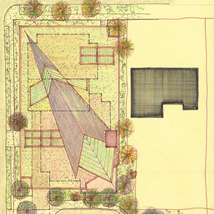
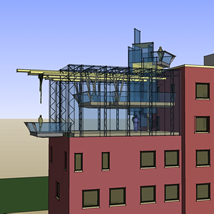
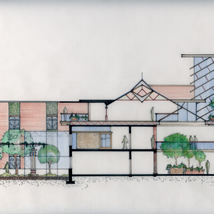
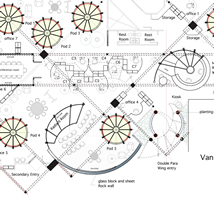
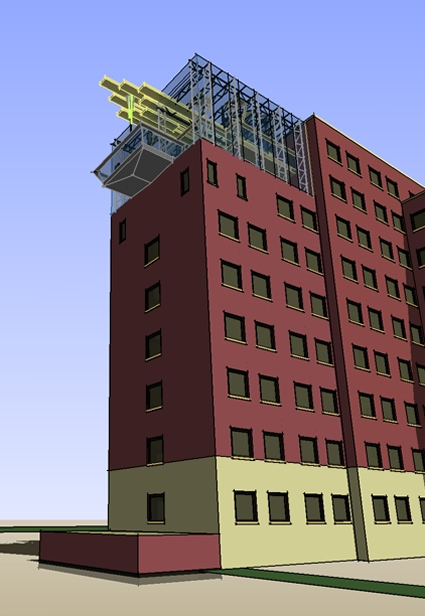
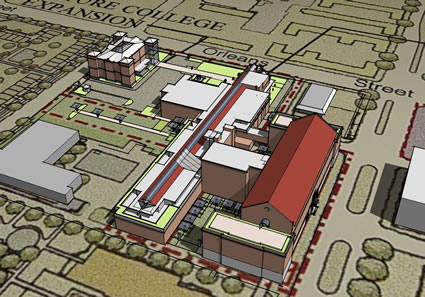
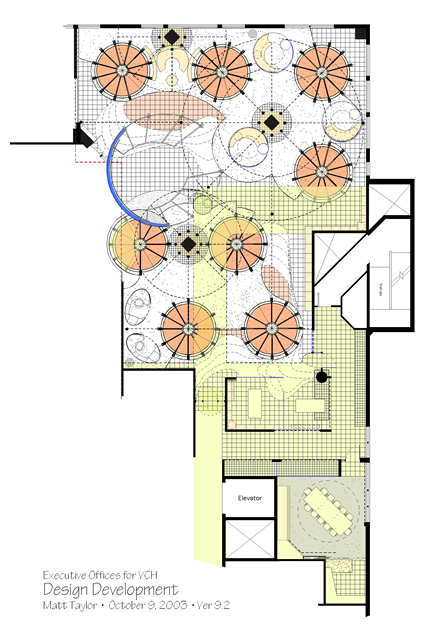
p. 107 | | | | | At first look, these projects are very different from one another. At the root, however, they are much the same and seek to accomplish the same set of outcomes in both method and built result. | | They are all urban in their setting. They are all associated with an institutional campus. There is both history and the future to consider as an integral part of their design - none of these projects are in a location - as so many are - that is devoid of both. Their individual histories are different but they are the same in that they each have history. They all are based on a new way of working. They all challenge the conventional wisdom associated with learning and creative work. Each blends traditional building materials and methods with new innovations. These projects require close integration between the structure/space and the Armature/WorkFurniture system manufactured by AI [112]. With all four projects, I am seeking a new level of intimacy between the user and the building, and as part of this, an enhanced tactile presence: texture, sound, smell - in this sense, the environments are more “residential” than typically commercial [113]. | | What is different about these projects is equally interesting. They range from five to seven thousand square feet (Cincinnati and VCH) to 25,000 (Cleveland) to over 135,000 square feet (SDC). Two (Cincinnati and Cleveland) house an organization’s learning group and a NavCenter; One is the executive offices for a new hospital (VCH) and one a multi-functional college environment of which the dedicated collaborative spaces and NavCenter are a part (SDC). Two (Cleveland and SDC) will have direct impact on their urban setting. Cincinnati and VCH “sit back” from their setting and are more intimate to their campus. | | Project One: Cleveland NavCenter | | The Cleveland NavCenter is set in a transition area between several typical urban settings [link]. It sends specific messages to the communities that make up its surround. As part of a major VA complex, it represents that organization. As one of the first new buildings in an area designated for restoration, it is a chaparral plant for the future. Standing at the junction of three different urban areas it has the opportunity to make integrated what today is disintegrated. Therefore the scale and character of the building is very important to its ultimate success or failure. At the same time, the building has its own program to accomplish. This cannot be compromised. | link: project description | | Project Two: Cincinnati NavCenter | | The Cincinnati NavCenter is on a VA Medical Center Campus that is land-locked leaving the only means for expansion to build on top of an existing structure [link]. It is an unusual setting and its treatment of space is unique; it the the surrounding landscape (which includes overlooking the Cincinnati zoo) that make the outside walls of this environment. This is why I have named it PROSPECT. | | The design is not insensible to the city of Cincinnati, itself, and its program promoting its architectural landscape [114]. It also is designed to be a legitimate statement in regards how those who use it relate to their community and their own organization through the state and nation. In this context, the building is designed to be provocative in the positive sense. | 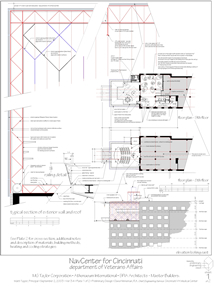 | The glass wall system is three panes on the exterior with one on the interior forming a air plenum which circulates through the walls, floors and ceiling of the space. Shades provide necessary sun screening. The mullions and glass hardware form a different pattern inside and out providing dimention to the the wall. | | link for larger image • link for project description | | Project Three: Sojourner Douglass Campus | | The Sojourner Douglass Campus [link] is being created by assembling three school houses of different eras and adding to them making - when completed - a new, integrated environment composed of over 140 years of architecture [link]. | | The Campus will be developed through four Phases the first of which is now in progress. It is in a marginal urban setting across the street from Johns Hopkins University which is the beginning phases of a 22 square block bio-technology expansion [115]. | | The first thing we had to overcome with this project was the low bank appraisal. The bank saw the project as a sunk cost for a small urban private college for buildings that had had outlived their usefulness - buildings that could only be used for traditional school instruction. We had to get them to see the project differently; to see in it context of the revitalization of the neighborhood, the expansion of Johns Hopkins and the re-use of the old school buildings. We told them to conceive of the project going a hundred years into the future, through four phases of development, to see not some old school rooms but a thriving community NavCenter, a fine arts center, a conference center and a world class office building - all integrated to form a campus of learning and community development complete with residency for visiting artists and scholars. We showed them what the expenditures would be in the early phases in relationship to the (conservative) value and that the margin of “equity” would grow rapidly through each Phase and that the re-use options protected their investment [link]. The bank promptly more than doubled what they were willing to lend to the college. They said that they never met an architect who understood financial matters and what a bank needed before - a strange indictment of the state of architecture. | | We then had to integrate these disparate pieces - and add new pieces - to get a campus that has all these features in a way that can work as a whole or as separate functions. This produced a campus layout of overlapping Zones [link]. How the Campus faced the street and community had to be worked out as the existing buildings were “fronted” in the wrong and opposite directions. This lead to creating a new focal point around a community-focused restaurant which will work in concert with the Phase III Fine Arts Center and Conference Center. The building were made approachable with privacy established by the layers of access naturally created by the placement of functions. Interior Atriums and semi-protected landscaped court yards are planned to bring Nature inside during the harsher moments of winter and summer. | 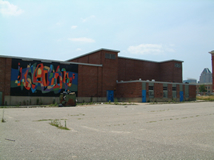 | | The back of the Auditorium faces what is now the main view into the Campus - it presents an unfinished and desolate disposition. | | 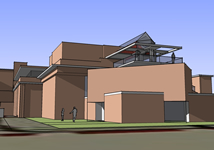 | | Extending the back stage, adding the restaurant and connecting back to the the Convenience Center creates an unified whole and social invitation. | | | Massing and masonry materials tie this campus together while the idiom of each era is preserved and augmented with a new, lightweight, transparent/translucent structure that brings forth its own embedded, subtitle ornament. | | Project Four: VCH Executive Offices | | The Vanderbilt Children’s Hospital Executive Offices [link] are part of a large new Hospital building which is, in turn, is part of a Medical Center on the Vanderbilt University Campus - a major aspect of the Nashville, Tennessee urban presence. | | These shells of urban landscape are interrelated. The innovation with this design is the degree that landscape is brought into the office environment - a degree far more real and tactile than a strictly metaphorical approach realizes. | | This project reintroduces a number of elements long missing from the workplace. Places for the community to gather and work together [116]. Individual settings, with unique character, for each worker. Individual control over prospect and refuge, lighting, sound, temperature, the configuration of ones own workspace [117]. | | The environment, itself, is a landscape and the first full realization of my 1990 design [link]. As a metaphor, streets and alleys, markets, parks, workplaces and places of refuge can be seen in this layout. However, this goes beyond metaphor to realization. All the elements of a Medieval city, in the positive sense, are here [118]. This is a high variety environment with no two aspects - even if modular - repeating themselves. There is continuity and each place within this commons is unique. | 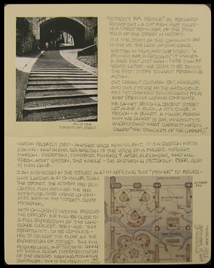 | Page 421 lh 9-19-03 Matt Taylor Notebooks Moleskin Series: The juxtaposition of a picture from Streets For People and drawing from my 1990 POD, Armature, Cube Office System concept lead to the determination to take the VCH design to the next level of realization. | | | The floor is composed of terra cotta tiles (on the flat lower levels and higher transition zones), textured, colored rammed earth (at the raised work-POD levels) and broken tile-bits of mixed colors and textures [link] (at ramps, radiuses and raised platforms), forming a large continuous mosaic of texture and color. The floor is solid and thick creating a horizontal armature of great strength and presence. The rotating turntables of the PODS are cork creating a resilient and tailored finish. | 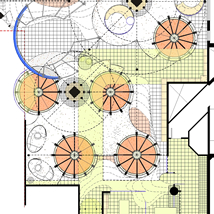 | | The totality of this space creates and environment not seen in the workplace since the days of craft and does so with integrated, sophisticated multimedia and computer augmentation [link]. | | | Rising from this earth-like base, the wood and plexiglas work-PODs [link] stand - connected overhead by Armature trusses (carrying wiring and lighting) and surrounded by extensive landscaping. The many kinds of spaces: prospect, refuge, logistical and for transporting, utility and work areas (supporting many different work modes), are made each blending into the other. Lighting for ambient, task and highlighting provided. The HVAC supplies and air returns run through the landscaping creating natural breezes and scent. | | The Four Projects Taken Together | | Each different, each based on the same values and philosophy of architecture, each based on a direct expression of learning and work, each creating a different aspect of the urban fabric. Taken together, they offer a variety of new approaches to how a new urban landscape can be created. Each will require a new method of Design/Build/Use(ing) to be realized at the level of their full potential. | | Cleveland takes on the issue of the urban landscape front-on as does SDC. They both, concretely, will make up a part of this landscape and will alter many aspects of their immediate urban fabric. SDC requires that a 140 years of buildings form one integrated whole, while respecting the past of each piece, and done in a way so that this complex can continue to evolve for an extended period of time. Cincinnati suggests infill, re-use and mixed-use strategies. VCH brings the landscape into the environment creating an intimate, tactile, space that is both metaphor and reality. | | The issues that these project address are: A buildings place in time and how a building can evolve [119]; adaptive reuse of old structures [120]; urban scale and mixed-use in relation to other structures [121], healthy materials [122], sustainable energy [123] use and non-intrusive HVAC systems [124]; human scale and user control of their work environment[125]; the creation of intensively collaborative work spaces that also work with private niches and personal areas [126]; the integration of traditional materials and forms with modern materials and techniques to return tactile quality to the workplace [127]; the creation of work environments that have prospect and refuge, shade and shadow and expansive interior (and where relevant) exterior landscaping as a natural aspect of the environment not decoration. All these are important - taken together, they create an environment that is greatly divergent from that which has become the norm. The quality of these workspace is a different kind then what we have come in our society to accept. This is architecture built upon a different concept of the human [128] and a different notion of economics [129]. | | The Four Projects: Addressing Standards, Achieveing It, Change | | These four projects are active and in Design Development. There is every expectation that they will be built. They involve interactions with complex institutions, local architects, builders and administrators - including government. They are, each in their own way, radical and involve a fair level of social risk for their clients and the professional teams assembled to realize them. By their nature, they force a number of controversial issues to be directly addressed. | | This style of architectural practice is not confrontational, however, it does take on problems generally regarded outside the scope of an individual work. It is a practice of consilience [130]. It combines art, economics, ecology, philosophy, science, psychology, history with the requirements of individual users and their society. It is based on the premise that the environment is not neutral - that it matters; that it makes a difference. It requires that there be no contradiction between the interests of the individual and the commons which we all share with each other and with all other living things. It is based on the idea that design can intelligently reconcile what, today, are considered competing interests. It demands a multi-layered, multidimensional approach to architecture. It requires integrity, dedication and a high level of skill. | | This architecture does not propose - it builds. It does not argue - it demonstrates. It does not hide - it incorporates the greater issues of our time into the actionable opportunities provided by existing work. It does not promote - it documents. It does not compete - it collaborates. It is not supported by privilege - it earns its way by providing measurable value in the workplace. It is not an architecture of the past or tomorrow - it responds to each time and all time. It demands the best of us all and it builds an expression based on the highest standard of the human. | | Criticism of the Status Quo | | The vast majority that would pass for building and architecture has been turned into a commodity. In viewing the common building, this is clear. That the same has happened in the arena of “art” architecture is less obvious but still true. In this latter case, it is often the architect that has been made in to a commodity and consequently socially “consumed” by fame, attention and money [131]. The process of making architecture has become a nightmare of confusion, complexity, unnecessary steps and wasted resources. This in turn - in mainstream work - makes only the very high-end efforts capable of striving for greatness. The social baggage that comes with this kind of “great” work imposes a cost all its own. One feeds the other in a constantly upward spiraling exercise in excess. This results in essentially three “levels” of architecture. The bottom which is what people with little or few resource have to settle for [132]. The vast middle which is singular in its mediocrity [133]. And, the so called signature pieces which are too often self-conscious attempts at greatness [134]. It all adds up to the architecture of mendacity. In total, as art, it reflects our society well. In doing so, it serves us poorly [135] [rbtfBook]. | | In times of cultural health, it is perhaps sufficient for the majority of architecture to reflect the values of the culture. In times like now, architecture must go beyond this basic performance; it must strive to present a better alternative. It must be fine Architecture and it must show an alternative path to a sustainable society. It must demonstrate valid alternatives in life and work. It must facilitate a healthy response to the overwhelming majority of mundane buildings and be an answer to the excesses - of the attempts at “statement.” And, it must do this with economy and grace, ecological balance and process integration [136]. Building a great building may always require attention and effort but it should not demand extreme social and financial risk. | | Too much of the focus of architects in the present era is on individual pieces at the expense of the totality of the urban landscape which is deteriorating not only ecologically but historically [137]. This narrow viewpoint and accountability destroys more than it creates and has reached crises proportion. New standards of professional behavior and accountability are called for. | | | The most neglected aspect of modern architecture in the United States today is the urban landscape. There is no coherent approach to it’s creation nor maintenance [138]. The Tragedy of the Commons prevails [139]. It is increasingly becoming nonhuman nor is it sustainable [140]. | | I do not expect the city to go away. I believe that Jane Jacobs [link] [rbtfBoook] is right about this and that Mumford’s many insights [141] are essentially correct [link]. And, I do not expect the city to change as much as some advocate - nor do I think it has to. I believe that the core, traditional cities have a great deal to offer and can be made quite livable with careful attention and a few changes [142]. It is mindless suburban sprawl I have the most criticism of. This has become a blight on the landscape [143]. Neither fish nor fowl. Not a city, not a village, not a community, not a wilderness - not anything. | | Of course, the urban environment does not exist in a vacuum. It must be considered in the context of specific bio/economic regions [144]. I believe it will be these that will be the the predominate political organizations of the the 21st Century as the Nation State continues its decline [link]. Ecology, economics and politics will become far less hostile and integrated in this coming era [145]. Design will migrate from the superficial to the deeper task of full systems integration [146]. In this environment, many forms of urbanization will be valid - each contributing something, none allowed to be stretched beyond all meaning and possibility of working as is the habit today [147]. Because of distributed, miniaturized and embedded computing and communication technology, people will be able to live and work where they choose [148] functioning in networks of global reach and self-selected affinity [rbtfBook]. Their choice of city-forms will be based more on how they want to live and what variety of density, interaction and sociability they desire rather than the demands of earning a living [149]. From this, new patterns of culture [rbtfBook] will emerge [rbtfBook] and, if we are to survive, the habits of human explotation will fad away [rbtfBook]. | | I have long believed that whole new forms of mega-structures and city-forms are viable [link]. It is probably a good thing that they have not been built before now. All the horrors [150] conjured up by mega-structure opponents would very likely have come about in this time of exploitation we are in and, hopefully, are now quitting. Of course, taken as a whole, our cities and suburban areas, today, are mega-structures - just poorly designed ones [151]. It seems to me we should recognize the facts and get on with it. To do so, successfully, we will have to give up brittle engineering solutions [152] and design organic, responsive, learning, self-repairing systems [153]. This is possible with today’s knowledge but not today’s attitude [154]. Our infrastructure is now reaching the complexity of Nature [155] it cannot be approached as simple machines connected together in complex networks [156]. The successful design algorithms of the future urban environment will follow “swarming” rules not the tight rationalist approach of the last 100 years [rbtfBook]. Craft [rbtfBook] and technology [rbtfBook] will make up complimentary aspects of the same whole. | | When the urban landscape is considered as architecture the failure of most practice models becomes readily apparent [157]. Architectural practices are structured to deal with pieces - with projects [158]. They cannot be requisite with the variety inherent in an urban landscape and its appropriate setting in a global context. Practices that can deal with this level of complexity will be ValueWeb [link] structures. They will build on a different model of collaboration than today’s typical practice. The closest model to this I can think of, in contemporary practices, is the Renzo Piano Workshop [159] [link]. | | | There are several practice models worthy of study. I will sketch-out some aspects of how Wright [160], Schindler [161], Greene and Greene [162], Saarinen [163], and, of course, Piano [164]. All of these models worked for their time and place - and well enough for the individuals involved. All can work today. However, it is Piano who seems to have brought together the many elements from all of them to create a practice potentially capable of creating architecture on the scale required by our present circumstance. | | | SFIA is introducing a number of new organizations designed to address many of the issues raised in this address. These have been in incubation for a number of years [link] and have not been discussed publicly until now. | | Center to this is the creation of an architectural practice associated with the school. There are many reasons for this. Primary is to create a school of architecture. This requires the entire range of activities from thought, research, writing, teaching, designing, building and the ability to do this on a scale that matters. By school, then, I mean the term in the sense like Prairie School - a movement [165]. There is, however, one significant difference than past movements. The unfortunate habit of architecture to divide into combating polemics is to be avoided [166]. This will be a school that is for not against - that is inviting and inclusive. Nothing less is moral and nothing less has the chance to scale as it must. | | It is time for the best architects to stop knocking each other out of the box by arguing who is the most virtuous and thus leaving the field to those who are merely paving over the world. | | The practice is also formed to bring economic support to SFIA. There is a tithe from the fees earned that goes directly to SFIA as revenue. All four of the projects profiled, as well as the dozen other projects underway, will contribute directly to SFIA and create work opportunities for SFIA students. | | It is this aspect of work opportunity that is perhaps the most important. Finding worthy, demanding work - work that allows real participation in the total process of making architecture - is one of the most difficult tasks a young architect faces. Working in a peer relationship with those that have a level of mastery of the key elements of an integrated practice is an equally elusive circumstance. The SFIA-Master Builders practice is designed to provide these opportunities across the entire spectrum of design/build and with projects of all types and scale. | | The SFIA-Master Builders practice [link] concept is based on the course I taught at SFIA in 2000, 2001 and 2002. It is now being instructed by Matt Fulvio and Scott Arenz with my time-to-time and remote participation [167]. It also is based on Fred Stitt’s work on architectural practice processes. | | | My MindMap [link] for this presentation is linked to many additional resources. It illustrates how I prepared for this session which was to draft this page, then do the MindMap and then, after the session finish this page with annotations. | | 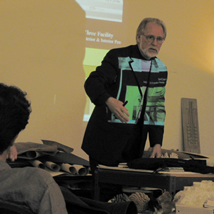 | The annotations, along with the RBTF Reading List, linked to this document, make up a comprehensive Syntopical Reading exercise. It is worth the time to explore these many threads and think through their implications. [link: annotations]
| | | | | Syntopical Reading 500 - One of Ten | | | | Matt Taylor
San Francisco
July 2, 2003 | 
SolutionBox voice of this document:
INSIGHT • POLICY • PROGRAM |
posted: July 2, 2003 revised: November 6, 2003
• 20030702.392512.mt • 20030704.398872.mt •
• 20030726.998297.mt • 20031010.400091.mt •
• 20031012.456288.mt • 20031015.452290.mt •
• 20031016.290071.mt.• 20031018.222290.mt •
• 20031020.356199.mt • 20031105.611200.mt •
• 20031106.471982.mt • (note: this document is about 85% finished) Copyright© Matt Taylor 2003 | |
|