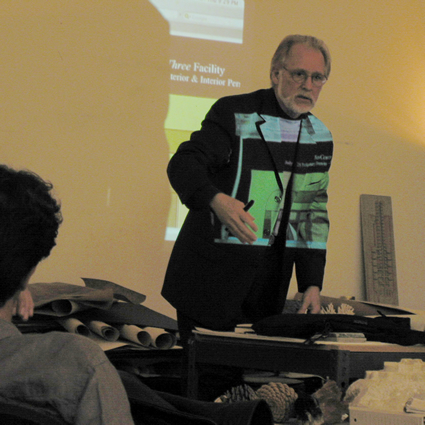
Redefining the Urban Work Landscape | SFIA Presentation October 16, 2003
[return to text document] | Part One of Two
[link: part 2] | | The following are annotations in support of my October 16, 2003 presentation at SFIA. Links from the supporting text [1], [2], etc. go directly to the appropriate reference. Clicking on the number returns you to where you were in the originating document. This can be used as an index to the presentation as can the mind-map [link] that I used to deliver the presentation and further developed the day afterward. | | As I stated in my introduction, I speak with great passion and conviction. It is not my intent, however, to win you over to my way of thinking - or doing. It is my intent to provoke your thinking - the real content is what you do with what you perceived. You then, as you choose, can create your own learning and approach to work. This is how the brain/mind works in reality - it is not a container into which knowledge is poured; it is generator of knowledge. As Fred stated in his introduction, I pull from many sources and dimensions in my approach to creating architecture. Making environments is not a neutral act to me. It is an act of art, of choice - it is done to the exclusion of doing something else. Architecture both builds and destroys in the act of its making. It has great economic and ecological consequence. If you kill a tree for some wood, dislodge an animal family from their habitat, pollute the air hauling the lumber to the site (which will make many who are vulnerable more inclined to sickness), contribute to terrorism [link] in the pursuit of the fuel used to do so - it had be better done in full awareness of these consequences and their cost. It had better result in something of great utility and beauty; something that will last; something that will payback the heavy investment made by Nature and Humanity. | | Not to be aware and not to honor consequences is to live in mendacity. I make many strong statements; they are based on my experience and study. The references, herein, constitute a partial basis for these remarks - a beginning path of study. I do not claim to be complete or always correct in my judgments. I do claim to be honorable in their making and I do claim that the issues I have raised - not matter their ultimate resolution - cannot be ignored with impunity [link]. | | Here is what I would have you consider: If am wrong or over critical is some of the these statements, what harm is there in paying more attention to the issues I raise? If I am correct, and we continue to ignore them, what will be the consequence? And, what will be the cost of recovery when we, finally, come face-to-face with it? This issue here is one of adapting the best strategy in a situation of great complexity, incomplete information and ambiguity. How do you act when you do not know; but when not to act means - when you know - it will be too late? Society, today, faces a new class of challenges: they are systemic in nature [link]. As a society, we do not have the design strategies to comprehensively deal with this class of problem. In fact, our way of working is what is generating them. To create a means to meet this deficiency, has been my work for the last 25 years [link]. | | At the core, most of us remember what it is to be human. This should be our guide. This we should never deny. We have acquired the power of gods and act as fearful, competitive, unsuccessful savages - yes, savage is the word for it. We know better - in that, there is hope. | | A final note. Do not assume that I agree with all the references herein or that these authors would agree with me. One of the more odious aspects of our present society is the tendency for anyone of the “wrong” ideological stripe to be branded as “biased,” “totally off,” or having “an agenda.” This may be true - or not. Their suggested solutions may - or not - be correct. Nevertheless, they are “reporting their experience of reality” [link]. Note to respect this is to further destroy the House of Intellect [link]. The prevalent attack on other’s credibility is another way to hide from the accumulation of what is overwhelming evidence. Of course good scholarship is to be expected and asked for - and certainly recognized. I seek to find the best sources I can - if I agree with them or not. My answer, however, is not to see how many facts I can get on a head of a pin, but as a designer, how much of the totality of them I can account for in the actions I take and the environments I construct. | | Matt Taylor
Nashville
October 20, 2003 | 
SolutionBox voice of this document:
VISION • STRATEGY • EVALUATE |
posted: October 20, 2003 revised: October 22, 2003
• 20031020.346109.mt • 20031022.342671.mt • (note: this document is about 20% finished) Copyright© Matt Taylor 2003 | |
|