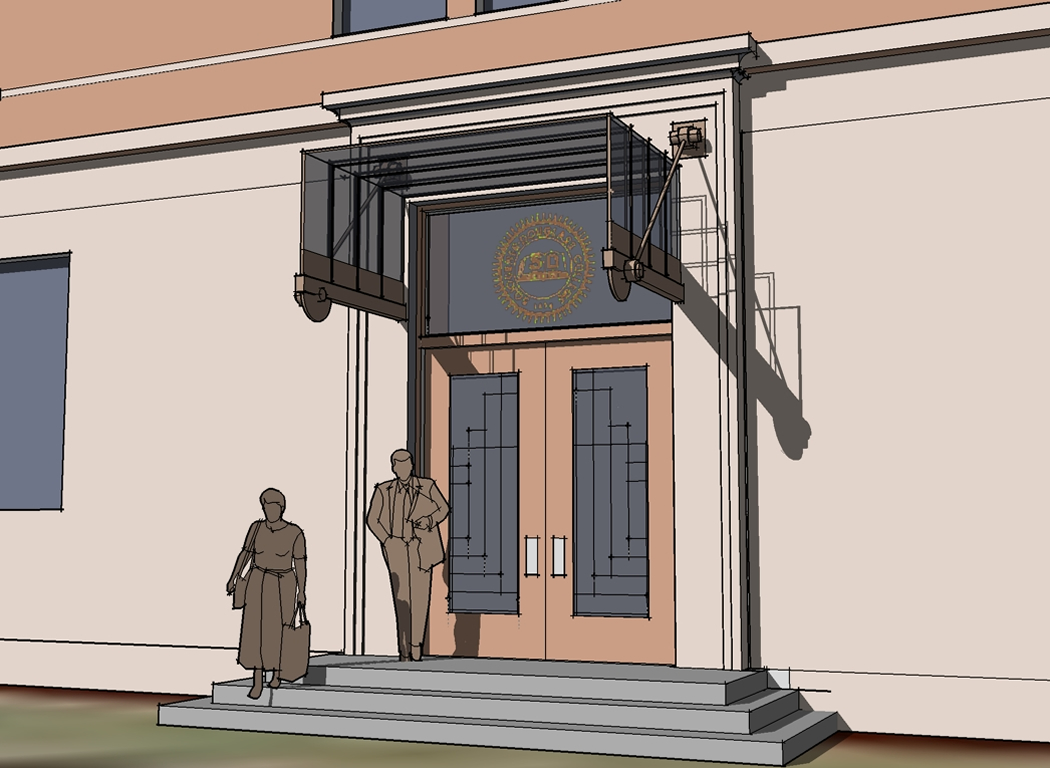
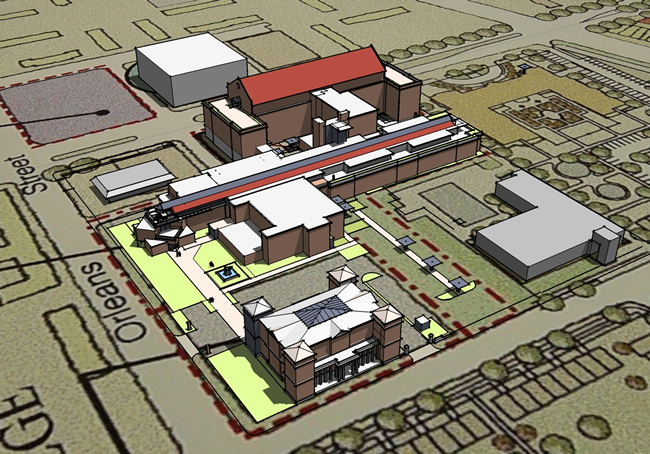
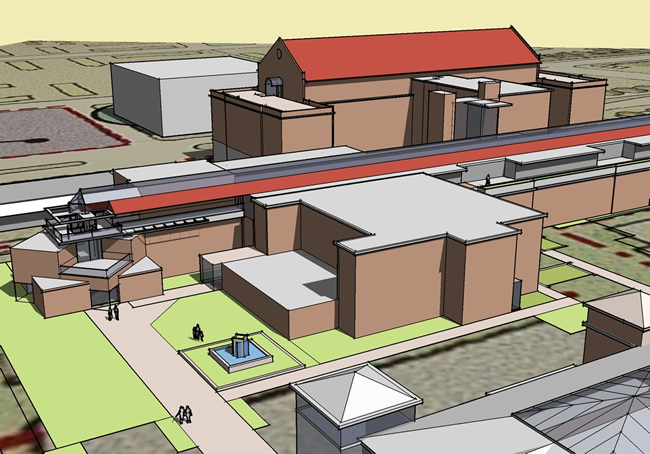
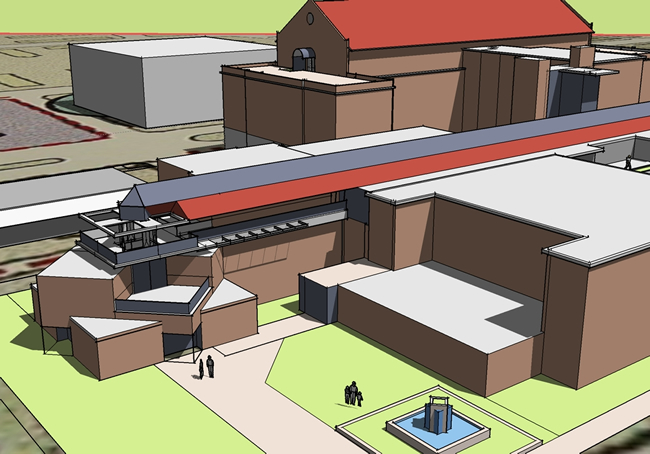
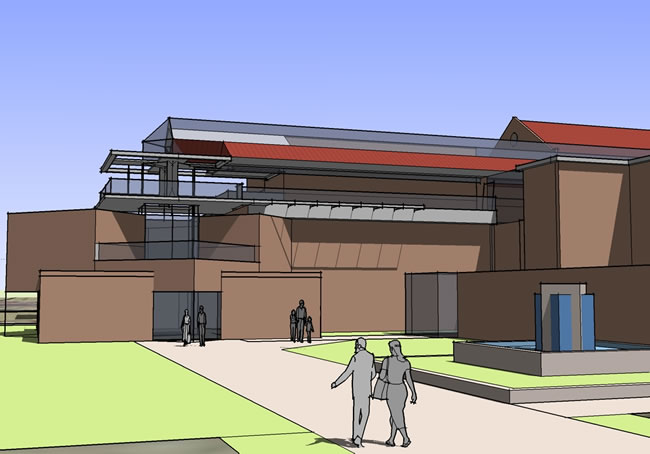
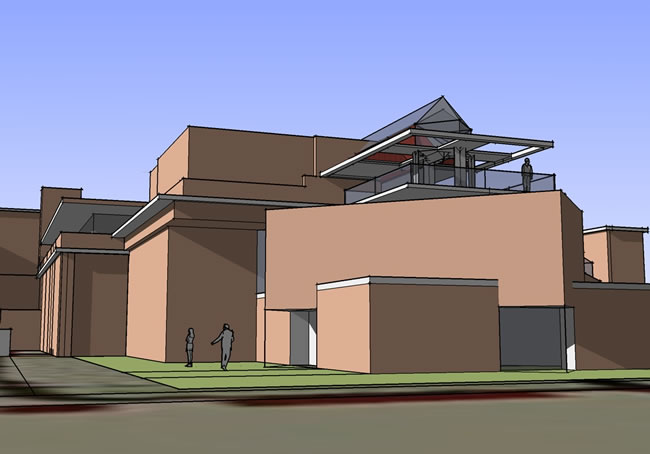
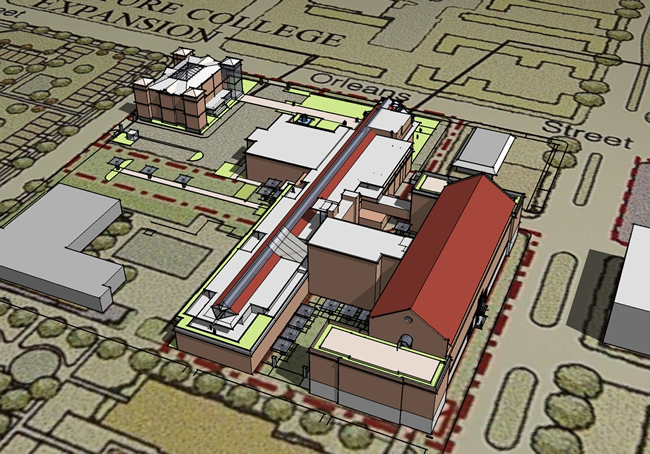
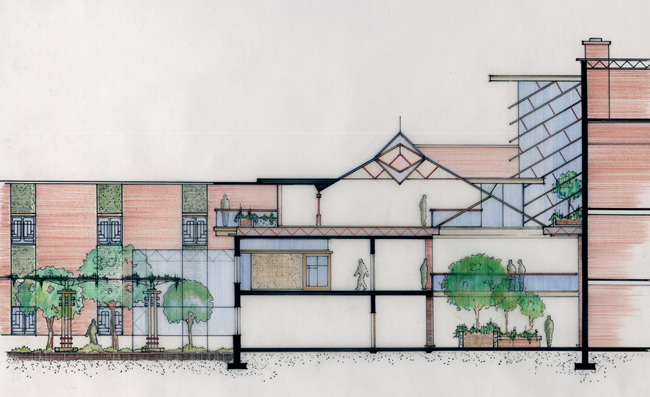
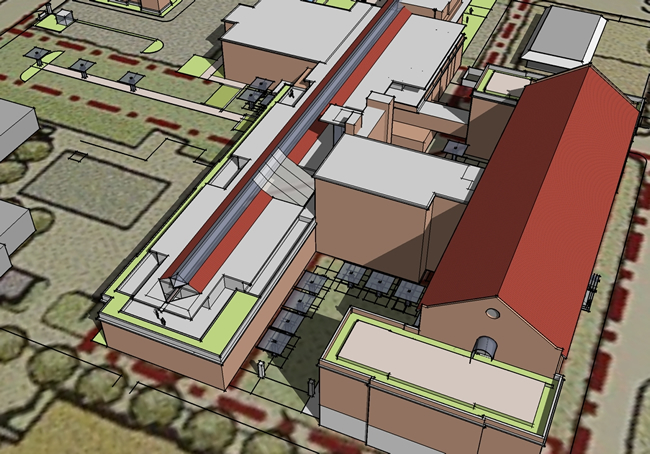
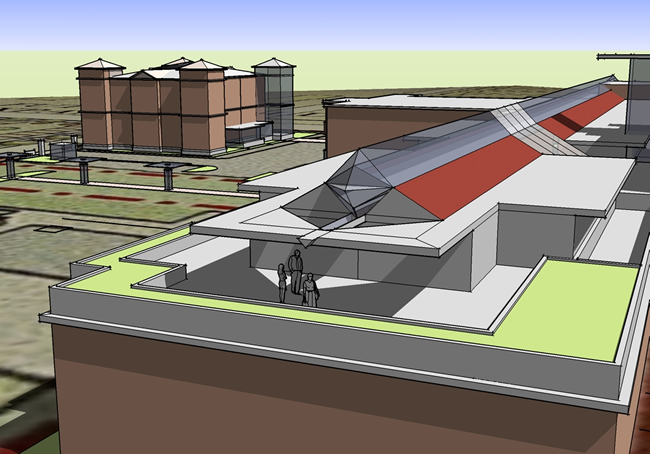
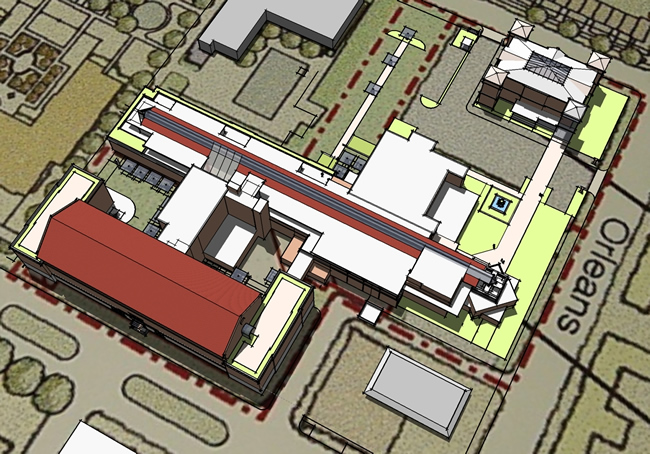
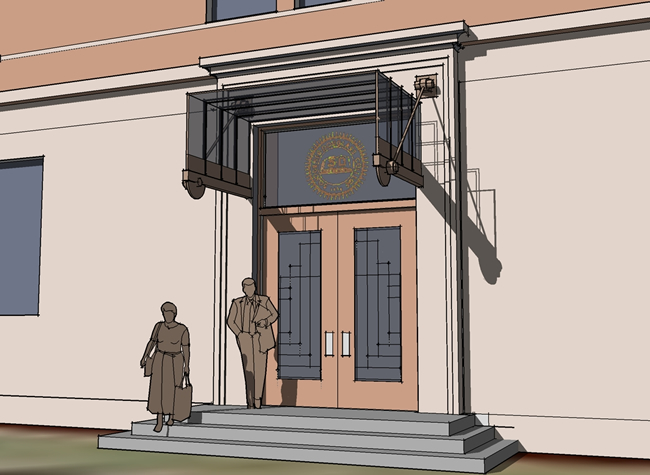
When fully developed, there will be 140 years of school architecture on this campus. While preserving the heritage of each piece, the whole must be integrated, function well, and meet 21st century requirements. The development of this campus is proceeding through several stages. The attitude embedded in this process is to build and maintain for the long term. These are not seen as buildings of small value to be used and then discarded. The idea is to make them, first usable (Phase I), then provide a modern infrastructure throughout the campus (Phase II), add carefully selected functionality (Phase III) and then maintain and upgrade. continuously. applying a systematic, long term, process. The goal is to create a compact - four acres - environment of study, learning, collaboration and community engagement - all key aspects of the Sojourner Douglass vision and mission. This intention leads to certain architectural problems and opportunities. Already on the site are three existing buildings each of a different era and character. It is Phase III, that the major new construction will take place. It is the task of this Phase not only to greatly extend functionality but to provide the integrating force that brings the whole into harmony. It is also the goal to provide far more amenity than buildings of this type usually render. Utilitarianism is rejected by this approach. It is believed that an environment of beauty and grace is a positive aspect of true learning and that the artifact of the built environment is an accurate reflection of the values and abilities of those who build and use it. In this regard, the act of building is not separated from the process of using; nor, is it unrelated to the development of the institution as a community-of-practice. Education means “to lead out.” It is the creative process aimed at the development of the human. Architecture shelters, facilitates and symbolizes the human - it is not merely the act of keeping out the rain; it is the act of expressing the soul while keeping it dry. A society that does not know it’s origins and history has no future. Architecture that does not respect and develop it’s past, as it simultaneously forges new perceptions of the possible, has no future either. How each piece of this campus is kept individual and made one is an act of philosophy, a task of design; and, the artful exercise of economics. The great theme of our present era is the dematerializing of thing-ness. Knowledge - the great value add - is becoming ubiquitous and transparent. Relationships are also changing their form. It will not be globalization versus local communities, it will be the weaving of many ValueWebs, each distinct, each spanning a globe, each a specific fit for a community of individuals. The heavy hand of 20th Century organizations will give way to networks of people and resources based on mutual values, respect and gain. Technology also will cease to impose itself on life but will become the silent and transparent human augmentation tool it is meant to be. Out of the shadow of the industrial era, a new organic way of living and working will emerge. The exiting structures are built of brick and heavily massed forms. The 1869 and 1923 buildings are beautifully detailed and reflect an attitude about the social value of education that is, unfortunately, long gone. The 1969 building, while well built, expresses the late 20th Century values of conformity and mass one-size-fits -all solutions. It is this building that will be modified the most with the addition of a lightweight, transparent third story structure that terminates with the Restaurant presenting a new face to the community. The old construction is rooted in the past and expresses those traditional values that are always worth keeping: solidness, being anchored - the tradition of hand craft. The new will show the proper application of design technique and advanced materials. It will build on the past; it will soar, connect everything and aspire; it does not protect by force - it is the reality of reciprocation. Institutional buildings most often keep nature out. They isolate in the name of practicality. This is a false utility. The acreage of this campus will become a garden; the building will embrace a renewed urban landscape. Density of use and nature will be made harmonious. Natural light will be brought into this place of innovation and collaboration; an elevated view of the city-as-prospect will be provided. The existing buildings built for one purpose, now gone, and poorly adapted over the years, will be restored to a new life; the new constructs will be adaptable and multi-purpose - they will extend the functionality of the old. The campus will support true economy - not a sunk-cost budget mentality. The buildings will pay back in human and financial terms for another century. The SDC Campus is located in an area of Baltimore that has long been economically marginal. 15 blocks to the South is the renewed downtown and marina areas. Directly on the North is the Johns Hopkins campus which is undergoing a multiple block expansion. SDC has deep ties to the local community. The development process of this campus constitutes a new model for renewing the urban environment. The campus will promote and support community development. It will exemplify what it teaches. This is an essential integrity. The architecture has to express identity, unity, security and openness; and inclusiveness. The Orleans Street side - the new campus “front” - houses the public functions of the college: Fine Arts Center, Restaurant, Entries to the Conference Center and Residency. This is SDC’s presence to the community. Through this portal, controlled access is provided to the Administrative Offices, Academic facilities, Collaborative spaces, Student Union, Gymnasium, Book Store and other support services. This is a layered approach to open access and gated security. Because of the immediate environment and traffic, much of the SDC spaces are enclosed. The North and South Court Yards are examples of contained areas that open up interior spaces that now have no outside sensibility. Buildings should shelter not encase life in artificial light and hard surfaces. The new West and North Entries are tall and wide glass green-house-like cubes that allow planting and make a transition space between outside and inside. The are the ritual of entering and exit - a ceremony and preparation for what is to come. Art eliminates the insignificant and focuses on a viewpoint that delivers a new perception - a new way of sensing reality. Architecture becomes art when it makes a context that elevates the mundane to the level of the sacred - when a new reality is actually created. Everything is different in this state of mind. Every act takes on significance - meaning is created by this embedding of philosophy into everyday life. Urban landscapes tend to violate human scale. When fully developed, this campus will contain nearly 200,000 square feet of usable space on a few acres of land. The key is how enclosure, prospect, refuge, intimacy, density, privacy and engagement are handled. Most buildings allow you only to be in them - and, to see them from the outside. There is rarely any interface. The SDC Campus provides a wide variety of different experiences. These are buildings you can be on as well as in. The transitions are subtitle and modulated. The landscape flow in, on and out of the structures softening their hard edges. Light moves through the spaces and there is natural shade and shadow reflecting the movement of the day. At night, many areas of the buildings are lighted from the outside creating both a sense of security and the prospect of endless space. Life is created in niches - it engages in large spaces. Modern architecture has forgotten this and neglects the deep patterns of human existence. This is why it is perceived as cold, unforgiving and removed. Architecture has become a visual art when in reality it is an experiential art. If you don’t want to touch a building it has failed you. If you do not want to take intimate care of it, you have failed it and reciprocity is lost. The building becomes a dead thing and your life loses a measure of meaning. A comfortable environment cannot be made up of only formal functional dedicated spaces - this leaves no room for something new and unexpected to emerge. If you cannot explore your environment much of the wonder of life is lost. Lose wonder and life slowly dies by a thousand small cuts until there is nothing left but habit. The building does not stand in isolation. It is the result of human values and it expresses them. It does facilitate and shelter life. It also receives energy by the way that people work, play and live within it. Architecture is based on a way of life - a sense of life and, in the case of this work, a way of working, learning and building community. The Program of SDC is a critical component of this design - not a isolated process that has no impact on how the architecture is created, perceived and evolved. This means that how this work is built is as critical as another other aspect. It will not be realized by contractors in it for the money - it will brought to life by Cathedral Builders who build as a passion and as a consequence earn their livelihood. This must be a thought-built experience; the act of creating art; the way to self and community expression. |