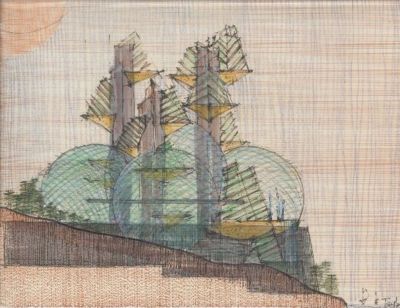
| The “stately pleasure-dome” [link] of Kubla Khan creates many technical challenges in the arena of augmentation, the philosophy of architecture and the design-build practice by which architecture is realized. It also requires the refinement of several new architectural ideas. | | When MG Taylor and NavCenters (called Management Centers in the early days) were conceived, we created the augmentation vision of our work. Aspects of these concepts are captured in the following pieces: | A description of the proto-typical NavCenter and how it functions to provide knowledge augmentation for individuals and groups - face-to-face or remote. [link] | 1984 Notebook comments: “The Management Center as Information Factory” - describing the basic functions and the necessity for a global approach employing a network of Centers. [link] | Integration of Tools and Envionments | Facilitating the Executive Routine | Defining the executive functions; developing approrpiate processes; augmenting executive work; bringing self disciple to the executive’s work. [xx] | We are creating a world of noise pollution with thought or intention. The acoustic properties of architectural spaces are rare considered. What effects this may be having on humans and animals is poorly studied and rarely considered. [link] | Much of modern society is disconnected from experience. Life and work is becoming increasingly fragmented - disconnected from its various aspects and a physical reality of direct consequence. [link] | Employing MG Taylor technical systems, Weak Signal Research and PatchWorks architecture to augment human creativity and facilitate emergence in complex situations while establishing and maintaining an integration between machine and nature - ”A cybernetic forest.... [link] | | | | There are a number of philosphical premises that drive our approach to work and creativity and, therefore, why we make the enviornments that we do. These are outlined below: | Life without quest is having a car but no fuel - an exercise in meaningless and frustration. Yet, this is the most missing element from the workplace and people’s lives in general. How did this happen? [link] | So... How is it We Know and... | To Hold an Unchanging Youth | 12 Aspects of UpSideDown Economics | We have built wonderful technology. Have we learned how to use it or will it mater use? Will our tecnological innovations become our monley’s paw and bring us results far from what we expected? [link] | | | | This view of human augmentation and what a human workplace can be like, of course, demands a new kind of architecture; and architecture that cannot be build to conventional standards by conventional means. | 25 Years of Design Build Use | Presentation at SFIA covering the development of MG Taylor/AI work environments. [link] | Making Place - 20 years of MG Taylor Environments | This overview shows pictures of 20 years of our work environments with commentary. While there is continuous evolution and improvement across these years, there is a continuity of principle in this work and it is not easy to paces the projects by year. [link] | The Executive Environment | NavCenters - System and Model | How NASA Went to the Moon | The present method of land ownership and real estate development is inherently at odds with sound economic and ecological principles and the art of architecture - a new model is required. [link] | Building a ValueWeb For Building | Basic Architectural Practice | The practice of architecture today is single dimensional and offers few alternatives. An architect’s practice model has to be congruent with the kind of work s/he wishes to produce. There are several practice models to choose from but each has direct consequences on the kind of work produced. [link] | The 21st Century Organization | | | | Xanadu, as a concept, is the summation [link] of my 47 years in architecture; it embodies all that I have learned in the quest of making the workplace a human place to be. It is my Cathedral to the creative human spirit. It is my THERE. And, of course, I bring as much of this There back to Here every project I build. Xanadu is the standard of my personal feedback system - the measure by which I judge my work. | | As such, Xanadu poses a number of technical challenges. Xanadu is possible to build but it is not possible to build today. Almost always, great buildings involve significant innovation. This is not, in itself, a criteria. It is just that new concepts often require new means; in addition, the energy of innovation can propel the creative processes required to complete a true work of ART where the detail and level of integration required is particularly demanding. Some classes of buildings, given their mission, do make innovation, per se, an integral aspect of what they are. Speranova [link] is one such concept. Xanadu [link] another. The concept of Xanadu pushes the state-of-the-art in every domain: structure, materials, finishes, glazing, mechanical systems, electrical, vertical and horizontal people movers, landscape integration and food production, energy management systems, embedded human augmentation technology, smart building systems, cleaning and repair technologies and processes, and project management methods. The economy of Xanadu will be significantly different than the basis by which buildings are built and managed today. The management processes that support the Xanadu enterprise will have to be equally innovative. | | All of these innovations have intrinsic value and they are worth doing for the spin-off technology transfers that will occur. However, it is the synergy [link] of these, in a single integrated environment, that is the most significant aspect of the project. The relationship [link] between Xanadu and the occupants of the environment will be like no other on Earth. | | There are antecedents to Xanadu in my architectural work. These works have many aspects of the future that is yet to come. No doubt, there will be many more on the road to Xanadu. Prior concepts of note are: | A miniature world that explores the idea of permutable skin over a spherical living space. A vertical core element supports cantilevered platforms for working and sleeping. A greenhouse is integrated for food growing, preparation and eating. Nature in a building. [link] | A re-creation environment for the growing, preparation of food and sharing it in a community context or ritual and celebration. [link] | A cluster of domes and hexagonal spaces, platforms and vertical elements - a very small scale version of Xanadu to be built out of prefabricated components and assembled on site. The RDS version to move from site-to-site in support of collaborative processes [link]. [link] [link] | This design questions the economics of the individual home, in many circumstances, by combining cooperative living with private spaces - co-housing it would be called today. Private residences, community facilities, greenhouse and recreation all housed in an energy efficient sphere. [link] | Each of the cantilevered suites of Xanadu are about the size and composition of this environment. The functionality is much the same. So is the idea of shaping the suite to the exact condition of the site and the viewpoint desired. In addition, the Xanadu concept calls for many clusters of Bay Area Studio type structures of various sizes scattered around the site. [link] | | | | These works are prior art in some respects although Xanadu as an idea came years before I conceived any of them. At the time (1958) it was a visual concept, driven by some unusual circumstances [link]. I did not have a purpose for the idea - just a burning vision of a “city” stimulated by Coleridge’s poem. These 67 words are, to me, some of the most provocative [link] in the English literature. | | To think that Coleridge was interrupted out of his writing trance by the delivery of a package! I wonder what we lost in that simple transaction. | | No, I had this idea and, over time, the pieces filled in in the form of the projects profiled above and as the accumulation of 25 years of making workplaces based on a different way [link] of working. When it all fell together it did so with the kind of finality that only something that is right and complete can bring. I also realized that the problem created by the concept was immense - a challenge worth a total investment. | | Most of the technical problems associated with Xanadu will be solved on the way to the project getting started. And, because of bringing There to Here, everyday, much of Xanadu-ness will be built in as appropriate in earlier works. Certainly, a big part of the global NavCenter ValueWeb network will be in place by the time Xanadu is built. However, there are some things that will not be possible until the full scale is realized. In the mean time there will be models, plans, engineering to keep advancing the idea. | | Matt Taylor
Palo Alto
August 23, 2001 Salt Lake City
May 12, 2003 
SolutionBox voice of this document:
VISION • STRATEGY • SCHEMATIC | |
posted: August 23, 2001 revised: March 26, 2005
• 20010823.255151.mt • 20030512.993406.mt •
• 20050213.558100.mt •20050326.451009.mt • note: this document is about 65% finished Copyright© Matt Taylor 2000, 2001, 2002, 2003, 2005 Certain aspects described are Patented and Patent Pending by iterations IP Statement and Policy The Xanadu Program is based on:
• THE KNOWLEDGE FACTORY 1986 • THE IC FACTORY 1998 • | |
|