an
alternative to wage slavery |
|
Note:
This posting was written in 1999 and edited, from time-to-time as noted at the bottom - it remains, however, essentially as first written. In April, 2010, I added a few lines and edits to bring several time-focused references into harmony as well as posted some comments and drawings of an updated version of the Domicile concept which is now in Design Development.
As always with this web site follow the many links provided to get the full intention of this project. Let your mouse do the walking.
mt |
|
Domicile
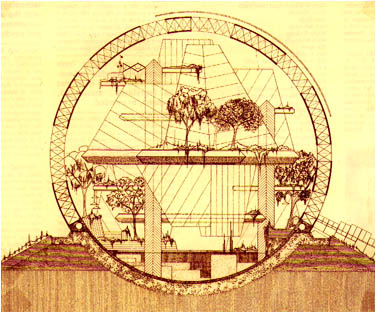
One is 75 feet in diameter and can house four
to five
families. It is designed to sit on two typical urban
house lots so the density increase is better than
two times. With the combination of outside Permaculture
[link: permaculture.org] and inside Greenhouse, the food needed by the Domicile inhabitants can be grown
on site. |
|
The
Dome and the gravel bed below frost line and the
“double shell construction of the superstructure
provides an“environment valve” that keeps
the interior temperature between 57 and 75 degrees
prior to active
treatment. “Interior” construction is therefore
concerned with utility, arrangement, beauty, sight-lines,
sound abatement and minor air cooling and heating
- not with raw weather. This allows a flexible interior
environment without the worry of water proofing and
major temperature swings - an economy in construction,
maintenance and energy costs. In addition, the way
the dome shape meets the ground is made “restful”
[link: dome dwellings] by
the earth berms and landscaping - both of which
are energy-food providers, as well as providing
security
and privacy. |
|
In
this environment, recreation facilities, libraries,
expensive office equipment, large living spaces, greenhouses,
expensive media systems and content, cooking, tooling, cars and so forth, are
provided in the “commons.” Individuals and
families will have their own space and facilities
providing whatever mix of personal tooling and commons
redundancy desired by each. Individual lifestyle choices
can replicate virtually all or practically none of
these “common” facilities - this is a personal
use and economic decision. |
|
Rules
of engagement [link: swarm incorporated] will determine the use of commonwealth items,
as well as,
other interactions among those living and working
within the environment. Domiciles can be created around many different philosophies-in-practice and affinity groupings. |
|
Most
of the common areas will be in the lower part of the
Dome. In the illustration above, the cross section
is cut through the swimming pool and the greenhouse
structure which is shown on the right (south) side
of the structure - both of these will take up only
a small portion of the lower area which will also
have Living Room, recreational, dining and other similar
facilities. On the various platforms inside the Dome,
different “houses“ are constructed according
to the requirements of their owners. Almost any combination
of group or personal space - and tooling - can be
provided. These dwelling units can be large or small,
simple or elaborate as fits each occupant. They can
be modified over time employing common materials and
prefabricated components. |
|
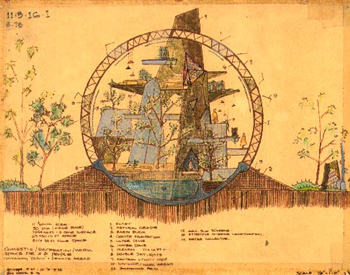
The
1967 concept sketches
(reproduced in May 1973 - click on drawing above) show another version
of the interior and one example of how Domicile can
sit on
a typical urban site. These sketches also indicate
and Entry building and Office where “reception”
and the Domicile’s business can take place without
unnecessary invasion of privacy. Access to the Dome
proper from the Entry building is through a partially
underground tube. This leaves the sight free for
other
uses and proves both added security and protection
from the weather. A 2010 version is illustrated at the bottom of this piece. |
|
A
great deal of the site is left free for recreation,
food growing and privacy. Domiciles can be clustered
(with connecting tubes) allowing even more land
freed for
a variety of uses. The land use aspect of this schema
is efficient and ecologically sensitive. Domiciles
can be adapted to serve a variety of co-housing
programs. See: Ken Norwood (Rebuilding Community
in America) of the Shared Living Resource Center
in Berkeley, California (800 475 7572). |
|
This
design concept is driven by three values often
missing
in today’s approach to housing: community, economy
[link: upside down economics - aspects] and stability of “family.” Families
do not have to be biological based (only). They will,
in the future, often
be based on many other affinity aspects: religion, work, philosophies, beliefs, life situations. |
|
Domiciles
were conceived from the beginning to be both living
and work environments. They were designed on the
premise of the KnowledgeWorker and knowledge economy,
or in
today’s terms, Free Agent economy.
This means the environment will not be “abandoned”
half the day and will be managed and employed as a 24/7/365
enterprise. Preliminary calculations indicate a several
times increase
in the quality of living at about a 50% decrease
in monthly overhead for a family. This radically
alters the cost of living to an individual and family
and significantly increases their life options and how they think about and use their time. |
|
The
actual social systems employed to govern the environments
can be highly varied from a “hotel” model
to, condominium to business to commune with many variants in
between. |
|
It
is is the realm of economic freedom that the Domicile
concept shows it’s strongest face. Do this thought
experiment. Fly over the city and “look”
into the offices and houses. How much redundancy
of effort, tools and resources do you see? How much
of
this wealth is latent, rarely used? It all
took, recourses, time and energy to produce. It
takes energy to keep.
This translates into hours for each of the owners.
Frozen hours of their life - not effectively
employed. The amount of this largely
unnecessary redundancy is staggering
- the
cost, a significant portion of a household’s
revenue. This leads to a society of wage-slaves.
In economic downturns, people realize the
traps that they have put themselves into by uncritical
acceptance of a consumer society and it’s present
attendant design strategies. Yet, few realize that
their situation is systemic - the in-the-moment economy
is blamed rather than the design strategies of their
architecture and their attendant living habits. |
|
Why
this over building and under utilization? The answer
is simple. So that each resource will be available
“on demand” to an individual owner/user. USE is the
principle that must be addressed - not unnecessary
control or ownership. More than adequate use can be
provided by proper analysis and rules-of-engagement
supported by “smart” scheduling systems.
The most constrained resource for the majority of
humans is time. Time for learning, play, recreation
and funding new ventures - be they personal, business
or nonprofit. There are three aspects to procuring
a basic lifestyle: income and costs are two of them.
Social costs and opportunity loss is the other. Domicile
addresses the cost side of this equation. It challenges
prevailing ideas concerning what it costs to live
in a stable community and accomplish a healthy, beautiful
well-tooled way of living and working. |
|
Many,
in our society, buy lower quality products than they require and
desire
because they cannot “afford” quality - every unnecessary
purchase makes this condition worse. The low quality
purchase generates a downward positive feedback loop:
low quality is, in the end, bad economics. Under utilization while a tools sits on the shelf bleeding value and relevance is bad economics. |
|
Because
of schedule constraints and the need to work more hours to afford more poorly made under used “goods,” most in our society spend money for goods
and services that used to be self-provided. This can
translate in to more day-to-day time freedom but too often
it means a reduction of options and an increase in
job dependency. The costs associated with most “packaged”
goods is mostly the packaging itself and the advertising
necessary to sell it. Many of these home products
can be safely and easily provided in a simple home
lab for a fraction of the cost and a few hours effort a
month. On the scale of a Domicile this makes common
sense. These can be “jobs” for those working
at home or are taking a work sabbatical. The entire consumer/work
cycle can be positively effected and turned back into a self-aware craft process. |
|
Families,
farms and communities used to provide many of the
basic staples of life - now, almost everything
is
a commodity supplied by ever larger and complex corporations
delivering through an ever more complex and economically
and ecologically expensive and often fragile supply chain. For some
products, such as computers and cars, this makes
sense.
For fresh vegetables it does not. Nor does it for
toothpaste that have but a few cents of materials
purchased at bulk. Even technology and service
costs
can be reduced because the Domicile community can
buy as a unit increasing it’s purchasing power. |
|
Domicile
is an urban homestead for families - it can radically
expand their economic options and freedom. It can
facilitate a far greater set of choices than the
existing default
housing models. In the 60s and 70s, when I first conceived and designed Domicile, alternative energy and water options were in their early R&D and experimental stages. Today, April 2010, an urban Domicile can affordably supply a great deal - if not all - of the basic food, energy and water needs of it’s inhabitants. Doing so allows everyone to reduce their ecological footprint, improve their economy and better protect their heath than is possible in almost any suburban or urban setting available today. Think about this. |
| |
| Domicile, and other similar strategies is not an attack on a global economy of refined goods. It allows an appropriate use of this industrial-economic tool. |
|
The argument for Domicile
also goes beyond these fundamental economic and
health
considerations. As a building strategy, the Domicile
offers significant architectural opportunities
that
few single family building schemes can
muster. Domiciles are potentially high variety environments.
Their architectural quality can be at the highest
level while being economically and ecologically
affordable to a vast number of people who can not
afford quality habitation - let along the junk now on the market - today. |
bolder_affordable_housing |
|
The
Affordable
Housing Project [link: boulder affordable housing project] for the City of Boulder,
designed in 1980, further developed many of the 1960s, 70s
Domicile
concepts.
The dome configuration was not used because the site
was close to the Flatirons and the view of these
mountains
could not be blocked. Instead, a low profile earth-sheltered
“greenhouse” was proposed. In this case,
the entire interior dwelling components: walls,
floors,
roofs and mechanical systems were made adjustable
and moveable by those living in the environment.
A
significant extension of the idea of adaptability, very possible today and a concept not being approached by any project being built or proposed at this time. |
| The
Xanadu
Project [link: xanadu project] which I conceived in the 1950s
and drew up in 2000 scales the Domicile idea to a
working
and
living environment for a thousand to two thousand people depending on the size chosen. There are
many scales in between Domicile and Xanadu that will work if matched
to
specific site and socioeconomic circumstances. The
principles remain the same. |
| It
is incomprehensible to me that projects like Domicile
are not now common. This concept is nearly 45 years
old. The problem of affordable housing is still with
us. The ecological issues are still with us. And,
in recent years, fear of losing work is returning
to the workplace [link: wage slavery]. The promise of the relentless engine of the consumer society has proven to be devoid of economic sense as it always has been of human sensibility. The many personal and social consequences
of these patterns can be easily seen. In the mid 80s over 80 percent of the workforce in the US had an adequate pension - today it is less than 20 percent. True there are economic, employment policy and political aspects to this circumstance. I point out that there are also life strategy and architectural design aspects and these are in the hands of individuals not vast institution in their death throes. A domicile with a mix of people from different economic levels, ages, and possessing different skill sets, can provide a better life style and pay it’s capital off in a few years. This habitat can be a pension for the retirement years. Yet, today, economics, architecture and social organizations are
still treated
as separate issues. And, it remains, for all practical
purposes, impossible to get investment for this kind
of project. I wonder why. Who benefits? What is the worst case that could
happen? A marginal return? Or, the same “economics” yet a far better life style? As long as our society
continues to think of architecture, ecology, economics,
life-style options and social policy as separate, we will continue along the insane path of
the present. As long as “making” money is seen as
governed by a different standard than what makes
a good “social” investment, projects like Domicile
will remain on the drawing boards. Yet, the 05 WEF meeting at Davos, projected
that the world economy will grow by 80% over the
following 15 years (now 10 and still feasible despite recent set backs).
Are we to believe that the present design strategies
of food supply, energy,
transportation,
employment and housing are to prevail? Has anyone
thought deeply about the consequences of this projection? Are
the barriers to innovations such as Domicile understood?
Who benefits from this existing social-economic entrenchment?
Who pays? Who loses? Maybe, a planet covered with
asphalt
really will be nice. Maybe, I am missing
something here. Maybe... [link: master plan for planet earth] |
|
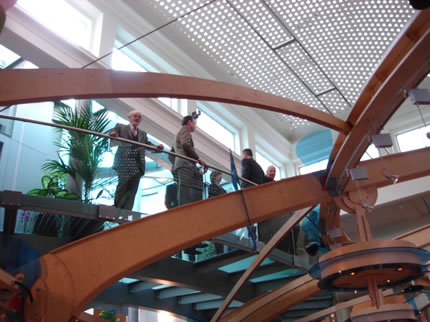
| The recently completed UniCredit NavCenter, while a work environment, best indicates the architectural quality that a Domicile can provide. It is also the closest built project that gives a taste of what the Xanadu project [link: xanadu] will be like. The scale and use is different yet the quality is the same. |
|
| Click on the picture above and look at the UniCredit NavCenter Tour while keeping the Domicile sketches in mind. This takes some translation, however, the interior landscaping the various zones, the “rooms within rooms” created by the PODs, the multiple heights of platforms all provide a small illustration of what a Domicile can be like. The structure will be more domestic in feel and there will be many more layers of privacy - let you imagination fill in the gaps. |
|
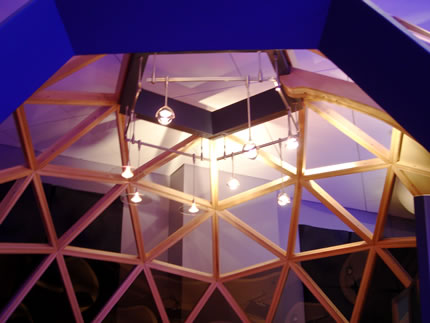
| The recently completed UVA mediaPOD illustrates , on a small scale, some of the earchitectural qualities of the geodesic geometry and that of a room-within-a-room. |
|
| Click on the picture above to see the mediaPOD prototype and consider how structures of this kind can be employed in a Domicile. Geodesic “rooms” the size of mediaPOD - to about twice as big- can be used to make work and living accommodations within a Domicile. |
|
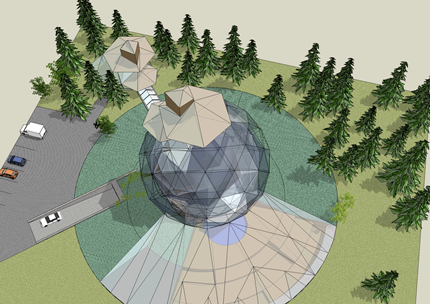
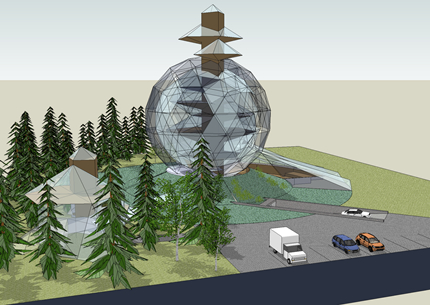
| In April, I started Design Development for a Domicile Prototype. The two sketches, below, are quick studies to explore dimensions and volumes to discover the size requirements for a fully functioning Domicile environment for 5 families and the minimum amount of land necessary for functional self sufficiency. |
Domicile - besides a viable design strategy itself for addressing critical issues of habitat in today’s social, economic, ecological circumstance - is an early step in a progression of projects aimed at practicing a method to facilitate the emergence of viable habitats on multiple levels: communities, cities, regions, Planet Earth as a system, and near space. It is a solution on it’s own level of recursion and a conscious experiment in support of larger future projects:
 |
|
 |
|
 |
| Mater Plan for Planet earth |
|
 |
|
 |
|
 |
|
 |
| Katrina - An Unnatural Disaster |
|
 |
|
|
| The present default practice of architecture does not address the meta challenges of building on Planet Earth in the 21st Century. We are building out a “solution” which is fragmented, not sustainable, does not address the conditions of our time and negatively adds to the worst of these conditions. Every project has to address local circumstance and economies as well as future global systemic issues and ecologies. Time no longer affords the “luxury” of practicing architecture with our heads buried in the local sand. |
|
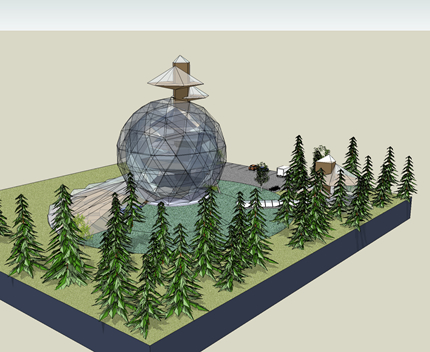
| In addition, these studies explore possible construction alternatives and grammar sets for a Domicile build with today’s technologies and methods. The original sketches assumed a craft level building method possible in the 60s and 70s. These new sketches assume a mostly prefabricated, manufactured approach. In their primitive form of development , they convey a somewhat mechanical and modernistic look - in reality, the pictures above, of Unicredit and the mediaPOD, provide a more accurate representation of Domicile’s potential finish and persona. |
| A final note. Planet Earth may be facing in our near future a period of turbulence: weather change, pole shifts, earthquakes, sun flares, hurricanes, flooding and sea change levels, and so on. In addition, human activities themselves are causing world wide, unpredictable consequences. The physical record and human history clearly shows these cycle have come before. These can be catastrophic times or a time to co-design with Gaia a more sustainable planet. Domiciles (alone with EcoSphere, Xanadu, Crystal Cave) , in the scope of my work since the late 60s, represent a class of designs intended to metabolize with the natural environment and/or be self contained to a high degree. The intent is to engage with the landscape while being able to “gate” unwanted impacts from one to the other. These techniques may also be useful in the development of human habitats on other planets. The outer skin of Domicile is an “environment Valve” - an interface mechanism - designed to protect both interior and exterior environments without isolating either from each other. |
|
| The present political, economic and ecological circumstance argues strongly for the Domicile approach. Affinity groups can pool resources, cut capital costs and living expenses dramatically while greatly increasing their standard of living and, at the same time, significantly reducing their negative impact on both society and planet. |
| As, Design Development proceeds, I will set up a web page to document this process. A design for prototype, of the structure, energy-food-water systems as well as the social processes and legal agreements should be available sometime in early 2011. |
|
|
| GoTo: Taylor Environments Tour |
|
|
|
| GoTo: Money - The Tool That Became a God |
|
|
|
| GoTo: The Story of the Monkey’s Paw |
|
|
|
| GoTo: UniCredit navCenter Tour |
|
|
|
| GoTo: UpideDown Economics - 12 Aspects |
|
|
|
| GoTo: Dome Dwellings and Workplaces |
|
|
|
| GoTo: workPODS - a History |
|
|
|
| GoTo: Return of the Usonian |
|
|
|
| GoTo: Practice - ideas into reality |
|
|
|
| GoTo: postUsonain Prototypes |
|
|
|
| GoTo: POD Greenehouse Home Workspace |
|
|
|
| GoTo: Nature of Experience |
|
|
|
| GoTo: Boulder Affordable Housing Project |
|
|
|
| GoTo: There’s No Place Like Home |
|
|
|
| GoTo: Authentic Architecture |
|
|
|
| GoTo: A Future by Design - Not Default |
|
|
Matt
Taylor
Palo Alto
February 21, 1999 |

SolutionBox
voice of this document:
VISION • STRATEGY
EVALUATION
|
click on graphic for explanation of SolutionBox |
|
posted:
February 21, 1999
revised:
April 11, 2010
• 20000206.233038.mt • 20000513.190127.mt •
• 20001212.517623.mt
• 20011026.872002.mt •
• 20050208.645120.mt • 20070325.999910.mt •
• 20081210.451329.mt • 20100410.318109.mt •
• 20100411.211230.mt •
(note:
this document is about 95% finished)
Matt
Taylor 615 720 7390
me@matttaylor.com
Copyright© Matt
Taylor 1977, 1999, 2000, 2001, 2005, 2007, 2008, 2010
|
|
|