c o n f i d e n t i a l
Privileged access only
This document uses a custom font for the Glyphical Language part of this Patent.
Download the font and place it in your system folder.
Else you will have strange charectors showing up on your screen
For Mac
For Window
SYSTEM AND METHOD FOR AUGMENTING KNOWLEDGE COMMERCE
Terminology and References
Part 2 of 3
...DEFINITIONS:
EVALUATION TO MEMORY
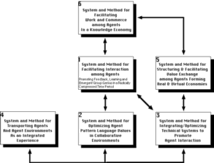
| EVALUATION A key step in any systematic process of work. See: Design Formation Model. Evaluation is also a key aspest of feedback and use. See Stages of the Creative Process and 4-Step Recreative Process Models. See also, criticism process. EVENT ! The first act 0 in the 10 Step Knowledge Work Process model. As a Term-of-Art of this System and Method, every event has to be seen and treated in this context. An event can be formal or informal. It can be of short duration or of many days. It is, however, treated as discrete. And, it is an EVENT, in terms of this method, only if the other steps in the 10 Step Model are taken. There is a strong relationship between MEMORY, as a term-of-art of this System and Method, and the “Mechanical Cat” Cof the 10 Step Model. The 10 Step is a process engine designed to emply many of the natural charectoristics of memory as observed in a complex system. The CyberCon Tool-Kit (Subsystem 3) is designed to augment this process. On the highest level, an event is a discrete act, as part of an extended process, augmented with cybernetic tools. Therefore, previously not-integrated, loose, non-intentional networks can be made to function like natural living systems. An event is bounded by a beginning and an end - by dimension and location. An event must be observed and documented to be an event. EVENT SPONSOR !DG rL4-Ss1: In the context of a DesignShop event, these are representatives from the client who usually have a considerable stake in the successful outcome of the DesignShop event. They may be project managers, department heads, or CEO's. Sponsors are also participants in the event, although in some cases they may work on the KreW. Some clients have only one sponsor, and others have an entire sponsor team. EXEMPLYl rL4-Ss1: One of the 5-E's in the 5 E's of Education model. To explain by example. Someone or something worthy of imitation or duplication. Serving as an illustration, a model, or an instance. To take out. EXPECTj rL4-Ss1: One of the 5-E's in the 5 E's of Education model. To look forward to the probable occurrence or appearance of. To look out at. EXPERIENCE; rL4-Ss1: One of the 5-E's in the 5 E's of Education model. The apprehension of an object, thought, or emotion through the senses or the mind. Active participation in events or activities leading to the accumulation of knowledge and skills. To try, test. EXPERTF rL4-Ss1: Person with a high degree of skill or knowledge in a certain subject. Latin: to try; (i.e., risk, lead over, press forward, to learn by experience). In the context of the Learning Path: Five Points of Mastery model, the Expert develops specialized knowledge to a high degree in a given body of knowledge and is a resource to others. Everyone has expertise to share; everyone applies their expertise to create value for themselves and others, as participants in this learning environment. EXPLAINk rL4-Ss1: One of the 5-E's in the 5 E's of Education model. To make plain; remove obscurity from. To define, explicate. To offer reasons for, or a cause of. To spread out; completely flat plain. EXPLORE ' rL4-Ss1: One of the 5-E's in the 5 E's of Education model. To investigate systematically; examine, study. To search into or range over for the purpose of discovery. To search out. Cry out aloud. FACILITATION2 Facilitation means to “make easy.” It is the second Domain of the 7 Domains Model: “Work Process Design and Facilitation.” FACILITATOR S (SOMETIMES CALLED THE KEY FACILITATOR) rL4-Ss1: The Facilitator works with the DesignShop, PatchWorks, (or other event ! Sponsors (which may include members of the Engagement Team ToA and the Process Facilitator ToA (representing the KreW) to design the event before it begins, manage the continuing design and execution of the event while it is happening, to bring closure to ideas and processes immediately following the event, and to open paths for progress to the next stages of work. To facilitate means “to make easy.” The art of facilitation is the art of bringing clarity and effectiveness to the work process 2 of individuals rL3 and groups rL4. The facilitator’s mandate is to ensure that the process 2 is designed & and implemented in a way that brings out the best thinking of each participant and the best resolution of issues from each group. In a further manifestation of this System and Method, facilitation and work can be performed by Agents of all kinds for Agents of all kinds (humans, machines, systems, and so on). Facilitation involves a wide range of actions K taken to affect the interaction of Agents. It involves bringing order to the universe of thoughts and possibilities 8 about a topic, and giving back to people (or other Agents) what they already know, in a way that brings clarity and a foundation for effective action K . It involves setting appropriate Boundary Conditions ToA (time, physical space, and agreements - Terms-of-Engagement ToA) within which an individual or group can work efficaciously b. It involves clarifying conditions and goals, through a process Ss1 we describe as “creating the problem” OH{}.. Facilitation involves introducing the right "new” information T (Objects/Agents) that challenge R existing ways of thinking Y and leads individuals to explore/discover ' their own unexamined Design Assumptions (ToA) about a given condition O. It involves providing feeback L so that what has been learned A is incorporated I into the design & work that follows avoiding unecessary looping ]. It involves observation and assessment, and taking actions to ensure that a groups natural biases do not prevent some vantage points from being heard, or certain phases of the creative cycle to skipped. When necessary, the facilitator will interject new challenges to prevent a group from coming to closure on an idea prematurely; and at other times to push a group to closure when the exploration is sufficient and no gain is to be made by working an issue further. The present inventors reject the notion that the facilitator should be an "objective third party" who does not get involved in content and focuses only on process, performing only some kind of umpire or gatekeeper role. The present inventors do not apply the “facilitator as umpire” (only) model for many reasons, including philosophical considerations: no one can ever be completely unbiased, and as modern physics has shown, even the act of observing a process will affect that process. Objectivity, in this System and Method, is accomplished by deliberately allowing all possible “voices” (Agents) to be heard and making clear all possible positions or biases (including those of the facilitator 2, tool-set 5 and environment 4). Moreover, its our experience that the agreements put in place by this model nearly always function more to protect the facilitator than to produce effective results. However, the Commissioner of Baseball metaphor has meaning in the act of governance and facilitation on the scale of ValueWebs rL6. FEEDBACK L Feedback is the message, to the controller of a system, from a sensor of a system, of the difference between performance and expectation. No message, no feedback. No message to a controller (an agent that can act to modify what the system is doing), no feedback. No message from a sensor (designated as such as an agent of the system), no feedback. This definition holds on all levels of recursion embodied by this System and Method from neural nets to a global economy. The frequency of feedback is a critical issue in the design of dynamic and complex systems. Messages have to be requisite with the rate of change in the environment taking into account the time “lag” inherent in the total response cycle (Jet Planes Model). POSITIVE feedback reinforces an action creating increasing returns. Too much positive feedback in a system will lead to instability. In this context, positive does not mean “good.” NEGATIVE feedback attenuates a system’s behavior. In this context, negative does not mean “bad.” (See Weiner) rL4-Ss1: In the context of the 4-Step Recreative Process model, discover how well the creation performs in the world. Does it fulfill your vision? How do others like it? Does it inspire new visions in you or in others? FOCUS 9 rL4-Ss1: One component of the SCAN, FOCUS, ACT model. FOCUS is often seen as the middle stage of a three stage model, but the model is in fact nonlinear and highly recursive. FOCUS implies choice. The majority of the opportunities presented by the SCAN are discarded in favor of only one or several, which are scrutinized and evaluated more rigorously. The models we build in FOCUS are more tangible expressions of the conceptual models we built in SCAN. At length a decision is made and it's time to ACT. GRACEFUL FAILURE An engineering principle attributed to Emery Lovens that advocates building the failure path into a system. Systems will fail. The important thing is to minimize the downside consequences by the way that the system is engineered, built and used. Graceful failure connotes an easy, non-catastrophic, recoverable failure path. Complex systems that survive exhibit this characteristic. Nature designs systems this way. Too often, human-made systems are more brittle than this. The scale and scope of present and future human complex systems requires the graceful failure approach. Failure is minimized by appropriately designed-in feedback, memory of alternatives and “graceful” exit strategies. The definition of “graceful” is dependent on the nature of the system users and the consequences inherent in the potential failures of that system. Several hundred humans dropping several miles in a metal tube, with no alternative recovery process, is not graceful. GROUP GENIUS rL4-Ss1: The ability of a group working iteratively and collaboratively to seek, model and put into place higher-order solutions. Time compression, systemic work-flow, dynamic feedback, individual creativity and collective creativity are core features of Group Genius. The Group Genius process is the heart of MG Taylor's methodology. Designing, building, and using environments, processes, and tools that systematically and repeatedly release this ability critically distinguishes the MG Taylor¨ Process from other ways of working. Gail Taylor first encountered the concept of group genius while living in Kansas City in the early 1970's in the work of Lawrence Halprin, community developer and co-author of Taking Part: A Workshop Approach to Creativity. The idea resonnated with Gail's core beliefs about the nature of creativity and the collaborative potential of a group. Several years later, when Gail and Matt Taylor formed MG Taylor (then Taylor Associates), releasing "group genius" became a core principle in the organization's philosophy. HYPERTILE rL4-Ss2: The WorkWalls manufactured by Athenaeum international as part of this Systemand Method, are made of steel and, therefore, accept magnets. Hypertiles are large rectangles of flexible magnetic material, matching various paper sizes. They are covered on one side with a sticky surface manufactured by 3M. Sheets of paper can be adhered to this surface and peeled off without leaving any residue on the back of the paper. The paper can then be photocopied or scanned for entry into the Knowledge Base. Many of these can be “tiled” togehter on the WorkWalls to create composite graphics made of many pieces that can be easily scanned - “Hyper” reffers to Hyper Text (Ted Nelson) - thus, the term HyperTile. IDENTITY r rL4-Ss1: The collective aspect of the set of characteristics y which a thing is definitely recognizable or known. The quality or condition of being or remaining the same. Latin; the same. The first stage in the Seven Stages of the Creative Process model. Explore, discover and understand how the system produces the conditions. Even if you think you know how it's done, think again. Use techniques of collaborative, creative design to see the system from different vantage points. Break out of common assumptions and past practices (you can always go back to them if you need to). Build a working model of the current system that replicates the conditions you see. It probably won't be right but it will lend some needed insight. Creativity is the elimination of options. So generate some optional ways of seeing the system and its components. Work until you can see the truth in everyone's viewpoint. This means building models of these viewpoints. Then, maybe you can assemble components of the viewpoints together to get a more robust map of the system and conditions than you could by clinging only to your own opinions. INCORPORATEI rL4-Ss1: To cause to merge or combine together into a united whole. To unite with or blend indistinguishably into something already in existence. To form into a body. In the context of the 'Spoze model, if the results of the simulation seem favorable, the system may incorporate the New Information into its Paradigm and begin making decisions based upon this new mixture. Also incorporation. INCREASING RETURNS A natural ToA and frequently recurring phenomena that “locks” a system into a positive feedback ToA loop. This becomes a growth engine until the system limit ToA is reached or some other agency ToA intervenes. If the system limit is reached, catastrophic failure usually occurs. See: Stages of An Enterprise Model. Many human designed systems are exhibiting this phenomena. This indicates a structural flaw in their architecture ToA. Within limits - maintained by properly placed negative feedback loops - increasing returns can be maintained in sustained growth. This requires structural recreation ToA of the system ToA as it proceeds through iterations ToA of activities and “jumps” recursion ToA levels at moments of transformation ToA. The Dutch Tulip craze and the Spanish gold inflation are notable examples from history of increasing returns unbounded by appropriate feedback. INFORMATIONT As defined by Gregory Bateson, information is“ the difference that makes a difference.” See: Data, Information, Knowledge Model. INFORMATION - NEWT(See: New Information) rL4-Ss1: A numerical measuer of the uncertainty of an experimental outcome. Knowledge derived from study, experience, or instruction. A non-accidental signal used as input to a computer or communication system. In the context of the 'Spoze model, systems are receiving all kinds of messages from other systems and the environment in general. Messages are neutral. They do not contain information. Rather, information is the result of a system's interpretation of a message, including whatever meaning it assigns to the message based on past experience. This meaning--or message in context of associated experiences--is what we call information. The measure of information is proportional to its uncertainty, or surprise. The more surprising the message, the more information it contains. Most messaging events are devoid of information, either because they are filtered out, or because they bear messages whose content is expected by the receiving system. INSIGHTu rL4-Ss1: The capacity to discern the true nature of a situation. An elucidating glimpse. Old English: thing seen within. At this stage of the Seven Stages of the Creative Process model, there's only one stumbling block: your vision is full of holes. You will have figured this out by now. Sometimes when working on simple problems, the vision really will contain a clear definition of the problem, and the answer, but usually there are lots of unknowns and gaps in understanding. The problem--the PROBLEM--is how to conceive of, invent, allow for the emergence of, or create the subsystems and ecosystems that will fill the gaps in the vision--that will rework the vision to make it more powerful. The problem is not how to fix the conditions. The problem is how to imagine, design and allow for the evolution of new components of the system (or new systems) that will help the system create different (and hopefully more healthy) conditions. There's no other problem you can solve. You can't fix the conditions. INTELLECTUAL CAPITAL A business concept that measures the true value of an enterprise. Three elements ToA have to be present for intellectual capital to be created and sustained: First, intellectual property ToA. Second, a market ToA that can employ the idea, service, product, artifact that represents the virtual/physical manifestation of the IP. Third, the operational capability to manufacture and deliver value to said market and to sustain the variability imposed by a changing marketplace. This System and Method facilitates the creation of ValueWeb ToA architectures as a means of accomplishing these three conditions in high variety, complex environments. INTENTy rL4-Ss1: Aim, purpose, meaning, purport. Firmly fixed, concentrated. Having the mind fastened upon some purpose. Latin: to stretch toward. In the context of the Seven Stages of the Creative Process model, Intent asks Are you excited yet? Do you have the juice to live in the vision and do the work to bring as much of it it back to the present each day as you can? How long can you live with the ambiguity and paradox of working in two different worlds? Can you assume the mantle and the risks of the prophet and advocate? Intent is the well of energy that you'll return to over and over while you're working to bring your vision to the present. The greater the distance on the fitness landscape between the old and new system, the greater the challenge and the more energy you'll need to succeed INTERFACE Interface is commonly understood in terms of the interaction between a computer and a person. Jef Raskin takes it further and relates it to the design of products of all kinds. In this System and Method, it includes these perceptions and extends them to transitions in architectural space and transactions in processes. There is an issue of Interface every time space, state, time, context, mode, style, purpose, use, environment (and so on) transitions. There is an issue of Interface every time energy and/or matter is transported (Subsystem 5). The management of Interface is the management of the “white space,” “negative space,” “time-out” and “shift” that happens between things. Different Agents require different facilitation between these states as appropriate to their nature and status in the system/process. INVESTOR x rL6-Ss1: One who spends or utilizes time, money or effort for future advantage or benefit. To besiege. To clothe in, surround. According to the ValueWeb model, the investor provides capital to the enterprise with the hope of receiving a return on the investment, and a return of the original investment as well at some point in time. ITERATION Progressive, feedback driven, full cycles of work that are closely coupled in time and context. KNOWLEDGE (see: Body of Knowledge) Data points are the bits of experience ;. Data, integrated by some principle or schema (Model ToA) is information T. Information, in context ToA of prior experience ;(memory ToA), with the focus 9 of intent y in act K is KNOWLEDGE. In this definition, which is intrinsic to this System and Method, KNOWLEDGE cannot exist outside of action K. There is no such thing (in this method) as abstract, passive knowledge. Remove action and you have memory of (high level information about); remove intent and you have (structured) information; remove an integrating Model and you have data - raw experience. KNOWLEDGE, in this method, is an intelligent construct that can exist on many levels of recursion of a complex ToA, learning system ToA. KNOWLEDGE, in this definition, is the result of the interaction of Agents. Knowledge emerges ToA as the result of this interaction. The interaction that results in KNOWLEDGE always takes place in an environment 4 and is always augmented by tools. It always results in memory ToA and Agent alteration. KNOWLEDGE ECONOMY (see; Network Economy) It is generally recognized today that the principle valued-added element in the production and use of products and services is knowledge - hence the term Knowledge Economy. This, however, can be misleading if the concept X is confused with the “mixed” condition Othat now exists. This System and Method employs these terms in a much stricter sense than this general philosophical( perception. The Industrial Economy and the Knowledge/Network Economy are intrinsically different (and competing) systems. The Industrial Economy will not evolve (with existing methods and tools) into a sustainable, self-correcting . knowledge-based economy. rL7-Ss6: Further, the entire method and means by which value is understood and assessed has to be recreated: operationally. rL7-Ss4:This will require more sophisticated means of exchange and structuring custom economies. Knowledge is a “no-thing” - an intangible. Our present economy measures and rewards things. Still. Even e-commerce, as its present confusion (June, 2000) discloses. There are two significant Design Strategies &+ that have to be applied to “create the problem” } worth solving: first, a comprehensive Model ToA of the process 2 of how idea becomes value (Ss6); and, second, an order of magnitude (or more) fine graininess and “smarts” in the medium of exchange (Ss4). Neither the present Model nor the medium can match the variety ToA of a global knowledge-worker, hunter-gatherer, affinity-based, tool-augmented society. The Knowledge/Network Economy will be global. It will reward knowledge. It will employ networks and systems immeasurably more complex ToA than exist today. It will employ smart/intelligent cybernetic systems and tools. It will destroy the old economy. Timing and transition are important. It is not here yet. KNOWLEDGE OBJECTS OR AGENTS Artifacts ToA of information, inserted, interactively, into a process (an environment of Agents) by a rule or algorithm for the purpose of knowledge ToA creation. rL4-Ss1: On the human level of recurion in a facilitated 2 event !, these artifact/objects are usually from outside of the body of knowledge # resident in the participant Agents and brought to the attention of the group at the right time to facilitate 2 ideas into focus 9 or expand (explore ') a perception. These artifact/objects may take the form of articles from magazines or journals, books, quotes, research papers, models, graphics, multimedia or databases - or any combibation of these. They will often be displayed on WorkWalls ToA. This act K is part of building w environment 4 for the participant/Agent. rL2-Ss3: In a robust expression of this System and Method, the CyberConn Tool Kit augments the 10 Step process and tracks % each Agent interation with each artifac/Agent. KNOWLEDGE BASE # rL5-Ss2: The Body of Knowledge that supports an individual, a group, an Enterprise, or a ValueWeb. In the 10 Step Knowledge Work Process model, the K-Base serves as repository, or data warehouse, and router for messages in the enterprise. The sum or range of what has been perceived, discovered or inferred. Skill, understanding, experience. Familiarity, awareness. KNOWLEDGE WALL rL5-Ss2: Management Center and NavCenter environments have at least one (usually more) large wall sometimes up to 50 feet in length, usually the back side of the Radiant Wall that is covered with a mildly adhesive surface manufactured by 3M. This wall serves as an oversized European-style kiosk. All sorts of information may be posted to the wall. Sometimes portions of the documentation are placed on it. Photographs, color art work, and diagrams are also posted here. Articles from magazines or the Internet are also displayed for participants to browse through. Information is not displayed haphazardly, rather, a layout is thoughtfully designed, making the wall a structured information event. In a further embodyment of this System and Method the KnowledgeWals will be electronic. KNOWLEDGE WORKERS 1G rL4-Ss1: The individuals who comprise the KreW that supports activities such as a DesignShop, Workshop, PatchWorks event or other embodiment of this System and Method. They are responsible for managing the flow of information temporally through the duration of the event and spatially within the Environment - or environments of the event. KNOWLEDGE WORKER SPONSOR 1GD rL3-Ss1: A Knowledge Worker of at least Journeyman level who is also a Process Facilitator or Facilitator, and whose purpose is to provide an official, facilitative and welcoming link to the work and philosophy of the organization for one or several other Knowledge Workers in the network. KREW rL4-Ss1: Another term for the Crew of a DesignShop or other event. The "K" and "W" in the title refer to the abbreviation "KW", or Knowledge Worker. The "re" can take on most any meaning that seems appropriate to the situation. KWIB Knowledge Work Information Broker. Each Management Center or KnOwhere store has a KWIB, usually assigned on a rotating basis, to collect, maintain and disburse information concerning events in the center. LEARNERA rL4-Ss1: Someone who gains knowledge, comprehension or mastery of through experience or study. Acquire through experience. In the Learning Path: Five Points to Mastery model, a Learner is an explorer, innovator, self-developer, model-builder and action-taker who is receptive to ideas and guidance, able to reflect and act creatively, learns how to access information and create value from it for self and others. A unique set of contacts--family, peers, facilitators, sponsors, experts, and community members--comprise the Learner's constantly evolving learning network. LIMIT The boundary of a system. When this is exceeded the system ceases to be the system that it was. This is catastrophic failure of the system’s architecture. LOGISTICS W rL4-Ss1: The KreW facilitates the flow of matter, energy and information through the DesignShop or the Management Center. Logistics focuses on the flow of matter and energy. This includes providing the physical environment, tools, equipment, materials, food. It also calls for the continual refreshing and maintenance of these elements. LOOPING] rL4-Ss1: A length of line folded over and joined at the ends to form into a loop. Loupe. Imperfect gem. A small magnifying glass used by jewelers. Most ideas go through a roller coaster ride of peaks of success followed by valleys of near collapse before they become viable--capable of separate existence. The Stages of an Enterprise model identifies this process as Looping. MANAGEMENT CENTER v4 rL5-Ss2: Special environment for managing the design and innovation process in the context of expected social-economic change, and for building action plans to accomplish the goals established. By careful facilitation of the elements of environment, information, design and group process, Management Centers decrease the "accident" factor of discovery and synergistic events. Management Centers are "safe" environments in which designers and decision makers can risk exploring and creating new models. Also called "DesignCenters.” MANAGER/MANAGEMENTv(see: Systems Integrator) rL6-Ss1:The act, manner or practice of directing or controlling the use of. To direct or administer. Hand, handle. To mete out, dispense. To be an aid, minister to, servant. Management provides the information and communication hub between the other players in the Business of Enterprise model. At different times in history, managers have focused alternately on fulfilling the desires of one player or another. According to the ValueWeb model, Management still balances the business of the whole web, but the management function is more distributed. There is more management going on, but fewer managers doing it. MANAGEMENT - PROJECT6 (See: Project Management) rL4-Ss1: Within the 7-Domains model, Project Management is the Domain of execution. It is the application of methods and procedures to planning and strategy. Goals cannot be managed - they must be translated into "doable" tasks and daily activities with resources allocated for specific reasons. At the same time, the mission cannot become too distant or projects lose focus and momentum. Project Management unfolds through cycles of measurement and feedback, in the true cybernetic sense that adaptation and evolution occur through self-correction and adjustment. Thus, when a project component is not achieved "as planned," it is both and opportunity of discovery and learning, as well as an opportunity to refine the plan, based on "real world" information. MANAGEMENT - VENTURE7 (See: Venture Management) rL4-Ss1: Venture Management is the sum of the preceding six domains in the 7-Domains model. Venture Management is also a function in itself and a driver which, in further cycles of work, recreates the first six Domains. It is both an attitude and a methodology. Venture Management is the practice of managing the organization, as a living system, that is dynamic rather than a collection of parts, and possessing integrity as a complete system. This is a different approach than seeing an organization only in terms of resources and results. MATURITYs rL4-Ss1: Fully developed. Worked out fully by the mind. The state of a note, bill or bond being due. According to the Stages of an Enterprise model, Maturity is probably the longest and most stable stage of the Enterprise. It is also the most favorable time for spawning new enterprises although many ventures fail to do so until it's almost too late. MEDIA The material in which an idea or thing ToA is rendered. All things exist in a media. No-things ToA do not. The media is not neutral. It imposes limits ToA on the expression and functionality of any manifstation (thing), When an idea or thing is transported ToA - to another media, it has to be recreated ToA or it will progressively decay by copying which will always bleed information ToA. See 4 Step Recreative Model. MEME An element of culture that is passed on by non-genetic means, such as by imitation. Ideas that catch on by passing from brain to brain. MEMORY Memory is a key concept of this System and Method and is described on all levels of Language and applied in each Subsystem of the System and Method. Memory, in this system, has to be understood as a series of state changes ToA that take place iteratively ToA (State 1, State 2, State 3, State... n) and existing on different levels of recursion ToA of a complex system. In a dynamic ToA complex ToA system, the memory STATES ToA will be different. Information ToA, provided by feedback ToA, is contained in these different states and can be used - this is a fundamental aspect of how the System and Method, of the present Invention, operates. Agents ToA and Agency ToA are objects ToA or units of this memory. In this Model ToA, the entire system is memory. Memory can be in the system (at a lower level of recursion) but is composed of the system and is regenerated when “recalled.” This recalling alters the state, and as an event/Agent (object) is part of the STATE of the (altered) system. Each iteration ToA is a discrete ToA step and involves a complete process ToA. See: Fig.SS1 -1.
Go To: |
Further information concerning these definitions can be found in the Appendices hereto, which are incorporated herein by reference.
Return to Outline
Return to Part 1 of Terminology and References
SolutionBox voice of this document:
IDENTITY • STRATEGY • CONTRACT DOCUMENTS
posted June 14, 2000
revised November 6, 2001
• 20000616.9582.mt • 20000623.164452.mt • 20000623.172350.mt •
• 20000625.80753.mt • 20011106.209174.mt •
(note: this document is about 50% finished)
Copyright© 1982, 1997, 1998, 1999, 2000, 2001 Matt Taylor
Matt Taylor 843 671 4755