c o n f i d e n t i a l
Privileged access only
This document uses a custom font for the Glyphical Language part of this Patent.
Download the font and place it in your system folder.
Else you will have strange charectors showing up on your screen
For Mac
For Window
SYSTEM AND METHOD FOR AUGMENTING KNOWLEDGE COMMERCE
Part 1 of 3
Throughout the present application, certain terms of art are used. To assist in understanding the intended meaning of these terms in this application, or their historical context, reference should be made to certain published works as detailed hereinafter:
| ADAPTION: as described in How Buildings Learn - What Happens After They’re Built (1994), Steward Brand. AGENTS AND AGENCY: as described in Society of Mind (1985), Marvin Minsky. ARMATURE: as described in Building to Last - Architecture as Ongoing Art (1981), Herb Green. COMPLEXITY, ORDER, VARIETY: as described in Architecture - Form, Space, and Order, 2nd Edition (1996), Francis D. K. Ching. Also as described in The Quark and the Jaguar (1994), Murray Gell-Mann and in At Home in the Universe (1995), Stuart Kauffman. CONSCIOUSNESS: as described in The Origin of Consciousness in the Breakdown of the Bicameral Mind (1976), Julian Jaynes. DEEP STRUCTURE: as it refers to language and cognition, in Language and Mind (1968), Noam Chomsky. EMERGENCE: as described in At Home in the Universe (1995), Stuart Kauffman and in Emergence, The Connected Lives of Ants, Brains, Cities and Software, (2001) Steven Johnson. FEEDBACK: (and of a complex kind) as described in The Human Use of Human Beings, Cybernetics and Society, and Cybernetics or Control and Communication in the Animal and the Machine (1948), Norbert Weiner. See the definition, in Part 2 of 3, for how feedback is employed in this System and Method. HUERISTICS: as described in The Metaphorical Brain (1968, 1989), Michael B. Arbib and Wayne Reeves in Cognition and Complexity (1996). INFORMATION: as described in Mind and Nature, A Necessary Unity (1972), and Steps to an Ecology of Mind (1979), Gregory Bateson. Also as described in Mathematical Theory of Communication (1948), Claude Shannon. INTELLECT: as described in The House of Intellect (1978), Jaques Barzun. INTELLIGENCE: as described in, for example, Frames of Mind : The Theory of Multiple Intelligences (1983), Howard E. Gardner. ITERATION: as described in The Exemplar (1984), Robert Carkhuff; and as discussed in The Gold Collar Worker- Harnessing the Brainpower of the New Work Force (1995), Robert E. Kelley. INTERFACE: as described in The Humane Interface (2000), Jef Raskin. "The way that you accomplish tasks with a product - what you do and how it responds - that's the interface" (pg. 2). LIVING SYSTEMS: as described in Living Systems (1978), James Grier Miller. MEME: as described in The Selfish Gene (1976), Richard Dawkins and The Meme Machine (1999), Susan Blackmore. META PROGRAMMING: as described in Programming and Meta-Programming in the Human Bio Computer (1967, 1968), John Lilly. MORPHIC RESONANCE : as described in A New Science of Life (1981), and The Presense of the Past: Morphic Resonance and the Habits of Nature (1988), Rupert Sheldrake. NETWORK: as described in Small Worlds, The Dynamics of Networks Between Order and Randomness (1999), Duncan J. Watts. NODES AND PATCHES: as described in At Home in the Universe, The Search for the Laws of Self-Organization and Complexity (1995), Stuart Kauffman. PATTERN LANGUAGE: as described by The Timeless Way of Building (1979) and A Pattern Language (1977), Christopher Alexander et al., and as demonstrated by The Wright Space - Pattern & Meaning in Frank Lloyd Wrights Houses (1991), Grant Hildebrand. Both of the above references are described in The Power of Place - How Our Surroundings Shape Our Thoughts, Emotions and Actions (1994), Winfred Gallager, and in Frank Lloyd Wright - A Primer in Architectural Principles (1991), Robert McCarter. PHYSICAL HEALTH, MENTAL WELL BEING, INDIVIDUAL PLACE and PROSPECT AND REFUGE: as described in The Power of Place - How Our Surroundings Shape Our Thoughts, Emotions and Actions (1994), Winfred Gallager, and in Places of the Soul - Architecture and Environmental Design as a Healing Art (1993), Christopher Day. RECURSION: as described in Diagnosing the System for Organizations, Managerial Cybernetics of Organization (1995), Stafford Beer. REQUESITE VARIETY: as described in Designing Freedom (1985), and Diagnosing the System for Organizations (1995), Stafford Beer; and Ross Asby in Cybernetics (1952) SYMBIOSIS: as described in The Symbiotic Man - A New Understanding of the Organization of Life and Vision of the Future (2000), Joel De Rosnay. SYMBOL: as described in Man and His Symbols (1961), Carl Jung, and in The Hero With a Thousand Faces (1949), The Mythic Image (1974), and The Innner Reaches of Outer Space: Metaphor As Myth and As Religion (1982), Joseph Cambell. SYNERGY: as described in Synergetics (1975, 1979), R. B. Fuller. SYNTOPICAL READING: as described in How to Read a Book (1972), Mortimer J. Adler & Charles Van Doren. TRANSPARENCY AND RECIPROCAL TRANSPARENCY: as described in “The Transparent Society - Will Technology Force Us to Choose Between Privacy and Freedom?” (1998) by David Brin. |
The definitions and meanings presented in these works provide a foundation and frame of reference only. This Invention develops and adds additional meaning to these terms and employs them as precise Terms of Art as will be noted herein.
The present Invention also employs language on several levels: “Descriptive” - Normal Use NU, “Technical” - Terms of Art ToA, “Pattern language” - Solution Sets SS, “Modeling Language” - Design and Process Terms D/PT, “Algorithm” - Rule Statements RS, “Deep Language” - Machine Language ML. These levels will be noted as appropriate herein.
 In addition, the present Invention employs an iconic, visual language ToA as a means of bringing deeper meaning and precise understanding to certain concepts and components of the System and Method. Glyphs are employed as an aspect of this language; as example: can you read this are Glyphs of this language - each with denotative and connotative meaning to one schooled in the art. These Glyphs will be employed as appropriate herein.
One example (left), of Glyphical use, is the “SolutionBox” which is used to document the “voice” of a document or transaction. A document without information about itself can be misleading and/or lack context. The Solution Box is one means of this System and Method to provide “information about (the) information.” In this example, the Solution Box voice is “ENGINEERING” SS on the Creative Process Model, “STRATEGY” SS on the Vantage Points Model and “PRELIMINARY DESIGN” SS on the Design Formation Model.
The SolutionBox system provides a 7 x 7 x 7 matrix - or 343 “states” - that frames the information contained in a document or transaction. Each of these “STATES” has language appropriate to it, Terms-of-Art related to it, rules of proof acceptable to it, processes common to it and other associations kindred to a specific culture ). The Models, with which individual Glyphs are associated, add further nuance. Thus, rich context and precise meaning can be created by simple means.
In addition to these terms and Glyphs, the following concepts and objects (below) are defined and are employable on the Descriptive, Technical and Pattern Language levels of language. These definitions pertain to different levels of recursion of this System and Method and relate to different Subsystems of the method (as will be noted). These are employed as terms of art ToA in this System and Method.
To facilitate understanding of what Level of Recursion T0A a given description or definition is applied to, the following convention is employed: rL1 = neural nodes, computer code, small parts scale; rL2 = machine environment scale; rL3 = human scale; rL4 = human team and group scale; rL5 = human environments and organizations scale; rL6 = social and ValueWeb ToA scale; rL7 = global network and economy scale. These scales are roughly derived from and related to Miller’s system and will be noted herein. This code is part of an Agent Definition Code which is an aspect the “Agent Builder” toolkit - Subsystem 3 Ss3.
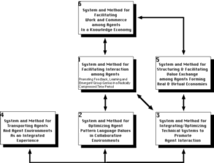
To further facilitate navigation, the following convention referes to the different Subsystems of this Invention: Ss1 = Subsystem 1 “System and Method for Facilitating Interaction among Agents;” Ss2 = “System and Method for Optimizing Agent Pattern Language Values in Collaborative Environments;” Ss3 = “System and Method for Integrating/Optimizing Technical Systems to Promote Agent Interaction;” Ss4 = “System and Method for Transporting Agents and Agent Environments as an Integrated Experience;” Ss5 = “System and Method for Structuring & Facilitating Value Excahnge Among Agents Forming Real and Virtual Economies;” Ss6 = “System and Method for Facilitating Work and Commerce among Agents in a Knowledge/Network Economy.”
A rL4-Ss1 annotation could refer to a human team scale facilitated interaction framework, as example. Any description or diagram annotated as such should be interpreted in this context.
...DEFINITIONS:
ACT KTO ENVIRONMENT4
| ACT K rL4-Ss1:The process of doing or performing something. An enactment or decree. To drive to do. To push, propel or push forward. Part of both the SCAN, FOCUS, ACT model and the 4-Step Recreative Process model. ACT is the opportunity to see whether the models will pan out as they become viable systems in their own right. If discipline and imagination have been brought to the two preceding stages, this stage should be successful. AGENCY Minsky defines Agency as “any assembly of parts considered in terms of what it can accomplish as a unit, without regard to what each of the parts does my itself.” AGENT (SIMPLE, COMPLEX, SMART AND INTELLIGENT) Minsky defines Agent as “any part or process of the mind that by itself is simple enough to understand - event though the interactions among groups of such agents may produce phenomena that are much harder to understand.” ANDMap Project Management Tool rL4-Ss3: The term ANDMap stands for Annotated Network Diagram Map and refers to an invention that synthesizes Gannt charts, network diagrams like PERT, CPM or GERT, and process flow charts. The items on the map are plotted to scale over time and may be collected across a series of horizontal tracks, like Gannt charts. A standard set of symbols are employed to represent a range of activities from the strategic (Landmark, Benchmark) to the tactical (Event, Task), to the conditional decision point (Cusp) to the task level (Milestone). Landmarks and Benchmarks can be employed to express large scale ideas like missions, visions and goals. Events are rounded rectangles used to identify activities in points of time. They can be annotated with resource and duration data and used in network diagram fashion. Tasks have symbols representing the start and end of an activity, much the way activities are represented on Gannt charts. The Cusp represents a decision gate that may be found in process charts. Since the ANDMap is laid out with time as one of its axes, loops are usually avoided--currently it's still impossible to go backwards in time--instead a NO decision out of a Cusp will either end in a cessation of the project, an alternative contingency, or an indication that previous work must be redone, and showing this rework extending out along the timeline so the project team can get a visual sense of the impact of the decision. Milestones are used to highlight significant subdivisions of Events or Tasks. All of the symbols are connected by lines that may be coded to represent dependency, parallel processing, or critical information exchange. The symbols and lines may be color coded to provide additional information to the user, and extensive annotations may be written around the symbols on the map to provide explanations. ANTICIPATORY , rL4-Ss1: To feel or realize before hand; foresee. To act in advance so as to prevent; prejudice; forestall. To foresee and fulfill in advance. To cause to happen in advance; accelerate. To take before. As one of the six elements of the Appropriate Response model, anticipatory represents the notion that designs or solutions to problems are living systems. As such, they must include the apparatus and processes necessary to use models based on past experience, along with current data gathering to make predictions concerning the future behavior of other systems in the environment. At the lowest level, this serves survival; at higher levels, anticipatory hardware and software enable systems to effectively collaborate with one another to support both the homeostasis and evolution of their collective ecosystem. ANTICIPATORY DESIGN ,& a concept of Buck Fuller that describes the process of designing solutions to emerging problem prior to their general awareness in an organization or society. The solutions are, thus, in the prototype stage and ready for swift adaptation when the problem can be see and, thus, when the motive exists to resolve it. ARCHITECTURE Refers to the field of architecture. In this system and method, the formal deffinition of architecture is: “the objectification of the values humans hold essential to living - making these values concrete by building and using the structures that form the environment.” Architecture is also employed herein as references to the basic structure/process of an idea system or artifact. ARTIFACT (TEST - PROTOTYPE)C (Known as Mechical Cat) In order to test our concept, we create physical models and compare them to the reality. The artist paints; the engineer builds scale models; the business person turns to planning software and spreadsheets; the writer composes stories. See the Three Cat model. AUTHOR-TO-AUTHOR (also known as BE-THE-AUTHOR) (See Syntopical Reading) rL4-Ss1: A type of DesignShop or Work Shop module in which each participant has been given a different book to read in advance. At the time of the module, the participants engage in a discussion of the issues facing the enterprise, however, they discuss from the vantage point of the authors they have read. Each participant assumes the personae, knowledge base, vantage point and opinions of the author whose book they were assigned to read. The exercise forces a change of vantage point and introduces new information into the pot. Its a day one or day two exercise. BODY OF KNOWLEDGE1 rL4-Ss1:One domain in the 7-Domains model, the Body of Knowledge represents the sum total of the historical and contemporary artifacts produced by all members of an organization. It is the living memory of an enterprise. Its purpose is to embody what is critical to successful planning, coordination and steerage, and implies the continuous interaction of members to sustain meaning and purpose. Group Genius does not occur systematically without a living Body of Knowledge that is documented, organized and synthesized. However, simply amassing volumes of archival data should not be confused with the function of the Body of Knowledge. The Body of Knowledge is more of a living property of an organization that arises in the process of creation. Capturing it in the form of artifacts augments learning and enables useful patterns to be recognized. This results in the cultivation of insights gleaned from experience that sustains organizational self-awareness and a sense of the future. BOUNDARY CONDITIONS The framework in which an exercise is conducted or a problem defined. See: Zone of Emergence Engine Fig. SS1-8. This framework is defined by a number of elements depending on subject, context and the operation in play. These can include: time, scale and scope, rules-of-engagement ToA and so on. BREAKOUT rL4-Ss1: A general activity during a DesignShop event or Work Shop when a large group is divided into smaller teams to work on either different issues, or different aspects of the same issue. The space in which this activity takes place is a Breakout Area. The group undertaking this activity is called a Breakout Team. Breakout activities are variously referred to as Breakout Rounds or Design Rounds. BUILDw rL4-Ss1: To form by combining materials or parts; to erect; construct. To give form to according to a definite plan or process; to fashion; mold; create. To establish and strengthen. To establish a basis for. One stage in the DESIGN, BUILD, USE model. There must be a process for rapid execution of the design that allows frequent adjustments to the realities of a build-out and the changing perceptions of the user as the design unfolds. The process and the product (space) must provide for this speed throughout the occupancy so that the enterprise of users does not have to waste time and talent in reconfiguring itself to meet changing conditions. CAPTURE TEAM rL4-Ss1: A subset of the KreW of Knowledge Workers in a DesignShop event who are assigned to work in a Breakout Area to document, or capture, the discussion in one or more forms: keywords, synthesis (by individual attribution or journalistic summary), graphics from the WorkWalls. The work of this team is published to the DesignShop Journal. CHANGE B rL4-Ss1: An element in the Rate of Change model. In this System and Method, change is treated as continuous but measurable in discrete steps see: Memory Aspect 12 . CHANNEL Referes to a means by which ideas, energy, goods or Agents are transported. See Memory Aspect: 11 and Mind Engine SS6-1. CIRCLE-UP rL4-Ss1: A ritual for the disciplined sorting of signals to help a Patch (Team) through the process of association and decision-making in support of the next major phase of work. Circle-Up also brings the Patch into unity at a point in time; although unity does not imply consensus in this case. Its also a formal time to acknowledge progress, failures and successes along the Lifecycle of the Web (Enterprise). Its a time to engage the multiple intelligences of the teams members in a process of collaborative design. Commonly a Circle-Up is use to shape the opening and closing of an event. It can put the Patch back in touch with its Vision and the iteration of the work to be done. CIRCUIT A complete loop usually involving a series of way-points. COEVOLUTION The process by which one evolving complex system, A, changes in concert and with feedback ToA - thus, causing change - with another complex system, B, which forms A’s environment. COMPLEX - COMPLEXITY V From the Principia Cyberneticus Web site: "É the original Latin word complexus, which signifies "entwined", "twisted together". This may be interpreted in the following way: in order to have a complex you need two or more components, which are joined in such a way that it is difficult to separate them. Similarly, the Oxford Dictionary defines something as "complex" if it is "made of (usually several) closely connected parts". Here we find the basic duality between parts which are at the same time distinct and connected. Intuitively then, a system would be more complex if more parts could be distinguished, and if more connections between them existed. (http://pespmc1.vub.ac.be/COMPLEXI.html) rL4-Ss1: An element in the Rate of Change model. CONCEPT (OF OBJECT/THING)X(Known as: Concept Cat) rL4-Ss1: The mental model that we build of an object or thing, based upon our observations of the real thing, that aids our decision making process. We learn to associate current phenomenon with past occurrences of similar phenomenon. We make decisions based on projections of past behavior onto the current situation. Lacking any such direct associations, we are forced to invent. See the Three Cat model. CONCEPTION[ rL4-Ss1: As the first component of the Stages of an Enterprise model, Conception is where ventures and enterprises originate. Scribbles on napkins, nagging dreams, a persistent or alarming push by the external or internal rate of change. Conception is the ability to form mental concepts; invention. The formation of a zygote capable of survival and maturation in normal conditions. Concept, plan, design, idea. To take to oneself. CONDITIONO rL4-Ss1: The particular mode or state of being of a person or thing. The existing circumstances. Latin, conditio, agreement, stipulation, from condicere, to talk together, agree. As the first stage in the Creating the Problem model, these are the existing conditions before you begin the creative process. Notice that these conditions, in and of themselves, are merely conditions. They are not the problem. These conditions are in constant flux and will change as the creative process advances. CREATIVE TENSION }(See: Tension - Creative) rL4-Ss1: Creative: the power to cause to exist, bring into being, originate. As a component of the Creating the Problem model, the creative tension that comes into being when you decide to resolve the problem is the interplay between vision and reality. As the two tug and pull at each other, they will each change and modify in an effort to reach a synthesis. CREW (Also spelled KreW) rL4-Ss1: A team of Knowledge Workers charged with supporting a process such as a DesignShop event. CULTURE) rL4-Ss1: Cultivation, tilling. The totality of socially transmitted behavior, patterns, arts, beliefs, institutions, and other products of human work and thought. As a component of the Vantage Points model, Culture defines the various components of the Enterprise and their relationship to one another in action. Also encompasses standard behaviors of these components--behaviors which are manifestations of the Philosophy. CUSTOMER z rL6-Ss1:A person who buys goods and services on a regular basis. To become, to accustom. According to the ValueWeb model, the customer still purchases and uses the product. But customers are also interested in how well and ethically the companies are run--they vote with their investments. And customers are included in production. CYBERNETICS The science of organization. The theoretical study of communication and control processes in biological, mechanical, and electronic systems, especially the comparison of these processes in biological and artificial systems (The American Heritage Dictionary of the English Language, Fourth Edition). DEATHh rL4-Ss1: Termination, extinction, loss or absence of spiritual life. As a component of the Stages of an Enterprise model, Death represents the fact that eventually all organizations reach their demise. Usually this is good. Sometimes it's the easiest way for the enterprise to allow new ideas to escape and try for viability. And even if the name of the corporation does not change, sometimes, its old self dies and a new one is born in its place. DESIGN & rL4-Ss2: To conceive, invent, contrive. To form a plan for. To draw a sketch of. To have as a goal or purpose; intend. A visual composition; pattern. To mark out; sign out. As part of the Design, Build, Use model, Design represents the creation of sketches, models, plans, schedules, and budgets to convey a sense of the scope of the project in many different dimensions. This is not done merely at the beginning of the project, but as a sort of continuous process throughout the life of the building. The design takes into account past and present work process requirements, and the uncertainty associated with the future as well..
DESIGN ASSUMPTION A major aspect that underlies a design approach. Remove the assumption and the design is massively altered. DESIGN DEVELOPMENT A discreet step following PRELIMINARY and proceeding CONTRACT DOCUMENTS in the Design Formation Model. DESIGN ISSUE An issue in a circumstance that is directly resolvable by exercising the design process. DESIGN STRATEGY &+ The core aspects and feature of a design that directly address the significant aspects of a problem. See: Creating the Problem Model. DESIGNSHOP EVENT &! rL4-Ss1: An event whose purpose is to release Group Genius in the client, condense the time in which a team moves from Scan to Act by an order of magnitude, capture and organize all of the information generated, and do all of this in a facilitated way by managing not the people involved, but the 7-Domains that regulate collaboration and evolve ingenuity. DESIGNSHOP SPONSOR &D rL4-Ss1: Representatives from the client who usually have a considerable stake in the successful outcome of the DesignShop. They may be project managers, department heads, or CEOs. Sponsors are also participants in the event, although in some cases they may work on the KreW. Some clients have only one sponsor, and others have an entire sponsor team. DISTRIBUTION $ rL4-Ss1: To allot, grant apart. Dispersion, diffusion. Divide and dispense in portion. As a stage in the 10 Step Knowledge Work Process model, distribution is the process of repackaging, encoding, transducing, and transmitting across the Web (Enterprise) to all parties that need the information as potential compelling input. DOCUMENT @ rL4-Ss1: To note down, to mark. Lesson, example, warning, to teach. Anything serving as evidence or proof. To support with citations, annotate. As a stage in the 10 Step Knowledge Work Process model, the information is captured, encoded in the form of a message, tagged for shipping, transduced across the Event membrane, and transferred via some signal, medium, and channel to the K-Base. Also referred to as Documentation. DOCUMENTATION TEAM rL4-Ss1: A subset of the KreW whose work comprises capturing reports and conversations that occur when all of the participants are assembled into one group. (The Capture Teams document reports and conversations that happen in Breakout Teams.) EDUCATION AND TRAINING3 rL4-Ss1: Education and Training, representing one domain in the 7-Domains model, are critical factors for thriving in an environment of rapid and discontinuous change. Often confused as one, education and training are actually very different in both intent and method. Education means "to lead out" and is primarily an open-ended process. Training means "drawn or dragged behind;" it is a closed process that ensures the continuance of purposeful habits. Training instills heritage. It transfers what is known. An organization should never lose its basic, root knowledge and skill; its memory. Education leads forward to discover the new. It is a form of leadership. Practicing the craft of leading through educating is how meaning and purpose are translated into a resilient capacity to create the future. EFFICACIOUS b rL4-Ss1: One of 6 components of the Appropriate Response model, Efficacious is the power or capacity to produce the desired effect. Ability to achieve results. To execute, make; perform, work out. To effect. By contrast, the word effective means "having the intended or expected effect." The difference lies in the use of the word "power." An efficacious design exudes power and this power is efficiently directed to yield predictable results.
EMERGENCE - EMERGENT BEHAVIOR Emergence is a new kind of cause and effect. It is the cause and effect of living entities and the phenomena related to them. It is that kind of cause and effect where "the interaction of the elements or entities gives rise to higher-level properties that are not apparent in the lower levels nor predictable from those levels. "Such a system would define the most elemental form of complex behavior; a system with multiple agents dynamically interacting in multiple ways, following local rules and oblivious to any higher-level instructions. But it wouldnÕt truly be considered emergent until those local interactions resulted in some kind of discernible macro behavior." Steven Johnson, Emergence, page 19. ENCOUNTER R rL4-Ss1: To meet or come upon, especially casually or unexpectedly. To meet, especially in conflict. In the context of the 'Spoze Model, during the Encounter stage, the system's current Paradigm meets up with a high information messaging event. This means, simply, that the system is experiencing the effect of New Information that does not fit into its current model of how things work--its Paradigm. And it means that the potential effect of this information is of such a magnitude as to compel a conscious decision for handling it. Either it represents a threat and the system must learn new strategies for thwarting it, or it contains a potential benefit and the system must learn how to take advantage of it. ENGAGEMENT TEAM rL4-Ss1: A group of people who are assigned to work with a specific client over the duration of the relationship. They may also include DesignShop facilitators and Knowledge Workers, but this is not necessary. ENTREPRENEURIAL BUTTONd rL4-Ss1: Organizing, operating and assuming the risk for business ventures to undertake--to take between; to strike against, thrust, pierce. Within the Stages of an Enterprise model, newly conceived ideas within an existing Enterprise, even if tested through the looping stage, cannot become viable unless the Entrepreneurial Button is pushed. There must be an overt recognition of the need for and value of the new idea or it will not be allowed to grow. ENVIRONMENT4 An environment is that which surrounds and creates the circumstances of an organism. In this System and Method, environments can be physical and/or virtual and make up one of the three core capacities of the system of the present Invention: (processes 2, environment 4, tools 5). In this System and Method, environments can include machine rL2 and network systems/structures rL7. Environments can include humans rL4 and other life forms and subsystems of these rL1. An environment can be a social system rL6. It can include transportation environments Ss4. rL5-Ss2: Environments to house this System and Method are presently referred to, generically, as Management Centers, NavCenters and KnOwhere Stores especially in the context of DesignShop events, PatchWorks exercises and other formal processes. This Invention is not limited to these expressions. More generally, any space that has been consciously designed and configured to support a process in a flexible and evolutionary manner. Most of us work in “spaces” (office space, work space, etc.) that are devoid of enlightened, conscious design, and therefore very poorly support our lives and the processes that comprise them. In this System and Method, environments for human teams rL5, while being architecture and accomplishing Pattern Language values, affording knowledge-workers ToA more individual accommodation, self-adjustment and adaptability - in less overall footprint - this System’s environments are conceived [, designed &, built wand used as a tool 5 of knowledge creation: to display, store, retrieve, recreate :and display, in iterations, information/knowledge objects/Agents. This is accomplished in extremly short design-build time periods, from manufactured components, at affordable prices, as a major Subsystem process and capability of the present Invention. Go To: |
Further information concerning these definitions can be found in the Appendices hereto, which are incorporated herein by reference.
Return to Outline

SolutionBox voice of this document:
IDENTITY • STRATEGY • CONTRACT DOCUMENTS
posted June 14, 2000
revised November 6, 2001
• 20000616.9582.mt • 20000623.164452.mt • 20000624.80653.mt • 20000625.221323.mt •
• 20000709.6463.mt • 20011106.339876.mt •
(note: this document is about 50% finished)
Copyright© 1982, 1997, 1998, 1999, 2000, 2001 Matt Taylor
Contact:
Matt Taylor 843 671 4755