c o n f i d e n t i a l
Privileged access only
This document uses a custom font for the Glyphical Language part of this Patent.
Download the font and place it in your system folder.
Else you will have strange charectors showing up on your screen
For Mac
For Window
SYSTEM AND METHOD FOR AUGMENTING KNOWLEDGE COMMERCE
Terminology and References
Part 3of 3
...DEFINITIONS:
METAPHORS EXERCISE To WORKWALLS
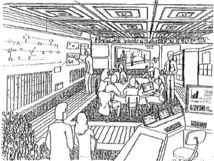
| METAPHORS EXERCISE rL4-Ss1: A Breakout Round in which the various teams will compare some "unrelated" system to the situation at hand in a metaphorical way. If the situation concerns a distribution system, a team might be asked to examine how an ant colony manages its distribution system, or how a distribution system might be described in quantum mechanical terms. The purpose is two-fold: (1) to actually learn how other, alien or obscure systems actually manage similar processes, and (2) to see the situation from a radically different vantage point since we know that this is a powerful technique for generating creativity. On a general level, all words - other than denotative - are metaphors of some “real” things or “no-thing.” Even a denotative concept is not the thing, itself, being referenced. The ability to manipulate and “bend” words (concepts)‚ is intrinsic to the human creative process and may well relate to machine “intelligence.” Making a pun is shifting the level of recursion ToA of a concept. It is an example of active K memory. Words are Models ToA and follow the rules associated with appropriate modeling. METHOD A systematic, documented way of doing work. In human Agents, it involves both ConsciousnessToA and unconsciousnessToA (See: Mind Engine SS6-1), however, it can be taught and transferred to other Agents of many kinds. MODEL rL4-Ss1: A "slice of reality," a vantage point of perception. The Latin derivation, modulus is the diminutive of modus, which means measure, rhythm, harmony. So a model is a little measure, a little rhythm, a little harmony--a slice. Of these three terms, we're perhaps the most familiar with "measure", but the other two are more important to contemplate. We're used to building models to measure things--the effect of air pressure on the surface of a wing, or the profitability of a corporation. We may not be so comfortable with ferreting out models that divine the rhythm and harmony of the world around and in us. Or if we are, we confine those models to the realms of art, philosophy, essay, poetry. But the complexity of the world--even the corporate world--is too deep to be fathomed by measurements alone. Business is art and the Enterprise should call upon the qualities of rhythm and harmony inherent in art for assistance to lead it into the future. NATURE - TRUE TO m rL4-Ss1: In the Appropriate Response Model, a design that is true to nature is composed of elements that support one another, that do not conflict, and whose capabilities are mutually requisite. In a growing seedling, the roots, stem and leaves all remain requisite with one another: the leaves don't photosynthesize too much or too little, the stem is sized just right to provide structural support and the transport of materials up and down. A design should be elegant, all of its parts fitting together in a pleasing fashion that makes people want to employ it. The forces or processes of the physical world, generally personified as a female being. The order, disposition and essence of all entities composing the physical universe. The aggregate of a person's instincts, penchants and preferences. To be born, birth. NET A term referring to a specific network. NETWORK An architecture ToA of nodes, channels, thresholds ToA and other elements that is loosely connected in various ways. Networks of critical mass act organically ToA and exhibit self-organization ToA. NETWORK ECONOMY ( see: Knowledge Economy) An economy characterized by a distributed ToA, nodal ToA, mind-like architecture that works through channels ToA and web-like configurations of Agents. See: ValueWeb Architecture SS6-2. Tightly related to the Knowledge Economy concept because knowledge-intensive environments ToA demand flexibility ToA , adaptabilityToA, high variety ToA and the ability to reconfigure on demand. Traditional organizational structure/processes can not respond well in these conditions ToA. Network and Knowledge Economies tend towards increasing returns ToA due to the nature of their core resources. Traditional governance ToA mechanisms do not function appropriately in these economies. See: Appropriate Response Model. NEW INFORMATIONT (See: Information - New) rL4-Ss1: A numerical measuer of the uncertainty of an experimental outcome. Knowledge derived from study, experience, or instruction. A non-accidental signal used as input to a computer or communication system. In the context of the 'Spoze model, systems are receiving all kinds of messages from other systems and the environment in general. Messages are neutral. They do not contain information. Rather, information is the result of a system's interpretation of a message, including whatever meaning it assigns to the message based on past experience. This meaning--or message in context of associated experiences--is what we call information. The measure of information is proportional to its uncertainty, or surprise. The more surprising the message, the more information it contains. Most messaging events are devoid of information, either because they are filtered out, or because they bear messages whose content is expected by the receiving system NODE A place of connectivity in a network architecture where resources cluster. OBJECT A discreet physical thing or virtual ToA no-thing ToA that can be treated as bounded ToA , defined and possessing certain characteristics, attributes ToA , functions ToA, relationships and rule-sets ToA. Related in this System and method to OOP (Object Oriented Programming) in terms of certain software methods. OVERSHOOT AND COLLAPSEa rL4-Ss1: To go beyond, to miss by or as if propelling something too far. To fall down or inward suddenly. To cease to function, to break down suddenly in health or strength. Slide together; fall in ruin. In the Stages of an Enterprise Model, if the enterprise does not learn how to maintain homeostasis, it may overshoot its envelope of healthy growth and then rapidly collapse upon itself. This stage is sometimes called the "Hollywood Star" syndrome. PARADIGMY rL4-Ss1: Any example or model. [In our case, a world model used by the controller of a system to make decisions based upon input to the system and past experience.] For a living system to make decisions, it must be able to compare the nature of sensory input that it receives to some model that predicts probable future outcomes based on stored previous experiences involving that input. This memory may be inherited genetic storage, or learned mental storage. In either case, it represents a guide to success given a variety of situations. The sum total of these situations and the guidelines stored in the system comprise its Paradigm. PATCH A collection of nodes ToA that are bounded ToA and follow certain swarming rules ToA. PATCHWORKS DESIGN A specific architecture of Patches ToA and Nodes ToA that deals with organizational issues related to information ToA overload, lock-in ToA, decision paralyses and over-voting. High variety, complex and massive scale networks employ this architecture to remain both effective and adaptive. PHILOSOPHY ( rL4-Ss1: Loving wisdom. The investigation of causes and laws underlying reality. Inquiry into the nature of things by logic instead of empirically. Any system of motivating concepts or principles of a culture. In the context of the Vantage Points model, Philosophy is the fundamental--usually hidden--beliefs that unite the components of an Enterprise, enabling them to act as a cohesive whole. Properly applied, philosophy enables both innovation and stability.. PRELIMINARY DESIGN rL4-Ss2: Latin: before the threshold ToA. Prior to or preparing for the main matter, action or business. Latin: to mark out. A drawing or sketch. The invention and disposition of the form,parts, or details of somethign according to a plan--a visual composition. In the Design Formation Model, the proof of the program showing the scaled relationships between elements of the program. A dimensioned, hard line drawing. . PROBLEM{ rL4-Ss1: A question or situation that presents uncertainty. A question put forward for discussion or solution. Greek, problema, "thing thrown forward", projection, obstacle. In the Creating the Problem Model, the problem is created when you discover a gap between reality and your vision for a new reality. The problem is neither current conditions nor the vision. Rather, it is the discrepancy between them.. PROCESS DESIGN AND FACILITATION2 rL4-Ss1: Process Facilitation is the systematic removal of blocks to individual and organizational creativity. To facilitate means to "make easy" or "smooth the way." It is the method and practice for removing obstacles and clearing paths so that organizational activity flows naturally and efficiently. Blocks are of many types, for example: Physical, a work setting that hinders one's ability to organize and produce; Conceptual, locked into past solutions or lacking models of new or different approaches; Temporal, not having the right people together long enough to break through to new solutions. Process Facilitation is knowledge work's equivalent of engineering. Its use not only removes waste, downtime, confusion and friction, it also enables the systematic creation of new knowledge and innovation. PROCESS FACILITATOR rL4-Ss1: An individual who facilitates the work of the KreW and the Facilitator during the DesignShop event. PRODUCER c rL4-Ss1: One who brings forth, creates by mental or physical effort. One who causes to occur; one who leads forward. The producer actually makes the product. Producers are employees, vendors and suppliers that make up the entire chain required to create and deliver a product or service. According to the ValueWeb model, the producer still makes the product or creates the service. But producers are more involved in understanding how the company works through programs like open book management. See: SS6-2 ValueWeb Architecture. PRODUCTION rL4-Ss1: The subset of the KreW of a DesignShop charged with keeping track of all of the documentation generated by the DesignShop and assembling it into paper and electronic Journals for distribution to the participants, usually within a few days of the end of the event. Journals may be 500 or more pages in length. The new documentation process allows the Journal to be captured in a database for ease of use in an electronic format. PRODUCTION MANAGEMENT A specific set of protocols and procedures related to the making of a specific product or artifact. PROGRAM rL4-Ss2: Greek: to write before. A procedure for solving aproblem. Any organized list of procedures. In the Design Formation Model, a set of specifications concerning the intended use of a space including who may use it, and what they want to use it for. The program is typically a list. PROJECT MANAGEMENT6 (See: Management - Project) rL4-Ss1: Within the 7-Domains Model, Project Management is the Domain of execution. It is the application of methods and procedures to planning and strategy. Goals cannot be managed - they must be translated into "doable" tasks and daily activities with resources allocated for specific reasons. At the same time, the mission cannot become too distant or projects lose focus and momentum. Project Management unfolds through cycles of measurement and feedback, in the true cybernetic sense that adaptation and evolution occur through self-correction and adjustment. Thus, when a project component is not achieved "as planned," it is both and opportunity of discovery and learning, as well as an opportunity to refine the plan, based on "real world" information. PROJECT STATUS MAP rL4-Ss3: A project management tool that employs a matrix of projects listed down one side and days or weeks listed across the top. There are two ways to use a project status map: (1) for each sub task within a project, place a tag along the projects line under the date when the sub task is due. Then track the progress of work on each sub task through a system of visual indicators (green for go, red for holding, blue for completed, etc.); (2) if youre tracking a number of identical projects, advance a single tag along each projects line to indicate the status of the project. Project status maps are most appropriate for projects whose scale and complexity tend to make them linear progressions of tasks. If there are many parallel tasks or the duration of the project runs for many quarters or years, an ANDMap or similar project management tool is more appropriate. PROSPECT A concept in architecture ToA that defines landscapes and spaces of high variety ToA, ambiguity ToA and mystery that stimulates interest and the desire to Scan ToA in intelligent Agents ToA. These architectural spaces can be physical (thing) or virtual (No-thing) or combination thereof. RADIANT ROOM rL5-Ss2: A large space in a Management Center where the participants gather together as one body to hear reports or have synthesis discussions of some sort. The focus of the Radiant Room is a long WorkWall called the Radiant Wall that may be straight, folding or curving depending on the design of the individual center. Some Radiant Walls stretch to over 40 feet in length. The back side of the Radiant Wall is frequently covered with an adhesive material made by 3M to which paper can be adhered and removed many times over. This is called the Knowledge Wall, although you may hear it called the Sticky Wall by old timers in the network. The term Radiant Wall comes from Isaac Asimovs idea of a Radiant Cube that he introduces in the third volume of his Foundation Trilogy. The cube is a device that holds the plans for the rebirth of an entire galactic civilization, yet sits unobtrusively on a table top. When a Speaker from the Second Foundation focuses his mind on the cube, it projects the plan on the walls of the room. With further mental effort the Speaker can navigate the plan from start to finish, zoom in to more detail or pull out to a more general landscape, and see the record of all the changes that have been made to the plan and all of the contingencies built into it as well. This System and Method includes the creation and operation of virtual radiant “rooms” and the combination of these with physical places. RDS (Rapid Deployment System) rL5-Ss2: Also called the Transportable Management Center. An entire kit of WorkWalls, Work Stations, Break-out Tables, lighting, computers, network, video cameras, video technical direction equipment, video editing equipment, supplies, library, games and toys sufficient to support a multiple day DesignShop for a group varying from five to one hundred participants and up to thirty or so KreW. The RDS is shipped in trucks and takes a day or two to assemble and tear down depending on the size of the event. READ AHEAD * rL3-Ss1: A collection of materials delivered to participants up to a week or so in advance of a DesignShop. The articles and books chosen for a Read Ahead will serve one of two purposes: provide more information concerning the problem to be created and solved during the DesignShop, and to stretch thinking and introduce new ideas that challenge preconceptions. The Facilitator, Process Facilitator, Sponsor and perhaps one or two KreW members handle the selection, assembly and distribution. Books are ordered through the KnOwhere store. REAL (THING - OBJECT)Z(Known as: Real Cat) rL4-Ss1:Being or occurring in fact or actuality; having verifiable existence. Existing actually and objectively. In the Three Cat Model, the real cat stands for "objective" reality. Actually, we don't really ever see the real cat. Our senses gather signals from the visible part of the electromagnetic spectrum, fluctuations in air pressure that register on our ears as sound, and the electrochemical signals that result from physically touching an object. Because our information concerning real cat is most incomplete, there's always more to learn.. RECURSION (AND LEVELS OF) In organizational structures and processes of all types - of any complexity - elements of that organization will operate at different scales (time, space, levels, and so on). Recursion is a design strategy that deals with excessive linearity, critical mass (too much, too little) at any place and misplaced complexity ( as a partial example). Recursion is a way of dividing an organization/process functionally without loss of feedback. Recursion levels act as environments to one another, as well as, support systems to one another. See: Zone of Emergence Engine SS1-8 and Table 2. Each recursion level must have all the attributes of a viable system (Beer) to function appropriately. See Appropriate Response Model. RECREATE: rL4-Ss1: To impart fresh life to. RE:again. CREATE: to cause to exist; to bring into being; to cause to grow. Latin: to cause to grow anew. Within the 4-Step Recreative Process model, between each of the steps, you must recreate what it is you are trying to do given the different and unique parameters of each of these different steps. REFUGE A concept in architecture that relates to the creation of places of rest, safety, peace and contemplation. This is the counterpoint to prospect. Both kinds of place are necessary to the functioning of human Agents. REPORT OUT rL4-Ss1: After participants have spent some time in Breakout Teams they are often invited to reassemble as a large group to hear each team report their work. To prepare for this report, the teams are asked to recreate (not copy) their work onto paper covered magnetic Hypertiles (11x17 inches) which will adhere to the porcelain steel WorkWalls. The group reassembles in a large room that usually has a very large, curving WorkWall called the Radiant Wall (some are over 40 feet long). The teams group their Hypertiles on this wall either by team or by some other sorting category, or they place them on the wall as they are being discussed. The tiles can be moved about and drawn around to sort, connect and emphasize ideas. RULES OF ENGAGEMENT rL4-Ss1: A list of boundaries that must be set on a DesignShop, session, Management Center or NavCenter in order to secure success. The requirement of having no observers or visitors during a DesignShop is an example (everyone either participates or they are on KreW). Another example is the limitation on the conduct of other business by the participants during the DesignShop (it destroys breakout team integrity and compromises the product to have individuals constantly conducting other business away from the team on the phone). Rules of Engagement are critical to all Agent relationships. These operating interactivity rules are part of what defines an Agent. SCALE In architecture, the relationship between elements of a design or built environment and the humans that occupy it. Scale is critical if continuity of experience is to be accomplished. Scale is a critical design element in the architecture of organizations (enterprises, cities, social systems, and so on). When a system, or parts of a system get “out of scale” the functionality of the system is compromised because the Agents within it can not “read” their environment and therefore lose context and sense of place. SCAN 8 rL4-Ss1: One component of the SCAN, FOCUS, ACT model. SCAN is often seen as the first stage of a three stage model, but the model is in fact nonlinear and highly recursive. SCAN means just what youÕd imagine; looking about for different options, or to gather information in a broad sort of way. SCAN also implies a vantage point of some sort from which to view. The original meaning of the word means to climb or mount. In the SCAN phase we build conceptual, mental models. SCHEMATIC CONCEPT rL4-Ss1: Latin: form, figure. A structural or procedural diagram, esp. of an electrical or mechanical system. Latin: a thing taken to oneself. A general idea or understanding, especially one derived from specific instances or occurrences. Within the Design Formation Model, the first proof of the program. Freehand blocking of the ideas at the smallest scale represented by the program, showing prominent elements that drive the design. "Bubble diagrams" and loose sketches.. SCENARIO EXERCISE rL4-Ss1: A module of a DesignShop that is frequently employed to uncover assumptions among the participants regarding how they think about trends, the past and the future. Its usually done in large group on the Radiant Wall. The Radiant Wall is divided horizontally into time frames. Sometimes the Scenario considers the distant pastup to 30,000 years ago, passes through the present (usually the current year plus or minus 5-10 years) and ends sometime in the future. Participants stand before the wall one at a time and state an event they wish to place on the timeline (sometimes further defined by the facilitators instructions) and perhaps its significance. Then they write that event on the wall under the year it occurred. Then the next participant places their event on the wall. This may continue through all of the participants and through several rounds. The exercise is very flexible in terms of how the wall is laid out, what types of events the participants are asked to place on the wall, and how Sketch Hogs are employed to augment and synthesize the visual display. A good synthesist on the KreW can predict much of the outcome of the DesignShop and the solution to the problem simply by studying a well-executed scenario. SCOPE - PROPER n rL4-Ss1: Breadth or opportunity to function. The area covered by a given activity or subject. Watcher, goal, aim. According to the Apprpriate Response model, an excellent design should properly fill its niche and not strive for too much, nor suffer from a timid presence. The boundaries of the design must be clearly defined. This does not mean they must form a contiguous presence, only that by some combination of matter, energy and information the solution is able to distinguish itself clearly from other elements in its environment.. SELF-CORRECTING . rL4-Ss1: To provide with knowledge or training. To discipline, train or develop. To bring up. Within the Apprpriate Response Model, once a system can make predictions about the future, it must compare these predictions with its current behavior and implement changes to adjust its behavior to bring it into harmony with its future models. In this sense it's bringing its vision of the future back to the present. SHARE-A-PANEL rL4-Ss1: A module of a DesignShop usually preceded by a Take-A-Panel exercise wherein participants assemble into teams and visit each team members panelor WorkWallin succession to hear a report of the work scribed on that panel. After each team member has reported their individual work, the team usually assembles in a Breakout Area to either synthesize what theyve heard, or begin work on another exercise. If the total number of participants in a DesignShop is small, they may all participate in the exercise, which is then called a "Walk-About". After each participant has had an opportunity to share their panel, the entire group may assemble for a synthesis discussion or may be divided into Breakout Teams to begin another round of work. SIMULATION An environment, A, in which some aspects of another environment, B, are played and tested to determine the efficacy of some aspects of their likely performance in the real, B, environment. Systems of great complexity cannot be understood and controlled. This means they cannot be successfully tested - predictability is impossible. Unintended consequences result. Simulation is a method for approaching requisite variety ToA by “testing” in as close to a real-world condition as is possible. See: 3 in SS6-3 ValueWeb Builder and SS3-4 in SS3-3 for reference to two ways (of many) that the present invention employs simulation. SKETCH HOG rL4-Ss1: Also called a scribe. A KreW member skilled in listening to a conversation or presentation and capturing its essence and significance in illustrated and annotated diagrams on WorkWalls, paper, computer, or in a 3D physical model. Sketch Hogs are called upon to support participants in Breakout Teams to illustrate their ideas, work before the large group during synthesis discussions, create finished art and icons to support the production of the Journal, and to create finished art and diagrams to support any follow-on WorkProducts. SPONSORDG CLIENT (See: Event Sponsor) rL4-Ss1: An individual or small group who hold primary responsibility or a principal stake in the outcome of a DesignShop, NavCenter, Management Center, or session. Often the sponsor is the champion of the idea which the shop or center is designed to address. The sponsor may also be a manager or executive. Often a sponsor team is assembled made up of representatives from various constituents who comprise the participants in the DesignShop. See: SS6-2 ValueWeb Architecture. SPONSOR D1GKNOWLEDGE WORKER rL4-Ss1: An experienced individual (usually of Journeyman level) who assists and supports another Knowledge Worker through the transition into, through, and out of the ValueWeb system rL6. The sponsor is not necessarily a mentor, and is chosen my mutual agreement - never assigned. Assigning sponsors would violate the pattern of "Stepping Up" or self-selecting tasks and projects from the work to be done. Sponsors are literally individual Transition Managers ToA. SPONSOR D4NAVCENTER rL4-Ss1: An individual, or most commonly a team who champions the purpose, mission and existence of a NavCenter. Since NavCenters are established to support a particular project or purpose, the Sponsor may also be the project manager. Because a NavCenter represents a way of work which radically departs from the behavior of the rest of the organization, the Sponsor should have a position of authority within the organization as well. SPONSOR SESSION D! rL4-Ss1: Usually a three or four hour session attended by the client sponsor (individual or team), the key facilitator, the process facilitator, and supported by one or more KreW. The purpose of this session is to develop clear objectives for the DesignShop, work on assembling the right participant list, decide on general logistics arrangements, take a first cut at the design of the DesignShop process, and get a general idea of what sort of products should be generated during and after the DesignShop. S’POZEU rL4-Ss1: Shorthand for suppose. To assume to be true for the sake of explanation or argument. To conjecture. To substitute, put under, forge. In the context of the 'Spoze model, It is not advisable for a system to accept any and all New Information to add to its Paradigm. The process of modeling enables the system to play "what if" without actually engaging in a potentially threatening experience. STATE CHANGE (or PHASE TRANSITION) When a group of people let go of one reality or model and shift simultaneously to a higher order solution. This state change usually happen about half way through a dynamic DesignShop process. Closely tied to the notions of Emergence and Tipping Points. STEWARDG rL4-Ss1: Within the Learning Path: Five Points of Mastery Model, the Steward applies talents and knowledge in service to others--in stewardship of the community and ultimately of the world. Stewardship means holding a vision for yourself, your community, and your world, and being committed to actualizing that vision. The only way to steward anything is to engage with what we are stewarding in a cybernetic, whole systems manner. By learning anticipatory design, we steward our future as well as our present. Stewardship encompasses stewarding what we value, what we invent, our personal growth, the growth of others, the health of our communities and the natural environment. Stewardship arises from the philosophy that "all life is sacred" rather than "everything is a commodity." STRAWDOG rL4-Ss1: Before each DesignShop, PatchWorks Design phase or other formasl event, the Event Facilitator (Key Facilitator) and/or the Process Facilitator generates a first cut at the design of the event. Sometimes this process is completed formally in a Sponsor Session with the DesignShop Sponsor, the Facilitator and Process Facilitator. These sessions are documented @. The Strawdog summarizes the planners thinking in terms of the purpose of the event, the desired outcomes and the individual modules that comprise the design. Usually the first half of the event is outlined in detail; the rest cannot be designed until the work is underway. rL4-Ss3: In a further manifestation of this System and Method, the KnowledgeBase ToA can be queried, by an Agent of the system, and a number of alternative Strawdogs can be generated based on specific (inputted) information. The memory of all Strawdogs and their results are part of the system and can be shared, as Agents, according to the created profile of those Agents. On an even more general level of this System and Method, any expert F process 2 can be captured in a template J in the KnowledgeBase # of the system to be thus queried and and employed as an Agent to facilitate 2 design &. This can occure on multiple levels of recursion ToA. Again, results can be shared as memory of the system according to specific Agent profiles and embedded rules. These Agents can make up an economy and be traded within it. SUCCESS\ rL4-Ss1: The achievement of something desired, planned or attempted. To follow closely, go after, to go toward. Within the Stages of an Enterprise model, at this stage, the enterprise is viable. This means it understands as an organism how to maintain its metabolism from month to month, and how to grow. SUSTAINABLE / rL4-Ss1: To provide with knowledge or training. To discipline, train or develop. To bring up. Within the Appropriate Response Model, a system must be able to survive birth, grow to maturity, and reproduce itself. It must do this without depleting the systems that support its growth, otherwise it will cause its own demise. SYNERGY In Synergetics, R. B. (Bucky) Fuller notes the following with regard to Synergy: “Synergy means behavior of whole systems unpredicted by the behavior of their parts taken separately. Synergy means behavior of integral, aggregate, whole systems unpredicted by behaviors of any of their components or subassemblies of their components taken separately from the whole. A stone by itself does not predict its mass interattraction for and by another stone. There is nothing in the separate behavior or in the dimensional or chemical characteristics of any one single metallic or nonmetallic massive entity which by itself suggests that it will not only attract but also be attracted by another neighboring massive entity. The behavior of these two together is unpredicted by either one by itself. There is nothing that a single massive sphere will or can ever do by itself that says it will both exert and yield attractively with a neighboring massive sphere and that it yields progressively; every time the distance between the two is halved, the attraction will be fourfold. This unpredicted, only mutual behavior is synergy. “Synergy is the only word in any language having this meaning. The phenomenon synergy is one of the family of generalized principles that only co-operates amongst the myriad of special-case experiences. Mind alone discerns the complex behavioral relationships to be cooperative between, and not consisting in any one of the myriad of brain-identified special-case experiences. The words synergy (syn-ergy) and energy (en-ergy) are companions. Energy studies are familiar. Energy relates to differentiating out sub-functions of nature, studying objects isolated out of the whole complex of Universe - for instance, studying soil minerals without consideration of hydraulics or of plant genetics. But synergy represents the integrated behaviors instead of all the differentiated behaviors of natures galaxy systems and galaxy of galaxies. Chemists discovered that they had to recognize synergy because they found that every time they tried to isolate one element out of a complex or to separate atoms out, or molecules out, of compounds, the isolated parts and their separate behaviors never explained the associated behaviors at all. It always failed to do so. They had to deal with the wholes in order to be able to discover the group proclivities as well as integral characteristics of parts. “The chemists found the Universe already in complex association and working very well. Every time they tried to take it apart or separate it out, the separate parts were physically divested of their associative potentials, so the chemists had to recognize that there were associated behaviors of wholes unpredicted by parts; they found there was an old word for it - synergy. Because synergy alone explains the eternally regenerative integrity of Universe, because synergy is the only word having its unique meaning, and because decades of querying university audiences around the world have disclosed only a small percentage familiar with the word synergy, we may conclude that society does not understand nature. “In addition, there is a corollary of synergy known as the Principle of the Whole System, which states that the known behaviors of the whole plus the known behaviors of some of the parts may make possible discovery of the presence of other parts and their behaviors, kinetics, structures, and relative dimensionalities. The known sum of the angles of a triangle plus the known characteristics of three of its six parts (two sides and an included angle or two angles and an included side) make possible evaluating the others. “Eulers topology provides for the synergetic evaluation of any visual system of experiences, metaphysical or physical, and Willard Gibbs phase rule provides synergetic evaluation of any tactile system. The systematic accounting of the behavior of whole aggregates may disclose discretely predictable angle-and-frequency magnitudes required of some unknown components in respect to certain known component behaviors of the total and known synergetic aggregate. Thus the definitive identifications permitted by the Principle of the Whole System may implement conscious synergetic definition strategies with incisive prediction effectiveness.” SYNTOPICAL READING A technique employed in DesignShops and other collaborative events that involves readers studying different books (or other materials) then sharing them interactively in a real-time dialog. This process (on the human scale) mimics their own internal mental processes of memory. An example of the scale-ability of this System and Method through many levels of recursion and the employment of different kinds of Agents. SYSTEM Any collection of parts that can be seen as such, that can function with continuity, and can be described. Once a “system” is declared the logic of the interrelationships between these parts takes hold. The making of a system is “arbitrary” (not bound by nature) but once made the rules of the system must be followed. Complex systems are always “partially overlapping” (Fuller). SYSTEMIC Where the core of everything is connected - tied together at the root and must be considered as a unified body of parts. SYSTEMS INTEGRATORv(see: Manager/management) rL6-Ss1:The act, manner or practice of directing or controlling the use of. To direct or administer. Hand, handle. To mete out, dispense. To be an aid, minister to, servant. Management provides the information and communication hub between the other players in the Business of Enterprise model. At different times in history, managers have focused alternately on fulfilling the desires of one player or another. According to the ValueWeb model, Management still balances the business of the whole web, but the management function is more distributed. There is more management going on, but fewer managers doing it. TAKE-A-PANEL rL4-Ss1: A module of a DesignShop wherein the participants take one panel of a WorkWall (about 6 tall by 4 wide) each and compose on it answers to an assignment. The exercise allows all of the participants to be heard, to express their ideas in whatever visual fashion they wish, and have their ideas available to be viewed by other participants and captured by the DesignShop KreW. This exercise is usually succeeded by a Share-A-Panel exercise. TECHNICAL SYSTEMS5 (See: Tools) rL4-Ss1: Technical Systems, Domain five in the 7-Domains model, augment and amplify human creativity. They are the set of tools and protocols that enable an organization to work effectively as a whole system. They help define and preserve the boundaries of an organization and enable it to sense and respond to the external environment. An organization's technical system is akin to the human nervous system: it continually organizes a vast amount of information about the health of all its component parts and their internal and external interactions. It provides the means by which knowledge that is fragmented or local can become organized and available where needed. TEMPLATE J rL4-Ss1: A pattern or gauge used as a guide in making something accurately or in replicating a standard object. Often a piece of wood or a thin metal plate. Old Fench "temple": a wooden device in a loom that keeps the cloth aligned during weaving. "Temple": sanctuary. As part of the 4-Step Recreative Process Model, create a template for your creation, in words, symbols, pictures, 3D, or some other physical medium. This template should represent your vision and be able to communicate its essence to others. TENSION - CREATIVE} (See: Creative Tension ) rL4-Ss1: Creative: the power to cause to exist, bring into being, originate. As a component of the Creating the Problem model, the creative tension that comes into being when you decide to resolve the problem is the interplay between vision and reality. As the two tug and pull at each other, they will each change and modify in an effort to reach a synthesis. THRESHOLD The band between the optimum operating environment of a system and it’s limit ToA. Approaching the threshold will increase the frequency and magnitude of (negative) feedback ToA in a viable system. TIPPING POINT Comes from the field of epidemiology and indicates the point at which a disease has infected enough hosts that it must be considered a raging epidemic and the spread of the disease grows exponentially. We use tipping points to mean that point which changes the game. The future is no longer a linear extrapolation of the past. Our system and method tracks tipping points through multiple iterations of weak signal research. TOOLS5 (See: Technical Systems) rL4-Ss1: Technical Systems, Domain five in the 7-Domains model, augment and amplify human creativity. They are the set of tools and protocols that enable an organization to work effectively as a whole system. They help define and preserve the boundaries of an organization and enable it to sense and respond to the external environment. An organization's technical system is akin to the human nervous system: it continually organizes a vast amount of information about the health of all its component parts and their internal and external interactions. It provides the means by which knowledge that is fragmented or local can become organized and available where needed. TRACKING% rL4-Ss1: To draw, pull. Trace, trail. To follow the footprints or traces of. Within the 10 Step Knowledge Work Process model, tracking records the condition, origin and destination of each message that crosses the Knowledge Base membrane (transduction). It creates a history of the use of the K-Base. TRANSITION MANAGER/TRANSITION MANAGEMENTYv Transition Management is a specific kind of management. It is required at specific historical moments in the life of an organization, corporation, city, country or planet. That moment is the transformation from one state of being to another. The Transition Manager facilitates the process of the transformation by combining the vantage points of strategic planning and project management, and forging an environment in which the creative energies of a group of people can function for mutual and planetary advancement. The role and duties of the Transition Manager are specific; and the ethical framework of the Transition Manager is of the highest order. The Transition Manager may or may not be in an apparent position of authority or power; s/he may or may not be recognized for the work performed--these issues are circumstantial and a matter of practical consideration. The Transition Manager works for no agency alone, s/he pledges allegiance to life, planet Earth, humankind, and the community within which s/he works. The Transition Manager is responsible to life's quest to reach a higher order of being, manifested in specific accomplishments. No matter what wok role or position the Transition Manager assumes, s/he functions from sapient authority in performance of the duties. Organizations in transformation are in the mature phase or exist in an environment that is in a mature phase of its life cycle. In those circumstances, human credibility, certification and authority are based on the assumptions of the old paradigm that is undergoing severe stresses. The Transition Manager maintains the ability to operate in two different, and often hostile, environments; this ability is essential to creating the bridge necessary for successful transformations. The Transition Manager must remain free from entrapment by either the old or the new; the correct vantage point is from both and from a healthy transition with no commitment to a predetermined outcome in the specific. The Transition Manager's fiduciary responsibility requires that s/he gain not undue advantage from the experience. The Transition Manager's Creed, Matt and Gail Taylor, 1982. TURN AROUNDg rL4-Ss1: To cause to move around in order to achieve a desired result. To reverse the course of. Unsettle, upset. A chance or opportunity to do something. Lathe, tool for drawing a circle. In the context of the Stages of an Enterprise model, ventures lose their ability to maintain homeostasis and begin to collapse. Usually this is due to a lag time in the organization's ability to respond to or anticipate external or internal rates of change: it falls behind or leaps too far ahead and is exposed. Careful crafting allows the organization to return to the Maturity stage. USEe rL4-Ss1: To bring or put into service; employ for some purpose. To consume or expend the whole of. The permission, privilege or benefit of using something. The power or ability to use something. The quality of being suitable or adaptable to an end. The goal, object or purpose for which something is used. According to the Design, Build, Use Model, as the environment is used, it will change the processes that take place within it. These changes, in addition to events in the external environment will drive a demand for the work space to adjust its function, and to do so rapidly. The design and build capacities must always be readily at hand.. VALUEWEB zxcv rL6-Ss1: The ValueWeb Model is made up of four components - each themselves a network (a ValueWeb architecture on anther level of recursion). No matter the size of the ValueWeb, these four components have to be in relative balance with one another. They are: the user (customer) network; the producer network; the investor network - and, the system integrator (management). The purpose of a ValueWeb is to create and distribute wealth. Wealth in the broadest definition not just in narrow (UpSideDown) economic terms. And, the idea of distribution is to do this in terms of the individual members. This is something a generic economy does not do. See: SS6-2 ValueWeb Architecture. VARIETY The number of possible states of a system (beer). See Requisite Variety ToA. VISION H rL4-Ss1: That which is or has been seen. Unusual competence in discernment or perception. A mental image produced by the imagination. The mystical experience of seeing as if with the eyes the supernatural or a supernatural being. Latin: to see. In the context of the 4-Step Recreative Process model, create a Vision for what you want to create. VENTURE MANAGEMENT7 (See: Management - Venture) rL4-Ss1: Venture Management is the sum of the preceding six domains in the 7-Domains model. Venture Management is also a function in itself and a driver which, in further cycles of work, recreates the first six Domains. It is both an attitude and a methodology. Venture Management is the practice of managing the organization, as a living system, that is dynamic rather than a collection of parts, and possessing integrity as a complete system. This is a different approach than seeing an organization only in terms of resources and results. WALKTHRU rL4-Ss1: A session during which the DesignShop is designed, including all of the modules, assignments, and team configurations. Day one is rigorously designed, day two a little less so, and day three may be rather sketchy at this point. The Client Sponsors, Facilitators, Process Facilitators and KreW participate in the WalkThru. WAWD TEAM rL5-Ss6: A consortium of knowledge workers, or enterprises of one, who are linked together in a vast value web, and whose expertise, skills, and passions can be focused on helping clients imagine visions and then implement them anywhere on the globe. WEAK SIGNAL RESEARCH Weak Signal research refers to processes that enable the enterprise to detect weak signals as a matter of course, build models and stories that illustrate the possible effects of whole sets of signals over time, and redesign itself efficiently to take advantage of these possibilities. A Weak Signal is a half-hidden idea or trend that will affect how business is done, what business is done, and the environment in which this business is done. Weak Signals often consist of new and surprising information from the receiverÕs vantage point, they are sometimes difficult to track down amid noise and other signals, and they are often seen as a threat to an organization. Weak Signal Research operates in the realm where uncovering a weak signal before anyone else does, gives us an edge in development and may allow us to witness the emergence of an entire ecosystem of interlocked, collaborating ideas, inventions, and enterprises. In a narrow sense, weÕre talking about tracking trends, but more generally, weÕre interested in spotting non-linear, hard to predict ideas long before they reach mainstream recognition. WRITING TEAM rL4-Ss1: A subset of the KreW and Sponsors of a DesignShop charged with crafting the assignments that participants will work on in their Breakout Teams. The term "craft" is key here. Assignments are not composed without considerable thought. When you consider that a single assignment will consume perhaps 1/6 of the duration of a DesignShop and that the reports from such an assignment will steer the entire content and tone of the DesignShop, its easy to understand their importance. WORK PRODUCT rL3-Ss3: A synthesis or evolutionary product of the DesignShop whose purpose is to either crystallize some concept, detail and illustrate some plan, or take the participants beyond the information of the DesignShop into new realms they may not have considered yet. Its purpose is not to simplify, but to present the complicated and obtuse in a way that is merely very complexso that it may be understood, but not watered down. WORKWALLS rL5-Ss2: Panels of light colored porcelain steel which accept a variety of marking materials such as chalks, dry erase markers, water colors, India ink, pastels, and water based markers. They are used by participants and KreW as a tool to support collaboration. A typical Management Center may have more than 3,000 square feet of this surface available. Large or small groups can illustrate complex issues and detailed plans all within plain view of the entire group, and all easily editable. The amount of information that can be manipulated on these wall systems and the flexibility of erasing or adding to it, dwarfs the capabilities of butcher paper, flip charts, or projection systems. The walls are typically six or more feet high and may be any length. Rolling walls come in lengths from four to 28 feet in length (although greater lenght is possible), some of which are folding. WorkWalls may also be permanently installed within the environment. The walls are manufactured by Athenaeum International under MG Taylor License and distributed by Athenaeum International or through MG Taylor Corporations chain of KnOwhere stores. The WorkWalls make up a significant component of the environment-setting aspect of this System and Method. They also are a strong element of the Taylor environments Trade Dress. This is further described in Sub System 2 of this Invention. The full manifestation of the WorkWall concept, in this System and Method, will incorporate electronic input and display (read/write) as shown in the diagram, as well as, smart technology as described in Sub System 3 of this Invention. The essential 2process contribution of the WorkWalls is several fold: they facilitate the display of Knowledge Objects and Agents (ToA). They allow Human Agents (ToA) to “work big” simultaneously seeing the scope and interconnectedness of their work while sharing in its creation. They are a strong symbol of collaboration. The essential 4environment contribution of the WorkWalls is they create space, bring Armature down to human scale and adjust quickly as the work requires it. The essntial 5tool contibution of the WorkWalls is that they provide “plug and play” capability for a wide variety of interactive computer and multimedia technolgy and integrate these devises into a seamless work process. The scale, scope and level of integration of 245is not accomplished by existing pieces and components in place nor the systems architecture in which they are employed. |
Further information concerning these definitions can be found in the Appendices hereto, which are incorporated herein by reference.
Return to Outline
Return to Part 1 of Terminology and References
Return to Part 2 of Terminology and References

SolutionBox voice of this document:
IDENTITY • STRATEGY • CONTRACT DOCUMENTS
Contact:
Matt Taylor 843 671 4755
posted June 14, 2000
revised November 6 , 2000
• 20000616.9582.mt • 20000623.164452.mt • 20000624.80539.mt •
• 20000625.193044.mt • 20011106.3543320.mt •
(note: this document is about 50% finished)
Copyright© 1982, 1997, 1998, 1999, 2000, 2001 Matt Taylor
Contact:
Matt Taylor 843 671 4755