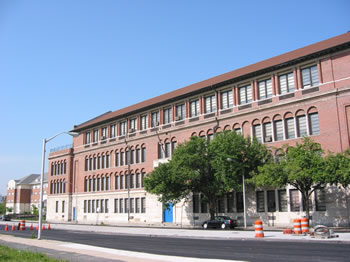
View from N. Central Avenue
May 8, 2002 | | This is the home page for the SDC ValueWeb. It documents the ongoing Design/Build/Use development of the seven zones of the SDC Campus through four Phases of evolution over several years of work. | This page contains the general description of the project and links to various subject-specific electronic documents.
| | This document, and others associated with it, is a work in progress and will be updated extensively and periodically throughout the following FasTracked Design/Build/Use process. At any time, it represents the most recent thinking about the project as a whole. When you return to the site, check out all active documents and remember to hit “refresh” as your browser may be displaying the last version. | Note: go the SDC Virtual Project Management web site for current documents; Work Orders, Drawings, Specifications. | | Present Status of the Project
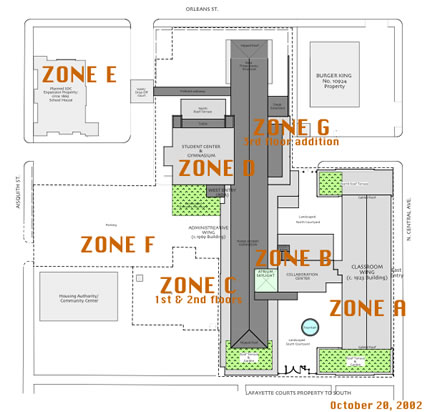
updated October 23, 2002 | | As of November, 2002, SDC is in possession of the property, has executed a loan from CHEVY CHASE BANK, has established a budget for Phase Ia work (to move in); the first Work Packages and Orders are issued. Temporary work and occupancy Permits have been issued from the City of baltimore and a Design/Build protocol is established. Design work for Phases Ib, II, III and IV is underway. Permit drawings for the various phases are being developed and permit review meetings are being conducted. The design team has been supplemented with a Baltimore-based architect-of-record and civil engineer. The on-site Project management Office is in the process of being set up. Prototypes of classroom work furniture are being built at AI. A RDS NavCenter to perform project management functions and to facilitate ongoing development and fund raising is installed at SDC; set up in the existing Gym until permanent space can be prepared. A NavCenter (Phase III, Zone D) is a central component of SDC’s long term functionality. As work is proceeding on Phase Ia, the day-to-day process of the Design/Built Team is developing a regular pattern. | | Phasing and Scope of Project: | | As a result of dialog and design work since April, 2002, the scope of the project and its phasing has become better defined. Besides the project scope as it was originally understood, there are additional properties and projects that require integration with the main Campus These includes off site parking and a future middle school and high-school building sponsored by Johns Hopkins. These are identified in an added Phase V work designation. | | Because of initial budget and schedule constraints, it is necessary to get student body and administrative people moved in prior to certain demolition and reconstruction work is completed (as was the original plan). For this reason,the demolition and construction of structural elements related to future modifications and additions will have to be both designed and phased in such a way that future projects can be constructed while the buildings are being used. This reality has caused a reassessment of several design options. | | The basic strategy in place is to do only what is necessary in Phase Ia to get the buildings in partial use: primarily, the student classrooms (Zone A) and the administration areas (Zone C). There will also be work done in the Student Union (old cafeteria - Zone D) and parking areas (Zone E). Minimum is defined by both scope (what aspects of the building we open for use) and depth of work (what work is actually done, now). Parts of the existing structures not to be used initially will be blocked off by decorative barriers. As little as possible of the available money will be spent in this initial phase. Phase Ib work will proceed immediately afterward funded by money not spent in Phase Ia and from additional sources. Phase Ib will add capacity and amenity to the facilities and act as a bridge to Phase II and III projects (which will be funded individually). It is extremely important that this continuity of effort be maintained. Phase I work covers the scope of work first discussed with the bank and upon which the appraisal of the property is based. | | Phase Ia work will allow the Design/Build team to establish and practice protocols and to configure itself for the long term duration of the project. Phase Ia work will be driven by time. Work afterward will be executed quickly, however, at a pace best supportive of the work itself not driven by external circumstances. | | The overall scope of the Campus development will take 4 to 6 years and 10 to 12 million dollars to accomplish. Because of the nature of the project, the fact that the Campus will serve not only the College but several institutions and the local community, funding is expected from many sources; private and public. The physical development of the Campus will be approached as a real estate project with both multiple-uses and re-use in mind. The value of the investment is expected to be maintained even under the unlikely circumstance that Sojourner-Douglass were to migrate to another campus in the future. | | Details of the Phases and their value consequences are outlined in the Bank Presentation. This analysis will be updated as the design work proceeds. | | The end result will be an urban Campus unique in its intimate scale and dense capacity; a world class facility with resources in a mix found in few places; a Campus fully capable of accomplishing innovative educational and community development missions. | | | The SDC Campus is conceived in five Zones each offering a unique functional mix of facilities and services. Although each of these Zones flows into on another in a seamless way, each has a distinct function and mission. | | Upon completion, the Campus architecture will span from 1869 through 2008; a 140 year period. The prior work was done in three major blocks: 1860s, 1920s, 1960s and, now, the 4th at the turn of the 21st Century. | | It will be the task of this 21st Century design and building process to bring the entire complex into functional harmony; a condition that does not exist today as the sites have never been integrated until this project. | | When completed, the Campus will be a living memory of the U.S. urban experience from the Civil War to this period when we are actually beginning to close that chapter of our history; nearly 60% of our time as a Nation; a fitting setting for Sojourner-Douglass College given its mission. | 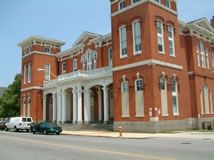 | | 1869 schoolhouse. The goal is to bring this property onto the SDC Campus and use it a a Residency Hall (Zone E). | | 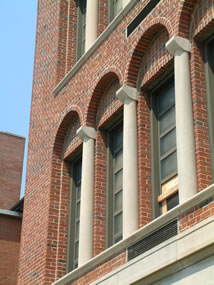 | | The 1923 Middle School building (Zone A) the cornerstone of the new Campus project. Although trashed out a bit by years of institutional management, the building is fine piece of work and worthy of the most careful restoration. | | 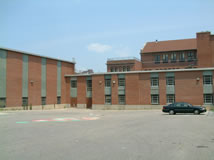 | | 1969 addition (Zone C). The 1923 building can be seen behind. The taller structure to the left was the Cafeteria and Gym on the second floor (Zone D). | | | The 1869 schoolhouse was converted into housing several years ago and rapidly degenerated in all ways possible. The Exterior is is good shape; the interior will have to totally rebuilt. The 1923 Middle School Building was compromised in the usual utilitarian ways: hung ceilings, painted over natural wood, exposed conduit and other esthetic atrocities. What is it we teach our children? Some beautiful parts of the fourth floor were altered and filled in when the 1969 addition was built. The 1969 building was utilitarian from the beginning. By this time all pretense of providing children with an aesthetic and inspiring environment had gone by the wayside; it is built hell for stout and will make a good platform from which to begin anew. | | The three buildings, together, almost span the entire history of American public school architecture. They each are typical of their type with the 1869 and the 1923 buildings being of unusually high quality. The new work (2002 and beyond) will require an architectural grammar that stands on its own merit while also integrating all the older buildings. Fortunately, the majority of the surrounding buildings, while not great works, have appropriately borrowed the better idiomatic aspects of these buildings and used scale and materials to good advantage. The setting for the Campus is workable. The one exception is the fast food drive-in, on the north east corner, being redone by Burger King. This will be standard franchise architecture, of the new kinder and gentler kind, handled with some sensitivity to the setting. All things considered, the site conditions are favorable. It will be possible to blend this Campus into its existing and future surrounds and provide it with distinction and identity. | | The following Zone analysis is an outline to be further supplemented with a Program Statement and Schematic Drawings. these together will present the basic concept of the Sojourner-Douglass Campus Master Plan. | | Zone Designations
on Schematic Phase III Layout
| Zone A Learning
The scope of Zone A includes:
A-1 Classrooms
A-2 Library
A-3 Child Care
A-4 Computer and Media Learning Center
A-5 Non-ADA Elevator and access to Zone B
A-6 Rest Rooms
A-7 Graduate School Facilities (4th. Floor)
A-8 East Entry
A-9 North East Access to Garden (B-1)
A-10 South East Access to Garden (B-2)
A-11 Hallway Armature
A-12 Fire Stairs and Exits
A-13 North Roof Garden
A-14 South Roof Garden | | The function and Mission of Zone A is:
Study and learning; both formal and informal; instructor-lead and self-directed. The Layout of the 1923 building will remain largely intact with the exception of the Library (A-2) which will require a larger open space on the south side of the first floor. The 4th Floor will be restored as much as possible to its original open feel and employed as the Center for the SCD Graduate School which will also have close ties to Zone B functions and facilities. As Phase 1b, II, II and IV work continues, the 1923 building will be progressively upgraded in a variety of ways. The building, itself, will be restored as a prime example of its type and era; and, the furnishings and technology of the teaching/learning areas will be improved. The goal is to be able to support every useful teaching/learning modality including presentation, seminar, group discussion, simulation and gaming, one-on-one coaching, individual study. While the ARMATURE of the hallways and original classrooms will be kept and enhanced, a robust mix of these teaching/learning modalities will be accomplished by making almost everything else flexible, adaptable and easily movable. The learning rooms (old classrooms) will be easily configurable as required for each class experience. | | As noted, the Library area will be the most architecturally changed in Zone B. Several smaller rooms in the south part of the first floor will be opened into one space with several Armature sub-divisions. Casework and trim will be restored to a very high level. Various reading areas and workstations will be provided. This approach is to create an environment in which the user will want to stay and use not just a place to find a book and leave. Along with certain areas in the Student Union (D-13), which will be more “public” than the Library, the Library provides significant ambiance of self-study activities. | Zone B Collaborative Interaction Facilities
The scope of Zone B includes: B-1 North Garden
B-2 South Garden
B-3 ADA Elevator
B-4 Atrium
B-5 Glass “Bridge” to Zone A
B-6 SDC ValueWeb Sponsor Facilities
B -7 SDC Community NavCenter (3rd. Floor)
B-8 Teacher Lounge and Facilities
B-8 Teacher Work Areas
B-9 Teacher/Student Interaction Areas
B-10 Design and Multimedia Facilities
B-11 Restrooms
B-12 Hallway Armature
B-13 Fire Stairs and Exits | | The function and Mission of Zone B is:
To facilitate interaction and collaborative design between student, teachers, administrators, the community and the larger world of learning and pubic policy. In addition to internal and local community use, the capabilities developed here are expected to become a business opportunity for students and community leaders and perform as a significant profit-center for Sojourner-Douglass College. A MG Taylor licensed NavCenter (B-7) will be the core of this collaborative process; it will be housed on the 3rd floor of the “bridge” building between the 1923 (Zone A) and 1969 buildings (Zone C) and expand onto the roof of the 1969 building (Zone G) when required. The prime mission of this Zone is to facilitate the growing Sojourner-Douglass ValueWeb community both as a whole and in discrete “Clam Shell” segments. In today’s world, in order to create a healthy Sojourner-Douglass, the college has to create a healthy ValueWeb of USERS (students, teachers,community and businesses); PRODUCERS (administration, teachers and fellows); and INVESTORS (individuals, foundations, businesses and governments). The 4th floor (of Zone B) will house the SDC ValueWeb Sponsors facility (B-6) which will function in close coordination with the NavCenter below it. In addition, Zone B will support teacher-to-teacher interactions, student-to-student and student-to-teacher interactions (B-9), community group meetings, and learning in the fields of creative processes, strategic planning and enterprise development and management. These processes will function in close cooperation with the SDC Graduate School. The North (B-1) and South (B-2) Court Gardens make the space between the 1923 and 1969 buildings. Zones A, B and C directly access them and Zone D may be able to be connected if the North Hallway can be extended to the Court. The second floor Bridge (D-14) between Zone D and Zone will requires access to the North Garden (B-1). The development of these sheltered outdoor areas is critical to developing separation between the major buildings and providing refuge from the urban nature of the site. Properly handled, these areas will be usable most months out of the year. Landscaping and energy strategies will be aimed at the creation of a mild micro-climate in all four seasons. Included in Zone B is a new ADA Elevator at the Zone C side of the hallway (B-12) between Zone C to Zone A. This places the ADA Elevator at the most central location of the combined buildings (Zones A, B, C, D and G) and fairly close to the West Entry D-6) and ADA parking slots (Zone F - West). Adjacent to the elevator and hallway Zones B and C intersection, is the Atrium (B-4) which acts as a vertical Armature tying Zones B, C and G together. | | In addition to the the primary functions of interaction and collaboration, it is important to realize that Zone B offers significant educational opportunity not only in areas like media and simulations but in a broad range of learning modalities. This space, in addition to event-focus activities provides at minimum the equivalent of 6 Zone A classrooms. | Zone C Offices and Administration
The scope of Zone C includes: | C-1 Administrative Offices
C-2 Restrooms
C-3 Hallway Armature
C-4 Fire Stairs and Exits | | The function and Mission of Zone C is:
To provide an appropriate environment for the administrative FUNCTION not just offices dedicated to specific work tasks. The function and the tasks that traditionally make it up the function is done need to be separated conceptually; the habit of how work used to be done, or is done now, cannot determine the space. The layout must reflect and support the workflow of the organization. As this changes, as it will, it is necessary that the layout changes with it. | | This flexibility will be accomplished by removing some of the original classroom walls (creating larger footprints), building some fixed spaces and supplementing these with a flexible, moveable system. | | Administration has to function without distraction; this requirement, however, too often leads to an unfortunate isolation. The main traffic area between the West Parking (Zone F) and the Learning Areas (Zone A), goes directly through the Administrative area (Zone C). By selective removal of walls and creation of adjacent “public” spaces (Zone B Atrium and Zone D Entry, Book Store and Sitting Area), a optimal mix of privacy and involvement will be promoted. | Zone D Community and Re-Creation Facilities
The scope of Zone D includes: | D-1 West Entry - ADA
D-2 Student Union
D-3 Multimedia and Live Performance Hall
D-4 Multimedia and Live Performance Hall Balconey
D-5 Multimedia and Live Performance Stage and Support Systems
D-6 North West Entry
D-7 North East Entry
D-8 Security
D-9 Book Store
D-10 Resrooms
D-11 Gymnasium and Perfomance Practice Area
D-12 Bathing and dressing Facilities
D-13 Student Union Cafiteria
D-14 Hallway Armature and Sitting Area
D-15 Bridge to Zone A
D-16 Hallway Armature
D-17 Gymnasium Roof Garden
D-18 Fire Stairs and Exits | | The function and Mission of Zone D is:
To support re-creation and culture bringing both to the College and the community. This is a space of social interaction, expression and celebration. The Gymnasium (D-11) will provide indoor sports and fitness classes and will double as back-up to the Student Union (below it) and the Performing Arts Center (D-3, D-4, D-5 and G-4 & G-5). Student Union events (dances and so on) can overflow to the Gym and the space can function as set making, staging and rehearsal areas in support of the Performing Arts Center. A north-facing out door deck will be constructed on the roof of what is now the Cafeteria Kitchen area during Phase II work. The Student Union (D-2) is below the Gymnasium (D-11) and adjacent to the Auditorium (D-3). Each of the these three areas have to function independently and as a whole. The SDC student is older than typical collage age and employed. This life-cycle fact determines the Student Union criteria. The Student Union has to be a flexible space that breaks down into a number of intimate areas. The existing column spacing (which will be provided with an AI Armature system in Phase Ia work) creates super modules of 17 by 24 feet. The kinds of spaces needed are: study areas, areas for dialog, eating, areas for collaborative projects. Each of these super modules has to be able to support any of these. Set up has to be easy and doable by the students. At the completion of Phase Ia, there will be 12 of these super modules allowing a fair number of different arrangements. In later phases of work, a food preparation area will be added in what is now the old Cafeteria cooking area. | | Presently the Student Union space is divided from the Auditorium’s by a long hallway that exits on the north side of the building. As Phases II and III work are completed, this hallway will become an integrated permutable space that can allow separation or integration of the two functions. This will facilitate events of different kinds and scales. | | The Performing Arts Center is key to the Sojourner-Douglass commitment to the development of culture. It is an important interface function between the College, the community and the larger Baltimore Area public. | | The Performing Arts Center provides an important curriculum component particularly in the realm of multi-media. The Center will promote live performances (theatre, music, dance), multimedia presentations and arts and crafts with a special emphases on their integration in multi-venue shows/events. In addition to performing arts as curriculum, the uses of these facilities and multimedia as a delivery method of all curriculum will be emphasized. This will be tightly tied to skill development in computer usage, internet access and desktop publishing - all basic future workplace capabilities. | | The Center forms the nucleolus for time-to-time Conferences sponsored by the College and it’s ValueWeb community members. | | The Existing Auditorium will be expanded (Phase III) horizontally and vertically. The building will be expanded northward to provide a larger stage, fly-space, staging and practice areas. Vertical development will involve adding a second level balcony expanding the “house” to about 750 and other facilities (practice rooms and gathering place) in Zone G (G-4 and G-5). | Zone E Residency and Dining
The scope of Zone E includes: | E-1 In residence Study and Sleeping Rooms
E-2 Seminar Rooms
E-3 Intimate Dining Room
E-4 Living Room
E-5 Small Library
E-6 Patio (East facing)
E-7 Fire Stairs and Exits | | The function and Mission of Zone E is:
To be the HOME of In Residence artists, intellectuals, exemplars, advocates, political and business leaders who will spend time in interaction with Sojourner-Douglass faculty and students. On a day-to-day basis is also is a PLACE for informal meeting, dialog and study in a more intimate setting that other Campus facilities. This use is an excellent re-purposing of the 1869 school building. | | At the termination of East-West axis from the Residency Hall and aligned with the the North-South axis of the Administration wing (Zone C) will be a commercial dining facility. This will be managed as an outsource enterprise that is directly associated with the collage (and that provides a significant revenue source to it). From Orleans Street, which now becomes the FRONT of the Campus, This facility becomes the focal point of this elevation with the one, two, three and four story massing of the other buildings receding away from it. | | The venue of this dining establishment will be good food, reasonable cost in a pleasant natural ambiance. The draw from the local community, Johns Hopkins and visitors to the Campus. This facility will also supply food to the other on-campus eating areas: D-13, E-3 and G-6. | Zone F Parking and Landscaping
The scope of Zone F includes: | F-1 West Parking Area
F-2 East (off Site) Parking Area
F-3 Walks and Trellis Areas
F-4 North Driveway, Portico and Fountain
F-5 Parameter landscaping
F-6 Landscaping Patches and Sitting Areas
F-7 Site Drainage System
F-8 Buildings Parameter Waterproofing
F-9 Campus Signage
F-10 Campus Parameter Walls and Ornamental Fencing
F-11 Exterior Lighting
F-12 Curbs, Cuts and Access/Egress Points | | The function and Mission of Zone F is:
To SET the Campus in its urban environment, including adjacent buildings, and to act as a transportation and parking area INTERFACE with the greater baltimore area. The LANDSCAPE of the Campus is the first thing that anyone sees when approaching. The message delivered is the first of many; it tells the story of what is to come. There are four major interface transitions that take place between someone approaching the College and settling in to some form of productive activity. The first is the view from the street; the second, the act of approaching the buildings through the exterior landscape; the third, the entry experience; and last, the transit through hallway Armature into a specific function dedicated space. Each of these is a critical interface event that must bring people to the appropriate place, in a graceful, efficient, pleasing and seamless way; and, prepare them, mentally, for the process in which they will be engaged. This moving from the street to the place of engagement is facilitated much as an overture to a musical piece or the opening exposition segments of a film; a shift in consciousness is required; properly done, architecture does this in the realm of human/building interaction. The message we will communicate is “this place is solid, secure, safe, cared for, comfortable (refuge); and exciting, innovative, modern, evolving (prospect). Refuge and Prospect are the two basic requirements of human comfort. The approach to the landscape of the Campus also direcly effects site temporature and the energy demands of the building throughout the year. | Zone G Roof Addition
The scope of Zone G includes: | Zone G Roof Addition
The scope of Zone G includes:
G-1 NavCenter Expansion
G-2 Administrative Offices Expansion
G-3 Administrative Lounge
G-4 Performing Arts Practice Areas
G-5 Performing Arts Balconey Gathering Place
G-6 Balconey Private Dining
G-7 North Roof Garden
G-8 South Roof Garden
E-9 Fire Stairs and Exits | | The function and Mission of Zone G is:
To tie the collaborative (Zone B), administrative (Zone C) and cultural functions (Zone D) together by providing a flexible enclosed roof garden space that can be easily configured to spontaneously serve emerging requirements. As this will be new light-weight construction, the spans will be clear of any interior columns. This will enhance flexibility making an excellent large scale seminar space. The combined Zones, will constitute a world-class conference space facilitating SDC’s ability to take their message to a greater constituency and also bring more resources to the College and community. | | Architecturally, This third floor addition over the 1969 building will tie the massing of all the exiting and new structures together thus resolving a number of visual discontinuities that presently exist on the West and North elevations (and, along the East/West Axis). This is important if the College is to be presented as an integrated and “complete” entity. | Zone H Off Campus Facities
The scope of Zone Hincludes: | H-1 Parking Area
H-2 Proposed Middle and High School | | | The Parking Area (H-1) is across and down the street from the East Entry (A-8) and will provide a significant increase in dedicated parking for the college. Fencing, surfacing and car slot painting will be done during Phase Ia work. | | The proposed school (H-2) is still in the talking stages and will be a few blocks from the Main Campus. Issues of architectural integration still exist, however. | | These 8 Zones, their functions and missions, add up to the overall capability of the Campus; they serve the PROGRAM of the project. The goal is to create a model urban campus of higher education that has extensive capability and human scale; that educates, promotes cultural diversity and development and serves a broad community: students, local residents and Johns Hopkins University; and, is built on sustainable economic principles. | | Matt Taylor
May 12, 2002
Palo Alto
Archived October 8, 2002
New Content October 8, 2002 New Commentary on the Master Plan April 24, 2003 • ENGINEERING • STRATEGY •
• PRELIMINARY •
| |
posted: May 21, 2002
ARCHIVED October 8, 2002 new content: October 8, 2002
revised: November 10, 2002
• 20021008.712690.mt • 20021017.309981.mt •
• 20021020.111199.mt • 20021021.769812.mt •
• 20021023.391100.mt • 20021024.767769.mt •
• 20021025.409911.mt • 20021110.399011.mt •
Note: this document is 75% complete
Copyright© Matt Taylor 2002 | | |
|