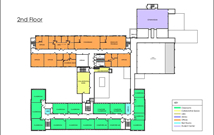
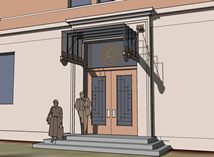
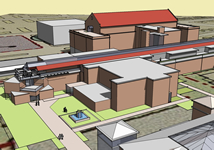
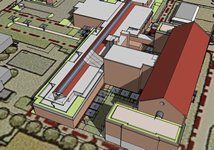
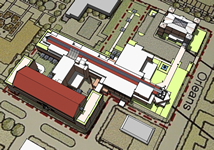
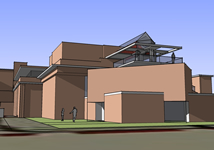
Notes on Mater Plan Development | | This document supplements the Facility Master Plan [link] and the SDC Environment Program Statement [link] in preparation for the MICUA Presentation on April 29, 2003, the opening ceremony in June [link] and the delivery to SDC of the Master Planning Document, by SFIA Architects-Master Builders, in mid July 2003. | | | The SDC campus is designed to become a unique place of learning, creativity and collaboration. The habits of lifetime learning, individual and team creativity and robust collaboration skills are key to successful living in the 21st Century. These habits have to be embedded into the very fabric of SDC and reflected in every aspect of it’s environment and process of education. | | Architecture facilitates these habits and provides the aesthetic expression of them. It is the infrastructure of leaning/creative processes. It is both the armature and the technical system that supports and augments these processes. | | The SDC Baltimore Campus will be developed over approximately a five year period stating from mid 2002. The purpose of the Master Plan is not to pre-imagine every aspect in unchanging detail; it is to create an integrated construct that organizes the work into doable chunks, establishes a reasonable budget and schedule, and clearly articulates the intent of the work to come. Each phase of work will require it’s own Design/Build/Use sequence as it proceeds. | | Phase I work largely prepared portions of the existing main buildings for administrative and classroom use. Phase II is planned to develop the buildings and the site more completely, providing increased utilization and creating the infrastructure for the Phases III and IV which are, in the main, to be funded by joint venture partnerships between the College and various enterprises and community groups. These are outlined below. This Phase II work will require significant cleaning up and upgrading of existing mechanical and electrical systems, as well as, further demolition and rebuilding of the existing structures. This work will be outlined below. The following descriptions are not intended to be comprehensive in scope of work nor complete in every technical detail. This is covered elsewhere. They are intended to portray the essence of the Phases and their architectural character and mission in support of the SDC education and community program. | Phase I Work to be completed | | Phase I work is ongoing and will continue through 2003. The mission is to continue development of basic functionality in support ongoing SDC operations at their present scope and scale. | Fire Doors: Install Fire Doors between the two Story Administrative wing (Zone C) and the four story “bridge” Zone B) to the 1923 building. This is for safety and code compliance. These are double four foot wide steel doors and casings at the intersection of Zones C and B. They will remain in the open position except in the case of fire which will trigger an automatic closing. | Signage and Landscaping: This work involves general outside and inside signage as required for navigational purposes and some minimal potted landscaping in the North and South Courtyards between Zones A, B and C. In addition, however, is the requirement to create SDC identity and presence along Orleans Street. This will require fairly extensive landscaping, a large sign and some screening walls. The intension is to do this work in such a way that minimal reconstruction will be required when Phase II Zones E and G work is done. The mission of this work is to enhance general amenity and to establish the North side of the Collage as the FRONT of the campus. Throughout Phases I and II, the work will transform the exterior of the Campus from a “hard” institutional look to an extensively landscaped, rich in intrigue, urban landscape. | Slab leveling and Book store: At the North end of the Zone C Hallway on the first floor, adjacent to the East-West Hallway leading to the exits, Theater and Student union, there is some existing slab failure. These slab areas will be remover and replaced over compacted soil and gravel. Some existing masonry walls will be removed and replaced with glass walls to create the spaces for the Bookstore and Waiting Area. | North Zone C Hallway Reconfiguration and Waiting Area: At present, this area (described) above is just two Hallways intersecting at right angles to one another - this makes a dull and uninspiring place. These will be reconfigured to accomplish a sense of entry, a Waiting Area outside the Administrative wing, and transparent access into the new Bookstore. This work start a process that will be continued in Phase II as the Student Union and Arts Center are further developed. | Activation of Theater and Gymnasium: This work involves basic repair, cleanup and painting as has been typical of most Phase I work.The NavCenter will reside in the the GYM until its permanent space is available in Zone B. In Phase III the Theater and Gymnasium will be extensively modified to become a Fine Arts Center (Zones D and G) and a Community Health Center (zone D) with a selected community JV partners. | | At completion of all Phase III work, there will be interoperability between The Student Union, Fine Arts Center and Community Health Center. For example, Large Arts Center events can make use of the Student Union facilities. Large Student Union events will be able to make us of the open Health Center Gym space. The Gym space will be accessible to the Arts Center for ad-hoc rehearsals and set building. | | The following plans suppliment these notes: | Upgrading of Administrative Offices and open work areas to match original plans: Due to budget constraints, the offices, in phase Ia were not completed as designed. They fall far short of the functionality and quality required by this Program. In Phase II, they will be rebuilt according to the original design and specifications. | | The replacement office units will have large corner sliding doors that open the office space to the adjacent work areas and will have sidelights and over transom glass to allow light to move through the space. Their architectural grammar will match the translucent screens and workstations to be supplied to the open office area. | Development of Hallways: Existing hung ceiling materials will be removed and the Hallways returned to their full height to the extent possible. A trellis-soffit system will be built to integrate electrical conduits, wiring chases, ducts, light fixtures and sprinklers. | | Lighting will be ambient, spot lighting to highlight wall art and sculpture and effect lighting in various wall niches that will be created by the partial removal of existing walls replacing them with off-set translucent walls. These niches will proved areas of interior landscaping, art display and sitting. | Sprinkler System: A sprinkler system will be installed in phase II in all Hallways, exit areas and areas of high people density. The piping will be integrated with the Hallway trellis and soffit system described above. | Atrium and Elevator Lobby: At the intersection of the North-South and the East-West hallways in the Administration wing (Zone C), an Atrium through the third level (Phase III - Zones D and G) will be constructed to provide sitting and gathering space and to bring light down into all levels of the building. Adjacent to this (in the four story “bridge” - Zone D), a new ADA Elevator will be built (see below) that will serve all four stories of the “bridge.” This elevator will be served by a glass Lobby that looks into and opens (at ground level) into the North Court Yard. Entry doors will be provided, at each level, into the East-West Hallway. | New ADA Elevator: The existing four story Elevator is not ADA sized. It is located in the 1923 building (Zone A) at the intersection with the East end of the “bridge” (Zone B). This elevator is being retrofitted and will operate as it is presently configured. A new Elevator will be constructed at the West end of Zone B adjacent to the two story 1969 building (Zone C) now the Administrative wing. This elevator will serve the two stories of Zone C, the third floor of Zone G (Phase III) and the four stories of Zone B, thus, it will provide ADA access to the entire complex. | East Entry and Lobby: aaaaa | Completion of Student Union: This work includes armature elements to break the space into smaller conversation and work niches, a food service area and multimedia capability. In Phase III, the East wall of the Union will be redone in glass and operable doors so that the Auditorium and Student Union can operate in concert when appropriate. | Development of Zone B Collaborative Learning and Work Spaces: Zone B is the four story bridge between the 1923 building (Zone A) and the 1969 building (Zone C) - between the teaching and administration areas respectively. This zone will be devoted to collaborative processes. With Phase III completion, the top floors of Zone B will open on to the third floor addition (Zone G) which will tie into the Fine Arts Center and Commercial Dining Facility (Zone D and G). Together, these capabilities will combine to make a world class, boutique-scale Conference Center. | North Side (Orleans Street) Signage, walls and landscaping: This work will supplement and complete the work done in Phase I. It will involve the placement of some structural walls and foundations that will be required for Phase III work in Zones D, G and E. This is to prevent redundancy of effort and to develop and more presentable “front” to the school prior to the completion of Phase III work. | Development of Court Yards (North and South) between 1923 and 1969 Buildings: The Court Yards (North between Zones A, C and D and South between Zones A, B and C) are an important element in the Campus. They will be arranged and lighted so that they can be used in all four seasons and during the day and evening. This extended used will be accomplished by semi-enclosed glass roofs and careful orientation to sun. Cold weather heating will be provided in winter and force air for cool air circulation in the summer. | | The Court yards will have easy access to the buildings and will provide abundant landscaping and sitting/gathering areas with benches and tables. wireless computing will be provided. | Electrical and Mechanical Improvements: Phase I repaired and added electrical and mechanical units as necessary to accomplish better energy use and to accomplished basic functionality in the administrative areas and classrooms. Phase II work will remove no longer useful circuits and equipment, re-route conduit and ducts so that hung ceilings can be removed where desired and generally upgrade all electrical and mechanical systems. New capacity will be added where required in anticipation of Phases II and IV work. | Communications and Computer Infrastructure: Completion of high speed lines and installation of wireless technology throughout the the entire Campus including outdoor sitting areas. This work also include installation of high speed multimedia backbone to support Phase III development of the Theater. | Upgrading and Completion of Library: This work involves removing several walls which opens the space into a large multisided room, the creations of soffits, coves and screens to create semi-private areas and the addition of custom case work and desks. | Opening and Basic Development of Fourth Floor (Zone A): In Phase II, the Fourth Floor will be repaired, cleaned and painted (as was the first three floor in Phase I) for general classroom use. This will provide “spill-over” capability and space that can be used temporality when other sections of the building are being remodeled or upgraded in Phases II and III. The Fourth Floor will become The SDC Graduate School Center in Phase III. | Development of East Parking, Fences, Walls and Gates (Zone F): aaaaa | Creation of Entries at East, North and Courtyards: Theese will be simple class structures over a stell struss system [link]. | | This is not a comprehensive list. It illustrates, however, the basic intent of Phase II work which is to provide full amenity to all existing SDC functions and to build the infrastructure basis for the Phase III projects which will mostly be done on a Joint Venture basis with other organizations and community groups. | | Upon completion of Phase II work, the SDC Campus will be complete in functional terms and appearance. It will be capable of supporting all work and activities associated with conducting SDC’s business and operations. Phase III work provides the amenities and capacities not normally associated with a Campus of this size and extends the outreach of SDC into the community and business. | | Phase II work will largely be accomplished with funds from MICUA. | | Phase II work will require careful sequencing to accomplish maximum results and minimum utilization disruption, time-loss and cost. This sequencing plan will be provided with the completion of the SDC master Plan documents. | Link: Phase III Drawings and Notes | | The following drawings suppliment these notes: | 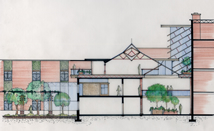 | | Section through Atrium and Elevation of West Entry | | | | Phase III work consists of a series of projects - most to be funded through Joint Ventures - that lever off the basic SDC Campus while providing functionality to SDC and some selected community group, educational institution or business. | | These projects include: The SDC Grad School Center (Fourth Floor - Zone A); The SDC NavCenter (Third and Fourth Floors - Zones B and Third Floor - Zone G); Performing Arts Center - (Zones D and G); Community Health Center (Second Floor - Zone D); Public Restaurant (Zone D & G); Front Garden and Portico (between Zones G and E); and SDC Guest Residency. | These projects are not pre-scheduled. Work can proceed whenever the appropriate JV partner is found, as long as, certain basic Phase II infrastructure work is completed before or in parallel. Each of these projects and designed be discreet and as independent of each other as possible. | | The key to Phases II and III work is steady construction by a dedicated design/build team with each project carefully assessed for economic value. | | After all components of the Master Plan are put in place (Phases I through III), Phase IV is the long term maintenance of the campus and systematic upgrading of it to world class standards. This Phase will also incorporate a program of continuous upgrades to accommodate new technologies and learning methods. | | The master Plan allows for incremental development that adds up to a complete and integrated Campus dedicated to higher education and community development. The location of functional areas allows for descrete individual use, at the same time, promoting shared use when one function is engaged in a large event. For example, the Student Union (Zone D), the Health Center (Zone D), the Fine Arts Center (Zones D and G), the third floor meeting areas (Zone G) and the NavCenter (Zones B and G) can be co-operated to provide a world class conferencing capability for well over a thousand people. Similar combinations are possible to extend day and nigh classes, Grad School activities and Arts and Media events. | | This flexibility and adaptation capability creates a Campus that can serve it’s designated function, evolve it’s uses as circumstances change - it can even be re-purposed into a world class business center if the College were ever to move. All this can be achieved at a cost appropriately one half that of a campus built from scratch. | | An integrated architectural result is achieved while also preserving and creating examples of 19th, 20th and 21st Century school architecture. | | These synergies make an unique Campus; historical quality, broad range of functions, contineously upward technological evolution, compact foot print and significant location as the ongoing development of Baltimore and the Johns Hopkins Campus continues. | | Matt Taylor
Elsewhere
April 24, 2003 
SolutionBox voice of this document:
VISION • PHILOSOPHY • PROGRAM | |
posted: April 24, 2003 revised: April 26, 2003
• 2003042.230125.mt • 20030426.200091.mt • (note: this document is about 25% finished) Copyright© 2003 Matt Taylor | |
|