| SRP
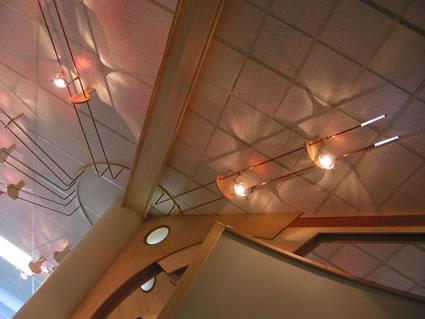
Sustained Rapid Prototyping | | | PipeDreams, SFIA Architects-MasterBuilders, MG Taylor and AI are collaborating on a SRP exercise with four projects to rapidly evolve a PipeDreams lighting idea into a marketable product solution and Business Model. | | Early this year (2002), Joe Humel was incubating some project ideas at the Palo Alto knOwhere Store. He wanted to supplement his lighting in his area and was astounded by the high cost, lack of variety and poor quality of the track lighting systems available. He decided to build his own and PipeDreams was born one afternoon when Joe assembled some half inch copper water lines, a 12 volt transformer, light-emitting diodes and standard 12 volt lights into a solution that light up his WorkWall. | | Joe’s idea was simple: construct a basic infrastructure using common materials - in this case copper piping - and then encourage the creation of a great variety of light units innovative in both engineering and artistic quality. | | When Joe showed me what he had built I immediately saw several design opportunities. First, the many variants of 12 volt system do not offer fixtures that move easily. Some are fairly easy - most too difficult. If the appropriate connection could be developed, it would be possible to merely lift the fixture up and lay it down at another place and that would be that. No twisting, turning, complicated adjusting. Another advantage is that the piping can be arranged where the lighting is needed - again, not easy to do with the majority of products out there. Another opportunity is to make the system and its fixtures custom designed and fitted to the unique architectural requirements of each unique space. The lighting system itself can come out of the walls and off the ceiling where it has been buried for the good part of a century and become visible - ornamental in itself not just in its effect. | | These opportunities, together, can radically alter the way that lighting is handled in everyday applications. To promote this, I offered Joe the use of four projects of SFIA Architects-MasterBuilders and MGT/AI as means to rapidly evolve the product and to accomplish practical demonstration of the idea and its potential. | | It should be noted that in the early days of electricity and lighting exposed systems were common and many innovative ideas were tried. Wright was an early user/adapter and is generally credited with the development of indirect lighting. Then, lighting became domesticated and ceased to be an architectural element except in the rarest of circumstances. The wiring, buried in walls to becomes a expense when the inevitable changes are made. The fixtures glued in place - and almost always in the wrong place. Modern buildings increasingly made bland in texture, geometry, variety and then juiced up with harsh colors and “lamps” and other items of meaningless surface decoration. | | Can light be made an integral part of the environment? Can it have utility, playfulness and be decoration? Can there be as many fixtures as flowers? Can they be changed to meet the task or occasion - as and when the occasion demands? Can they be economical and safe? Let us see what four iterations of design/Build/Use can produce. | | Iteration One
joseki offices | | | The Joseki offices are literally a space built within a larger exiting space. The existing outer walls were cleaned, painted and trimmed out. The interior space was filled with a ship-like wood and Plexiglas structure made up of three main elements: an Armature of overhead trellis and posts; wood and clear Plexiglas fixed partitions; and, sliding “shoji” screens the open and close the various space. The 12 volt lighting system is attached to the trellis and embedded in various translucent Plexiglas elements like the posts supporting the trellis. | 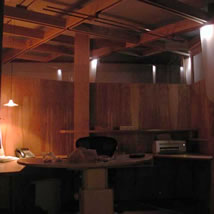 | | The copper piping runs through wood block that are mounted to the Armature. Fixture both hang down from and are resting on the copper. LEDs are buried in the translucent panels. | | 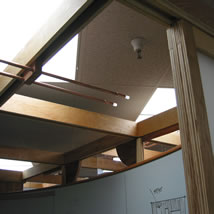 | | Each copper pipe provides one pole for the electrical flow the fixture itself completes the circuit when put in place. Wires inside the pipe feed the LED light at the ends. The original lighting has been upgraded to full spectrum tubes. | | 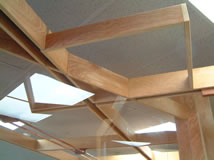 | | Light, Plexiglas, lighting and wood refract and reflect creating an always changing canopy of light. | | 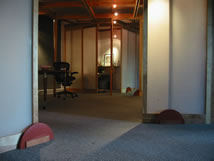 | | Shadows, pinpoints of light, wall colors reflecting different washes, transparent and translucent glazing - light becomes an active agent of the space. | | | This first iteration of the PipeDreams lighting system was designed and engineered in the field as it was being installed. Everything used was “off the shelf” supplies. The lessens learned from the project were immediately applied to the Vanderbilt project. | | Iteration Two
VCBH Innovation Center | | | The VCBH Innovation Center presented a number of lighting challenges. These came as three types. The first was the intrinsic condition of 18,000 square feet of a 2 x 4 hung tile ceiling with many glaring 2 x 4 fluorescent lights. The second, the challenges presented by our Armature system designed to bring spatial distinction to this ubiquitous, generic space and to provide chases for the multiplicity of wires still necessary to the modern work environment. The third kind of challenge emanates from the fact that everything in this space, with the exception of the fixed Armature (arches) themselves, can be completely reconfigured in a matter of minutes. How to bring all the desired kinds of (ambient, general, task, highlight and effect) lighting into play keeping proper balance. | | The goals of the 12 volt lighting system are: | Adjust and improve the light signature. Provide highlight and effect lighting. Be easily adjustable as required by the multiple and fast changing arrangements typical of the environment. Be an architectural feature in itself providing a ‘layer” of natural (integral) ornament. Create the capability to enhance “mood” in concert with and in support of facilitated work processes and collaborative events. Provide shade and shadow and variable lighting levels to enhance prospect and refuge, reduce glare and to provide a more “nature-like” visual experience. | One comment we hear over and over regarding our environment is “this place is so comfortable.” This is because of the natural use of materials, simple finishes, the geometry we employ and because we avoid uniform, harsh, glaring light levels that an individual cannot escape. Our material and color palette is simple, however, the way these textures, colors and patterns play out with one another is rich and varied like a forest. Our environmentss change like a natural environment changes. They are high variety places and that “translates” to being “comfortable” for most people no matter their personal, intellectual architectural likes and dislikes. | 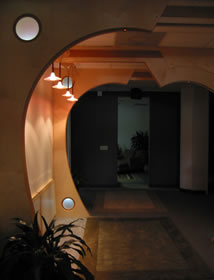 | | Wood, copper, glass, Plexiglas, aluminum... simple finishes, natural textures. An honest expression of materials just doing what they do best. Shade, shadow, graceful shapes... the box disappears a more human-fit space emerges. A small anteroom become a transition between two worlds. | | 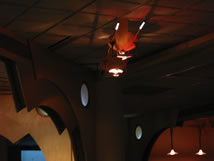 | | Shade and shadow has been almost purged from modern architecture and particularly the workspace. Why? | | 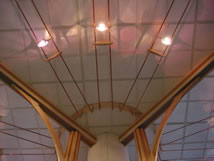 | | The ceiling surface become a screen creating reflecting a pattern on pattern that become a direct expression of the principles of iteration and recursion. | | 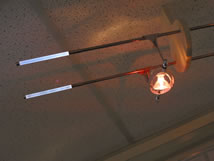 | | Reach up and lift the fixture - which you can do without getting burned - and it goes off. Set it where you want it - it stays there - and it turns on. Flexible lighting is finally achieved. | | 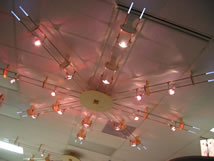 | | The system allows the creation of expressive geometric patterns something few commercial products do to any significant degree. | | 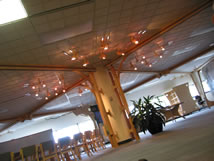 | | Once a column of no distinction, now a tree of light. The character of the space is transformed. Utility enhanced. The place becomes organic. | | 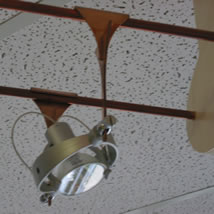 | | We bought this gimbaled fixture and fit it to our own bracket design. | | 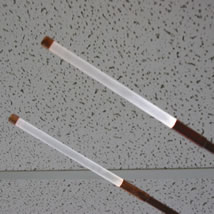 | | Translucent glowing tubes terminate the electrical piping armature. These are always on acting as night lighting. | | | Iteration Two accomplished a significant jump in both lighting utility and architectural design integration. This is an effective lighting system. A few technical bugs remain and the process is still a custom install. Costs (including design and development) were roughly equivalent to standard systems although they will much lower as we get through the basic R&D and learning phases. Over 200 lights and 17 dimmer switches make up the system in this iteration of work. | | | | SDC Project Notes to be added. | | | | knOwhere Project Notes to be added. | | | | | Lighting - Sustained Rapid Prototyping | | | | Matt Taylor
August 18, 2002
Nashville 
SolutionBox voice of this document:
USE • LOGISTICS • PRODUCTION MANAGEMENT |
posted: August 18, 2002 revised: August 18, 2002
• 20020818.023201.mt • note: this document is about 10% finished Copyright© Matt Taylor 2002
Aspects of the work shown and described are Patented and Pending by iterations | |
|