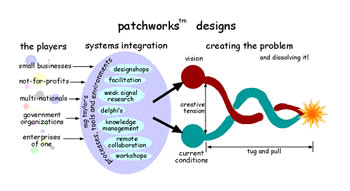
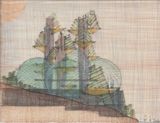
| At present, there are several PatchWorks Designs projects underway. | | Most of these are proprietary in nature and cannot be disclosed outside of their own “invited” ValueWeb. This is in a way a paradox; one of the major aspects of a PatchWorks exercise is to bring multiple resources to bear on complex problems; resources that go beyond the scope of any one or a few organizations - even networks. Therefore, one of the first tasks of the PatchWorks process is to determine the constitution of the patches and their relationship to one another - this often requires a complete design cycle itself. Another aspect of a PatchWorks exercise is that the different players, by definition, are each participating for different reasons, in different ways, often for a different duration. This means that the rules-of-engagement have to be carefully thought as part of that first iteration of design. | | That certain individual institutions and people are, or not, included in a PatchWorks exercise may or not be disclosed. The reasons, themselves, why this is so may be disclosed or not. | | Not to disclose the presence of these players and their motives, in some cases, may distort the exercise itself - in other circumstances, to disclose participation,or sponsorship, may do the same. | | These are questions that the facilitator’s of the PatchWorks “game” have to resolve. The facilitators (or game-masters) of a PatchWorks exercise have to establish and keep a level playing field - a neutral space - in which members of a ValueWeb can play with maximum security and equality. Yet, in a PatchWorks, what this constitutes is defined differently by each player - “equality” does not mean the same. This aspect of the process is rule-driven; there are tests to determine if the exercise is appropriately populated, and usually takes several iterations of design. | | A ValueWeb, of course is by definition a complex system made up of many interests. Inside ValueWebs, there are always multiple levels of recursion at work. The number of stakeholders of any modern enterprise is great - and, much larger than all but a few realize. When we worked on the F-15 project, it was estimated that 40,000 persons, worldwide, were involved in designing, building, using, fighting, maintaining, buying and selling, the System or some aspect of it. It was impossible to identify all of these people. the cost of producing the F-15 was reduced by double digits, in just 18 months, by better aligning the understanding, interests, work processes and rewards of many (not all) of these players. This was done even thought is was impossible to identity all those involved nor get to them directly. | | All really interesting, systemic problems share these attributes of size, complexity, wide and often obscure distribution of people and resources; they are composed of ValueWebs - recognized or not. The PatchWorks architecture is critical to the success of the venture. This architecture is built by intention and heuristic discovery and is the first part of the process of “bringing and Agent into an environment of Agents.” The process is goverened by feedback - “of a complex kind” - the results have to be emergent. | | The first real PatchWorks Design test was an event at the Palo Alto KnOwhere Store in May 1999. MG Taylor and the KnOwhere Stores supported the Foresight Institute in a weekend event designed to further the understanding and cause of Nano Techology. To get information regarding this event, contact the Foresight Institute. | | Below, other PatchWorks Designs projects are profiled. Some are public and “commonwealth” focused and some are aimed at the development of new technologies. The reason that PatchWorks exercises are essential to the operation of ValueWeb systems is because ValueWebs cannot be “managed” by conventional management processes; the complexity is too great and the dynamics of the enterprise are too emergent. ValueWebs are like replacement “economies” in Jane Jacob’s terms. They have the inherent diversity, history and will to replace their economies when required by changing circumstances whether they be internal or external to the ValueWeb system. | | The PatchWork exercises and ongoing projects fall into three broad categories: projects that I have started on my own - many of which that will take decades to bring to fruition; social entrepreneuring projects that others has started and that MG Taylor, iterations, SFIA Architects-Master Building and/or TomorrowMakers are supporting; work the MG Taylor ValueWeb does in support of our clients and license holders (including projects in which they are employing our System and Method for various enterprise reasons). | | For complex problem and opportunities, the PatchWorks process, ValueWeb organizational structure and NavCenter facility all are co-dependent concepts and make up mutually supporting capabilities. It will take a network of NavCenters to tackle the many large-scale work that needs to be done. | | In 1974, I found myself professionally stymied. It seemed impossible to do the kind of “Cathedral Building” that I wanted to participate in. I realized that these frustrations were not just a local consequence but resulted from systemic causes. It was 1979 before Gail and I were able to launch an enterprise to get at these systemic blocks. It is now nearly 30 years later and the infrastructure of NavCenters is nearly in place. There exists more than 30 environments on the planet that can do the Taylor Process and many of them are building the technology augmentation necessary for PatchWorks scale work. This number will easily double over the next five years and it will not be too soon. Humanity continues to struggle with one another in endless “civil” wars while ignoring the interesting and dangerous issues we as a species face. We are making our future by default. | | 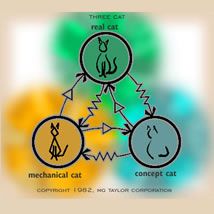 | | The Three Cat Model is, on the top level of recursion, is the basic engine of a PatchWorks Design exercise. Multiple iterations of “three catting” are necessary for true emergence to occur. | | | From the time of the development of the PatchWorks architecture in 1997, to the first full scale PatchWorks exercise in mid 1999, to now (mid 2003), the in-place capacity of the “Taylor” Big E has grown an order of magnitude. This is critical if we are to take on the interesting and significant challenges we face as a emerging global society. This maturation is also necessary for the “Taylor” ValueWeb achieving it’s goal of migrating beyond the limits of it’s founders and the capabilities of it’s starting organizations - the inner clam shell of the web. In the Network Economy, it is not just organizations that have to be built - no even just networks - whole new economies have to be created. The tools have to be developed to do this - we have built the basic tool kit; now they have to be made operational and expanded. This is intrinsic to the goals, scale and scope of the Taylor System and Method. These requirement are driven by the MG Taylor mission which to reach ubiquity with a new way of working. | The Gaia Project deals with aspects of the economy/ecology split. It’s premise is that economy and ecology are the same disciplines that operate on different scale, scope and time measures. It is the lack of adequate feedback between these two now separate systems that is the primary problem. The Gaia Project addresses this feedback inadequacy by developing “Speakers for Gaia” that can represent planet Earth in the policy and decision making councils of human society. The design assumption is that Gaia does not require special and different treatment, Gaia requires a full voice in human affairs - that is all. This Project, conceived in 1986, is now just stating - the maturing of the Internet being an essential requirement of the Project’s communication and governance method. The Gaia Hypothesis was developed by James Lovelock; this project is but one way to test it and employ the concept fruitfully. | | The Master Planning Project is a 1971 concept that actually formed the intent for what is now MG Taylor Corporation. There are two scales of this Project. One global, the other local. On the Global scale, the notion is to recreate Earth as a garden. The Earth, now, is a human artifact and actually has been so for a long time. It is time to face up to this reality - fortunate or unfortunate according to you point of view - and to start stewarding the process in a responsible manner. The work is done on the local level and in a way that appropriately “adds up” on the global scale. The local work uses a participatory method to bring effective collaborative participation and design to the creation and recreation of communities and bio-regions. Such a project needs a process armature powerful enough to achieve an integrated result; and one that is free, flexible and open enough to ovoid dogmatic, repressive and arbitrary planning that stifles innovation and initiative. | | The Xanadu Project is an idea looking for a “problem” - or an opportunity. It is a “building” designed for large scale system integration design work and collaboration. It is, at present, the full expression of the Taylor System and Method in so far as it can be located in one place. The architectural idea came to me in a literature class in 1959. The basic function of the building as a live-in, full service “knowledge-factory-hotel” was articulated by me in 1986 - this was my net-take-away from my Acacia years. The concept - IC Factory - was further developed in 1998, as part of the our Patent application. The first sketch putting this all together was developed in 2000 stimulated by a possible joint venture with a silicon valley technology company who wanted to do an innovation center in Europe. This version of the project is now latent, although, the concept of an European Innovation Center, to be built in Italy, resurfaced in 2002 with a whole new group of possible sponsors. Xanadu is more than an architectural concept in the traditional sense of architecture as it is now defined and practiced. Xanadu is an actively intelligent building that facilitates the work-life processes of it’s human inhabitants. It could be said, that the FULL development of Xanadu would almost totally sum up my life’s work in so far at this is possible in a single work. I certainly would be willing to call it “done” if I could get this building built to the full expression of the possibility. The scale of Xanadu, and the technical development [link] required to make it real, is such that the project will take a decade to realize. For this reason, the path to Xanadu will be accomplished in a number of discrete steps. | | The Baltimore Project is in the concept phase and should be published and opened up to participation by the end of the first quarter 2001. Access to the web site is now restricted. e-mail me if you want to view it. The basic idea of this project is that traditional approaches to urban renewal typically fail because they do not build a viable economy into the area being “helped.” An entirely new approach is required to avoid this result and new rules of engagement are necessary for everyone involved. The objective is to install a replacement economy, per Jane Jacob’s definition of it, in a section of the Baltimore inner city. This will be approached as an investment and care will be taken that the wealth created by the process largely remains in the inner city and in the hands of it’s inhabitants. An installation of a community NavCenter in an abandoned high school building will be the first phase of the project. | | | Matt Taylor
Palo Alto
April 19, 1999 SolutionBox voice of this document:
INSIGHT • POLICY • PROGRAM | |
posted April 19, 1999 revised: May 12, 2003
• 19990419.333300.mt • 20010131.122439.mt •
• 20010203.124824.mt • 20030511.390087.mt •
• 20030512.299822.mt • (note: this document is about 50% finished) copyright© Matt Taylor 1999, 2000, 2001, 2003 Note: Certain aspects of the system and method described herein is Patented and Patent Pending by iterations. | |
|