| By
mid 1974, I had become completely unemployable. It
had taken nearly 18 years of dedicated, hard work
to reach this state being. |
| I
had steadily developed a radical view, not only of
architecture itself, but the purposes to which it
should be put. I knew enough to question almost everything
- technically, ethically and organizationally - but
did not have the “social” skills, nor network connections to be
an effective part of any organization since what I had experienced during my building
days [1963 - building] in
the 1960’s. Even then, I had found only one [tishman] organization
that, in any way, created the organizational space
for growth, creativity and the accomplishment of work with high integrity, that I needed to build well - and this only in one
narrow field of work. From my point of view this was a dismal state of affairs and the general condition remains so to this day. |
| Because
of my past work and my ideas, it was easy for me
to get projects or assignments but any organization
that I worked for was quickly driven mad by my approach
to work process as I was by their methods of decision,
their ethics and work standards. I had no idea, at
the time, that I represented a revolution in the
work place - the emergence of the Knowledge Worker.
I thought that I was simply the odd man out. |
| Until
1974, I had not focussed on what the larger issues
of management might be. I had simply fought every
organization I worked for by insisting on running
my projects another way. Tishman, the only company I did not have to fight was a brilliant, curous exception.
When I succeeded in keeping ”control“ of
my projects, I often brought them in at 30 to 40%
less cost and in over 50 to 60% less time. This performance
gave me a certain immunity - but not always. Once,
I built a small hotel (40 units) in 6 weeks (instead
of the 6 months the ownership considered a great
push goal) and under cost. This enabled the hotel
to open in season instead in the annual down cycle.
The resulting difference in the ROI was enormous.
After the project, I was fired for going against
the General Superintendent’s orders although
nothing I did lead to any adverse circumstances for
the company. My blunt and abrasive personally, of
course, contributed to their dislike of my methods.
I thought he was wrong and told him so - I also told
him to let me run my job or fire me. He did both
by firing me after the result and got satisfaction
two ways. Ah, the lessons of youth! |
| Throughout
the 50s and 60s, I continued my random eclectic reading
habits reading on average one book a day. I read
in almost every field, architecture, design, philosophy,
biology, psychology, engineering mechanics, future
studies, art, education, computer science, humanities
- and so on. |
| Now,
unemployed and unemployable except for occasional work where my talents were so necessary that I would be put up with for a limited time and thereby with real time on my hands, I really got into the
program. |
| For
two years I did almost nothing but read. Several
books a day - several subjects simultaneously all
leading to new subjects leading to others and on
to others. It was a repeat
of my
time [reading the britannica] in
the Philippines a quarter a century before. It was
glorious. I built a library of several hundred
carefully selected books that, together, produced
a synthesis that “contained” my experiences
and produced a way of looking at the future.
|
| My
method was derived from “How To Read A Book” a
classic written by Mortimor Adler the developer of
the “Great Books of the Western World” and
the design of Britannica III. He called this “Syntopical
Reading” [syntopical reading]. |
| One
of my source documents was the Whole Earth Catalog and I paid particular attention to the recommendations
of Steward Brand and Jay Baldwin. I also read a great
deal of fiction of all kinds but science fiction
slowly become my favorite. Writers like Heilein,
Asamof, Clarke and Dirk seemed to me to be among the few
that could even imagine a future different
than the ONE we lived in. Out of all this - and out
of my experiences of building (both positive and
negative) - slowly emerged a different world-view. Something was
happening! Or trying to. What
was it [quote]? |
| Still
lurking, in the back of my mind, was that strange
encounter I had at the construction project
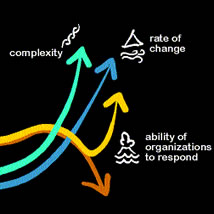
in New York City, in 1961, when I stumbled onto the question of increasing rate-of-change and complexity
[future link]. |
| Before
this 1974 reading period period, I did not have a large enough container in which
to put my experiences and reading. I was seeing,
however, that many ideas that went back to my earliest
thinking were beginning to emerge, not only for me,
but sporadically on the fringes of intellectual thought
and technology development.
A new model was taking shape and the perceptions
that I had developed in New York about the growth
of change and complexity were showing signs
of proving out. Toffler had published “Future
Shock,” Bell, “The Postindustrial Society” and
Herman Kahn was promoting a radical notion of the
future from the Hudson Institute. His basic view,
which fell under much criticism at the time, was
that humankind was able to solve the problems
facing us and that the near future was going to be
benign. Neither the Liberals nor the Conservatives
liked this point of view. |
| It
was at this moment that I read two people that, together,
provided a Basic framework. One was Thomas Kuhn [link] and
the other was Bucky Fuller [link].
Kuhn wrote a book called “The
Copernican Revolution” in which he traced the
phenomena of paradigm shift. Bucky wrote a
stack of books but the ones that impacted me the
most at this time were “Ideas and Integrities” and
Utopia or Oblivion.” From Bucky I got the idea
of “Anticipatory Design Science.” This combination
of Kuhn and Fuller created a framework: great shifts
have taken place before and they had a pattern -
now was no exception only things were moving at a
faster rate. Decades not centuries. The appropriate
response is to design alternatives and put
them on the shelf for humankind to choose from
when needed. “Change the environment - not
people!” |
| Personally,
I was broke, unmarried, at a dead
end [my quest] with
my career and had few prospects. In other words,
I had nothing to lose. This was a great
opportunity. I had to reinvent myself so
why not start with the society that I lived in? Most
of the ‘60’s
revolution passed me by because I was too busy building
things and it did not fit my intellectual style.
Now, some of these ideas started to work their way
into my awareness and thought processes. I looked
up and scanned the larger landscape of Human Experience.
What I saw amazed me. |
| During
this period, I did a few commercial design projects
- including a Bank - that were fun and paid most
of the bills. I lived very simply. Friends helped
me out with room and board from time-to-time and
participated in numerous rants that helped
me formulate and integrate my thinking. No doubt
I was a real pain in the ass to most folks. |
| I
started meeting people who had very radical ideas
far away from the mainstream. I found a rich vein
of alternative thinking and experimentation. I discovered
that for every problem our society faced there were
many, many feasible solutions. Every problem.
The storehouse of solutions was full. The “Solution
Box” - as Steward Brand called it - was populated
with many many viable alternatives to the “future” we
were drifting into the future - by default [link: a future by design not default]. |
| I
discovered that the problems that I faced, professionally,
were not unique to me but systemic of the
entire way we, as a society, organized our organizations
and society itself. A bigger problem, to be sure,
but one that could be worked on with some prospect
of improvement. Through this, my life experience
merged into a larger framework that provided a useful
context for viewing it all together. |
| Also,
I started to reinvestigate several architectural
ideas that had come in and out of my mind over the
first 20 years of my work. Ideas I had not had time to explore while building 24/7/365. My concern returned to the cost
of living and the demands that the cost of buildings
placed on people and the attenuation of options that
followed from this unnecessary expense. Was there
a way that high building costs could be dealt with,
as well as, high energy costs? Were there social alternatives
to how resources were shared? Could the concept of
family housing, itself, be rethought to radically
alter the economics of the situation? Yes - it could.
It turned out that there were many alternatives in
building methods, family organization and agricultural
methods. One design that I developed between 1973
and 1977 was DomicileOne [link: domicile one]
and idea I first sketched in the 60s when I lived
in Phoenix.
An early sketch [link: early sketch of domicile] was
for a couple of lots where I was living in Kansas
City. This project was never realized but the house
and lot did become the nucleus for the Renascense
Project [renascence newsletter] and served as its Library for several years. |
| A
friend of mine asked me to put my discoveries into
a lecture series to be presented at the Kansas City
Unitarian Church in the fall of 1974 [link].
By then, I was more than ready to do something with
all this
material so I accepted and delivered a 20 lecture
series - 60 hours of material and several hundred
books of reading. It provided a model of what
could happen in the last 25 years of the 20th Century. |
| It
pointed the way to alternatives and proposed a new
paradigm of organization. I called it “ReDesigning
the Future” based
on the premise that the future we were “getting” was
not the product of conscious work... but default.
We, as a society, had a hodgepodge
of left over strategies that were being scaled up
to a domain too large, too dynamic and too complex
for them. The series proposed that here would be
- on a global basis - more change between 1975 and
the year 2000 than had occurred since the middle
ages. It took, in those days, three hours of a carefully
worded argument - and numerous examples - to get
people to even entertain this basic notion. |
| This
Lecture Series launched the Renascence Project, brought
me Gail,
[link: partners] and
turned my attention to the question that Gail and
I were to ultimately answer as the geneses [link: 1979] of
MG Taylor Corporation: “how do you facilitate
individuals and organizations through a transformation [link: transforming organization] of global scale and scope?” |
| In
many respects, the two years of reading - and the
Lecture series that followed, and the book [link: designing creative futures] that
follow that - was the most profitable investment
I have ever made. It was in these two years that
I outlined the basis for “Weak
Signal Research [link: weak signal research]” (although
I was not to get the name for it until 1988). It
was through this
process that I was able to find a personal path and
renew my own quest. The ride that followed these incubation years has
been a long and fascinating one - and now, it needs
to
be entirely
redone [link: the big E do it again] again. Social reality is now now catching up
with the construct. What was prospect is now fact. As a society, unfortunately, remain ill prepared for the future we have created [an unnatural disaster]. |
| I
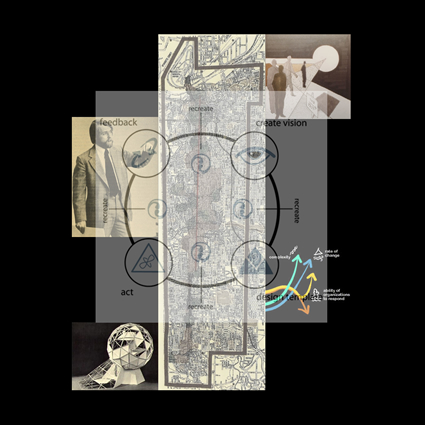
was 36 years old when I delivered the ReCreating
the Future series - today (2000), as I revise this
article, I am nearly 62. In some ways it seems like
a long distance back. In other ways, like yesterday.
I wonder, sometimes, if all of the effort has been
worth it - if any of it has made a difference. This
is, perhaps, a silly question. What would I do with
an answer? I do know that it is time to document [link] this
journey in a form that can be accessed by a large
number of people. Somewhere out there are those starting
a new innovation cycle. They are wondering about
how to do it. They are questioning their sanity.
They are looking for support [link]. |
| For
ReCreating the Future I abstracted a set of creative “rules” extracted
from my reading of innumerable biographies and my
own experience. Gail and I have subsequently used
these in our Work Shops. These “Guidelines” [link: jotm 07 creative] have
helped me at the time of many derailings: |
Have
strong convictions and a flexible mind |
Know
yourself... goals, motives, roots, methods,
capabilities |
Know
the state-of-the-art |
Be
objective about (the ) idea and self |
Work
from the whole to the parts; then from the
parts to the whole |
Define
and document goals, progress, etc. |
Use
metaphor/analogy, i.e. Synectics |
Ask
why.. why... why... what if... why not... |
Integrate
goals to life... live them |
Ask
how was this solved before, what is different
now? |
Organize
your environment |
Expose
yourself to diverse stimuli, and know when
to walk on the beach, etc. |
|
These
work. They also take discipline to practice. Everyone
of them are embedded in the DesignShop, NavCenter
and other processes we use today. Every time I
get lost I go back to this list and “remember.” |
| The premise of the 1974 ReDesigninging the Future Course remains the same as does the present ReBuilding the Future Program and all the work we are doing today: |
The physical evolution of Planet Earth is not over.
The social, cultural, technical system of Humanity is not stable and is entering a time of increasing turbulence and transformation.
This transformation is not one of just scale and scope - it is a transformation of structure, of kind.
This “structure” is not about Earth, Humanity and other forms of life as separated and merely their interactions - it is systemic, the entire gestalt of Gaia, Humanity as it’s technologies, all life forms, as a Planetary wide living system.
The outcome of this transformation cannot be predicted nor controlled.
The focus of Humanity is short term and exploitive dominated by consumerism and war.
Humanity is increasingly destroying itself, all other life and the planet.
Our actions as Humanity are insane - any individual in any human society acting as humanity is acting would be locked up as dangerous to self and society.
Our collective behavior contradicts virtually every religious, philosophic, ethical, political code ever developed and seriously proposed except of course those which are overwhelmingly condemned.
The vast majority of humans, in moments of serious reflection, do not want what is happening yet feel unable to effect any change.
We actually have the base of knowledge, technology and productive capacity to transform ourselves and Earth into a Garden capable of sustaining our population and all life - and the planet as a living system - yet we are drifting into a future of our own making by default.
We must create a new way of working based on design involving the collaboration of all living beings on the planet.
This design process has to be systemic, cybernetic and employ feedback of a complex kind. |
|
| ReDesigning the Future was about exploring the mass of information which supported this premise and establishing a framework for future action.The time premise was that “these things will emerge over the next quarter of a century.” |
| ReBuilding the Future covers the same ground although in a different time continuum. The framework now is “these conditions are here, our margin is spent and we have a narrow window to act if we are not to fall victim to our past logic.” |
| Both ReDesigning and ReBuilding have extensive reading lists which clearly show we have not only the intellectual frameworks, the design and engneering talent, but also the tested alternatives to conditions we face if we will only employ them. |
| If our civilization stumbles now, as so many have in the past, it will be precisely for the reasons outline in COLLAPSE. No matter the specific cause that may trigger such an event we will - if it happens - have no one to blain but ourselves. It would be impossible to run a successful drug store the way we are running our planet. |
|
| I first wrote this piece in 1998 on my 60th birthday. It was one of the first entries in this ongoing autobiographical Notebook. As noted I was 36 when I first delivered the ReDesigning the Future course an event which launched the work which has been my central focus to this day at age 71. Eleven years ago I was trying to make sense of 60 years of living and 42 years of dedicated work. This is no long the case. Many questions remain but a few do not. As I have noted elsewhere, you do not choose your life’s work, it chooses you and if you are lucky you realize this. Knowing it does not necessarily make it easier yet it does make you far less dangerous. |
| I started out to become an architect and thought for many years that the work of MG Taylor was an unfortunate yet necessary detour to contribute to creating a world in which my architecture would find a place. It had become abundantly clear to me by 1974 that the world which exited, and the world that seemed to be the dominate “design” - had no place for what I wanted to build.
Every year from the start of MG Taylor I looked forward to the time of my leaving it. That time is certainly closer now but not so significant. As it all turned out it has merged onto one thing. MG Taylor is about architecture only a new definition of it. My architectural designs always were about creating place for a new kind of society. The two cannot be disconnected. |
| The task outlined in 1974 with ReDesigning the Future will not be completed in a generation - it has taken a generation for the real design challenge to reveal itself to a significant number of people. It will take another generation for Humanity to fully embrace and get to work recreating our planetary society. I now call the course ReBuilding the Future as this defines the phase we are entering. It is clear that we are at a cross roads. We can destroy our planet and our civilization. We can muddle thorough just doing enough to survive and experience what may well be the worst period in human history even assuming we survive it. We can roll up our sleeves and engage in a two generation effort to create a free and sustainable habitat for all life, ourselves and Gaia. This later course has my vote. It will be the making of the greatest work of art in our history and it will be our ticket to a viable future and the stars. |
| 30 years ago, Gail and I set out - with no money, reputation, social network and business experience to create a facilitation METHOD to nurture the transformation which was clearly taking place. Our goal was not to cause the transformation. Our goal was to support it, to minimize the blood on the street which it the typical consequence of such times, and to seek a clarity and integrity so that the result was as free of embedded self destructive memes as possible. This was an outrageous goal. As I have said, I did not choose it - it chose me. Therefore, I take neither credit or blame for it. |
| What we have accomplished in these 30 years, since we created MG Taylor, is proof-of-concept. Our System and Method - even in it’s nascent form - works and has been tested by many complex, emergent, multi organizational, global challenges. We have launched the first youthful ValueWeb to sustain this mission and work. We have been part of many many exciting projects each serving as “an example of one” showing a way to a different kind of future. |
| For me, personally, the future is unknown yet not uncertain. At 71 in this day and age two realities exist. I could die tomorrow and I could be alive, well and working a hundred years - or longer - from now. The science is actually about balanced on these two alternatives. The ambiguity of this reality is actually freeing. It leads to the old adage “ live every day like it is your last and plan like you are going to live forever.” This is what I have always done and I intend to get better at it. This does require three kinds of effort: document this experience; build the Armature of the Method and ValueWeb; design and test examples of possible futures. This also is what I have been doing for as long as I can remember and I intend to get better at it. Each day I look at how I can best advance all three of these efforts. |
| The documentation, primarily via this web site, makes feedback possible. This is “feedback of a complex kind” and involves extremely long loops. How it is going today is not necessarily a good measure of how it is going 40 years from now. How I am doing is one of the basic motives for starting this web site and keeping it up. The other primary motive is to return the favor for those who mentored me and helped me along my path. Of course they are mostly long gone so the favor is “returned” not to them but to those who are starting along a similar trek and who may find instruction, encouragement and insight from my successes and failures. |
| By building an Armature for the Method and ValueWeb I use the term in exactly the way we employ it when building environments. Not as a metaphor but literally. The first step with this is finishing my work within MG Taylor and complete it’s transition from iteration6 to iteration7. Given how things are going, this is progressing well and if we do not loop again will be completed in a year or so. |
| At the completion of the transition from 6 to 7, I will be free of MG Taylor and it of me. My work, then is to become - for some period - a transition manager of the ValueWeb to help it grow to the critical mass required to do it’s work. If then this role is taken on by others or if the web grows beyond the need of it is at this point a question which is outside any understanding of ValueWeb creation. My theory is that ultimately the system integration function becomes embedded, distributed and ubiquitous throughout the ValueWeb requiring no agency of that designation. |
| It is my hope, as time goes on, that more of my focus will be on design and building many “examples of one” which may express “another kind of future.” It is with these projects that my original work and the work of the last decades will merge. |
| In 1992 when Camelot was docked at St. Augustine, as the official lead boat welcoming the Columbus replica fleet [link: may 8 1992], we were in a slip next to a round the world single-handled racing yacht. This vessel was made of a single piece 65 feet long carbon hull with a 75 foot carbon mast and 15 foot deep keel. In side were only two bunks one on the port and starboard sides over the water tanks which to be filled and emptied to stabilize the boat. A center mounted swinging navigation center stayed mostly vertical no mater the angle of the vessel. On the other side of this was the galley. Through a bulkhead over half the length of the boat was an open area to house sails which could be taken in and out through a large deck hatch. Several thousand of feet of sail could be set in various configurations providing the a top speed of the high teens and low twenties of knots. Just aft of the Navigation center was a semi enclosed deck where the boat could also be driven. On the instrument panel over the knot gage was a sign which said “fun factor.” One person can sail such a boat around the world non stop. Imagine coming off 20 waves at 20 plus knots in the south seas and you get the idea. Fun factor. |
| Camelot is a cruising boat with three cabins, 22 tons net displacement and 1,000 square feet of sail. Capable of nine and a half knots she can out sail any of the Columbus ship yet her construction can be considered the end of 500 years of Caravel building methods. Her decks are over three feet above water line and putting her rail into the water in a stiff wind does provide a thrilling human-machine-environment experience providing a hint of the performance of a round-the-world racer. It was interesting to walk the dock at St. Augustine, the oldest city in the U.S., and see the 5 crafts together. The Columbus replicas - our biggest problem leading them in was to sail slow enough - the beginning of a nautical tradition, Camelot the end of it, and a new technology sitting in the water being prepared for an upcoming world class race. Of the thousands of people who came to the marina, over several days, it was interesting to note that they paid equal attention to all three types sitting within 40 feet of each other. It is not often that you can see past, present and future all in one glance. |
| Bringing past present and future together, in the real time act of designing and building a work of architecture, in a complex, dynamic environment undergoing a sea change, is my fun factor. These works, even at their very best, will not save the world. They are examples of a way of working, a tool kit to support this way of being, and an example of a new human, nature, system synthesis which points toward a possible emergent future. With this, I can take some measure of satisfaction although my sense of risk in which Humanity has placed itself remains undiminished. |
|
Matt
Taylor
Cambridge, Massachusetts
September 16, 1998

SolutionBox
voice of this document:
INSIGHT • POLICY • PROGRAM
|
|
click on graphic for explanation of SolutionBox |
posted
September 16, 1998
revised
January 30, 2000
reformatted
and editied July 27, 2005
edited and ending note added November 22, 2009
(note:
this document is about 98% finished) |
|
|