It
was in 1961 when I began to think about the change
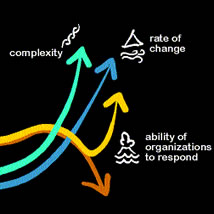
in the rate of change and
the increase in complexity that is an integral
part of it. There is an amusing story about how this insight came about [link: don’t you think]. I have been tracking change, complexity
and their rate of change for over 49 years (as of this edit in, 2010) now. The increase in the rate of the rate continues. There are three major possible outcomes in regards this phenomena. One is, if the rate increase continues and human society does not get requisite with it, there will be a time when the resulting problems will be “solved” by a collapse - most likely a catastrophic one - in major parts, if not all, of our global society. Such collapses have happened before [link: collapse]. A second possibility is that deteriorating conditions may convince a majority to go “retro” and attempt to go back to a mythical time and condition which never actually existed, is unlikely to solve much, and perhaps effectively cut of many possible viable human futures.A third possible outcome is that we slow down a moment, think about what we are doing and stop doing anything and everything just because we can, and respond appropriately to the conditions we have ourselves created.
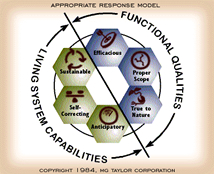
These three qualities and capabilities together make up the characteristics of any appropriate response. A serious question is: are we, humanity, are approaching our future this way?
click on graphic for
more information
The
basic premise behind MG Taylor’s work, starting in
the 70s, is that the accelerating rate of change
and complexity are,
themselves,
becoming the major driver of organizational change
and, ultimately, our global transformation. The nature of this
change is systemic and this constitutes
a new kind of challenge for humankind [link: a future by...]. Our personal
habits and institutional structure/processes are
not requisite with this new rate of change and the inherent complexity which comes with it.
This is leading to the failure of otherwise competent
organizations and many long successful, or at least stable, human patterns. The scale and scope
of this failure has the potential of being global
and catastrophic. Nothing in our history has prepared
us for this. This increase in change and complexity
is the output of the sum of all human activities plus a few wild cards that Nature can and might send our way.
Our reactions to the change we ourselves have created
generates even more change. We are locked in a positive
feedback loop. To achieve dynamic stability and to
become requisite with this world of our own making,
will require a massive transformation of human society
and it’s institutions [link: organizational transformation]. This, in turn, will require
a personal transformation of individual humans their concept of life and what is legitimate behavior on both personal and social levels.
There is no escaping this dynamic, we have passed
the tipping point. It is not too late to effect how bumpy or soft the landing to come might be but not if we are going to make the flight.
I am not addressing change and its impact in merely abstract terms. The mind-brain-body system of a person is a complex structure. The culture, social, economic system of which we are part of is a complex structure. The global architecture of nations, ecology and millions of species is a complex structure. These structures all interact on multiple levels in billions of ways every day. No matter our human designed organizations and their intent, the sum of all these structures and their interactions constitute a complex, emergent network organization which seeks dynamic equilibrium. Doing so impacts the many parts. As this network system gets ever more tightly connected, this creates greater opportunity and new vulnerabilities and the impact of remote change and the connect actions of “small worlds” can disturb local circumstances in ways considered impossible a half century ago. Be these changes “good” or “bad,” by our personal opinion of them, the impact on the system as a whole can be very different than local perceptions. And, visa versa is true. Our history is to try and understand and control change. Change of the kind and scale we are now experiencing cannot be understood nor controlled. This is a requisite variety issue. It is possible to build better feedback loops into systems. It is possible to be more aware of the impacts of our actions. It is possible to think of Planet Earth and all the life forms inhabiting it as a single system. It is possible to look beyond personal like or dislike, want or rejection, and consider both the whole and the parts far more comprehensively than we do today. This is not how we are conditioned nor trained to think and consequently act. This is not how we measure success.
As of 2011 (when this section was written), lets look at the last 10 years: Internet commerce, Asian Market crises, bird flu, 9/11, dot.com bubble, Dolly, Afghanistan, Iraq, Katrina, swine flue, numerous, “unusual” weather, earthquake, water related crises, housing and financial markets failure, Democracy demonstrations in the Mid East - food and oil shortages and price increases; is this system “too big to fail?” What are the threads which tie these sample events together? How do they impact on one another and other whole sets of issues? How do the “solutions” we develop in response do the same? What is the trend line? Have you noticed there is hardly an event that can hold the media for more than 10 days?
The change in the rate of change and complexity has be increasing for a long time now. The curve is getting steeper. What is not commonly recognized is that the actions individuals and organization take in response induces more change and variety into the system. In Cybernetics , this is called a positive feedback loop which leads to system instability. System variety is being amplified iteration upon iteration. The post WWII structure which held and evolved over the last half century is transforming into something else. This is a special kind of change and complexity. It is not just change within a stable system. It is change within a collapsing and potentially regenerating system. This is change of a different kind. The scale, rate and magnitude of this change will be like the last 400 years in a few decades. Singularity fits this projection. So does collapse.
There is nothing new about this. Civilizations have come and gone for millennia on this planet. Collapse and a slow rebuilding is the common pattern. Transformation and continuity is a much rarer occurrence.
If we look carefully, we will see that there is abundannt documentation and lessons to be learned from both types of renewal. Will we be distracted and careless or attentive and diligent? What are we preparing ourselves and our children for? As a global society, we certainly have the knowledge and tools we need. Will we use them?
These are not rhetorical questions. Is the consensus that it will all work out no matter what we do?
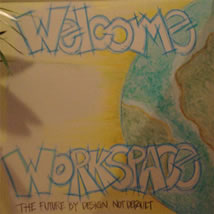
It took me 32 years to get the subject of a future by design, not default from a lecture series in Kansas city with 28 people attending to the WorkSpace, which we created, at the the Annual Meeting at Davos of the World Economic Forum. At the time of origin, a four function hand calculator cost more than an iPAD today.
For example of a change in structure which is generating enormous change and new complexities in some areas of the economy and for some people while being a simplification for others, watch this video of Kevin Kelly talking about the book and authorship Better than Free: How Value is Generated in a Free Copy World.
Kelly noted that it is a Renaissance for reader as there has never been so many good books for such little cost which is rapidly trending toward free, yet not a good time for authors and traditional publishers. His talk provides a way to re frame their economic understanding in the era, of the internet - which he calls the world’s biggest copy machine - the movement from “book” to “screen” and the continuous, ubiquitous flow of linked data. It is notable that his talk was giving close to the time when Boarders Book Stores filed for bankruptcy. Implied in his message is that you can fight the major trends and lose or change in the right way. The rate of change is overwhelming an industry that thought they could ignore it. An interesting antidote was Kelly telling of a friends young daughter who went up to a picture on the table and squeezed her fingers over it to change its size and concluded that “it’s broken.” She may never know the world of immutable information and its unchanging presentation. What will it mean to be a publisher or writer in 2020? What is gained and lost by the introduction of this new technology. What happens when this story is scaled up by a factor of 10,000, or a 100,0000, or more?
Return
to INDEX
GoTo:
Organizational Transformation
GoTo:
A Future by...
Matt
Taylor
Nashvillle
April 04, 2002
Tiburon
November 18, 2010
SolutionBox
voice of this document:
VISION • STRATEGY • EVALUATE