Basic Architectural Practice
Course Notes for Session Two
• Criteria • Architecture’s Scope•
• Practice Scope • Life Cycle Economics •

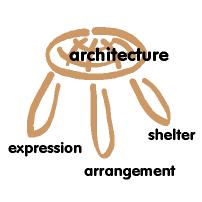
| Remember criteria and feedback - apply critical thinking to your work but do not confuse it with the act of design itself. The definition of architecture is not a prescription - it is an idea to absorb; an attitude that breaths life into everything you build. It is not a dry intellectual expression. When you build, you should know that you are providing shelter, arranging how a life is lived at a certain time and place and expressing the values of those who live it - all this in context of a unique culture. Your are facilitating every moment, every act to sum up - to be living art. This complexity is made manageable by employing THEME in the process of making and employing the work.
|
| What are your design assumptions regarding what is “in” and “out” when you think about the scope of architecture and your practice of it? Based on what information and experienced did you form your concept of architectural practice? How do you conceive of and use economics to facilitate this practice model? How is economics designed in to each project? What is the life-cycle frame of your economic concept?
|
| The dimensions of Architecture:
|
| What has been traditionally considered the scope of architecture is far too narrow to deal with what are now unintended consequences attended by no one.. To me the scope is the entire built environment. This includes highways and infrastructure of all kinds. It includes the design of cities, subdivisions and the like. I consider a space-station a work of architecture. So is a cruise ship three times the size of the Titanic. It is now time to consider the Earth, itself, not only a living system but an human artifact - because it has become one. In reality, the Earth has been a human artifact for centuries. The solutions here lie not in passive aggressive domination or submission but with collaboration and co-design. Design with Nature. This is what my master plan process is about.
|
| This definition of the scope of architecture is extraordinarily broad. This is why I say the architecture is a social art and the role of the architect involves as much facilitation and systems integration as it does design - actually, all of these roles are equally important. To practice this way is not how architects are trained today and it is not how most of view their practice. It will not do to attempt adding the “new” concerns of building, manufacturing, ecology and economics onto the traditional architectural practice model. A new model has to be created.
|
| However, that said, there is still a great deal of variety and difference in how one approach to practice can vary from another. The point is that each different practice will open and preclude certain specific opportunities. A small office without a strong financial position, an appropriate track record and the ability to collaborate with many larger organizations will not get large commissions. It has been difficult, for economic reasons, for large offices to do well in high quality residential work. How you profile your practice will set the range and scope of both your opportunities and your results. Choose carefully. Choose with self awareness of what your true talents and interests are.
|
| However, that said, there is still a great deal of variety and difference in how one approach to practice can vary from another. The point is that each different practice will open and preclude certain specific opportunities. A small office without a strong financial position, an appropriate track record and the ability to collaborate with many larger organizations will not get large commissions. It has been difficult, for economic reasons, for large offices to do well in high quality residential work. How you profile your practice will set the range and scope of both your opportunities and your results. Choose carefully. Choose with self awareness of what your true talents and interests are.
|
| To make a mistake in this self assessment can be costly to the success of your practice - and to your life. There is a great deal more talent and desire to build well than the buildings going up would indicate. This is because the entire field is composed of a hodgepodge of broken processes and convoluted organizations. If you drew an organization chart of all that are involved in building even a simple building, you would be shocked. Try it. No one in there right mind word propose this as a serious model of how to produce anything. Structure wins! The purpose of a system is it’s output.
|
| To make a mistake in this self assessment can be costly to the success of your practice - and to your life. There is a great deal more talent and desire to build well than the buildings going up would indicate. This is because the entire field is composed of a hodgepodge of broken processes and convoluted organizations. If you drew an organization chart of all that are involved in building even a simple building, you would be shocked. Try it. No one in there right mind word propose this as a serious model of how to produce anything. Structure wins! The purpose of a system is it’s output.
|
| What results is architecture that is far too expensive to build and maintain, supports little R&D, is steeped in inefficient building processes and reflects dubious economic and ecological assumptions. This machine grinds on thwarting most efforts to produce good work at a reasonable cost. The tragedy is that so many put up with it and treat this situation as if it was a law of nature. It is not a law of nature, it is a human made design - the result of a series of short term adaptations over the last 200 years. Presently, Architecture has no integrating set of principles. This results in primarily a profession talking to itself while ignoring the consequences of the vast majority of the structures being erected throughout the world. The long term costs of this are disastrous.
|
| Architecture, increasingly is treated as a visual art dominated by photographic feedback. The picture is the thing - carefully taken of course. Architecture is the art of experience. It is not abstract it is real. It is not to be judged by it’s effects on the day it is finished. It is to be appreciated by how it wears and evolves.
|
| Honda Car Company told me in 1998 that 30% of the cost of their product was pure non-value added wasted cost. They are an efficient manufacturer. What do you think the wasted cost of an average building is? It my experience it is about 75% of the time and over 50% of the cost. In this financial environment, good design, good materials and workmanship, innovation and R&D, and concern for the larger economic, social and ecological issues are not likely. |
| Masterpieces remain today, as they have for centuries, the results of patronage - and they remain rare.
|
| Think about the amount of building that will take place - on a global scale - over the next 25 years and ask yourself if a few masterpieces here and there amid miles and miles of mundane buildings in a brutalized landscape is an adequate response.
|
| There are several dimensions of architecture that must be considered:
|
| Type | Scope | Duration | Fitness | |
| Infrastructure
| Today, infrastructure is rarely considered to be an architectural issue - neither as itself nor how it impacts what is accepted as the architect’s domain. Yet, Infrastructure radically effects both public and private space. Infrastructure, like the landscape is the environment in which individual works are executed. It sets the parameters. Infrastructure can be material such as utilities, bridges and power lines. It can be immaterial such as codes and property line grids. | Infrastructure, on one hand, lasts a long time - hundreds of years in some cases. On the other, it must be constantly refreshed. This has interesting implications for how it is designed and built. This is, properly, a co-evolutionary process. | Naturally, there are great fitness issues here. Fitness with “Nature.” Fitness with itself. Fitness with the many structures that make up the built landscape. | |
| Mega Structures
| Years ago, there were great debates about Mega structures. Now, we build them without talking about it. They have become common by default. My definition of a Mega Structure is any coherent structure that serves thousands of people with all the basic functions of life - a place where, in principle, you can stay for extended time periods. Some International airports already fit this definition. So do many destination resorts as do some shopping and entertainment complexes. Cities, themselves, as they become more component connected and integrated, are becoming Mega Structures. A Mega Structure can - and I would argue should - stand in an isolated landscape. This preserves it’s integrity, the landscape and defends against sprawl which is the primary argument for the form. | By definition, Mega Cites take a long time to build and will last a long time. Adaptation and evolution processes must be build in. The end of use cycle and return to landscape must be an intrinsic design consideration. Mega Structure do not have to be - nor should be - built at one time. Infrastructure and Armature elements can be put in place so that the Structure can grow and evolve over time. This is, perhaps, the only way we will get Mega Structures that truly work. | Scale issues abound in this domain. Human scale, as well as, scaling with the landscape. Transportaion to and from Mega Structures can negatively impact the landscape and distort the Mega Structure itself. Mega Structure can -if properly designed - provide large dense populations in a way that minimizes sprawl and negative ecological impacts. They can provide human built landscapes with great identity and sense of place. The can be hot spots of human discourse and economic development. They can focus brand, sense of place, specific cultural values and social, business, educational capacities. | |
| Private Buildings | ||||
| Commercial Buildings | ||||
| Institutional Buildings and Complexes | ||||
| Cities and Landscapes | ||||
| RVs, Cruising Boats, Trailers | These are living environments - Earth Ships. They plug in to site specific Infrastructure elements then, like a bee, travel to others. As such they are architecture in themselves and they also make up the landscape of architecture. | |||
| Temporary Buildings | Today, we build a great number of cheap buildings that are a bad mix of permanent and temprary. Unlike the “wonderful one horse shay” they do not “fall apart in one day.” Temporary buildings, even when built as such, have a bad habit of staying around a lond time - look at all the WWII stuff that is still in use. There should be an honorable paradigm of temporary structures, build well for a specifically defined life-cycle, closely coupled to land use life cycles. There in no reason that these structures cannot be great architecture even an opportunity for deliberate experimental architecture. | World Fairs and Olympics offer beginning models for temporary buildings, their use and adaptation. These can be extended, however, for buildings of all types in a far greater range of circumstances. Following Alexander’s lead in the Timeless Way of Building, it can be argued that projects should often start this way and evolve into more permanent structures based on experience rather than abstract notions. The are some interesting economic implications here. In general, a far greater fine-grained model of time-use, economic cycle and structural decay rate will yield more affordable and supporable results than the“ build it cheap” and throw it a way strategies employed today using, more or less, “permanent” building materials. Cut down on noise, distractions, inconvenience, wasted money, ugliness and land fills. | ||
| Ocean and Air Ocean | ||||
| Space | Space Colonies, in the 1970’s, first raised the issue of architecture in space. Now, the International Space Station is under development. Mars tera forming project studies are underway. Where is Architecture? | |||
| Virtual | Here the scope is for all practical terms unlimited. There exists, now, thriving virtual cities, with populations of over 75,000 and a scale size greater than the State of California. | Virtual environments can come and go in a blink yet it may be that it is they that endure the longest. How many buildings of the architects you have studied have you actually seen? How many days have you lived in their work? |
| These different dimensions make up the major building types. Together, they form much of our experience of the physical world. In the future, they will make up even more of it.
|
| Architecture has to balance between the universal and the totally unique. The Cooper House, for example is designed for a specific life style that a large number of people might not enjoy - at least at this time. This means it has less adaptability and reuse potential than many projects. However, there are not that many kinds of space in any project. Each kind of space can be appropriate to for several different functions. It is wise to think of this when creating a building.
|
| In the past there has been too much argument between universal space and unique space. Both are necessary. Balance is the key. Every good work is an artful combination of universal and mass production elements and unique, site and time specific custom elements. Trade-offs - not compromises.
|
| The Dimensions of Architecture’s Users:
|
| Given the scope of Architecture outlined above, it should be clear that I consider all life forms as being “consumers” of human architecture. This goes far beyond seeing to it that the favorite pet has a door to go in and out of. I have long advocated that animal and plant preserves be connected and have over-under passes allowing migration through human-intensive areas and infrastructure chains. This is easy to do, is now being tested, and is just one example of how the negative impacts of the human-built environment can be mitigated.
|
| There is no reason that we cannot have greater human populations while preserving biological diversity for it’s own sake, as well as, better human, plant, animal interaction and non-exploitive symbiotic opportunities. The problems we have today - and the damage we do - in this regard are the result of bad design and upside-down economics. Nothing more. In this case, the “bad design” can be attributed more to the paradigm of what is in the problem than to designer’s lack of skill or real engineering constraints.
|
| Another aspect to consider is artificial life-forms. We are, at most, a generation away - and more likely a few years - from creating machine and machine-biological intelligent systems. At some time in the near future these will have mobility, autonomy and political rights. What then? Will there be an ADA code for intelligent machines - very likely.
|
| Human augmentation has to be considered as a serious design challenge. We have been augmenting ourselves from the very beginning, however, the pace, scale and scope of this is about to explode. In addition what can be augmented, how this will effect our habitat requirements is about to take a quantum leap. Extended life, replacement of parts, machine-human (event plant-human) symbiosis, mental and physical augmentation, technological extenders (Bots and Agents) are all on the short list of things in the labs now. Yet, we live in a world (of our own making) where the simple computer technology we presently have fails to “plug and play” with any great ease or effectiveness of result.
|
| Augmentation | Scale and Scope | Implications |
| Augmented Humans | Take the smartest human, and the strongest, and the fastest, and the most flexible, and so on... And then imagine everyone having all these attributes. Not a big stretch, but... Even this is a huge leap. What would the athletes from the first modern Olympics have felt in Sidney last month? Imagine Games in the future where genius level intellect is a base-level entry requirement. Now add: cloning, machine augmentation, implants, parts replacement, growth therapies, gene therapy (and manipulation) and so on... What about a human in a machine, animal, or plant body or some combination of all three? What if there was a community that wanted to experiment this way? What if, to some extent, all humans after 2020 had a fair measure of these choices? | You may question if any or all of this is a good idea. Your can be close to certain that these will be issues in your lifetime and practice-time. How many deep rooted assumptions about human habitats, workplaces and architecture are effected by even a partial realization of this scenario? A young couple, scientists, come to you for an underwater house so they can study the biology in this beautiful shallow water sea - among their special problems is how to accommodate and interact with their visitors who do not have gills. How will you address these kinds of circumstances in your architectural practice? |
| Intelligent Machines and Environments | In The Age of the Spiritual Machine, Ray Kurzweil predicts that a $3,500 computer will be smarter than a human within 24 years. Long before this event, the world will be flooded with ubiquitous and ever smarter machines - all networked together. Every task - no matter how complex - if it can be defined - can be automated. Marvin Minsky in A society of Mind indicates how complex results can be accomplished by many simple Agents. The Internet, itself, will evolve like a life-form changing human’s sense of time, place and self. Employing “bio-mimicry,” new materials will be created replacing the crude, heavy, fault-intolerant, expensive materials that make up today’s palette. On the path to nano technology, the human built environment will become ever more biological in function and form. We will ship information and “grow” a building on site from local resources. By employing new materials, virtual techniques and fields, engineers and architects will gradually “decompose” solid architecture into something far more ephemeral than today’s structures. Massive computing power will allow totally realistic simulation making possible building of fantastic complexity - their “drawings” totally automated. | It will take awhile for buildings to “wake up” and become intelligent but is is possible, now, to start making them smart. This cuts down on numerous redundant systems and eases the life within the structure. My Bay Area Studio project and the Chris Allen Building will explore these possibilities. |
| Plants | Now we use plants for materials, food and to create visual and climate amenities. We are beginning to use human adapted biological systems to recycle wastes, create new materials and provide energy. What would “smart” plants be able to do? Could they respond to weather, protect soil, guard your house, protect children? | |
| Animals | Animals who are valued pets are not accommodated all that well by our architecture. And of course I promise not to talk about feed lots and other “production” processes. Animals in the wild survive by responding to changing conditions by migrating. We are, by our building, condeming them to every shrinking ghettos of slow extinction - immoral and totally unnecessary. These three relationship circumstances: companion, husbandry and wild indicate the range of architectural considerations that should be included in almost every project. It will take very little to make circumstances very different. | In Hilton Head, where we used to live, they are shooting the deer for no other reason than they are eating some peoples flowers. When we lived there, we carefully placed our plants, provided a feeding area for deer, birds, and raccoons and negotiated a settlement that worked for everyone. It worked fine and the animals provided value that is impossible to completely measure. Where we lived is called Deer Island - I wonder if they will bother to rename the place. Imagine that Dolphins turn out to be a smart as some believe and there is a language breakthrough and you have to design an environment so they can join the UN representing the Ocean. |
| Life We Do Not Recognise | What is here, already, that we do not recognize as alive? What does our paradigm not allow us to see? What can we not perceive because of our sense limitations? Is the planet alive? | There can be - most likely is - whole generia of life on this planet now that we simply do not recognize - what happens when we do? How might this effect infrastructure, buildings, landscaping? |
| Extra Terestrial Life | Is there? Of course. The planet is being bombarded with biological materials - or the base chemistry of it - all the time. It does not have to be ET to be alive. The first complex Extra Terrestrials we may interact with may be our own descendants - new space habitats will quickly lead to new technological and biological adaptations. | Ever design a habitat that had no floors because there was no gravity? What about one where the life forms have radically different biological tolerances? What is Human? |
| Warning. Much of this may seem way out to you. Ask yourself how long you expect to live then go back that same amount of time and survey the world as it was then. What has happened, globally since 1925? Of course, this is too simple and conservative a model - a linear extrapolation. Change will be 4 or 5 times this - or even far greater.
|
| The dimensions of Architectural practice: The scope of architectural practice has been more narrowly defined than it should be. This has been somewhat addressed, by the larger architectural practices and their clients, however, many who have done this have been too focused on business and mass production.
|
| The four Tables below focus on the Producer, User, Investor and Systems Integrator roles of a ValueWeb system. For our purposes, here, we will not think of this as a ValueWeb because there are few that work that way. What it takes to make a ValueWeb will be addressed in Session Eight. For now, the Tables describe each aspect that together make a four dimensional Matrix of practice options.
|
| The Producer (mostly) and Systems Integrator (to some extent) Tables include the architectural practice roles common today. I will argue, that this is a symptom of the problem with popular practice models.
|
| There are, of course, many combinations that can be generated from these Tables - you may want to apply the Zwicky Box method to find them. Mine can be primarily derived from Producer/Studio + User/Integrated + Investor/R&D Use + System Integrator/Developer.
|
| ...Producer This Table most describes architectural design practices as they exist today with the exception of “Self” which includes the nonprofessional, do it yourself and, of course, indigenous cultures who maintain their traditional (and highly integrated!) ways of making shelter and commons.
|
| Practice Types | Description and Benefits | Constraints and Failures |
| Self | There are several expressions of this: the non professional owner-builder, virtually all indigenous cultures, practitioners from other arts that do an occasional work, and so on. Some very good work has been produced this way.
| Blissful ignorance can often destroy otherwise remarkable efforts and this is too often the fate of projects done this way. |
| Boutique or Studio | This is the default model of most design-focussed architects. Saranen (sp?) worked this way as did both Wrights, Goff, Schninler, (SP?), Dow and a host of others. The focus of this practice model is around small, highly productive, talented staffs that stay together for a long time. Usually, there is a “family” atmosphere often with the studio directly adjacent to the home. This practice has remarkable economic resiliency because costs are kept to a minimum and there is little specialization of work. | Often, a talented architect will go to a city(often a “fringe” one) and stay a long time. When someone wants design s/he gets it. Gradually, starvation gives way to a measure of success and, ultimately, fame and some small projects away from home. Remember, FLlw practiced 20 years in Oak Park. Rarely, does this kind of practice get large commissions. The financial base, experience, client relationship - just pure band width - is not there. The principal(s) of a Studio practice are not “trusted” enough. Large institutions, government, corporations - the source of most big projects - have standards and oversight constraints that eliminate the Studio practices. They cannot take the risk. The Networked practice is an evolutionary step that can overcome many of these obstacles.
|
| Traditional | This is your standard practice model and is still the most employed. It is a broad category. Many of the best architects that have ever practiced have worked this way as well as some of the most mundane. Louis Sullivan is an example as is Cary Goodman. Usually, several Partners are involved each with a client base. This provides steady work compared to a one-person firm and supports a reasonable diverse and talented support staff. Design partners can collaborate on complex projects and, in today’s economy, many of these firms do global work. The upper size limit to this model seems to be around 100 to 150 in two to three locations. These firms tend to be traditional in their approach to contract documents and bid the majority of their work. They probably have the broadest range of commissions than any other model and often evolve to the Networked practice to extend their reach and resource base. Some are on their way to a Global practice but most do not want this. They seek the best (for them) min/max between opportunity and complexity.
| |
| Networked | The Network practice model is becoming more prevalent. Primarily, it is an extension of the other types and driven by several circumstance: practices are becoming more global, local knowledge is required almost everywhere, complex modern building require specialists in many specific types and only the largest firms can afford the increasingly complex and expensive army of support people that make up a modern office. In addition, many designers rather concentrate on this aspect of architecture and partner with firms that can provide support and contract development work. This model can work well and it is almost inevitable for any except the largest, global organizations.
| By their nature, network organizations are not organization dominate. This is both their strength and weakness. They require a great investment in time to build. They can disintegrate in an instant. Currant organizations generally default to an operational model that defeats their desire to partner. This increase misunderstanding and the cost of maintaining the system. Issues of control, accountability, revenue sharing and philosophy soon make hash of good intentions. |
| Global (Commercial) | This practice is what I used to call the commercial firms. However, this term no longer describes the model with any accuracy. The old Welton Beckett firm, SOM and Gensler are examples of this type. In recent years, these organizations have grown to remarkable size, incorporate Partners that produce a wide body of building types and idioms, and support specialty knowledge across the entire continuum of design, build use. These environments can be excellent place to learn the broad aspects of Architecture as long as one avoids getting stuck in one silo - a major risk.
| Unfortunately, practice of most of these firms is flawed. Few solve the problem of scale and become increasingly difficult to manage. The many disciplines that have been strung like beads rarely affording neither economy nor synergy. The very value of the organization, itself, and the size of the projects undertaken tend to drive an ever more conservative approach to organization and work. Often, branch offices, for all practical purposes might as well be rival firms. The need to drive dollars through the organization - to grow and preserve it - soon dominates the architecture. |
| Design Build | There are two completely different practice models that fit in this category. They serve opposite ends of the market. One can be called Studio Design Build and the other Commercial Design Build. The Studio Design Build practice is an extension of the Studio model into the construction world. Many Organic and Green architects work this way. The Jersey Devils being an example. The prime value is control of the entire project resulting in faster build times, lower costs and better construction craft. Feedback to the design process is excellent and supports FastTracking. The Commercial Design Build is practiced at the far end of the scale. It is an extension of the Global practice - usually, in the Integrated User mode. Austin Company is an example. Many large developers like Tishman and Del Web employ Design Build. These companies build large projects(on a regional and global scale) and combine sophisticated engineering and specially in specific building types.
| |
| Academic | The educator who maintains a small practice. Bruce Goff in his early years did this. In a way, this is what Palo Soleri has done by employing a community-user model. A lot of the theoretical work gets done this way and what, now, passes for R&D. There is a financial stability here that many practice models do not have. There is also a greater opportunity to engage in cross disciplinary work than the standard practice seems to do.
| Often, this becomes a self-referencing trap that is disassociated from the “real” world of Architecture. A subtle elitism reins. |
|
...User This Table mostly refers to what is now called the client or customer although “Integrated” and “Community” sometimes involves a complete or total producer presence with no “outside” producer participation.
|
| Practice Types | Description and Benefits | Constraints and Failures |
| Patron | The oldest user model for architecture and art. Individuals and families with influence and money who commission works of distinction and innovation mostly to see it done. Some of the greatest works have been made this way - think of the Price’s and Frank Lloyd Wright and Bruce Goff.
| |
| Individual | It is a rare client that commissions a home or work environment as an individual.
| |
| Institution and Foundations | ||
| Business | ||
| Government | ||
| Integrated | ||
| Community |
|
...Investor This Table describes significant Investor roles and motives. Often, the Investor is the Users but more often not outside of single family and small business types.
|
| Practice Types | Description and Benefits | Constraints and Failures |
| Individual Use | ||
| Commons Use | ||
| Revenue Use | A large percentage of projects. Being built today are designed to produce revenue.
| |
| Investment Use | ||
| R&D Use | ||
| Prestige Use | ||
| Message/Symbol Use | Rare today - more common in Medieval, Roman, Greek and Egyptian Architecture. |
|
...System Integrator The System Integrator role, from my perspective, can be performed by anyone possessing a number of different professional backgrounds. It should not be done from a singular and distorted perspective driven by the narrow interests of any of these professions - particularly as they are practiced today. This is the present circumstance. As above, I describe the System Integrator options in the context of the best of the present practice. How this evolves, in a true ValueWeb application, will be covered in Session Eight.
|
| Practice Types | Description and Benefits | Constraints and Failures |
| Governments | The government functions as the Integrator in a vast number of projects. The Corps of Engineers as one example of this pervasive role. In most cases, this is not seen as architecture or as a serious architectural opportunity. But think of the Mississippi river! Many military bases are entire industrial cites. Another way that governments take the Integrator role is though financing, laws, regulations and codes. Tax law, as example has a profound influence on the financial trade offs between capital investment and deferred expense decisions. Capital is taxed. Expenses are written off.
| |
| Corporations | ||
| Owners | ||
| Manufacturers | ||
| Architects | ||
| Builders | ||
| Developers |
|
Like any Model beware false conclusions. The purpose here is to document a number of comtemporary elements, describe them at their best, and indicate, by placing them in a Matrix, some of the synergism possible with another organizational architecture. The way these elements are composed today, in the vast percentages of projects, is a nightmare organization of competing passive aggressive relationships. No one could ever design an organization this bad. It took centuries to get to where it is and it consumes over 50% of the costs and up to 75% of the time typical to make a building. The individual people trapped in this mess are far better than the dismal performance of the whole “system” indicates or predicts. Structure wins.
|
| The NASA story is one of the best examples of the creative process of an entire culture being employed to accomplish a brilliant piece of work in an incredibly compressed time frame. This was done because three processes were brought together in an integrated way: Design Strategy, Performance Specifications and Administrative Method. The great innovation of NASA was how it built. In the end, NASA kept the rocks and throught away the organization that went to the Moon. After a generation, it is trying to come back.
|
| Every innovation shatters one or more “hidden” design assumption. Before designing a work I always deliberately review my assumptions about architecture and it’s practice. I want to take constraining habit out of the process. Circumstances change and new ideas come along but old conclusions are not automatically refreshed. In this regard, most people have one years experience 40 times - the objective is to have 40 years experience 40 time - or more. For example: instead of using computers as merely another way to draw, in a manner created by paper and pencil, ask how - with computers as an augmentation tool - the process of communicating architectural concepts and details can be far better than before. Instead of accepting long build times, uncertain craftsmanship and extraordinary costs, find our what really drives this waste and create an organization and process that can do far better.
|
| Areas of Some Success: Airports are an interesting segment of architecture. They are, in effect, Mega-cities. Airports are Capitalism’s cathedrals. In recent airports, the best syntheses of “modern” technology, conventional function, “modern” material usage and human comfort (as now commonly understood) - of any other large scale works - can be found. This is where the large-scale architectural practices shine the most and demonstrate that very complex projects can be executed with a high degree of precision. These works, however, are not energy efficient and ecologically fit - they are not sustainable. They are based on dubious economic assumptions. The process model that determines how an individual moves through the space is flawed. Too often, they are temporal creatures of style that age quickly. These concerns have to be elevated to the same level as the many others that now clearly have designer’s attention. Given all this, for now, they remain some of the best examples of large works and they point to many new possibilities.
|
| Organic and green architects have built an impressive number of projects demonstrating human, natural buildings that are much more sustainable than a vast majority of work. Few of these architects have executed large works. Their impact on mainstream building has been surprisingly small. The size of a project imposes it’s own economic and design constraints. One size does not automatically scale to another. Whole different structural methods and building means are involved. The organization necessary to build a project of any type will be entirely different from another.
|
| NASA and other space agencies are getting into the architecture business in space and have done significant basic research on what conditions humans need in order to live off planet (and by the way on planet). Their science and technology is far advanced over traditional architecture but their biology and human measures still lag what will be necessary to build environments from which complex cultures will evolve and, within which, they will thrive. What happens to the ART of architecture in these new circumstances? What values will be expressed?
|
| Notes on Applying Knowledge: To effectively approach architecture in the way we have been discussing requires a great deal of knowledge. The difficulty of acquiring and applying this knowledge is the primary reason given for the more restrictive definitions of architecture and the practice of it. However, building a knowledge process is, like anything else, a matter of system, method and practice. Too many declair the task impossible without examining and challenging their own habits in this regard. In executing work of this scope, the 10 Step Process is critical. Study the emerging field of Knowledge Ecology.
|
| Life Cycle, in the way that I use it, has two meanings and fields of focus. In the economic sense, meaning the full “lust to dust” costs and benefits of a project. In the biological sense, meaning the impact the project has on the entire cycle of life. The two together requires that the economic (human ecology) and ecological (nature’s economics) are considered equally in the cost benefit understanding (analysis and synthesis) of the project. When this is being done at some significant scale and when we are no longer in scarcity economics paradigm, then it can be said that we are in a NEW economy model.
|
| Kinds of Costs | Description | Opportunities |
| Individual Costs | Our entire economy runs today, primarily, on individual cost feedback loops - and at that, immediate and short term cost measures. This, of course, creates an enormous distortion. What if the price tag of an automobile carried with it the net present vaue analysis of the investement including all true social and ecological costs? The capital that is invested in a building is the least of expenses when considered over the lifetime of the structure. Few individual could compute their real costs of ownership.
| |
| Social Costs | Social costs include transfer costs of which there are many kinds. They also include deferred costs and the cost of unintended consequences. What makes these costs “social” is that the bill is not presented directly but is paid by society in general. Sometimes there is a measure of fairness in this, other times not. A great deal of the political game is involved in shifting these costs and ten sometimes balancing them again.
| |
| Ecological Costs | Ecological costs, of course, pertain to those paid by nature. These often involve a huge withdrawal form Nature’s Capital account without thought of the downstream consequences. In time, these do become social and individual costs - often ones very hard to track or relate in any causal way. There is a tendency to support ecology because of the coming awareness that we humans are destroying many of our future options. This is a good trend. However, it is also important to address ecological issues beyond this human-centric viewpoint. Other like forms have the right to exist and should not be destroyed without reason merely because we can do it - a might (and ignorance) makes right policy of denial and arrogance.
| |
| Global Impacts | In reality, all ecological costs are global and so are most economic ones. However, what I focus on here are impacts that result in a systemic and large scale dislocation.
| |
| New Economics | A new economy will be one where feedback from all levels of recursion and scale will inform decisions - individual and group. Feedback of a “complex kind” will make balanced and sustainable outcome far more likely. The values that people vote for in the marketplace will be more consistent with their stated values and goals - not the dichotomy we see today. Human technology and economy will be orders of magnitude more complex with a variety that approaches Nature. Options will be greater. Organic Architecture will not be an idea and a metaphor but a living reality and presence. |
|
A application of Life Cycle thinking is demonstrated by my Bay Area Studio project. It is surprising (until you think about it) what the most expensive cost elements are to own and use the building over time.
|
| Summary: In our first session, I offered a definition of architecture that stresses the integration of utility and art. It says that the function of architecture is to serve both utilitarian and esthetic causes. This definition, and the the scope of architecture as described by it, establishes the criteria by which any work be produced, judged and used. The definition as provided, however, was framed in the context of traditional architectural opportunities and concerns. In this session, I ask you to extend your consideration of architecture’s scope. The scope of what is materially a concern of architecture by habitat types (The Dimension of Architecture), the users of architecture (The Dimensions of Architecture’s Users) and the various practice types that can be employed (The Dimensions of Architecture Practice), and, the Economic Cycle of a work from conception through re-use to the death and recycling of the artifact. You have to revisit both the definition of architecture and the criteria from this perspective to grasp my idea of 21st Century architecture.
|
| The point of this entire course is that what architecture is, the necessary scope of architectural concerns, and that the true variety of the users drives architectural criteria. Your practice model will determine what you can do and how you will be rewarded for doing so. In addition, I contend that your responsibility is the entire life cycle of the project - not just it’s design or builing. The SUM of all this is vast and beyond the practice of any individual and perhaps any single practice. It is not beyond a well designed, mature ValueWeb system of practices.
|
| Each of you have your own strengths and weaknesses, skill sets, economic requirements, personal life-style requirements, interests and so on. The right practice model for you is the right practice model for you - no other will do. Although there are general models (some offered above), like any suceesful building project, a specific design is required. How you design your practice - I claim - will impact your life’s work far more than any other factor including dedication, hard work and raw talent. It certainly will massively impact the quality of your life and the satisfaction you achieve from your work.
|
| You have to choose. You have to design it. You have to fit it in to the society you are a part of and with the collaborators you will work with.
|
| Next Session we will explore the Practice types more deeply and some aspects of the creative process that directly relate to collaboration in a complex organizational environment.
|
| Assignments: Be prepared to briefly outline your studio project, on the Program level, in terms of your present thoughts regarding criteria, architectural scope and practice models. You may want to review my Bay Area Studio program as an example - as one way to do this. It is important that you start thinking about how you are going to set up your web site. Let the various concepts we has discussed stir around in your mind. How do these various ideas play with one another? What do they suggest? Let your ideas form - do not force them.
|
Matt Taylor
Palo Alto
January 12, 2000

SolutionBox voice of this document:
ENGINEER • STRATEGY • PRELIMINARY
posted January 12, 2000
revised August 22, 2001
• 20000418.175746.mt • 200001014.648612.mt • 20001021.126598.mt •
• 20010822.528871.mt •
(note: this document is about 40% finished)
|
| Course Outline | |
| Final |
• Matt Taylor Studio Project •
• Pattern Language •
• Xanadu Project •
• My Palo Alto Workspace •
update to Matt’s Notebook