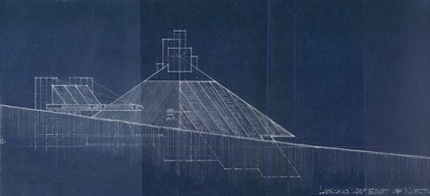
elevation
from the street viewing carport and house
Matt Taylor
March 13, 1976
|
| The
Steinmeyer Residence was a commission that nearly got built. It was
my first design for a totally self-contained environment. It the end,
it proved too much for the client. Emery Lovins executed his house at
the Rocky Mountain Institute, Snowmass, Colorado, in the early 80s.
His project demonstrated the feasibility of this approach in a far harsher
climate than Kansas City where the Steinmeyer project was to be built. |
| This
house is much more buildable today than a quarter of centurary ago but
nevertheless would require the leading edge of a number of technologies.
Even today, a totally self contained house requires a completely different
lifestyle than does living on the grid. This is, perhaps, the primary
value beyond all the energy ecological reasons usually given for such
a project. I was interested in pushing the technology envelope, yes,
but the prime focus was the place as a work of art, a facility for a way-of-living. I think I failed to adequately convey this point
to my client and they felt they were funding a research project and
an experiment not a residence to live. I think the idea of “working”
a house like a homestead sounded too much like going back (they remembered
the depression) not forward. I think that the issue of self-service
as a trade-off for earning money and buying services and goods is still
an open one. Self-service involves time, yes, it is oftern “better”
time than the equivalent spent “earning”
in order to shop and buy inflated goods of dubious value. In a different
context, these ideas (intrinsic economics, work, lifestyle choices)
are the central design theme of the Domicile project. |
| At
any rate, the economics of architecture is not well developed and there
are problems in three areas: the (design/build) costs,
the life
cycle costs (use) and the intrinsic designed-in technology (total
supply chain). The social, economic, ecological tradeoffs involved do
not add up. It is often promoted that modern housing makes economic
sense against ecological sense. It does not make sense in either realm.
Only narrow analysis in strict isolation can produce an answer that
support our present practices. |
|
| The
basic concept of the house was a 40 foot square pyramid suspended from
a single masonry mass. The living areas were in three levels: the Garden,
greenhouse and utility areas - at the bottom and opened onto the lower
side of the sloping site; The living, dining, library, siting level
- at the center level and suspended over the greenhouse; bathing, sleeping
at the top level - this area viewes the site to the North through a
large corner skylight. The roof, which makes up the majority of the
structure, forms a composite wood structure with suspension cables running
through it’s prefabricated sections. |
| The
reason for prefabrication was to increase quality and finish decrease
the overall build time and minimize site disruption. Many of the same
reasons as delineated in the Bay Area Studio project documentation.
The two projects, separated by 25 years have many similarities and employ
the same fabrication process. |
|
| The
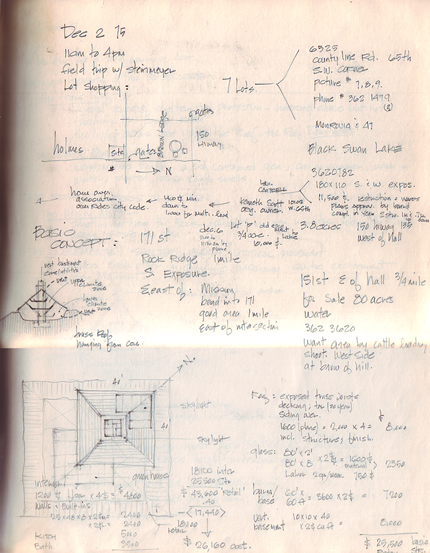
site, the third selected, selected encompassed 3 plus acres of slopping, wooded landscape
in a small subdivision around a lake outside of Kansas City, Missouri.
The subdivision was more than 20 years old and had established the tradition
of minimum “landscaping” - the idea was to leave the natural
landscape as is. This was one of the primary reasons for selecting this location.
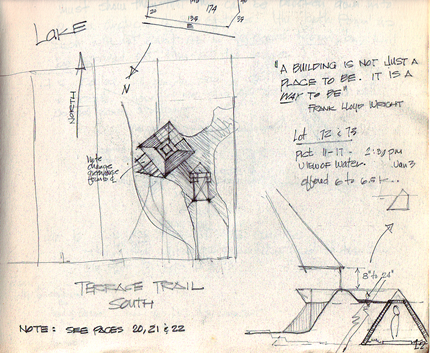
The house was designed for one lot, originally, and then, and second and finially the third was purchased This
required that the plan be “flipped” which allowed it to fit
perfectly on the new property. The carport was detached with an underground
entry into the greenhouse section of the house. The house was protected
by earth berms on three sides leaving a strip of glass from the berm
to the roof. The forth side was sloped greenhouse glass (extending the
roof) and floor to ceiling glass to an outside patio. The idea was for
the greenhouse, a serious food growing area, to act as an indoor/outdoor
living place. Laundry and basic food preparation was also on this level. |
| The
house was a typical suburban floor plan turned on it’s side with the entire grade lever area an indoor and outdoor garden. |
|
| In August, 2009, I built a 3d SketchUp Model of this design (shown below and augmented with additional scans from my 1976 Notebook). This is, short of building and being in the real thing, almost the only way that the Steinmeyer House can be fully comprehended. The space, and how light, spilling from the top to the bottom, plays with the texture of the simple natural materials and create a landscape; and, how the off-the-grid “green” technology integrates into the entire architectural concept, produces a unique environment not only for its time but for today 32 years later. It is tragic that this building was not accomplished. |
|
| Below, I will cover several aspects of this concept: what led to its not being realized. Why and how conditions today make it an eminently feasible project. The Steinmeyer House’s relationship to other projects of mine during the 70s and early 80s and to the postUsonian Project of today. I will outline the basic architectural and building method of this design. The role of prefabrication and other aspects of how this building can be built will be explored in more depth at another URL, as well as, a comprehensive analysis of the work as architecture. |
relationship to other projects: |
architectural integration: |
| This piece ends with a short explanation of where I was at the time, what I was seeking to accomplish with this project and its relevance to my entire body-of-work. |
|
My Personal Context
for the Steinmeyer Project |
Sir George Dyson, in his The Progress of Music, had written, long before, without intending it, a kind of epitaph for Orion, a prophetic appreciation of his Son’s involvement with the spacecraft. The metaphor was musical. the subject was a great composer.
“By a supreme act of faith,” Sir George wrote, “he deliberately devoted the best years of his life to the inception and gradual completion of a work of colossal proportions, a work covering the whole range of of his ideas, philosophic, poetic, and musical, and a work which he, the practical operatic producer, of all men well knew to be absolutely beyond the available means of any theatre then existing in the world. There is in music no parallel to The Ring. There is no parallel to it in any other art. If an architect were to spend half his life designing a huge and elaborate building which was not only unauthorized and unwanted, but for which the very materials did not at the time exist anywhere in the world, that would be a fair parallel to Wagner’s chosen task.”
The difference is that Freeman did not devote half his life to Orion, just one of two of his best years, and that the spaceship, unlike The Ring, never flew. Had Orion left the ground, though, it would have done so with much crashing of cymbals. Pounding through space, Orion would have made Wagnerian music.
Kenneth Brower
1978
The Starship & the Canoe
pp 87-88 |
|
|
| Architecture is never created in a vacuum. There are thousands of years behind any work and one can hope far more following it. What society is concerned with at the time of its making, as well as those aspects paramount in its creators life, all add to the complex mix involved in the making of a work of art. |
| It is impossible to make architecture outside of this context. |
| I have always made it an integral part of my design discipline to be aware of what I was doing - and why - with every design project which I took on. Still, it is an unique experience to go back to a project 33 years old and take it though its next level of design development. Doing so strongly brings back the ambiance of the time and the memory of the “me” who conceived this work. The “me” of today is, the same and radically different. |
| During my Kansas City and Renascence Project years, I was (and remain) deeply concerned with both what has become to be called “green” architecture and self-contained building. It was in this period that I began to grapple with the unique architectural challenges associated with protecting people from industrial pollution and the planet from people while considering a variety of scenarios from the necessity of building survival Arcs to environments in space and on other worlds. It was out of this period that the idea that we were entering the period of Planetary Architecture began to take form in my mind. Up to this point, as my design work made clear, with some isolated exceptions, I had focused on how to maximally open the human-built environment to the nature-evolved environment. I began to question if this design strategy could remain valid given likely future conditions. Theodore Taylor had proposed the complete separation of human technology from natural ecological systems as the only way to arrest the increasing destruction of the planetary habitat. How could this be done while keeping a close connection between Humanity and Gaia? How could there be technological separation and yet human-planet integration? |
| At the same time, My ongoing quest for creating affordable architecture - in both economic and ecological terms - which to me meant, and still does, a far greater integration between design, manufacturing, construction practices and financing and ownership models, was still a chief goal. All of these design issues where deeply imbedded in the Steinmeyer solution. In the genera of the single family home, the project was my synthesis of all these, which most considered to be competing factors, into a new direction for architecture. |
| The design of this work was done just after I had complete my two years of reading, delivered the ReDesigning the Future Course and was in the process of launching the Renascence project. All architecture, intended or not, is a social statement. This design was a deliberate one. By being a cutting edge example of green technology, affordable - economically and ecologically - and a work of art with no compromises of architectural expression or life-style concessions, the Steinmeyer House was intended to be a proof that housing of that day was not sustainable nor necessary and that there was a practical way out of this circumstance. |
| Instead, of course, what we got was another generation of Mac Mansions and all that goes with them. The late 60s and early 70s were a time of questioning and search for alterative solutions to human economy and ecological problems. A generation later, we have gone full cycle with, unfortunately, few of the promises accomplished and many of the more dire predictions coming to past. The principal difference is that then we could say “these things will come” and now it can be said “they are happening.” |
| One of the interesting things in retrospect is what I was most concerned about at the time in terms of successful execution. I had few doubts about the structure or the fabrication/building process nor do I today. This will actually be more complex, today, but only because there are so many new products and processes to choose from. Although I knew that the green technology was new, in the 70s, and marginal, again, I believed (and do) that we would have worked our way through it one system at a time. We would have had to engineer and make most of the systems one off. The technology is much more advanced and packaged now so there is less need to do this yet, like the structural options, much more to study and learn about these sophisticate systems. My biggest concern was the layout of the “rooms” and spaces and how the building would actually function. As complete as my Preliminary Plans were, by the time the projected was cancelled, I did not know, then, how the layout would prove out as the Design Development phase progressed. I did not expect anything that I could not fix, I just did not know how much I would have to fix. In building the SketchUp model, I was pleased to find that the spaces went together as I had conceived them requiring little adjusting. In fact, less than normal when moving from a Preliminary Design into Design Development. By the time I started this work, there was a 75 year history of opening the space of a house horizontally. Vertical opening had been done on a limited basis. With this design, as with the Cooper House, Domicile, EcoSphere there is an extreme horizontal and vertical “play” of prospect and refuge. These works are symphonic in their complexity and layering of fields of view and sense. With Steinmeyer, as with EcoSphere which I designed earlier and developed afterward, each major area serves a distinct set of functions. In this way the design was more traditional than the multi use plans of my prior work yet more adventuresome in that the spaces flowed one to the other in a complex syncopation. Public areas morphed to private as one advanced into and upward in the space. This is a technique we use often in our navCenters today. |
|
| In terms of architectural practice, there are many things to learn from this experience yet they are not as simple as at first may seem to be the case. |
| In my kind of practice, a work is not shown a client unless we are more than a little excited about it and we are convinced that it is appropriate for its time and place. Even so, there are ones that are seminal. They are a watershed. You know that you have both broken new ground and produced a work wherein the magic happened. The Steinmeyer House was such an experience. I feel the loss to this day. It is a child still born. |
| This was particularly painful as I was recovering from the Phoenix disaster and energized with the necessity of Humanity building in a new way. Nothing that is in the headlines as we approach the end of the first decade of the 21st Century was absent from expert knowledge in the 1970s. You only had to look a little to find it. The only difference today is that a generation has been largely wasted and the headlines are in our face every day. |
| The crisis is far greater now and my time is shorter. Yet, my sense of the WORK, is different. I expected, after leaving Taliesin, a half century ago, to have built several hundred works which - as a body of work - added my contribution to this ancient art we call architecture. At the time of Steinmeyer, my scope was broad yet my time frame of urgency short. I did not know what my true contribution would be. If I had known then, my perspective and thus patience would have been much greater. I understand now that what I have to do far exceeds an individual work no matter its value. I also understand that each properly executed work does encompass the whole. It is fractal. |
| Unknowingly, I set out to change more than what the 20th Century called architecture. As I did the Steinmeyer House the full scope of this ambition was just dawning. Even given that the outrageous notion of Planetary Architecture was nascent in my mind, my focus in 1979 was on the production of individual buildings. I tended to judge my professional success or failure in these terms. It was not until 2001 and several years into this web site that I understood that it was the whole body-of-work which was the accomplishment. Now, I see that judging a life time of work - a practice - as successful or not, is merely an interference to doing it well. Judgment is an act of history and for others to do.The individual works are important, of course. Each does tell the whole story. It has to be experienced to do so. As real and concrete building is it is transient. A one time and always changing expression of idea. Had Steinmeyer been built it would have mattered. It would have been a significant punctuation point along a long path. |
| As I write this summary, I am preparing to go to New York City to see the last day of the 50 year celebration of the Guggenheim Museum with the display of Mr. Wright’s work prepared by Guggenheim and Taliesin curators. I was at Taliesin, in 1958, when the Guggenheim was going up and partially aware of the battles involved to get it done. A half a century later, I have a fuller understanding of what was happening at the time and can see this exhibit in context of a long dialog among often competing interests. This celebration is a closure and a new beginning. To see the architect’s work on display inside the architect’s work is particularly poignant. |
Freeman Dyson has expressed some thoughts on craziness. In a Scientific American article called “Innovation in Physics” he began by quoting Niels Bohr. Bohr had been in attendance at a lecture which Wolfgang Pauli proposed a new theory of elementary particles. Pauli came under heavy criticism, which Bohr summed up for him: “we are all agreed that your theory is crazy. The question which divides us is whether it is crazy enough to have a chance of being correct. My own feeling is that it is not crazy enough.” To that Freeman added: “When the great innovation appears, it will almost certainly be in a muddled, incomplete and confusing form. To the discoverer himself it will be only hal-understood; to every else it will be a mystery. For any speculation which does not at first glance too, crazy, there is not hope.”
Kenneth Brower
1978
The Starship & the Canoe
pp 146-147 |
|
|
| Science has a process of sorting out the “muddling.” The scene above describes on aspect of this. Rigorous testing is another. Architecture does not welcome building muddled results. The Design Development process generally refines ideas as does the act of building. This is why feedback between all of the design, engineering, manufacturing and building processes is so important. In architecture, ideas tend to come in bits and pieces until in one project a new concept leaps forward seemingly fully developed. Yet, traced back can often be seen to have a long history - sometime decades, if not centuries. |
| Once built, an architectural innovation is not necessarily understood, accepted, used well or maintained. Often it is not published in a way which brings the idea into the mainstream. Architecture is Art left out in the rain subject to arbitrary modifications, war and the periodic decline of neighborhoods, sometime rescued decades later and expensively restored. The average work slowly disintegrates preserved sometimes by an early photograph taken before the landscaping developed. |
| Getting a work built is one thing - the majority of designs put on paper do not become realized - stewarding it through is lifecycle of use - as an idea and as an artifact - in another and far greater challenge. The Steinmeyer house did not get built as did not all my seminal projects of the 60s and 70s. One way of looking at it is that this was a mercy. At least they were spared the fate of those built. Perhaps they will built in a time and place more compatible to their philosophy. |
| Although Wright was at the peak of his power and fame, the Guggenheim suffered many indignities though the final budgeting and building permit process. It was modified before being finished and never used in the way the design intended. Those opposed to it, as soon as they got their hands on it, changed it without even allowing a test of the basic concept. I have been in the building three time in 50 years, vastly disappointed each time. All of this has gone full cycle. The flaws recede into memory, the old conflicts forgotten, newer and better uses and modifications happen, the idea of it emerges with greater clarity and power. We shall see... |
|
Matt
Taylor
Palo Alto
April 2, 2001
Nashville
August 18, 2009
SolutionBox
voice of this document:
VISION • STRATEGY • SCHEMATIC |
|
click on graphic for explanation of SolutionBox |
posted
April 2, 2001
revised
August 21, 2009
• 200010402.12701.mt • 20010403.448211.mt •
• 20090818.453711.mt • 20090820,971090.my •
• 20090821.565665.mt •
(note:
this document is about 25% finished)
me@matttaylor.com
615 720 7390
Copyright©
Matt Taylor, 1975, 1976, 2001, 2009 |
|
|