sketch by Matt Taylor
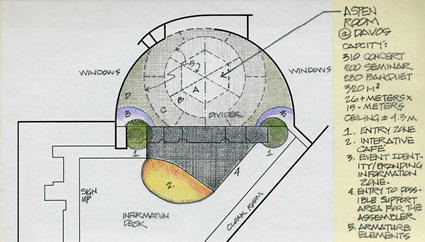
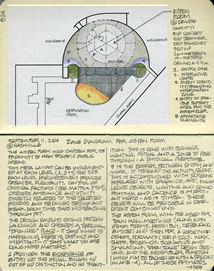
september 11, 2004 | Aspen Room Plan-Section
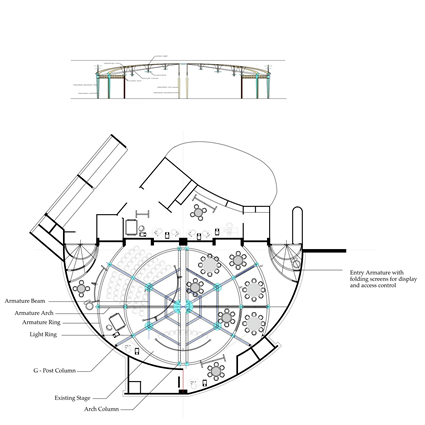
by Bill Blackburn
September 27, 2004 | Aspen Room
Job Visit
October 12, 2004 | MOU Signed November 11, 2004 | Armature Design by Bill Blackburn
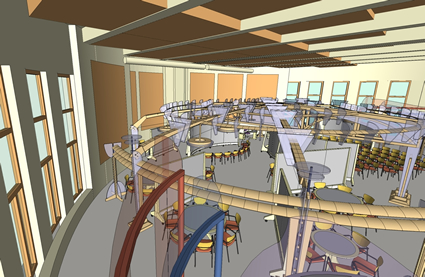
3d Model by Matt Fulvio and Scott Arenz
December 6, 2004
| Fitting of first Armature Cord
December 28, 2004 | Install @ Davos
January 20, 2005 | Install @ Davos
January 25, 2005 | First interactive WorkShop
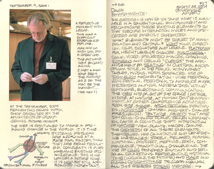
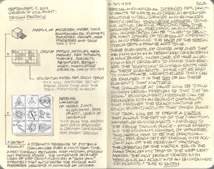
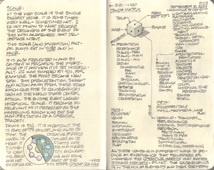
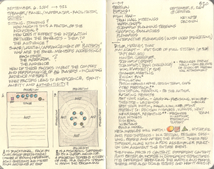
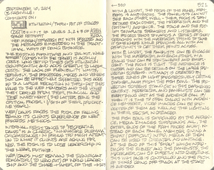
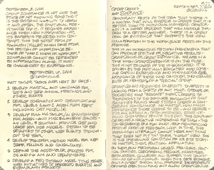
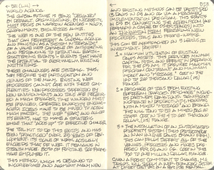
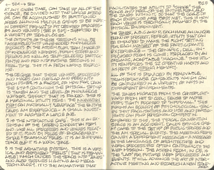
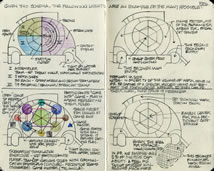
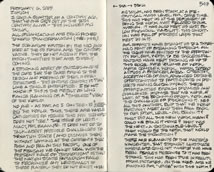
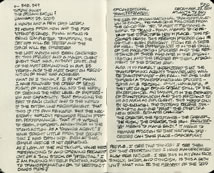
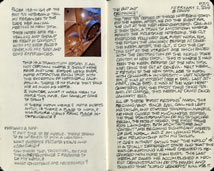
January 27, 2005 | now called the DAVOS WorkSpace | | In early September (2004) Architects of Group Genius [link], a member of the MG Taylor ValueWeb [link] licensed to do our process, conducted a Work Shop in Geneva with WEF members to look at ways to “Reinvent Davos.” Maurizio Travaglini of AOGG facilitated the session. Gail, representing TomorrowMakers [link], worked with Maurizio who was backed up by his excellent team, MG Taylor network KnowledgeWorkers, and two facilitator/KnowledgeWorkers from the Gap Gemini Paris ASE [link] who also provided an RDS environment for the exercise. It was truly an international team. I attended the session as a participant. | | Below is my hand Notebook documentation recorded before, during and after the event. I returned to Geneva in October to see the Aspen Room space at Davos and to meet at the WEF headquarters in Geneva to advance the thinking about how we can utilize this one space to create an environment for a number of the new processes that we designed in the Work Shop. The work since then, until my return trip in November, focused on configuring the existing MG Taylor RDS, adding a new Armature to it, and getting the system in place for the Annual Meeting [link] in late January 2005. | | | | 517
08/24/04 Davos - WEF
Rate of Change
Environment Elements
09/04 Workshop link: full screen view | | | | 518
08/24/04 Davos - WEF
Environment Elements
Matrix, Grid, Language
Design Factors link: full screen view | | | | 519
09/05/04 Davos - WEF
Matrix
WEF Scale
Creative Process link: full screen view | | | | 520
09/05/04 Davos - WEF
Session Forms
Conventional to Alternative Layouts link: full screen view | | | | 521
09/05/04 Davos - WEF
Utilization
Fish Bowl
Innovator’s Dilemma link: full screen view | | | | 522
09/07/04 Davos - WEF
GroupGenius versus
Group Ignorance
MT Tasks link: full screen view | | | | 523
09/07/04 Davos - WEF
3 levels of
Investment and Payback
Design by Default link: full screen view | | | | 524
09/11/04 Davos - WEF
Aspen Room Use
Zone Diagram - Brand
Sub Spaces
Decription of Parts
Implementation Levels link: full screen view | | | | 525
09/11/04 Davos - WEF
Aspen Room Zones
Sub Spaces
Decription of Parts link: full screen view | | | | 526
09/11/04 - 02/16/05 Davos - WEF
Layout for Work Shops, Simulations, seminars, Assembler Team link: full screen view | | | | 533
10/14/04 Davos RDS
How Do We Do It?
Tasks
Schedule link: full screen view | | | | 548
12/21/04 - 01/25/05 throw away the
organization?
betting the farm
RDS @ DAVOS? link: full screen view | | | | 549
12/21/04 - 02/06/05 MGT critical mass
point of success
Master’s NavCenter
Switzerland link: full screen view | | | | 550
12/22/04 - 01/25/05 idea Organizational of Transformation is back
Agents are changed
DAVOS RDS link: full screen view | | | | 552
02/02/05 - 02/06/05 post 9/11 series start
ASE DNA Dip
WEF Annual Meetings
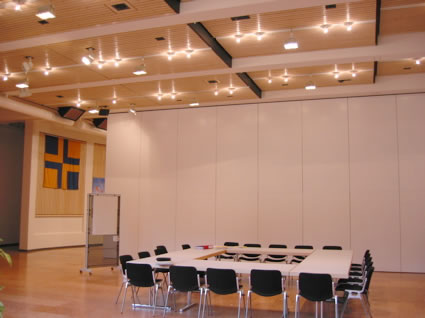
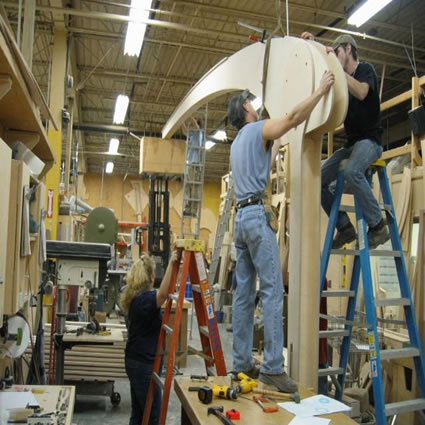
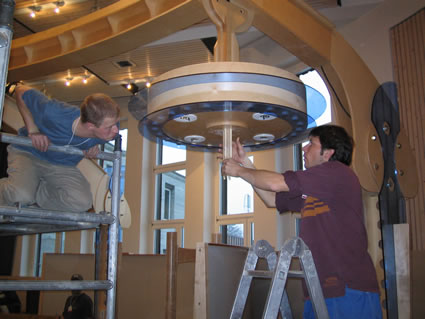
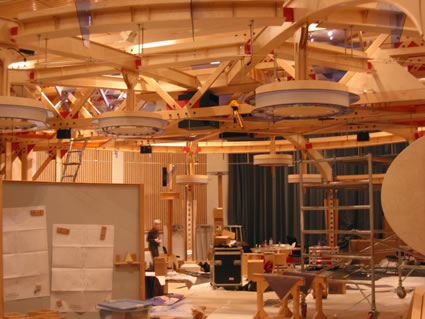
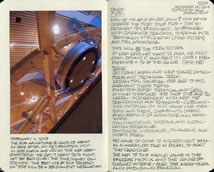
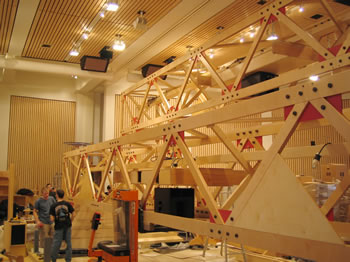
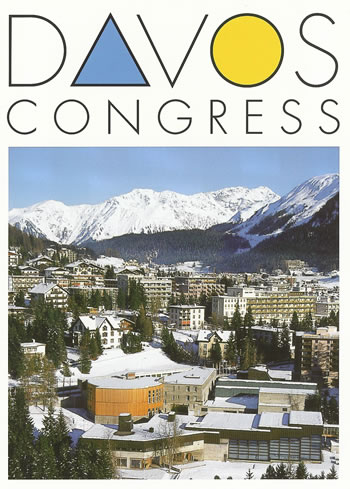
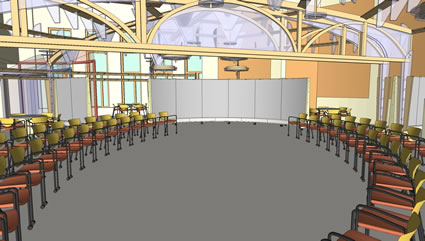
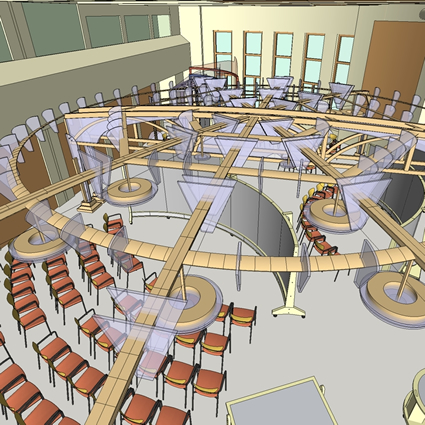
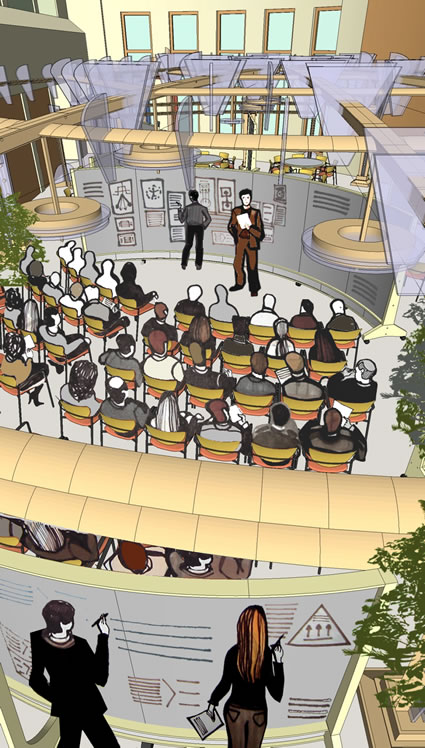
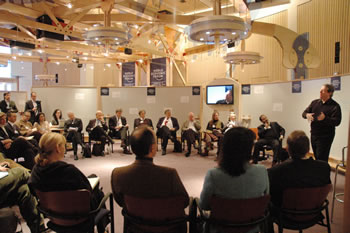
my location strategy? link: full screen view | | | There are many innovations that came out of the WEF-AoGG Work Shop and will be experienced throughout the entire Annual Meeting. This documentation primarily focuses on the Aspen Room [link for video clip of the room] as a dedicated space for new approaches and a place where our environment and processes will be featured. Three major goals for the Aspen Innovation Studio were defined in the September session and refined during my October trip to the WEF headquarters: | innovation_studio_mission | Provide for a much greater level of participation, collaboration and design - on a much greater scale - than has been the case at Davos in the past. This collaborative work will be focused on issues of global significance. Create a BRAND, a signature process, where over a 1,000 attendees can have a significant experience that becomes, in their mind, what Davos is about and the direction that it is heading. This experience to be grounded in the fact that they made real gains designing solutions to systemic, complex, global problems that they recognize as being essential to their future. Perform the ASSEMBLER function, incorporating aspects from the entire 05 Davos, creating RED THREADS, that published, tie the entire Annual Meeting together. Thus, the Aspen Innovation Studio brings significant leverage to the total effort expended during the week. The Innovation Studio is not about one room being different - it is about Davos and how it functions in the meetings ahead. | | | These are not trivial goals. However, based on our 01 [link] and 02 [link] experiences with WEF, and the work done in the Work Shop, the other innovative processes being brought to the Annual Meeting [link] - and the commitment being shown by the WEF leadership - these are doable objectives. However, given the time frame and the degree of innovation involved, near flawless execution was required to create a capability and process to accomplish them. | | | Bill Blackburn developed scale layouts of various setups for the Aspen Room and an Armature concept for my trip to Davos and Geneva in early October. After dialog on the use GRID, logistics of getting an RDS to Davos for the 05 Annual Meeting and the decision to move ahead by the WEF Board in early November, engineering design started on the Armature. It was decided that the existing MG Taylor RDS would be shipped to Davos by sea and that the Armature and other new elements shipped by air for assembly starting in mid January. The Aspen Room will be fully available only three days before the AM starts so there is a short time line to set up the environment - a good test of the system. | | Structural engineer Dick Lowndes worked with us on the Armature [link]. This is the first Armature that is designed to be portable. We have worked on a portable Armature, conceptually, for years. In function and feel, it is close to the Armature in the Master’s Collaboration Studio [link] although more than doble the size. Structurally, this Armature is designed like an aircraft wing; it is self supporting, will erect in sections, and has to be stable without permanent attachment to the floor. The tenancy is for the columns to “kick out” at their base in reaction to the transfer of horizontal loads. The design solution is to use vacuum cups in the bases capable of resisting this sheer but requiring no physical pinning to the floor. Dick has used systems like this before with drilling equipment. Vacuum cups are also typically used to handle large sheets of glass when being placed. I do not know if they have ever been used as a semi-permanent structural solution before. | | The RDS Armature will be adjustable vertically and will accept different configurations around its perimeter so that spaces of different sizes and kinds can be created in response to different uses and the physical opportunities the host building offers. The Armature is a main element that creates and sets the feel of a space, it carries wires for media equipment, adjustible lighting and establishes subdivisions for different work set ups as required by the various processes which the environment has to support. It is a “room within a room” that itself can, with the other WorkFurniture components, create a great variety of display and work spaces. | | Along with adjustable screening/display elements that are an integral part of the Armature system (yet independent of it), appropriate use of the Armature lighting and the arrangement of the WorkWalls and WorkFurniture, the exact “mood,” sense of prospect and refuge, and utility can be created as appropriate for each use of the space. The process can be supported on a granular level. These adjustments can be made quickly by the KnowledgeWorkers supporting the work. The Aspen Room has a folding acoustic partition that allows the room to be divided in half. The Armature, as installed in this case, is configured to work as a whole space and as two - each, of course with their further own subdivisions. This means that the Armature, in this application, has to be supported by a truss system that allows the folding partition to be operated. | RDS truss going up
January 18, 2005 | | As the participants come into the Aspen Room, they will move through a series of experiences that is at once reinforcing of the Davos experience, and an unique expression of it, and that supports the intense design and collaboration desired. They will travel into another mood, another mode of work and into another mental world without losing connection with the Annual Meeting as a gestalt. Space can be defined and shaped horizontally and vertically - with wood, plastic, metal, light, plants and music - to create this experience, and vary it, at each sector of the entire room. | | Aside from accomplishing this mission for this event, there are four aspects of significance with this deployment. As mentioned, it is the first RDS with an Armature which means an adjustable one that can be used in a variety of different spaces. As such, it will be the most sophisticated Armature design and the most developed expression of the idea to date [link]. The shape and the structure and how it functions is craft-like (boat/airplane). This is moving towards a more dynamic architecture we have long envisioned. The RDS is not only portable, it is highly adjustable. The ideal of the environment adjusting to the work (rather than people having to make their work-process conform to the environment) is expressed on a new level. With this Armature system, the AI shop approaches the scale of structure necessary for producing an EcoSphere [link] or a postUsonian [link]. There is a fitness with these accomplishments and the very use of this RDS at the WEF given the issues it will be addressing. Missions and capabilities converge. | | | The WEF Annual Meeting requires no introduction [link]. Here I will focus on DAVOS as a place, the DAVOS Congress environment, in which the majority of the activities are held, and those innovations we intend to bring to the 05 meeting with the presence of the RDS. | | The WEF Annual Meeting is held in the DAVOS Congress, pictured above, and in several hotels throughout the village. The wood finished section of the Congress is the Aspen Room. 2005 will be our first return to the Annual Meeting at Davos since 2001 [link]. It is almost impossible to imagine a better place to hold a meeting such as the WEF Annual Meeting than DAVOS [link]. The entire village becomes the place of the event. It is an unique and glorious setting. | | The CONGRESS Center, itself, is a building with many strengths and some significant weaknesses. The WEF Annual Meeting stretches its capacity to the limits of reasonable use. Great care is taken, however, to set the space so that it “reads” and so that many modes of interaction are supported. The public spaces are the most successful. The rooms in which the formal sessions are held are the most problematic. There are three issues that require improvement. First off, the rooms lack distinction; they do not have the architectural quality of the rest of the public areas nor do they express place that is congruent with the entire setting which is Davos. Once you are in these rooms you might as well be anywhere in the world. Second, they support only a few modes of (mostly traditional) interaction; mostly present, sit and get, with a minimal amount of interaction. These are not places that easily support engagement, intense collaboration and GroupGenius. Third, they are not easily set up for different kinds of sessions and it is nearly (one could say totally) impossible to adjust them in the middle of a session; The work has to conform to the space - the architecture does not respond to the work. | | It is these aspects that we are going to address by placing a RDS in the Aspen Room. The Aspen room is one of the nicest spaces in the complex. It has a great deal of glass, some wood elements, a high ceiling and a shape that, while not architecturally significant, is at least not square and mundane. For the Forum, this will be a significant experiment, risk and innovation. We do not see it that way, of course, at least on the technical level; however, for those that come to the Forum habitually, this environment will constitute a significant change in physical environment, process architecture and subject-focus venue. | | 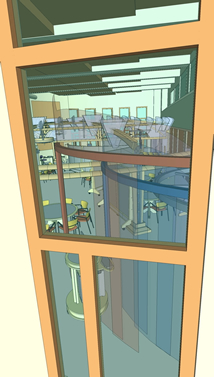 | The 3d Model images are hard line with minimal rendering. One has to imagine them as the space will be with real materials, populated with people, plants and knowledge-objects, and bathed in complex, reflecting, refracting light. A review of the Master’s NavCenter [link] is worth while even though photos do not fully capture the essence of one of these spaces. Masters is the closest in finish and feel to this RDS although the Aspen Room is nearly twice as large. Despite these graphic limitations there are several aspects that can be seen: the layering of architectural elements; the “room within a room” and the distinct space that the Armature creates; the delivery of cabling, power, lights and sound system to all parts of the space; the adjustability of setups and the fact that each of them - smaller spaces within the greater space - has its own character and feel. This latter aspect is best understood in terms of spatial dimensions coupled with the controllability of light spectrum and levels (including natural light). In all, there are three major layers vertically and four horizontally. The vertical and horizontal colored poly fins serve four major functions: they help sub-divide a large column into spaces of more human scale; they reflect and refract light; they breakup and therefore diffuse sound; and, they - by their form - convey through conotation [link] an aspect of the “signiture” message (brand) of the environment. The round disks that are suspended from the top cord of the Armature house light fixtures and speakers. the lower cords are made up of structural wire. The main poly and wood columns are attached to the floor with suction eliminating the need for physical pining. The two trusses that divide the Aspen Room space allows the folding acoustical panels to be pulled out without interference of the Armature. In other situations, this allows for a one half set up. In large spaces with no division, the trusses will be replaced by a compression ring turning the Armature into a dome. The two entries are protected by rolling, folding screens. | | 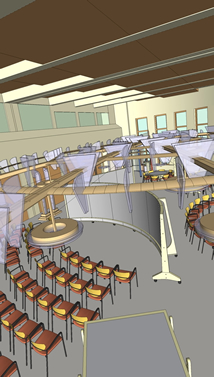 | 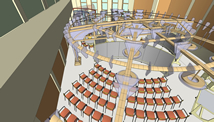 | 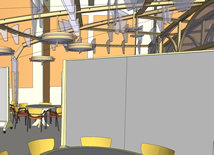 | 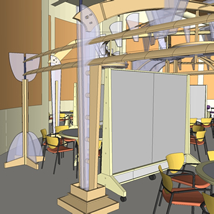 | 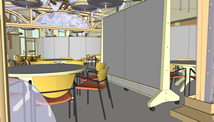 | 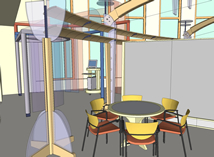 | 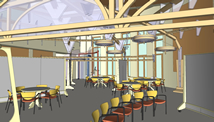 | 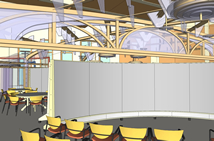 | 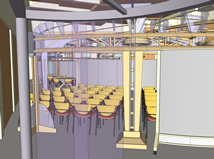 | | | The RDS, like all of our environments, will have a quality that does not translate well in media no matter how well done. Alexander [link] calls it the “quality that has no name.” This is an accurate and literal statement - there is no name for the quality we seek. Few architects know how to get this quality IN to their work. It is not simply a visual design issue; it involves how the environments are made (which is why we have an excellent shop that itself has design and detailing capability) and how the space is used. Design, build, use, feedback through multiple high frequency low magnitude iterations of creative work [link]. Alexander calls this the timeless way of building. Our environments are not visual, “esthetic” architecture. They are reality-based. They have to be experienced to be understood [link]. The difference between how our environments are experienced is like the difference between a technical manual and poetry - or, between illustration and art. Our NavCenter and RDS spaces are four dimensional places that people work in. They reflect the qualities we want their work to produce. This transforms routine into self-aware living art [link]. | | The 3d model over stresses linearity - this is natural to the medium. It is drawn by lines. Lines do not exist in nature. Volume and surface does and we see them by reflected light and experience objects another way - by touch. We also smell materials and hear the acoustic space. Modern architecture has dulled much of humanities’ senses. This is unfortunate and the consequence of attitudes, design theory and the fact that we have not yet sufficiently learned the grammar of modern materials. It is easy to do, but a misinterpretation, to translate these drawings into the typical language of modern architecture. This tendency is reinforced by the fact that the architectural elements (Armature, WorkWalls and Furniture) are made up of strict geometry. The pieces in the model tend to look a bit heavier than they will in reality - while accurate in perspective, perspective is not truly representational of the many dimensions of reality. The real elements of the space are made of woods that have a natural depth of surface and texture. Of translucent glassing - more an idea rather than a thing although it is structural in many places. There are wires acting as truss cords (bottom) and in double pairs holding lights on double gimbals. Each of these architectural elements are rendered distinct with their mission made clear. Together, they make a synergy that is not suggested or expressed in the parts. Also in the space are many other objects of knowledge, utility and art. And, of course, the real subject of this art: the many people working - in this deployment a hundred to two hundred at a time - is the focus of the space. It does not come alive until people walk in, through the entry experience, and start to work. | | The Armature will create PLACE. However, it will not attract the eye in the way it does in a technical drawing or photograph. It will “read” as background music. It is a creature of light. It has little thing-ness. There are lights on the Armature (shinning up down and horizontally) and light sources from above that are part of the Aspen building (and from the high windows when the shades are open). There may be lights shining up from the base (we are still considering this). So, the result is a shelter made up primarily of reflecting, refracting light making a room within a room that expresses the idea of what is to take place within it. By controlling the light, we create mood in each of the areas. The focus of the light will be on the WorkWalls, objects that are being displayed, on work surfaces, and on people when they are “up front” in the Radiant Room or in a breakout work space. The areas (vertically and horizontally), beyond the Armature, will be either a source of “outside” light (like this was a building sheathed in glass) or will fade away into a darker “infinite” space - all depending on how we employ the lighting and what time of day it is. There will be abundant shade and shadow to rest the eye and to reinforce prospect and refuge. | | As I noted, the architectural elements are geometrical. The space they define, however, is much more complex than they are. The thing looks linear; the space within the thing and defined by it is much more complex and always “changing” as one walks through the environment. The architectural elements are attenuated by plants, people, objects and the play of light. In this deployment, the floor will be covered by a dark gray carpet which will create a solid plane creating the single largest unbroken surface in the entire environment. This will stress horizontality. Other than this, the Aspen room and everything we are putting into it is made up of fairly “bright” reflective (light and sound) surfaces and is vertical in nature with the Armature mediating between the vertical and horizontal. As mentioned, the “fins” on the Armature will diffuse both light and sound. The carpet will act as “ground.” Everything else will move. | | This space is on of great diversity of form, texture, color, utility and expression. And, it can be quickly set up in a variety of ways (along with light and sound modulation) to support, specifically, a high variety of work processes. All of the 3d graphic used in this article are of the same set up except the one directly below. To show even the basic possible set ups, and the variety inherent in each one, would take hundreds of projections.The idea that architecture should adjust to the requirements of the users has been around for some time. The task of making this possible has required significant design, engineering and manufacturing innovation and an intimate work process between these too often separated disciplines. In building in this integrated way, we are literally making a space that exemplifies what we want the users to do. To think, feel and act systematically and systemic - WHOLE SYSTEMS; to collaboratively integrat the best knowledge and skills of each team member without forcing compromise on anyone: GROUPGENIUS. | | | The RDS has been a long time in coming into full expression and use [link]. The WEF and Club of Madrid deployments will advance the art of the RDS in three significant ways. First, with the introduction of the Armature and other elements, the RDS now approaches the full functionality and amenity of a state-of-the-art NavCenter [link]. The second, is the focus of this year’s Forum Annual Meeting and the Club of Madrid; while each are different, both address important, global, social-economic and political issues - these constitute the closest employment of the RDS to its intended purpose [link]. Third, is the environment of these deployments. They are in Europe, they focus on the making of a positive future for everyone. Each, in their own way, reject a knee jerk reaction to currant political economic conditions their focus, instead, is to to design of a more positive future. Both events will be attended by world-class leadership. Both will break the standard conference venue and stress collaboration. It could be said that these events are the beginning of what we set out to [link] do 25 years ago. | | Rendering by Irena Sokolona
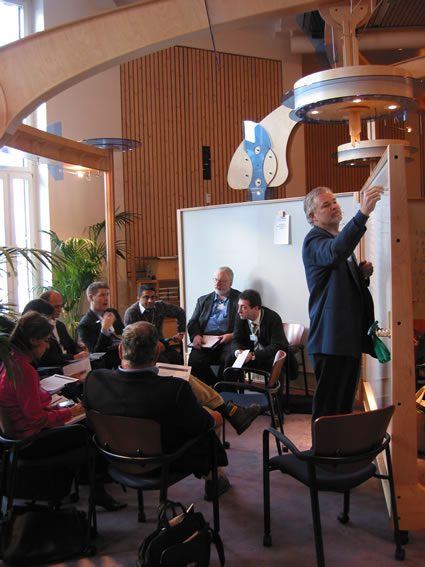
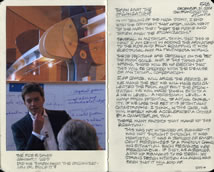
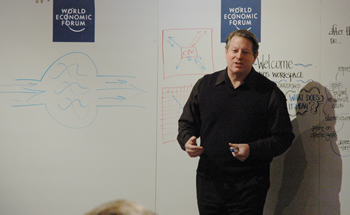
December 7, 2004 | | As this is written, we have designed and started the engineering and fabrication of this deployment. We have 6 weeks to get a collaborative environment for 80 people to Davos and set up. At the WEF 05 Annual meeting, over a thousand people will experience this environment. They will tackle questions of importance. Perhaps, we can add some magic to the magic mountain. | | The task of integrating structural and electrical engineering with media, lighting and control systems while meeting shop build-ability requirements for the Armature has been one of the most demanding design tasks that we have ever undertaken. This is a complex system made more so by being shippable and the need to erect it in a few days. | | There is no question that this experience takes us to the threshold of being able to build a postUsonian [link]. I will document this process, from design-engineering iterations to final deployment and set up, starting now and through next February, when we have accomplished our first full cycle of D/B/U [link]. | The last event of the 2005 Davos WorkPlace took place a few hours ago. It was a private session on Responsible Wealth Ownership. This short session will be followed up with a two day one in July At Liechtenstein. gore_prigogine_von_neumann | Al Gore
Explaining Prigogine’s State Change Model [link], complexity
and the Von Neumann Bottleneck [link] | | | This was, hands down, the most enjoyable Forum event for me. The process was simple and unobstructed by external circumstances. The subject was fascinating. Everyone played well and produced good work. This was a diverse group. Al Gore sparked the dialog with some well focused and important observations. It is difficult to imagine a more qualified, experienced, serious and sincere group of people discussing a subject of greater importance. I think of these moments as “payback time.” All the hard work, the risks, the times when is seems that none of it is appreciated or goes anywhere is balanced by these moments when it is possible to believe a difference has been made and the world does have a future because people are paying attention to the things that matter. This is my form of “investment” [link]. | | As I write this, the KnowledgeWorkers are finishing their documentation of the many sessions and the AI crew is dismantling the RDS. We are nearing the end of an exciting, demanding, sometimes frustrating and risky time. Would I do this again under the circumstances that existed - no I would not [link]. Did it advance the Forum - I believe it did. Was it consistent with our mission - yes. Did we benefit from the experience in terms of being able to sustain our work or will it result in a devastating economic setback - that is a question yet to be answered. Will the Forum proceed further down the path to greater member collaboration - I think so [link]. Will there be a European RDS [link] - there is a good chance. The task now is work out the details of the Club of Madrid deployment [link] and see if there is viability for the RDS in Europe. | | In September 2005 the development of a new RDS for the World Economic Forum began [rds II ]. The next phase of of the Davos WorkPlace is unfolding [link: the next generation rds]. A meeting with the WEF Team and the MGT Team will take pace the first week in December to set the final specifications and determine the design strategy of the the work. | | | | GoTo 2005 Matt Taylor Papers INDEX | | | | | GoTo 2005 Papers Red Threads | | | | | | Go To: Building the RDS Armature | | | | | | Go to: Tour of Taylor Environments | | | | Matt Taylor
Elsewhere
October 14, 2004 
SolutionBox voice of this document:
INSIGHT • STRATEGY • CONSTRUCTION DOCUMENT | |
posted: October 14, 2004 revised: February 3, 2005
• 20041014.425186.mt • 20041031.759015.mt •
• 20041101.311209.mt • 20041111.234109.mt •
• 20041206.999910.mt • 20041207.292827.mt •
• 20041208.654098.mt • 20050121.342414.mt •
• 20050127.097861.mt • 20050130.452112.mt•
• 20050131.567392.mt • 20050203.608100.mt • (note: this document is about 98% finished) Copyright© Matt Taylor, 1983, 2004, 2005 IP Statement and Policy | |
|