| The RDS was conceived in 1983 and first deployed shortly thereafter. The present version of the system started deployments in 1995 that continue to this day. The actual physical components that we presently use for RDS deployments are the same components that we employ in NavCenters and other work environments. The RDS ultimately, to reach its full potential and economy, will require a system of interior, exterior and support components designed specifically for the mission and for the rigors of multiple rapid shipping, set ups, breakdowns and storage. | | The social purpose for which the RDS was conceived is yet to be realized. Recent opportunities [link], however, indicate that this is now possible. | | It is time to create a new generation of RDS that the MG Taylor ValueWeb can employ for both corporate client work and for the social entrepreneurial uses first envisioned. | | This document describes a structure for a partnership organization, inside a ValueWeb architecture, created to invest in the RDS and derive a healthy return from it’s operations while creating the social armature necessary for nonprofit, socially focused deployments. This combination, of for-profit and not-for-profit use, facilitates a level of deployments across a wide variety of situations that otherwise would be nearly impossible to accomplish. | | | There are three primary concepts that form the basis of the RDS ValueWeb Partnership Program; they have to be thoroughly understood else the program does not make sense. These are: The RDS concept itself; the notion of individual and social wealth upon which the ValueWeb concept rests; and, the concept of the ValueWeb as an alternative to the present concept of - and the relationship between - organizations and their markets. | |  | The RDS Rapid Deployment System, is an environment, a collaborative process, a tool kit for documentation, media production, project management, and a social support system, that can be rapidly deployed to crisis situations - wherever they may be - in order to facilitate a more rapid recovery and the restoration of a living environment more capable than what the crises so ably demonstrated to be inadequate. It is based on a concept of wealth different than what is commonly recognized today - an integration of individual wealth and commonwealth with no schism or conflict accepted between the two. The RDS is organized, delivered, staffed and supported through a ValueWeb organizational architecture that is, itself, a reflection of, and a practice of, the principles and motives inherent in the RDS concept. click on
the masthead graphics to the left to find articles on these subjects | | 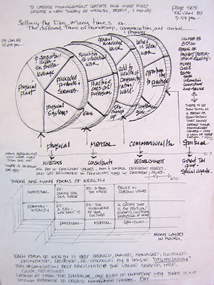 | 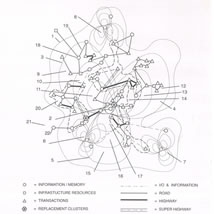 | | These three primary concepts are outlined below with links to additional material. | | | The RDS was conceived [link] to create the capacity and organizational support necessary to help communities in distress. It also has commercial and global agenda [link] applications. In any application, the core of the RDS capability is: deploy-ability (rapid set up and breakdown); neutral space (free of biasing economic and political agendas); full representation and participation of all communities necessary to a solution and who are impacted by the outcome; the facilitation of a complete SCAN before participants jump to a “solution” that is merely an improvement of what existed before; integration of the design process through design development and implementation; the production of work products that advance the work and document the assumption upon which it is based; a return of capital to each ValueWeb member in kind that fits their specific structure and mission. | nav_center_rds_social_economy | | page 505
Matt Taylor Notebook - January 1983
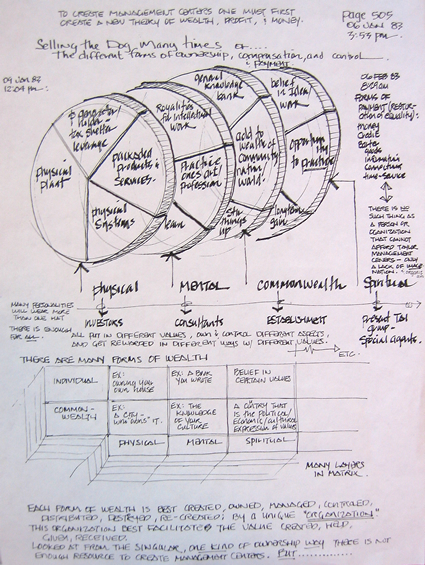
Boulder Series | The page (above) from my Notebooks (Boulder era) was written in the early days of MG Taylor. I was dealing with the issue of how the capital intensity of a NavCenter (we called them Management Centers, then) could be both justified and dealt with from a cash flow basis. How could the money, necessary for the creation of the capability we thought necessary in order to solve the systemic problems that society faced, be raised ? There was a companion page (506) that described the network architecture I believed to be essential for success. This network model, which was integral to the basis of MG Taylor, became by 1985 what today we call a ValueWeb. link to page 406 post 9/11 series for
a contemporary assessment of this strategy | | Page 505 addressed two different but related issues. The first was the difference and co-dependency between the existence of individual wealth and wealth held in common (commonwealth). The second, the recognition that there are many forms that wealth takes and that there are multiple ways of exchanging it. Understanding this is key to understanding why an organization, institution or city may want to have a NavCenter. It is also the key to the economic validity of the RDS. | | In the last several hundred years, in the West, there has been a growing schism between individual wealth and commonwealth (wealth held in common). This is unfortunate because neither can exist without the other. Page 505 give examples of these two forms of wealth holding across the spheres of physical, mental and spiritual wealth creation. A short look reveals there is not competition between these two forms of wealth; it also reveals their co-dependency. It further identifies which constituencies may be interested in investing in to which types of wealth-formation, that when added together in an appropriate mix, makes up a healthy capability, community and marketplace. | | There are several conclusions to be drawn from looking at wealth this way. First, there is plenty of wealth to develop a NavCenter or RDS capability almost anywhere. Second, these various forms of wealth, and the social protocols and rules that bind them, are all in need of an integrating function which s precisely what a NavCenter or RDS does. This capability is not only affordable, it is necessary to the sustainability of a complex wealth creating society. NavCenters and RDS deployments support the replacement economic process as described by Jane Jacobs [link]. | | The various forms of ownership and management, we have created through many centuries of society, each have a role to play in the MATRIX of these types and forms of wealth. Instead of arguing over isms, we should be working to discover what works and how to best match type, form, process, capability and capacity with individual and social intent. | | Patent Diagram
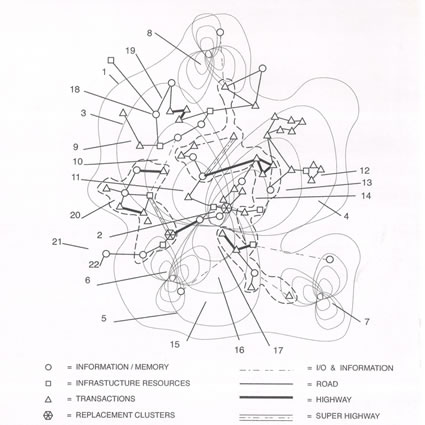
ValueWeb Components | | A true ValueWeb is made up of 22 components. Each of these relates to other by specific rules-of-engagement. Some of these rules are general to all ValueWebs and some are specific to individual ValueWebs. These rules facilitate the transactions between the individuals that make populate the ValueWeb. The ValueWeb architecture is designed to re-position a number of relationships that have become, in existing organizational models, passive-aggressive in their interoperability with one another. The dysfunction caused by these existing practices imposes enormous costs on organizations - costs that will eventually lead to their death. The ValueWeb makes use of all the dynamics inherent in open networks and provides these adaptive systems with the systematic transactional capability of an organization without all the baggage that typically goes with it. In other worlds, it seeks to fuse the best attributes of both systems while limiting their inherent liabilities. I developed the ValueWeb architecture and seriously propose it as the prototype design for next generation of enterprise organization. | | In a properly executed ValueWeb, the interest of the investors, producers and customer/users are aligned and not in conflict. The purpose of the ValueWeb is to produce wealth and to distribute it according to the agreements in place - the entire ValueWeb is the ENTERPRISE and is the market. Creating and supporting sustainable ValueWebs is at the core of MG Taylor’s work [link]. | | | The RDS ValueWeb Sponsor Program offers the Sponsor several values not easily obtained elsewhere and almost never together. The Program is equally responsive and profitable [link] for an individual, a community, a business, a foundation or a government. In fact, all of these organizational recursion levels of our social fabric have to be involved if the RDS concept is to be fully realized. | | The RDS offers a sponsor tasteful, high value, “institutional” promotional exposure;real-world product/process testing (if relevant to them); an unique opportunity for executive and knowledge worker development; and, the satisfaction of a worth-while and effective social investment that also offers, for those who invest cash beyond “in kind” products and services, a long term ROI (basically, capital preservation). | | Sponsorship is not unlike backing a racing team or product placement in a movie except that this is a far more serious business and the sponsorship has to be based on the real utility of the Sponsor’s product/service/knowledge to RDS deployments. We will not accept Sponsorship for anything except that which we would otherwise buy for use in an RDS application. | | And, we require, at different times in the sponsership period, involvement in deployments from members of the sponsoring organization. | | In turn, we provide real world exposure of the Sponsors products/services, training in our methods for Sponsor personnel, and systematic, documented performance feedback of all aspects of what the sponsor provided (tools, processes, people, knowledge) with suggestions for improvement. This is real world, real time R&D and rapid prototyping in demanding, high-performance, high-stakes environments. In addition, the Sponsoring organization can do tasteful institutional advertising featuring their involvement in concrete applications producing social good - not an easy venue to replicate. | | While the principles are the same for each Sponsor relationship, the terms of each are customized to fit the circumstance and the specific capacities and requirements of each Sponsor. Based on prior experience, it is estimated that a appropriate Sponsor time commitment is three years. | | Sponsors will have a voice in the governance function of the RDS. | | For further information, e-mail [link]. | | Matt Taylor
Palo Alto
October 14, 2004 
SolutionBox voice of this document:
INSIGHT • STRATEGY • CONSTRUCTION DOCUMENT | |
posted: October 14, 2004 revised: December 27s, 2004
• 20041014.102630.mt • 20041020.224527.mt •
• 20041031.923098.mt • 20041110.112344.mt•
• 20041227.000081.mt • (note: this document is about 40% finished) Copyright© Matt Taylor, 1983, 1988, 2004 IP Statement and Policy | |
|