c o n f i d e n t i a l
Privileged access only
This is a Hypertext version of the Patent Pending
by iterations of the Taylor System and Method
SYSTEM AND METHOD FOR AUGMENTING KNOWLEDGE COMMERCE
Overview of the Invention
History of the Patent Application
FIELD OF THE INVENTION
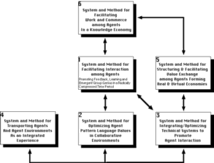
The present invention broadly relates to a system and method for addressing the paradoxes, problems and opportunities associated with the Knowledge Economy, and the transition to it. The system and method of the present invention create a unified experience of work that scales from the level of individual thought processes (and their component aspects) to the building and using of a global system of commerce. Described in several levels of recursion, the system and method of the present invention integrate, into a single system and method several discrete Sub-Systems and methods that comprise a myriad of now unintegrated tools and processes that are conducted across contradictory, partially communicating and non-collaborative environments.
TERMINOLOGY AND REFERENCES
Throughout the present application, certain terms of art are used. To assist in understanding the intended meaning of these terms in this application, reference should be made to certain published works as detailed hereinafter:
| ARMATURE: as described by: “Building to Last - Architecture as Ongoing Art” PATTERN LANGUAGE: as described by: “A Pattern Language” Christopher Alexander And demonstrated by; “The Wright Space - Pattern & Meaning in Frank Lloyd Wrights Houses” Both of the above references are described in “The Power of Place - How Our Surroundings Shape Our Thoughts, Emotions and Actions” COMPLEXITY ORDER VARIETY: as described in “Architecture - Form, Space, and Order” ADAPTION: as described in “How Buildings Learn - What Happens After They’re Built” PHYSICAL HEALTH, MENTAL WELL BEING, INDIVIDUAL PLACE and PROSPECT AND REFUGE: as described in “The Power of Place - How Our Surroundings Shape Our Thoughts, Emotions and Actions” And, “Places of the Soul - Architecture and Environmental Design as a Healing Art” META PROGRAMMING: as described in “Programming and Meta-Programming in the Human Bio Computer” AGENTS AND AGENCY: as described in “Society of Mind” NODES AND PATCHES: as described in “At Home in the Universe” REQUESITE VARIETY: as described in “Designing Freedom” and “Diagnosing the System for Organizations” ITERATION: as described in “The Exemplar” Also discussed in “The Gold Collar Worker- Harnessing the Brainpower of the New Work Force” RECURSION: as described in “Diagnosing the System for Organizations, Managerial Cybernetics of Organization” Morphic Resonance: as described in “A Science of Life” and “The Presense of the Past: Morphic Resonance and the Habits of Nature.” CONSCIOUSNESS: as described in “The Origin of Consciousness in the Breakdown of the Bicameral Mind” INTERFACE: as described in “The Humane Interface” DEEP LANGUAGE: as defined in “?” FEEDBACK: (and of a complex kind) as described in “The Human Use of Human Beings“ and “Cybernetics and Society” and “Cybernetics, or Control and Communication in the Animal and the Machine” HUERISTICS: as described in “The Metaphorical Brain” INFORMATION: as described in “Mind and Nature, A Necessary Unity” and “Steps to an Ecology of Mind” SYMBIOSIS: as described in “The Symbiotic Man - A new Understanding of the Organization of Life and Vision of the Future” INTELLIGENCE: (multiple) as described in, for example, “Frames of Mind : The Theory of Multiple Intelligences” LIVING SYSTEMS: as described in “Living Systems” SYNERGY: as described in “Synergetics” SYNTOPICAL READING: as described in “How to Read a Book”
|
The definitions and meanings presented in these works provide a foundation. This invention develops addition meaning to these terms and employs them as precise Terms of Art as will (ToA) be noted herein.
The present invention also employs language on several levels: “Descriptive” - Normal Use (NU), “Technical” - Terms of Art (ToA), “Pattern language” - Solution Sets (SS), “Modeling Language” - Design and Process Terms (D/PT), “Algorithm” - Rule Statements (RS), “Deep Language” - Machine Language (ML). These levels will be noted as appropriate herein.
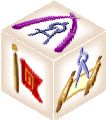 In addition, the present invention employs an iconic, visual language (ToA) as a means of bringing deeper meaning and precise understanding to certain concepts and components of the system and method. Glyphs are employed as an aspect of this language; as example: QWE RTY UI OPASTZXN . These Glyphs will be employed as appropriate herein.
One example (left), of this use, is the “Solution Box” which is used to document the “voice” of a document or transaction. A document without information about it can be misleading and/or lack context. The Solution Box is one means of this System and Method to provide “information about the information.” In this case, the Solution Box voice is “ENGINEERING” (SS) on the Creative Process Model, “STRATEGY” (SS) on the Vantage Points Model and “PRELIMINARY DESIGN” (SS) on the Design Formation Model.
In addition to these terms and Glyphs, the following terms are defined and are employable in the Descriptive, Technical and Pattern Language levels and on the level of recursion (ToA) of the DesignShop, PatchWorks Design, Weak signal Research and other processes which are primarily an expression (but not exclusively) of certain aspects of Subsystem I: “System and Method for Facilitating Interaction Among Agents.” Examples of their application to other Subsystems will be noted. These are employed as terms of art (ToA) in this System and Method.
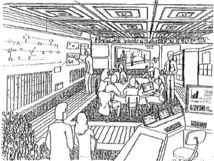
| ANDMap Project Management Tool The term ANDMap stands for Annotated Network Diagram Map and refers to an invention that synthesizes Gannt charts, network diagrams like PERT, CPM or GERT, and process flow charts. The items on the map are plotted to scale over time and may be collected across a series of horizontal tracks, like Gannt charts. A standard set of symbols are employed to represent a range of activities from the strategic (Landmark, Benchmark) to the tactical (Event, Task), to the conditional decision point (Cusp) to the task level (Milestone). Landmarks and Benchmarks can be employed to express large scale ideas like missions, visions and goals. Events are rounded rectangles used to identify activities in points of time. They can be annotated with resource and duration data and used in network diagram fashion. Tasks have symbols representing the start and end of an activity, much the way activities are represented on Gannt charts. The Cusp represents a decision gate that may be found in process charts. Since the ANDMap is laid out with time as one of its axes, loops are usually avoided--currently it's still impossible to go backwards in time--instead a NO decision out of a Cusp will either end in a cessation of the project, an alternative contingency, or an indication that previous work must be redone, and showing this rework extending out along the timeline so the project team can get a visual sense of the impact of the decision. Milestones are used to highlight significant subdivisions of Events or Tasks. All of the symbols are connected by lines that may be coded to represent dependency, parallel processing, or critical information exchange. The symbols and lines may be color coded to provide additional information to the user, and extensive annotations may be written around the symbols on the map to provide explanations. AUTHOR-TO-AUTHOR (SEE "SYNTOPICAL READING") A type of DesignShop module in which each participant has been given a different book to read in advance. At the time of the module, the participants engage in a discussion of the issues facing the enterprise, however, they discuss from the vantage point of the authors they have read. Each participant assumes the personae, knowledge base, vantage point and opinions of the author whose book they were assigned to read. The exercise forces a change of vantage point and introduces new information into the pot. Its a day one or day two exercise. BE-THE-AUTHOR a BOUNDARY CONDITIONS a BREAKOUT A general activity during a DesignShop when a large group is divided into smaller teams to work on either different issues, or different aspects of the same issue. The space in which this activity takes place is a Breakout Area. The group undertaking this activity is called a Breakout Team. Breakout activities are variously referred to as Breakout Rounds or Design Rounds. CAPTURE TEAM A subset of the KreW of Knowledge Workers in a DesignShop who are assigned to work in a Breakout Area to document, or capture, the discussion in one or more forms: keywords, synthesis (by individual attribution or journalistic summary), graphics from the WorkWalls. The work of this team is published to the DesignShop Journal. CIRCLE-UP A ritual for the disciplined sorting of signals to help a Patch (Team) through the process of association and decision-making in support of the next major phase of work. Circle-Up also brings the Patch into unity at a point in time; although unity does not imply consensus in this case. Its also a formal time to acknowledge progress, failures and successes along the Lifecycle of the Web (Enterprise). Its a time to engage the multiple intelligences of the teams members in a process of collaborative design. Commonly a Circle-Up is use to shape the opening and closing of an event. It can put the Patch back in touch with its Vision and the iteration of the work to be done. CREW (Also spelled KreW) A team of Knowledge Workers charged with supporting an event such as a DesignShop. DESIGNSHOP EVENT An event whose purpose is to release group genius in the client, condense the time in which a team moves from Scan to Act by an order of magnitude, completely capture and organize all of the information generated, and do all of this in a facilitated way by managing not the people involved, but the Seven Domains that regulate collaboration and evolve ingenuity. DESIGNSHOP SPONSOR Representatives from the client who usually have a considerable stake in the successful outcome of the DesignShop. They may be project managers, department heads, or CEOs. Sponsors are also participants in the event, although in some cases they may work on the KreW. Some clients have only one sponsor, and others have an entire sponsor team. DOCUMENTATION TEAM A subset of the KreW whose work comprises capturing reports and conversations that occur when all of the participants are assembled into one group. (The Capture Teams document reports and conversations that happen in Breakout Teams.) ENGAGEMENT TEAM A group of people who are assigned to work with a specific client over the duration of the relationship. They may also include DesignShop facilitators and Knowledge Workers, but this is not necessary. ENVIRONMENT Typically a Management Center, especially in the context of a DesignShop. More generally, any space that has been consciously designed and configured to support a process in a flexible and evolutionary manner. Most of us work in "spaces" (office space, work space, etc.) that are devoid of enlightened, conscious design, and therefore very poorly support our lives and the processes that comprise them. FACILITATOR (SOMETIMES CALLED THE KEY FACILITATOR) The Facilitator works with the DesignShop Sponsors (which may include members of the engagement team) and the Process Facilitator (representing the KreW) to design the DesignShop before it begins, manage the continuing design and execution of the DesignShop while it is happening, to bring closure to ideas and processes immediately following the event, and to open paths for progress to the next stages of work. To facilitate means "to make easy." The art of facilitation is the art of bringing clarity and effectiveness to the work process of individuals and groups. The facilitators mandate is to ensure that the process is designed and implemented in a way that brings out the best thinking of each participant and the best resolution of issues from each group. Facilitation involves a wide range of actions taken to affect the interaction of agents. It involves bringing order to the universe of thoughts and possibilities about a topic, and giving back to people (or other agents) what they already know, in a way that brings clarity and a foundation for effective action. It involves setting appropriate boundaries (time, physical space, and agreements) within which an individual or group can work effectively. It involves clarifying conditions and goals, through a process we describe as "creating the problem." Facilitation involves introducing the right "new" information that challenges existing ways of thinking and leads individuals to discover their own unexamined assumptions about a given situation. It involves observation and assessment, and taking actions to ensure that a groups natural biases dont prevent some vantage points from being heard, or certain phases of the creative cycle to skipped. When necessary, the facilitator will interject new challenges to prevent a group from coming to closure on an idea prematurely; and at other times to push a group to closure when the exploration is sufficient and no gain is to be made by working an issue further. The present inventors reject the notion that the facilitator should be an "objective third party" who does not get involved in content and focuses only on process, performing some kind of umpire or gatekeeper role. The present inventors dont apply the “facilitator as umpire” model for many reasons, including philosophical considerations: no one can ever be completely unbiased, and as modern physics has shown, even the act of observing a process will affect that process. Moreover, its our experience that the agreements put in place by this model nearly always function more to protect the facilitator than to produce effective results. FEEDBACK A HYPERTILE The WorkWalls that MG Taylor Corporation manufactures (through Athenaeum international) are made of steel, and therefore accept magnets. Hypertiles are large rectangles of flexible magnetic material, measuring up to 11"x17". It is covered on one side with a sticky surface manufactured by 3M. Large sheets of paper can be adhered to this surface and peeled off without leaving any residue on the back of the. The paper can then be photocopied or scanned for entry into the Knowledge Base. KNOWLEDGE OBJECTS OR AGENTS Pieces of information, usually from outside of the body of knowledge resident in the participants, brought to the attention of the group at the right time to help bring ideas into focus or expand a perception. Knowledge Objects may take the form of articles from magazines or journals, research papers, or databases. KNOWLEDGE WALL Management Centers have at least one large wallsometimes up to 50 feet in length, usually the back side of the Radiant Wallthat is covered with a mildly adhesive surface manufactured by 3M. This wall serves as an oversized European-style kiosk. All sorts of information may be posted to the wall. Sometimes portions of the documentation are placed on it. Photographs, color art work, and diagrams are also posted here. Articles from magazines or the Internet are also displayed for participants to browse through. Information is not displayed haphazardly, rather, a layout is thoughtfully designed, making the wall a structured information event. KNOWLEDGE WORKERS The individuals who comprise the KreW that supports an event such as a DesignShop. They are responsible for managing the flow of information temporally through the duration of the DesignShop and spatially within the Environment. KNOWLEDGE WORKER SPONSOR A Knowledge Worker of at least Journeyman level who is also a Process Facilitator or Facilitator, and whose purpose is to provide an official, facilitative and welcoming link to the work and philosophy of the organization for one or several other Knowledge Workers in the network. KREW Another term for the Crew of a DesignShop or other event. The "K" and "W" in the title refer to the abbreviation "KW", or Knowledge Worker. The "re" can take on most any meaning that seems appropriate to the situation. KWIB Knowledge Work Information Broker. Each Management Center or KnOwhere store has a KWIB, usually assigned on a rotating basis, to collect, maintain and disburse information concerning events in the center. LOGISTICS The KreW facilitates the flow of matter, energy and information through the DesignShop or the Management Center. Logistics focuses on the flow of matter and energy. This includes providing the physical environment, tools, equipment, materials, food. It also calls for the continual refreshing and maintenance of these elements. MANAGEMENT CENTER Special environment for managing the design and innovation process in the context of expected social-economic change, and for building action plans to accomplish the goals established. By careful facilitation of the elements of environment, information, design and group process, Management Centers decrease the "accident" factor of discovery and synergistic events. Management Centers are "safe" environments in which designers and decision makers can risk exploring and creating new models. Also called "DesignCenters". MEMORY Memory is a key concept of this System and Method and is described on all levels of the Language and applied in each Sub System of the System and Method. Memory, in this system, has to be understood as a series of state change (ToA) that take place iteratively (State 1, State 2, State 3, State... n) and existing on different levels of recursion (ToA) of a complex system. In a dynamic (ToA) complex (ToA) system, the memory STATES will be different. Information (ToA), provided by feedback (ToA) is contained in these different states - this is a fundamental aspect of how the system operates. Agents (toA) and Agency (ToA) are objects (ToA) or units of this memory. In this Model (ToA), the entire system is memory. Memory can be in the system (a lower level of recursion) but is composed of the system and is regenerated when “recalled.” This recalling, then, alters the state, and as an Agent (object) is part of the STATE of the (altered) system. METAPHORS EXERCISE A Breakout Round in which the various teams will compare some "unrelated" system to the situation at hand in a metaphorical way. If the situation concerns a distribution system, a team might be asked to examine how an ant colony manages its distribution system, or how a distribution system might be described in quantum mechanical terms. The purpose is two-fold: (1) to actually learn how other, alien or obscure systems actually manage similar processes, and (2) to see the situation from a radically different vantage point since we know that this is a powerful technique for generating creativity. PROCESS FACILITATOR An individual who facilitates the work of the KreW and the Facilitator during the DesignShop. See roles and duties here. PRODUCTION The subset of the KreW of a DesignShop charged with keeping track of all of the documentation generated by the DesignShop and assembling it into paper and electronic Journals for distribution to the participants, usually within a few days of the end of the event. Journals may be 500 or more pages in length. The new documentation process allows the Journal to be captured in a database for ease of use in an electronic format. PROJECT STATUS MAP A project management tool that employs a matrix of projects listed down one side and days or weeks listed across the top. There are two ways to use a project status map: (1) for each sub task within a project, place a tag along the projects line under the date when the sub task is due. Then track the progress of work on each sub task through a system of visual indicators (green for go, red for holding, blue for completed, etc.); (2) if youre tracking a number of identical projects, advance a single tag along each projects line to indicate the status of the project. Project status maps are most appropriate for projects whose scale and complexity tend to make them linear progressions of tasks. If there are many parallel tasks or the duration of the project runs for many quarters or years, an ANDMap or similar project management tool is more appropriate. RADIANT ROOM A large space in a Management Center where the participants gather together as one body to hear reports or have synthesis discussions of some sort. The focus of the Radiant Room is a long WorkWall called the Radiant Wall that may be straight, folding or curving depending on the design of the individual center. Some Radiant Walls stretch to over 40 feet in length. The back side of the Radiant Wall is frequently covered with an adhesive material made by 3M to which paper can be adhered and removed many times over. This is called the Knowledge Wall, although you may hear it called the Sticky Wall by old timers in the network. The term Radiant Wall comes from Isaac Asimovs idea of a Radiant Cube that he introduces in the third volume of his Foundation Trilogy. The cube is a device that holds the plans for the rebirth of an entire galactic civilization, yet sits unobtrusively on a table top. When a Speaker from the Second Foundation focuses his mind on the cube, it projects the plan on the walls of the room. With further mental effort the Speaker can navigate the plan from start to finish, zoom in to more detail or pull out to a more general landscape, and see the record of all the changes that have been made to the plan and all of the contingencies built into it as well. RDS Rapid Deployment System. Also called the Transportable Management Center. An entire kit of WorkWalls, Work Stations, Break-out Tables, lighting, computers, network, video cameras, video technical direction equipment, video editing equipment, supplies, library, games and toys sufficient to support a multiple day DesignShop for a group varying from five to one hundred participants and up to thirty or so KreW. The RDS is shipped in trucks and takes a day or two to assemble and tear down depending on the size of the event. READ AHEAD A collection of materials delivered to participants up to a week or so in advance of a DesignShop. The articles and books chosen for a Read Ahead will serve one of two purposes: provide more information concerning the problem to be created and solved during the DesignShop, and to stretch thinking and introduce new ideas that challenge preconceptions. The Facilitator, Process Facilitator, Sponsor and perhaps one or two KreW members handle the selection, assembly and distribution. Books are ordered through the KnOwhere store. REPORT OUT After participants have spent some time in Breakout Teams they are often invited to reassemble as a large group to hear each team report their work. To prepare for this report, the teams are asked to recreate (not copy) their work onto paper covered magnetic Hypertiles (11x17 inches) which will adhere to the porcelain steel WorkWalls. The group reassembles in a large room that usually has a very large, curving WorkWall called the Radiant Wall (some are over 40 feet long). The teams group their Hypertiles on this wall either by team or by some other sorting category, or they place them on the wall as they are being discussed. The tiles can be moved about and drawn around to sort, connect and emphasize ideas. RULES OF ENGAGEMENT A list of boundaries that must be set on a DesignShop, session, Management Center or NavCenter in order to secure success. The requirement of having no observers or visitors during a DesignShop is an example (everyone either participates or they are on KreW). Another example is the limitation on the conduct of other business by the participants during the DesignShop (it destroys breakout team integrity and compromises the product to have individuals constantly conducting other business away from the team on the phone). SCENARIO EXERCISE A module of a DesignShop that is frequently employed to uncover assumptions among the participants regarding how they think about trends, the past and the future. Its usually done in large group on the Radiant Wall. The Radiant Wall is divided horizontally into time frames. Sometimes the Scenario considers the distant pastup to 30,000 years ago, passes through the present (usually the current year plus or minus 5-10 years) and ends sometime in the future. Participants stand before the wall one at a time and state an event they wish to place on the timeline (sometimes further defined by the facilitators instructions) and perhaps its significance. Then they write that event on the wall under the year it occurred. Then the next participant places their event on the wall. This may continue through all of the participants and through several rounds. The exercise is very flexible in terms of how the wall is laid out, what types of events the participants are asked to place on the wall, and how Sketch Hogs are employed to augment and synthesize the visual display. A good synthesist on the KreW can predict much of the outcome of the DesignShop and the solution to the problem simply by studying a well-executed scenario. SHARE-A-PANEL A module of a DesignShop usually preceded by a Take-A-Panel exercise wherein participants assemble into teams and visit each team members panelor WorkWallin succession to hear a report of the work scribed on that panel. After each team member has reported their individual work, the team usually assembles in a Breakout Area to either synthesize what theyve heard, or begin work on another exercise. If the total number of participants in a DesignShop is small, they may all participate in the exercise, which is then called a "Walk-About". After each participant has had an opportunity to share their panel, the entire group may assemble for a synthesis discussion or may be divided into Breakout Teams to begin another round of work. SIMULATION a SKETCH HOG Also called a scribe. A KreW member skilled in listening to a conversation or presentation and capturing its essence and significance in illustrated and annotated diagrams on WorkWalls, paper, computer, or in a 3D physical model. Sketch Hogs are called upon to support participants in Breakout Teams to illustrate their ideas, work before the large group during synthesis discussions, create finished art and icons to support the production of the Journal, and to create finished art and diagrams to support any follow-on WorkProducts. SPONSOR (CLIENT) (See also DesignShop Sponsor.) An individual or small group who hold primary responsibility or a principal stake in the outcome of a DesignShop, NavCenter, Management Center, or session. Often the sponsor is the champion of the idea which the shop or center is designed to address. The sponsor may also be a manager or executive. Often a sponsor team is assembled made up of representatives from various constituents who comprise the participants in the DesignShop. SPONSOR (KNOWLEDGE WORKER) An experienced individual (usually of Journeyman level) who assists and supports another Knowledge Worker through the transition into, through, and out of the ValueWeb system. The sponsor is not necessarily a mentor, and is usually chosen my mutual agreementnever assigned. Assigning sponsors would violate the pattern of "Stepping Up" or self-selecting tasks and projects from the work to be done. Sponsors are literally individual transition managers. SPONSOR (NAVCENTER) An individual, or most commonly a team who champions the purpose, mission and existence of a NavCenter. Since NavCenters are established to support a particular project or purpose, the Sponsor may also be the project manager. Because a NavCenter represents a way of work which radically departs from the behavior of the rest of the organization, the Sponsor should have a position of authority within the organization as well. SPONSOR SESSION Usually a three or four hour session attended by the client sponsor (individual or team), the key facilitator, the process facilitator, and supported by one or more KreW. The purpose of this session is to develop clear objectives for the DesignShop, work on assembling the right participant list, decide on general logistics arrangements, take a first cut at the design of the DesignShop process, and get a general idea of what sort of products should be generated during and after the DesignShop. STRAWDOG Before each DesignShop, the Event Facilitator (Key Facilitator) and/or the Process Facilitator generates a first cut at the design of the event. Sometimes this process is completed formally in a Sponsor Session with the DesignShop Sponsor, the Facilitator and Process Facilitator. These sessions are documented. The Strawdog summarizes the planners thinking in terms of the purpose of the DesignShop, the desired outcomes and the individual modules that comprise the design. Usually the first half of the shop is outlined in detail; the rest cannot be designed until the shop is underway. SYNERGY In Synergetics, R. B. (Bucky) Fuller notes the following with regard to Synergy: “Synergy means behavior of whole systems unpredicted by the behavior of their parts taken separately. Synergy means behavior of integral, aggregate, whole systems unpredicted by behaviors of any of their components or subassemblies of their components taken separately from the whole. A stone by itself does not predict its mass interattraction for and by another stone. There is nothing in the separate behavior or in the dimensional or chemical characteristics of any one single metallic or nonmetallic massive entity which by itself suggests that it will not only attract but also be attracted by another neighboring massive entity. The behavior of these two together is unpredicted by either one by itself. There is nothing that a single massive sphere will or can ever do by itself that says it will both exert and yield attractively with a neighboring massive sphere and that it yields progressively; every time the distance between the two is halved, the attraction will be fourfold. This unpredicted, only mutual behavior is synergy. Synergy is the only word in any language having this meaning. The phenomenon synergy is one of the family of generalized principles that only co-operates amongst the myriad of special-case experiences. Mind alone discerns the complex behavioral relationships to be cooperative between, and not consisting in any one of the myriad of brain-identified special-case experiences. The words synergy (syn-ergy) and energy (en-ergy) are companions. Energy studies are familiar. Energy relates to differentiating out sub-functions of nature, studying objects isolated out of the whole complex of Universe - for instance, studying soil minerals without consideration of hydraulics or of plant genetics. But synergy represents the integrated behaviors instead of all the differentiated behaviors of natures galaxy systems and galaxy of galaxies. Chemists discovered that they had to recognize synergy because they found that every time they tried to isolate one element out of a complex or to separate atoms out, or molecules out, of compounds, the isolated parts and their separate behaviors never explained the associated behaviors at all. It always failed to do so. They had to deal with the wholes in order to be able to discover the group proclivities as well as integral characteristics of parts. The chemists found the Universe already in complex association and working very well. Every time they tried to take it apart or separate it out, the separate parts were physically divested of their associative potentials, so the chemists had to recognize that there were associated behaviors of wholes unpredicted by parts; they found there was an old word for it - synergy. Because synergy alone explains the eternally regenerative integrity of Universe, because synergy is the only word having its unique meaning, and because decades of querying university audiences around the world have disclosed only a small percentage familiar with the word synergy, we may conclude that society does not understand nature. In addition, there is a corollary of synergy known as the Principle of the Whole System, which states that the known behaviors of the whole plus the known behaviors of some of the parts may make possible discovery of the presence of other parts and their behaviors, kinetics, structures, and relative dimensionalities. The known sum of the angles of a triangle plus the known characteristics of three of its six parts (two sides and an included angle or two angles and an included side) make possible evaluating the others. Eulers topology provides for the synergetic evaluation of any visual system of experiences, metaphysical or physical, and Willard Gibbs phase rule provides synergetic evaluation of any tactile system. The systematic accounting of the behavior of whole aggregates may disclose discretely predictable angle-and-frequency magnitudes required of some unknown components in respect to certain known component behaviors of the total and known synergetic aggregate. Thus the definitive identifications permitted by the Principle of the Whole System may implement conscious synergetic definition strategies with incisive prediction effectiveness.” SYNTOPICAL READING a TAKE-A-PANEL A module of a DesignShop wherein the participants take one panel of a WorkWall (about 6 tall by 4 wide) each and compose on it answers to an assignment. The exercise allows all of the participants to be heard, to express their ideas in whatever visual fashion they wish, and have their ideas available to be viewed by other participants and captured by the DesignShop KreW. This exercise is usually succeeded by a Share-A-Panel exercise. Transition Managers A WALKTHRU A session during which the DesignShop is designed, including all of the modules, assignments, and team configurations. Day one is rigorously designed, day two a little less so, and day three may be rather sketchy at this point. The Client Sponsors, Facilitators, Process Facilitators and KreW participate in the WalkThru. WAWD TEAM A consortium of knowledge workers, or enterprises of one, who are linked together in a vast value web, and whose expertise, skills, and passions can be focused on helping clients imagine visions and then implement them anywhere on the globe. Weak Signal Research A WRITING TEAM A subset of the KreW and Sponsors of a DesignShop charged with crafting the assignments that participants will work on in their Breakout Teams. The term "craft" is key here. Assignments are not composed without considerable thought. When you consider that a single assignment will consume perhaps 1/6 of the duration of a DesignShop and that the reports from such an assignment will steer the entire content and tone of the DesignShop, its easy to understand their importance. WORK PRODUCT A synthesis or evolutionary product of the DesignShop whose purpose is to either crystallize some concept, detail and illustrate some plan, or take the participants beyond the information of the DesignShop into new realms they may not have considered yet. Its purpose is not to simplify, but to present the complicated and obtuse in a way that is merely very complexso that it may be understood, but not watered down. WORKWALLS Panels of light colored porcelain steel which accept a variety of marking materials such as chalks, dry erase markers, water colors, India ink, pastels, and water based markers. They are used by participants and KreW as a tool to support collaboration. A typical Management Center may have more than 3,000 square feet of this surface available. Large or small groups can illustrate complex issues and detailed plans all within plain view of the entire group, and all easily editable. The amount of information that can be manipulated on these wall systems and the flexibility of erasing or adding to it, dwarfs the capabilities of butcher paper, flip charts, or projection systems. The walls are typically six or more feet high and may be any length. Rolling walls come in lengths from four to 28 feet in length (although greater lenght is possible), some of which are folding. WorkWalls may also be permanently installed within the environment. The walls are manufactured by Athenaeum International under MG Taylor License and distributed by Athenaeum International or through MG Taylor Corporations chain of KnOwhere stores. The WorkWalls make up a significant component of the environment-setting aspect of this System and Method. They also are a strong element of the Taylor environments Trade Dress. This is further described in Sub System 2 of this Invention. The full manifestation of the WorkWall concept, in this System and Method, will incorporate electronic input and display (read/write) as shown in the diagram, as well as, smart technology as described in Sub System 3 of this Invention. The essential 2process contribution of the WorkWalls is several fold: they facilitate the display of Knowledge Objects and Agents (ToA). They allow Human Agents (ToA) to “work big” simultaneously seeing the scope and interconnectedness of their work while sharing in its creation. They are a strong symbol of collaboration. The essential 4environment contribution of the WorkWalls is they create space, bring Armature down to human scale and adjust quickly as the work requires it. The essntial 5tool contibution of the WorkWalls is that they provide “plug and play” capability for a wide variety of interactive computer and multimedia technolgy and integrate these devises into a seamless work process. The scale, scope and level of integration of 245is not accomplished by existing pieces and components in place nor the systems architecture in which they are employed. |
It should be understood that the terms described herein represent, in themselves, a philosophy and pattern language that can be expressed and defined in connection with various Sub-Systems described herein. As noted, many of the foregoing definitions relate principally to the context of Design Shops but the terms can also be used in the context of other systems and processes at the same and other levels of recursion. Further information concerning these definitions and details of the environments discussed herein can be found in the Appendices hereto, which are incorporated herein by reference.
BACKGROUND OF THE INVENTION
 It is now widely understood that we are in the midst of a global transformation from a manufacturing society to an information based society, i.e. Knowledge Economy (ToA) or Net Work economy (ToA). As our society makes the transition to this new economy, we must have set in place new ways of working that will be fundamentally different from those we have experienced in the last 100 years. These new ways of working will demand that we view agents (To A), whether individual humans, machines, groups or organizations, as the economy’s most important resource and resource creator, the resource that moves and creates information and designs artifacts (ToA) and solutions (ToA).
Unlike most natural resources, intelligent (ToA) agents and the knowledge they produce have unlimited potential. Unlike most natural resources, these resource are not “lost” when spent and tend to increase in value through use. We, as a society, have only begun to find ways to effectively, measure, account, tap and nurture this potential for new knowledge (ToA). This knowledge will affect everything we do, from tilling the land, to manufacturing vehicles for transportation, to the delivery of education, health and other services. It will redefine our understanding of work itself, as well as, the very nature of our economy. Our investment in Intellectual Capital (toA) and how we organize and manage it will be the key to our society’s productivity and growth. Indeed, it may be the key issue in determining if our society can continue to exist at anything near its current level of wealth which, in its present form, is created and used by means that are not sustainable over any significant period of time. If we accept and successfully meet the challenge of this window of opportunity (ToA), we can experience unprecedented growth and development in the quality of life supported by this society. If we refuse to see the need for this transition, or fail to meet its challenge, we are doomed to decline, not just in power, but in our quality of life.
 The nature of the problems that Humankind faces are different than those of prior generations. Problems that are socially significant, offer great opportunity or danger and relate directly to the emerging Knowledge/ Net Work Economy are systemic in nature. These problems do not yield to the kinds of approaches characteristic of simple problems. An example of a systemic problem (ToA) is a river running through three states, 8 counties and 14 cities. Who owns it, controls it, pollutes it and stewards it? Equally, a systemic problem can be described as a weapon system used by multiple services and countries, deployed globally and employing 40,000 people world-wide in its creation use and support. Systemic problems cannot be solved (without harmful unintended consequences) in a linear fashion from a “parts” perspective using simple tools. Systemic (complex) problems cannot be solved (dissolved) based on definitions formed in a language (ToA) not able to describe them. Complex solutions cannot be implemented by inadequately adaptive organizations transacting business with financial tools that are cumbersome, based on the structure of a prior economy, ambiguous and lacking sufficient complexity.
The economic shift from an Industrial Economy to a Knowledge Economy has been the subject of a tremendous amount of discussion and commentary in business and political literature. Among other things, it is widely recognized that this Economic Shift creates both opportunities, challenges, problems and paradoxes.
What is lacking is a framework (ToA) for systematically and methodically addressing the paradoxes and problems associated with the Knowledge/Network Economy and the transition to it. While there is no known system (ToA) and method for augmenting (ToA) knowledge commerce, there have been attempts to address discrete parts that relate to the augmentation and facilitation (ToA) of knowledge commerce (ToA).
In this context, the background relating to the principal Sub-Systems of the present invention will now be discussed.
FACILITATING INTERACTION AMONG AGENTS
SolutionBox voice of this document:
IDENTITY • STRATEGY • CONTRACT DOCUMENTS
Access to this site is restricted to the following groups:
MG Taylor Corporation Core Staff
MG Taylor Corporation Board and Advisors
MG Taylor Corporation Legal Team
AI Core Staff
KnOwhere Stores Core Staff
Yolke Core team
iterations
CAMELOT KreW
BDO Evaluation Team
MGT Core ValueWeb Team
Alacrity Ventures
HP Star Team
If you are not a member of these groups and received your passwork from Matt Taylor or your team leader, you are violating the privacy of iterations and MG Taylor
- unauthorized access WILL BE PROSECUTED -
Contact:
Matt Taylor 843 671 4755
posted May 26, 2000
revised June 1, 2000
• 20000526.120717.mt • 20000527.93515.mt • 2000061.100239.mt •
(note: this document is about 85% finished)
Copyright© 1982, 1997, 1998, 1999, 2000 Matt Taylor