The
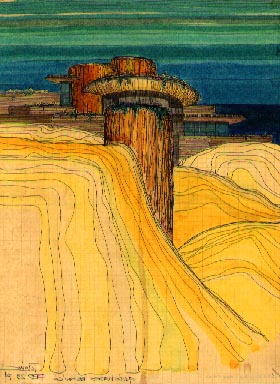
sketch, used for the masthead, was drawn in 1973 as a retrospective exercise. It is typical
of several designs I produced in the 1950s period. The site is Southern
California cliffs dropping to an ocean beach. The building method is
gunite which I explored in several theoretical works and two actual,
un built, commissions. These gunite (sprayed concrete) houses are ones which I would build today given the client opportunity. They were considered to radical then. Today they may be better accepted in terms of their form yet perhaps still radical in regards the lifestyle they were conceived to support. This later aspect is most likely the gap which stood between me and clients then and remains so today. |
In
1960, I spent a summer supervising a gunite construction crew to gain
hands on experience with the material. I produced several innovations
with the technique which lead to my first offer of a Partnership with a successful architectural firm. The idea was to use pre cast concrete pieces, as “forms,”
and shoot the gunite into them. This way precision edges can be accomplished
while taking advantage of the superior materials-handling and “free-form”
attributes of sprayed gunite for the majority of the walls and roofs. |
Unfortunately,
to this day this method remains, to my knowledge, unexploded. However, the idea of combining
shop built precision components with built-in-place field work has been
employed by me several times - most recently with the soffits of the
Hilton Head KnOwhere Store. The Bay
Area Studio [link: bay area studio] will employ this technique in wood. It no doubt will become a mainstay in any postUsonian houses which we do. |
My
stepfather was assigned to the Pentagon in 1949 so we moved to Falls Church,
Virginia that Fall. The general environment of Washington D.C. stimulated
my slowly growing interest in architecture. One of my favorite places
today, to go sit and think, is the Rotunda and fountain-rooms of the
old National Gallery off the Mall [link: national art gallery - february 2005]. Even though I have never worked in
the classical idiom, It is interesting (and enlightening) that one of
the most influential buildings, that had great impact on my subsequent
work, was done in the “Federal Style.” My parents gave
me a drawing board and tools [link: matt history 1949], along with some mechanical drawing
manuals, and turned me loose. I taught myself to draw. From that time
on to this day I have never been without a drawing board by my side (now augmented with computer) and have always had at least one conceptual
project in progress. In 1955, I took a high school extension course
in drafting and found out that I had covered the equivalent of several
semesters of the subject on my own. By the time I started working
professionally in June of 1956 [link: the promise - 1956], this was - and remains - my only formal training
in architecture. What I have learned of this art has been a combination of sitting at the feet of giants, direct work experience, extensive reading and traveling to see great works, and a demanding self-critical analysis of every line I draw and stick I build. The intensity of this process has never abated. |
| This
“50s” design period lasted until I moved to New York in 1961 and started my
work in field engineering and construction management. Most of the actual design and drafting work I did,
from 1956 through 1961, was work in other architect’s offices. My
personal learning process and the development of my own architectural
“voice” was facilitated by a few conceptual projects and eight
commissions - seven that remained un-built. My first commission was built,
without my supervision, a few years after I designed it in 1953. It still stands, today, about a mile away and 47 years distant from the Palo
Alto KnOwhere Store, which I designed in 1996 and built in 1997, and where I am writing this piece. The 1950s, particularly in the West where I mostly worked, was a vast post WWII building boom. I quickly learned how to be a fast and accurate draftsman and soon was charged with do the production drawings and supervising a drafting staff of many subdivisions of houses and apartments. While of poor architectural quality, this work - which I never lacked employment of - provided me with a strong foundation in traditional architectural office procedures and drawing methods. I did not try in this period to bring my design ideas into these offices. I did “clean up” to the degree possible the work I was charged to execute. |
| Eight
comissioned projects I learned my architectural “basics” on: |
| 1953 |
The Nichols House (built) |
| 1955 |
Parking Shelter for Marin County Apartments (un built) |
| 1956 |
Swimming Pool Equipment Building (un built) |
| 1957 |
Bryant Street Studio (un built) |
| 1958 |
Coffee Creek Ranch Guest House with Jack Rapp (un built) |
| 1960 |
Hoover House (un built) |
| 1960 |
American Pool Building (un built) |
|
|
Seven conceptual projects supplemented this process: |
| 1958 |
Cicular Hillside House |
| 1958 |
Architect’s Home and Studio |
|
|
And, one infrastructure project: |
| 1956 |
San Francisco transportation system |
|
|
These projects covered a wide range of problems, materials
and modular forms. They spanned the period from my own nascent thoughts
through my first four jobs working for other architects, my time with Frank Lloyd
Wright and my seminal week of tutoring with Bruce Goff. In sum, this was about as good an architectural education as it was possible to get at the time. |
As
can be seen, I did not pursue a great many different conceptual projects in these
beginning years but worked - and reworked - a few sketches over and
over. Each explored different basic ideas and each presented a different
set of challenges to my evolving sense of architectural grammar. This
body of work, in addition to articulating my own architectural viewpoints,
became the medium by with I developed ideas and lesions I learned from
those who taught and influenced me during this period: Wright, Goff, Schindler,
McCallester, Maybeck, Drake, et.al. These sketches are long gone - yellowed
and torn, ultimately lost. I will reproduce them here as a documentation
and history of my seminal learning path and note what problems were
being “worked” and what influences I felt in each work. In a
certain sense I am still reworking these projects - there is much left
to explore in them and I consider several of them buildable to this
day. |
At
the end of this period, I felt myself to be a competent designer - in
other words, I could conceive a building in my head clearly and expect
no surprises when it was built - it was the building process, itself,
that I took on as my main focus throughout the 60s. |
| Predominately,
in this period, my focus was on domestic work - I considered this (and
still do) to be one of the most challenging of architectural assignments.
To this day, great architecture has not been made accessible or affordable to the
average income family. When you consider the energy
and ecological impacts of our housing systems, there is little affordable,
sustainable housing in existence for anyone no matter the budget or
requirements of the owners. |
|
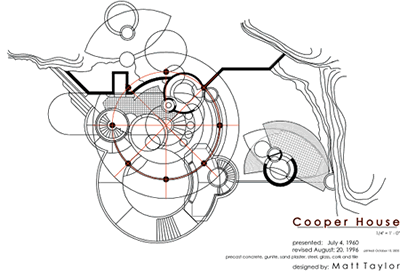
| Of all these projects, along with the American Pool Building, it is the Cooper House that constituted my most mature effort and it became my seminal statement of domestic architecture. The concept of life style, the way that the plan facilitates this concept, the integration of the building method to the idea of the building and the landscape for which it was conceived, is an accomplishment which, today 46 years later [2006], gives me great satisfaction. I started reworking this design in 1998 and it is notable that in December of 2005 I received an enquiry as to its possible adaptation to a site in the Virgin Islands. Of all the 1950s work, this is the one I still hunger most to build. If, to this date, I had to leave one domestic work - the Cooper House would be my choice. |
| I was intensely studying construction when I designed the Cooper House. During this period I was working for architects and developers and learning “production housing” methods. As noted, I worked for a swimming pool company to learn gunite methods and also design a display and office building for American Pools. It was these works that motivated me to move to New York and get directly into construction. This phase dominated my next ten years. It is this material focus and tight integration of form and building methods that makes the Cooper house such a visceral design. This sense will permeate the structure when build. In a way this is a building that only a young person would design but it may well take the experience of someone older to render it and make it real. The problem will not be it’s design nor method of construction. The challenge will be the education and integration of a ValueWeb able to build it for an affordable price. In this regard, my work from the late 70s to 2000 was dedicated to developing such skills and methods. |
| My 50s projects are full of ideas that can be successfully built today. They constitute a legacy of old and new opportunities. They are “old” in that buildings are rarely, at least in the U.S. today, built in so physical and authentic manner and “new” because there remain a number of architectural concepts that have not yet been successfully or frequently employed. Much of the craft base necessary to these concepts has eroded. The technology base necessary to their completion has enormously advanced as has the advancement of materials. The 3d drawing tools of course now make the design and engineering, as well as the pricing and scheduling, of a work such as the Copper House much easier to execute. In balance, this house will be easier to build today than 50 years ago. Yet, finding a client for which this house will be fit is a greater problem. I cannot help but feel that among 6 billion people and the whole of Planet earth that these is a family and a place to which this house belongs. I hope so for not to build it will leave a piece of me un done and forever incomplete. |
|
| It has been over 10 years since I first started this page. In this period, the many designs I explored in the 1950s have become even more relevant than before. And, it may be, may be... that the excesses of the last couple of decades may cause people to reflect on what they consider to be a “necessary” environment for a productive and fulfilling life. It may be that what will become to be understood as economical (life-cycle costs, sustainability, preservation) will favor buildings build the way that these 50s designs were intended. May be. If so, then there is hope that some of these concepts will find their way to built reality. |
| The paradox is that these designs - as all of my work to this day - are at the same time much more and much less than what is now being built. “More,” in terms of materiality, quality, sustainability and the designed life-cycle of the buildings. “less,” in terms of size, frills and social gesture. As a consequence, they are expensive building for the lower end of the economic pyramid and inexpensive for the upper end which too often the high cost of something is considered a distinction. I argue of course that considered on a cost-to-own life-cycle basis these design are not more expensive and to spend more fore a habitat simply because it distinguishes you from those who cannot is fraudulent and wasteful. Most houses built today are far larger than they need to be to serve the functions they do. Clearly some require larger homes and this is legitimate if true. The smaller, well built, beautifully designed and crafted house is left out. That is is a social factor is demonstrated by the many tricks used in housing today to make designs look larger and more imposing serving neither functional needs nor esthetic sensibilities. This essentially dishonest design technique is reinforced by the time honored tradition of making the front of the house elaborate while the sides and rear remain relatively plain. Clearly, the modern home is far more a social statement than an environment to live in. |
|
Matt
Taylor
March 6, 1999
Palo Alto, California

SolutionBox
voice of this document:
VISION • STRATEGY • EVALUATE
|
|
click on graphic for explanation of SolutionBox |
posted
March 6, 1998
Revised:
December 22, 2009
• 19880306.181950.mt • 20000709.466791.mt •
• 20060122.911022.mt • 2009.1222.123191.mt •
note:
this document is about 25% finished
Copyright® Matt
Taylor 1960, 1999, 2000, 2006
me@matttaylor.com |
|
|