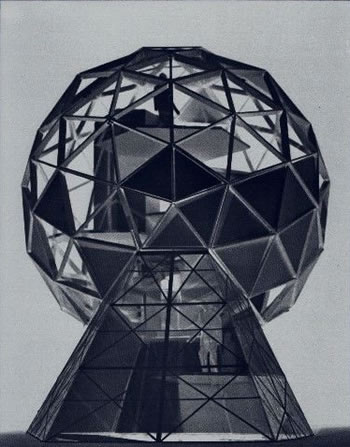
| EcoSphere is a small scale project with a clear mission [link] that can produce usable knowledge in a number of areas applicable to a wide range of future projects: affordable housing, green building, alternative energy applications, technology integration, movable structures, new form-factors, glass structures of larger scale, and ultimately, megacities and other new building types. EcoSphere is designed to be a living lab for the entire process of creating and using habitat: R&D, design, fabrication, building, using and the dissemination of the accumulated knowledge. | | EcoSphere is, perhaps, the smallest project possible in which so much can be tested and from which so much can be learned. It is affordable for four reasons: first, because it is not large; second, because most of the technology involved is at that stage where a real application is possible; third, because there is a use for the structure that can be paid for by money that will be spent anyway; fourth, because EcoSphere is designed to be moved thereby significantly altering the land cost factor. | | This article outlines a Business Model. It is the argument why EcoSphere should be built now and why a ValueWeb [link] should form to do it. It shows how the members of this ValueWeb can profit, in many different ways, from the experience. | The following Questions have to be answered: Why do this project now? What is unique about this project? What is the fundamental technologies involved; and, once demonstrated how can they be scaled for benefit? What knowledge can it produce that other options cannot? Who is needed to participate - and why? What is the scale of the total investment? What kinds of return are possible? How will those who invest profit? What are the consequences of doing this project - or not? To meet the project timing goals, what has to happen - and by when? What happens with the IP and Intellectual Capital that is generated? How do you get involved? What will be the organizational Model? How will the project be managed? Where will the prototype be first placed? | | | | | There are many forces that indicate that now is the time to do this. Some are general and some are specific to the Calgary projects. Together they make a compelling argument. The question is if a ValueWeb (i.e. an integrated, creative market) [link] will form, at this time, to see it through. | | On the global level there are many trends and drivers: truly affordable housing does not exist at any significant scale; People’s awareness and desire for better ecological solutions has made a dramatic increase in recent years. Interest in high quality small domiciles has, remarkably, returned The US economy is “recovering” but not in a way many expected - it is leaderless, without identity or passion Materials and technology breakthroughs in building skins, energy, waste and water cycles management has given us a rich tool kit to draw from while scarcity and prices in these areas continue to climb. People continue to get educated to advanced technologies in their transpiration options and consumer good yet housing just goes on and on - as always - only more bloated. This is a great time to bring alternatives to the market, to bring design and integration to bear on the myriad of existing pieces and make a real solution. There is a set of trends without a name waiting to be ignited, ready for a symbol and a voice. | | In Calgary, we have the Master’s Academy project and enterprises and the Design/Build/use ValueWeb we are assembling to design the “school of the Future” [link]. Money spent on hotel rooms and rentals for the MGT part of this team alone, over the span of the project, will pay back the “mortgage” on an EcoSphere. The first question is just where do you want this money to go and to buy what level of work-life style? The second question is if this money should - or not - be spent in a way that informs the project or merely supports the real-estate-method-in-place [link]? To provide for myself and the team and to inform the project, time is of the essence as the Phase I NavCenter and the basic planning for the new Campus (Phase II) will take place over the next year. It is all a matter of how you want to Vote with your money and how much leverage you want from it. | | And then, EcoSphere and the recreated Usonian House [link] are but two projects on the path to affordable housing [link]. | | | There is a great deal of R&D, demonstration and new architectural realities packed into a small, thus affordable, space. Besides the thing of it, the process by which it is built - while not new in its parts - is new in the degree of integration between the building form and the method of fabrication/building. This is an exercise in lean design and construction. | | The project is unique in its ValueWeb organization, in that it is both an end in itself and a precursor to several specific other designs. Also unique is having the lead designer live in it and practice it into reality - and document the results. Architecture, as a profession, has no systematic R&D process. Design, engineering, building and using are, in actuality, practiced as separate businesses. In design, exterior and interior work are most often separated. It is a fragmented profession and not very efficient in the economic sense. The tight integration of EcoSphere demands a level and style of collaboration that is unusual. | | In architecture today, R&D is generally accomplished with big “signature” projects where cost is not the object and the experimentation can be absorbed in the scale of the project. This is a high profile, star studded system that is highly competitive with reputations at stake. Not really a good learning environment. | | | The core technologies to do EcoSphere already exist. There are places where the state-of-the-art can be pushed and the choice to do so is a factor of time and money. Also, the range between a “craft” solution and a “manufactured” one is also variable and a factor of time and money. It is the integration of systems, the integration of design, build, use, the integration of artifact and life-style and the form-factor of the design that opens up many new possibilities for innovation. | | The fundamental technology in this exercise is the application of the GROUP GENIUS processes to the artful assembling of many techniques and technologies into a solution that has never existed before and that can inform the creation of larger and more complex structures. | | | Unique knowledge will come into this project, unique knowledge will be created by it and unique knowledge will be distributed because of it. What is unique is what is sideband in other efforts. Most go after what they think they need to know rather than seeking what the want to learn. EcoSphere is not a tool - it is a work of art [link]. In creating it - we learn. | | The learning is in the doing. It is not in the abstractions of engineering and design nor in the project plans, field management and budgets. These are important tools, means and methods and of course they will be refined. The unique learning is in the making and living in a work of art that rests gently on the Earth, respects all nature and augments all life. That is what we do not know how to do nearly well enough even given our tremendous knowledge, social organization and economy. | | We have forgotten the simple things of life and we do not know how to integrate them with the mechanisms of our sophisticated technological society. | | Strange words for a Business Model? No, only a strange world that would think it so. Business, once, was about making and delivering GOODS. What is the good now? This is a serious question. We are running out of time and are the first generation that will leave the mess to ourselves; the habits [link] of UpSideown Economics have to be offered an alternative. | | Learning how to live gently is not about giving up - it is about expanding what we consider to be in the game we call human life. EcoSphere seeks to be inclusive - it respects nature even as it embraces it. It treds lightly and it is proud. When it is time to go, it leaves the Earth as it was. It provides an unique viewpoint of the world and life. It frames a way-of-life. It is not consumptive. | | Can we learn how to to do this? | | | We need people who want to know - who need to learn. To them and them only we can offer a gift. | | And, of course, we need competency. Competency in design, engineering, fabrication, building, business; in real estate, logistics, scheduling, research, deal making; facilitation, communication, education, documentation and finance; in landscaping, gardening, energy and transportation management, nutrition, cooking and personal hygiene. | | EcoSphere, as designed, presents an organized yet open-end problem for a vast array of disciplines. No assumption about living and work processes can go unchallenged in this process. Yet, this is not a 10 year research project. We have to bring existing knowledge to bear in record time, discover and invent as we go, and build a building that is not static and dead the day it is finished. | | We need people who can do this and are capable and willing to bring money, tools and personal time to the project. | | We need people who can live with the ambiguity of a project where everything is not tied down from the very beginning; who can work in an environment of trust and not take advantage of a situation but work to bring the project and the whole team through intact. | | We need Cathedral Builders who can have fun doing it. | | | I estimate that the total necessary investment is in the realm of $1,000,000 three hundred of which will have to be cash with the rest being “in-kind” and product contributions. Even a great deal of the the 300 can be turned into “capital” if we can turn field labor into a “capital investment.”A big chunk of this cost will be in R&D and engineering along with the project management time of getting all the product companies and fabricators lined up. EcoSphere will have a fair degree of technology augmentation including “smart building” components, multimedia and communication capabilities [link]. As noted [link], the skin of the building is the most challenging aspect of the design and the most expensive. The energy systems can also be approached in a relatively conservative or radical way [link]. In all of these aspects, the idea is to take a middle road approach: push the art but don’t break the project. | | The EcoSphere prototype must be a business success even if it does not lead right away to a business. It does this by meeting the financial goals of the prototype and by meeting the agreed upon expectations of each investor. | | | No matter the kind of investment made, there are many kinds of return for those who participate in this project. Some will want one or the other, some many, some all of them. | | I sum these up as recreation, satisfaction, learning, professional advancement, idea or product demonstration, personal use, D/B/U team experience, revenue and equity building. | | Depending on one’s situation, one or a mix of these may be attractive. The idea is that everyone coming into the project and ValueWeb has a unique contribution to make and also an unique set of requirements that determine what makes a good “return” for them. Each relationship, therefore, requires on a different deal. Fairness is not giving everyone the same thing. Fairness is giving each what works for them. This is the mass customization of contracting. | | | The notion of profits flows out of the idea of personal returns. Other than personal rewards, there will be no financial profits unless EcoSphere reaches a market of some consequence. This is a long term proposition and it involves all the risks associated with any business venture. However, profiting from one’s investment in other ways is entirely dependent on the the quality of the effort put in and the integrity of how the project is run no matter how far it gets down the road (at this cycle) to built reality and use. Each iteration of the work will be “finished” and documented. Each step advances the cause and brings us closer to the end result. | | | The consequences here are not insignificant. EcoSphere is a small project but the world is different with it than without it. | | Bucky Fuller designed the first Dymaxion house in 1927[link]. He did a full prototype in 1947 [link]. The prototype was successful even though unusual [link] and thousands sent in their orders unsolicited. The production houses were estimated to cost about the same as a new luxury car of the time - this made it affordable to the average home owner [link]; however, Fuller walked away from the project when he feared that business interests would exploit it. Fuller’s concept was that the housing industry would become a service industry much like the phone company [link]. | | In the mid-70s, I found myself riding to the Kansas City airport with Bucky. He made it quite plain that he considered the housing industry of that time, unprofessional, corrupt and hidebound - an evaluation that I shared having already had over five years experience doing projects for developers as a designer, field engineer and project manager on projects ranging from small semi-custom subdivisions to a city of 40,000. I shared with him my perception that it was fear and the inability to see the transition to a new way of working that was the problem and I told him of my then still nascent ideas of how to overcome this - ideas that 5 years later, with Gail’s partnership, were to become MG Taylor Corporation [link]. He looked at me and said “you, you will build my house, I will never build it; you and others like you will.” It was a startling moment and one I have never forgotten. And I have not forgotten my promise to build his house. I have spent most of my since refining the method by which this can be done. It is not, primarily, a technological problem. | | EcoSphere, while a geodesic structure that employs many of Bucky’s ideas, is not, of course, Bucky’s house. It will be an artful mix of technological and traditional materials. Wood is a warmer material, renewable, easier to work than metal and, if used properly like in modern boat construction, remarkably strong. Today, the best economy is the Lean approach mixing the best materials, processes and resource strategies to come out with the best results. In Bucky’s version, the house could be deployed anywhere in the world - he demonstrated this 50 years ago and did it repeatedly. With EcoSphere, we will ship information first, critical components second and rely on local fabrication where/when it makes sense. Never-the-less, in spirit, this is a small piece of Bucky’s dream. | | I bring this story about Bucky into this Business Model because it is highly relevant to the subject of consequences. I was 9 years old when Bucky prototyped his house. I am over 66 now [in early 2005]. It is still not built and the principles upon which it was based remain at the fringe of our society. The impact on the Earth, as a consequence of how we build, it what it is - and it is not good. It does not take much imagination to see what another half century of what the present design strategies will render. | | There are always good reasons not to start a diet, today; not to start living healthier, take the effort to improve education, stop polluting, or start saving for the future - or thinking about the future at all. The consequences, however, cannot be escaped. Nature doesn’t care. | | It is time we learned how to habitat better. | | | Before timing we first have to outline the tasks: a site has to be found. The basic structure engineered. A business organization established. A project bank account and financial controls. A project web site established with a means of exchanging information, files and facilitating dialog; Rules-of-Engagement established. The producer network of the ValueWeb chosen. A cost model created. A legal agreement covering organizational structure, ownership, control, IP protection and sharing, rules about how any resulting products will be employed. The necessary capital attracted and design-engineering assignments agreed to. Suppliers and manufactures contacted and enrolled in the program. | | Then, the work can begin. | | Different glazing and structural components will have to be engineered, fabricated, tested and selected. Tooling set up. Final fabrication drawings completed. Materials ordered; and, the manufacturing of structural and interior components completed; the modular shipping trailer set up followed by permitting, site preparation, shipping, field erection, any necessary field work and then the debugging of systems. | | The move-in process includes landscaping (exterior and interior), starting the garden and fish pond, furnishings (not much of this) and goods: dishes, glassware, silverware, towels and so on - all products to be evaluated, selected and purchased. | | The energy and water systems will have to be “charged” - depending on the time of year, it will take time for the system to reach stability. | | Now, the process of learning how to live in EcoSphere begins. Don’t forget the celebration - and documentation. | | And throughout all this, an interactive web site has to be maintained to engage in the market exploration/creation process, as well as, support any parallel prototyping projects that may arise. | | What is the best that can be expected? A month to find out if there is a basis for a project. Three months to do the initial design and engineering. In the meantime, funding, land and the full team can be secured. Then, three months to do design development and component testing. A month to set up the final fabrication process. In this period permits can be acquired and site preparation can begin. Three months to fabricate and ship. One month to erect and debug. This adds up to 12 months as a generally best case scenario. This means spring 2005. | | This schedule is in parallel with the building of Master’s Phase I NavCenter project and the planning work of the Phase II new Campus. | | It would be useful if the EcoSphere project schedule could be accelerated so that the “informing” of Master’s Phase I could be greater. This, however, is not feasible unless a far greater amount of cash would come into the project very quickly and/or a larger team, assembled, quickly, able to give it dedicated attention. And, as long as a year is, a shorter time does not leave the necessary time for thinking and design. This project should have started a year or two ago and there is no easy way of making this up. | | | IP when it comes into the project will be registered and respected. IP created within the project will be shared according to the rules established at the beginning. How each project member employs the Intellectual Capital they derive from their involvement will be governed by the project covenant that all will sign at the beginning. These rules and covenant will be drafted as the first piece of legal work. | | | It starts with an e-mail or phone call. Decide what you are willing to contribute and under what conditions including what you want out of it. Even small amounts of money will be useful. Systematic and validated knowledge is gold. The willingness to contribute labor (be it engineering or physical) will make a big difference as long as you are a self-starter-organizer. | | There is much to do besides making a prototype. We will need to build a web site, produce plans, provide a service to support local owner-builders - this means, besides web-delivered services, a network of local engineers, architects and builders to offer work or consulting. This capacity, of course, then creates the basis for the Post Usonian Project [link]. We certainly will want to produce a video of both the design-engineering process, the fabrication-construction process and living in the environment. This requires many forms of knowledge-work. | | | It goes without saying that none of this can be construed as an “Offering.” The legal aspects will have to be designed and engineered along with everything else. Until we know we have sufficient support for the project and until we know the nature of it, the form of the organization cannot be foretold. | | A likely Model is what we did when we published The Most Amazing Thing [link]. We created an LLC and valued everyone’s contribution which gave them a position in all the down stream revenues in a property that was clearly described. This is the “movie-making” model. In the case of EcoSphere, there are a wider range of reasons to invest, a wider range of contributions and, I expect, a greater variety of “returns” required. The organizational Model will have to reflect this variety. | | | The project management process will employ the full Taylor NavCenter processes and tool kit. | | The processes learned from the NASA and Swimming Pool stories will be systematically applied [link]. | | | At the present time the most likely place for the prototype will be Calgary, Canada. With master’s Academy project [link], this is the most relevant place for immediate application and the project will also require a great deal of of my presence over the next three to five years. I have to live somewhere, I will be spending the money to do so, EcoSphere will require documentation. The weather conditions are both challenging and ideal for this kind of experiment. All this adds up. | | It is, of course, possible to prototype more than one EcoSphere if there is both the human to “drive it” and and financial means to produce it. | | One goal of the project is to get to a marketable owner-build, shop fabricated product and can be produced at some scale. It will take one to a maximum of three prototypes to achieve this. Even these prototypes will get significantly less expensive, each iteration. A production level of 5 units a month will yield healthy cost reductions and the basis of a business. | | In time, it will be possible to adapt EcoSphere to wide range of climes. Economy, however, will require both a distributed and locally adaptable production methods. Much of the structure, skin components and interior components can be fabricated out of the present AI shop. However, in time, and with greater production, shipping costs can be reduced by finding local and regional shops to work under license. | | | A ValueWeb architecture with MG Taylor as systems integrator will assemble a Design/Build/Use Team to build a prototype (one to three) of the EcoSphere concept. Each member of these Producer, User, Investor Inner Clamshell Networks [link] will join according to their own individual contribution, risk and profit profile, and therefore, agreed upon rules-of-engagement. | | The MG Taylor NavCenter environment and system will be employed to manage the project. This will involve the full use of the 10 Step Process thus creating an Archive and KnowledgeBase of the experience. Existing MG Taylor, SFIA-Master Builders and AI capabilities will be employed, as well as, new enterprise members as they join. | | A FasTrack process will be employed with the goal of placing the prototype in Calgary in time to inform the Master’s D/B/U Team in both Phases I and II of that project and to provide living-work space for Matt Taylor and visits from state-side members of the MGT Team at market rent rates. Free EcoSphere capacity will be made available to the ValueWeb members at agreed upon terms. | | If the EcoSphere resources and capacities do not assemble fast enough to meet this objective, other prototyping locations and schedules will be considered including “shelving” the project for a period of time if necessary. In any circumstance, continuity will be maintained and the project pursued until it is completed, morphs into something else or is proven a failure. | | Concurrent with the prototyping process, an EcoSphere web site will be established augmented with WIKIs and BLOGs. The purpose of this effort will be to explore the creation of the Middle ValueWeb Clamshell necessary for the building of a viable business. At this point, consideration will be given to the possible merger of the Usonian One and Work Conservatory projects. | | A PROTOCOL will be established, from the beginning of the project, to identify Intellectual Property and Intellectual Capital coming into the project, developed during the project and the rules-of-engagement by which both can be employed by the Enterprise members - within the enterprise scope and outside of it. | | There are several kinds and scale of business activities that can emerge from this project, progressively: an information exchange and clearing house; owner-builder plans with component manufacturing and professional support services; licensing of local professionals and production shops; adding new products and scaling, over time, to a full-service affordable housing company. As part of the ongoing, facilitated, business development process, these options will be explored by the Enterprise members and the appropriate opportunities pursued. | | The estimated “capitalization” of this start-up is one million dollars - this is based on the market value of all contributions including design, engineering, land use, manufacturing and building, enterprise overhead and planning. Of this, as much as 300 thousand or as low as 50 thousand in cash will be required depending on the level of in-kind and product contributions made. After an accurate financial model is created, a fixed initial valuation will be declared and all contributions will be factored accordingly. | | This Business Model outlines a means to the creation of an unique piece of architecture as well as a means to evolving a business based on the result. Both of these are heuristic processes. There is inherent risk in any start up. There is compounded risk when the state-of-the-art is being pushed and when the market cannot be predicted. There is no way to guess that there is a market for EcoSphere of one or ten thousand. There is no way before expending engineering effort to know how far down the sustainable continuum EcoSphere can be taken with the first prototype - or three. There is no way to bracket EcoSphere costs, as a prototype and as an eventual product, within a 300 percent spread, until engineering is done and a considerable about of fabrication/construction analysis is performed. However, there are things that are known: EcoSphere is build-able. It can be very green and sustainable. It can be movable with breakdown and set up times within a week. There is at least one buyer who can utilizes the environment in such a way that can be afforded given the likely costs. Based on the response to my web site alone, there is ample evidence that there exists a large and growing population that is seeking affordable alternative architectural solutions [link]. | | There are three valid motives for joining this Enterprise. You may have one, two, three or all. The first and the major one is to see it done, to experience the ValueWeb and rapid prototyping processes and to acquire the personal Intellectual Capital that is the inevitable result - this is an individual learning, professional enhancement and social investment motive. The second is to test out an idea or product in an environment where you and your property will be respected and the feedback you get will be reliable - this is an Intellectual Capital and personal business return motive. The third, for the business entrepreneur, is the belief that there is, in fact, an economic pony in there somewhere and a market exists or can be developed within which one can build a profitable enterprise - this is the motive to grow capital. This one, however, is a lengthy journey and we are just on the starting path. | | All this said you have a choice. You can look at your marginal utility of cash, ideas, talent and social capital and you can decide how to invest it. Your investment can be large or small. A new car this year, a way out vacation, an advance in life-style, a conventional investment - and/or EcoSphere. You choose. Any way you go is valid and only you can make the decision. You have to determine which is more rewarding. Only you can access the short range and long term consequences. | If you want to play the EcoSphere game contact me. e-mail | | | | | Return of the Usonian Project | | | Matt Taylor
Nashville VCBH
March 22, 2004 SolutionBox voice of this document:
VISION • STRATEGY • DESIGN DEVELOPMENT | |
posted: March 22, 2004 revised: March 23, 2004
• 20040322.335111.mt • 20040323.200982.mt • (note: this document is about 85% finished) copyright© Matt Taylor 1967, 1975, 1979, 2002, 2003, 2004 | |