I
N D E X |
Facebook
|
|
twitter me |
|
GoTo: What is New Achieve #1 |
|
| In the 25 years that CAMELOT has been with us, the last 10 has been an idle time for Her. Our personal and business circumstances have prevented CAMELOT having an active role in both our re-creation and work. This has been a great personal loss as well as a lost opportunity for our ValueWeb. It is time for this to change. |
| The very circumstances which have prevented us from keeping CAMELOT active have evolved to where now there exists a window for Her return to service in a way true to what She is and also completely fitting for a time and place where significant change is taking place. |
| The place is San Francisco, “Baghdad By the Bay.” |
| The time to start the new Program is now with arrival in San Francisco late spring of 2015. |
|
| Camelot’s Program Statement |
|
|
| Camelot’s Legacy web site |
|
|
| CAMELOT has a new mission. “Think of this as a floating Chautauqua experience with peer groups of innovative, future-focused, individuals with the San Francisco Bay as supporting cast.” |
|
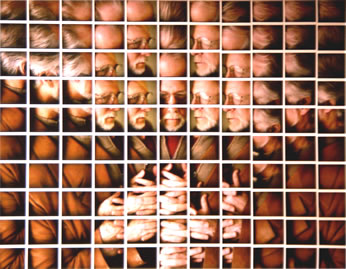
| Six years ago, the UniCredit Center was opened and the UniCredit Team gave me the wonderful experience of being photographed by Maurizio Calimberti. The original, © Maurizio Calimberti 2007, is hanging in the Garden of the UniCredit Center. The image above is a photograph of a copy printed on canvas that the photographer sent me and can be found in my Northern California home. I have always liked the result yet it was the experience of being photographed - not one of my favorite activities, usually - that sticks in my mind as a Strong Memory to this day. |
| Maurizio Calimberti shots only in Polaroid. He is famous for what he has been able to capture with this medium. The composition you see above was accomplished in a little over two minutes and is exactly how the instant images came out of 11 packs of film. Maurizio shot these 110 images, put down his camera and arranged them, one row at a time, and the final picture emerged... just how he had conceived it in his mind. |
The film was instant. The shooting was instant. The result was instant. The preparation was less than instant as there was none in the usual sense of the term. No lights, no tripods, no posing trying to look alive and attentive - none of all that. We sat for almost an hour, in one of the third floor rooms, and Maurizio shared his work and his ideas and gave me his book of New York City images. We then went down to the first level and I walked him through my work and the story of how it had come about. Realizing we had so much in common in our work, we returned to upstairs and continued a spirited dialog, two artists sharing dreams and means, aspirations, successes and times of struggles. |
| At one point, Maurizio asked me a question - not an easy one and I paused to formulate a reply. He grabbed his camera and said “don’t move!” and that moment in time was captured. |
| Gail named that moment pieces of matt. |
| You can legitimately wonder why would this memory be shared so many years later under the title of “What is New?” Because there are old, new and future pieces of the scenario called Matt and all of these are about to configure into a new pattern. The real adventure is beginning. The real work is emerging and there are a finite number of pieces of me to invest in this happening. If you feel like adventuring; if you want to influence how I play my Glass Bead Game of the next few yeas, click on the Canvas above. |
What is Pieces of Matt? What pieces make up Matt? How can you have a piece of Matt? Why might you want to? Why is this moment the time? |
|
The 50 year Anniversary
of an un built work
|
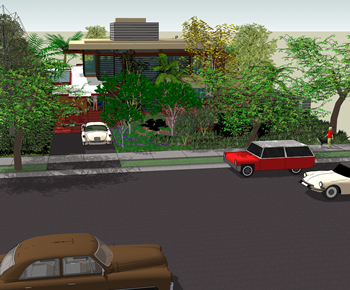
| Today, July 4, 2011, would be the 50th year anniversary of the Hoover House if it had been built. It was not built yet it has gone on to inspire many of our works up to this day. |
| The original drawings long lost, in August 2007 I started to build a SketchUp Model of this work as part of the postUsonian Project development process. A few months back, I was challenged to employ an innovative App, which is in development, to publish a piece which demonstrates some of its many attributes. I decided to tell the story of this house as if it had been built and lovingly lived in and stewarded by the family for half a century. The scenario is their annual July 4th family gathering. If all goes well, the App, and my story, well launch later this month or early August. |
Click on the picture above for a brief description of the design. The longer story will have to wait for the App and subsequent publication. The links below will be added to as the work progresses.
|
 |
| Introduction: postUsonian Project |
|
 |
| Reading List postUsonian Project |
|
| The long time between this entry and the one below about the Sydney trip is no indication that there is little of note happening. It is consequence of so much new happening that there has been little time to write about it. In progress is an entirely new generation of WorkFurniture at AI, a school expansion in Calgary, a new NavCenter in Vienna, and many developments in the DesignShop arena. |
|
A Visit to Sydney - a DesignShop
and an Icon of Innovation |
| I am half way through a 15 day stay in Sydney where I have just finished facilitating a DesignShop® exercise focused on creating a viable and ecologically sustainable Australia. |
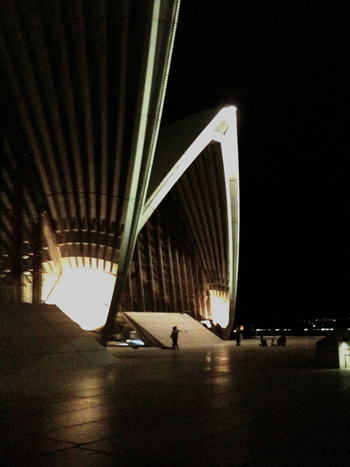
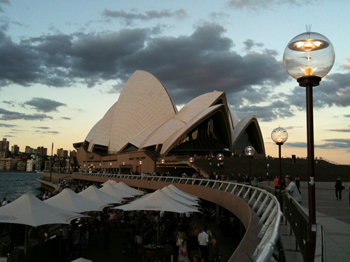
| Last night I treated myself to a walk by Sydney Harbor, and a dinner within it’s Opera House complex. This was my first time off, in a month, and the beginning of my think time about my coming talk at the Sydney Mechanics School of Arts on a Future By Design and employing GroupGenius to accomplish it. The Sydney Opera Complex is astounding and one of the best places to contemplate the future that I can think of. |
| Andrew Gaines organized the DesignShop and upcoming workshops and talk. These activities are described on the Alliance for Sustainable WellBeing web site. Exploring the many facets of this web site and Andrew’s work will be rewarding and I encourage those interested in my work to do so and discover the many parallels. |
| The Sydney Opera House is one of the greatest works of architecture ever attempted. It was completed with controversy and the resignation of the architect. It’s building demonstrates the complexity of collaboration with works of large scale and great cost. This story is well told in a wikipedia article which ends with the happy note of at least the partial reconciliation of architect and opera administration a generation after construction. The story is not unlike that of Frank Lloyd Wright and the Guggenheim Museum except that Wright was at the end of his work while Jorn Utzon was at the beginning. We will never know what future works were lost due to the resulting controversy. |
| I have just met this building and intend to get to know it better in the future. My brief time with it was fitting. The Opera House is an icon of Australia and reminder of the complexity of the task we have ahead in the remaking of global architecture. |
The following links - click on the lh icon - connect to my Notes in support of my Presentation on the 11th and Workshop on the 13th of March. These pages are a work in progress so you may want to return more than once. It is likely that it will take me a month to bring them to Maturity and even longer to Make them “complete.”
The content touched on in both the Talk and the Workshop is broad in scope and depth as it covers over 30 years of work. The purpose of the documentations is to go further and deeper than time permitted by both venues. As always with my personal web site, the content is not about me our even my work. These are merely the subjects as I only speak from my own personal experience. The real content is the thinking you do and the subsequent actions you take because you have engaged with what to offered herein.
I want to thank the respective audience and participants for their involvement, interaction and enthusiasm. I felt that both myself and the ideas I brought were accepted in the spirit that they were given.
In all I enjoyed my visit to Australia, enjoyed the land and the cityscape of Sydney immensely and was totally captivated by all of you I met and your dedication to building a better world.
Thank you for the Strong Memories. |
|
|
 |
|
|
| DesignShop Method Workshop |
|
|
|
|
A Book and a new navCenter
progress in theory and practice
|
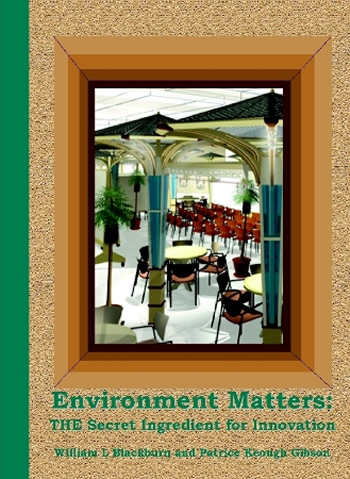
click on cover graphic to review book |
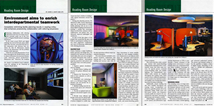
| Bill Blackburn’s and Pat Gibson’s new book Environment Matters: THE Secret Ingredient for Innovation is now available. |
| Bill Blackburn has been involved with MG Taylor almost since our beginning first as a client, later as a board member and co-designer with me in the development of our philosophy, methods, designs and technologies. As President of AI, of which he is a 20% stockholder, he and Pat, guided the organization’s transition from a small design firm which contracted the production of its goods, to a design and manufacturing organization producing a full line of WorkFurniture capable of forming complete environments from a modular kit of parts. In 2002, Bill and Pat turned the management of AI over to MG Taylor and since then Bill has run his own design practice and devoted a great deal of his time designing work environments as part of the MG Taylor, AI, TSM Architecture design-build practice ValueWeb. |
| Pat Gibson also started her relationship with MG Taylor as a client. Subsequently, for a number of years before joining Bill at AI, she did writing and knowledge work in support of DesignShop® activities for a wide spectrum of MG Taylor clients. |
| Bill and Pat brought their combined experience to the production of Environment Matters and have distilled a number of principles essential to the making of a new kind of work environment. I was a reader of a later draft and look forward now to enjoying the final result. The message announcing the publication of the book came as I was on the phone with the Johnsonville Team receiving their decision to proceed with their navCenter environment - itself the distillation of many decades of work. This convergence reminded me of the many late night discussions that Bill and I had, almost 30 years ago, and the realization we are beginning to build what then we dreamed. |
|
click on graphic for a pictorial tour of INSIDE |
| Johnsonville Sausage of Wisconsin has authorized the building of a new building to house their new navCenter COMMONS. A MG Taylor, AI, TSM Architecture Team will provide architecture, Construction Management and the manufacture of the interior components and WorkFurniture systems, as well as, transfer the patented Taylor System and Method. The COMMONS , which will be accessible to all Johnsonville Members 24/7/365, will provide training, education and collaborative design support to Johnsonville’s ongoing transformational process. Johnsonville has been widely recognized for its progressive management practices outlined in Flight of the Buffalo - SOARING TO EXCELLENCE, LEARING TO LET EMPPLYEES LEAD by James A. Belasco and Ralph C. Stayer. |
| The design was selected out of five options, four designs by us (one, a remodel of an exiting structure and three new building concepts) and a design produced by a local architect. |
|
Columbus VA Learning Exchange
in Fabrication at AI
|
click on picture for drawings and description |
A LONG AWAITED ADDITION TO THE
VA LEARNING EXCHANGE NETWORK |
It was several years ago when Patsy Kahoe and I traveled to Columbus, Ohio to talk to the VA about a Leaning Exchange facility in their new hospital wing then only a gleam in their architect’s eye. |
| Construction is nearing completion and fabrication is underway for installation early next year. Of all the VA projects built to date, we enjoyed an easy and collaborative relationship with client and architect leading to what will be one of the most complete projects of our four year relationship. |
| The design was executed by Bill Blackburn who acted as president of AI, 1993 to 2002, and now practices as a designer and consultant in the MG Taylor, TSM Architecture-AI, ValueWeb. Bill is completing a book Environment Matters: the Secret Ingredient for Innovation, with Patrice Gibson, which will soon be published on line and in print. [Note: see above - April 20, 2009] |
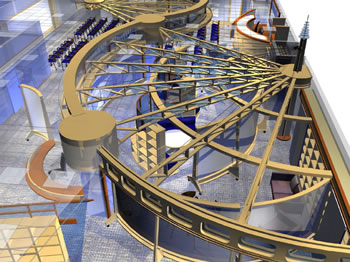
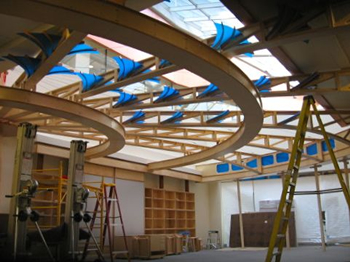
| Designed in 2006 and taken through design development in 2007, the Columbus environment represents a benchmark for us in several ways: The integration with the building made possible by new construction and a collaborative architect who was intent on achieving integration and allowed us great design freedom. The development of the Armature as a response to the design challenge presented by the space provided, has led to one of the most complete expressions of this concept to date. This work extends and refines the AI interior landscape language building on the last 10 years of development of our Foundation II series WorkFurniture. Projects of this scale, complexity and integration to the larger architectural context, advance us toward our goal of achieving a tight combination of shop fabrication and field construction. This is necessary to establish a new level of Design/Build/Use which can be employed for creating both work and living environments of great beauty, utility, at affordable costs, with sustainable building practices. |
| With each project such as this one, the capacity to build successful postUsonian and affordable housing gets one step closer. |
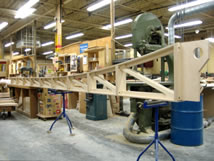
| Fabrication of Columbus VA Armature pieces underway at the AI Shop. 12 such pieces will be required for the project. |
|
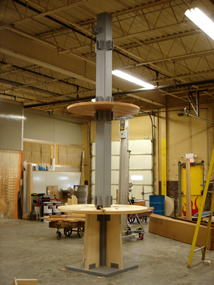
| This is the last of the Columbus VA Armature pieces to be fabricated. Installation is underway and will be completed shortly. |
|
|
| The great pleasure of architecture is the process of taking an idea and making it a reality. The Armature concept was developed by Herb Greene in the early 80s. It was about that time that Bill Blackburn and I spent many hours discussing and specifying the attributes of the MG Taylor navCenter. Concept is one thing. Design another. Then, the process of production turning an idea into a practical reality. In the end, over 20 people had a hand in bringing this environment into existence. Now, the real task begins and this is use. Architecture is not a visual art. It is an experiential art. It is those who use it who breath life into a work. |
|
pre-Prototype MediaPOD Mule Presented
|
click on picture to go to mediaPOD Design Development |
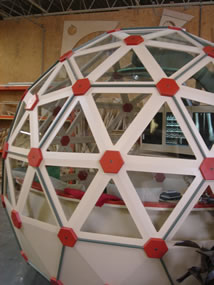
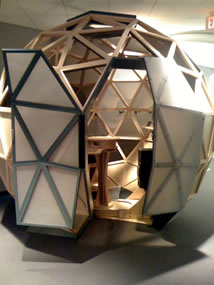
The mediaPOD™ Mule was presented at the AI production facility to UVA today to receive feedback necessary to producing a prototype for their radiology facility. It was a great meeting, we learned a lot and solved the remaining interior arrangement problems for this application. |
| A “Mule” is a model of an intended design. Usually rough in many of its aspects and built to demonstrate the most critical elements of the design. It is also provides an opportunity to explore many solutions to problems intrinsic to the design. In this case the overall shape, acoustic properties, possible internal arrangements and entry/exit door were the main items in focus. In addition we explored different ways to make the mediaPOD in easy to ship, assemble and install components. Detailing and appearance of the outer shell were of lesser importance, this iteration, although we did this as nicely as possible given we used flat stock paint grade materials. We applied “Arts and Crafts” colors which provided a playful look to the product. The prototype and production versions will be made from natural woods and some metal elements, with the detailing being much crisper and delineated, providing a warm yet more technological look. The design metaphor is the mediaPOD as a fine, well equipped, yacht which can be “sailed” through world of the media content. For a Mule, we are very pleased with how far we got and we had a lot of fun doing it. After we learn all we can from this iteration, we intend to finish her up and put her somewhere to be enjoyed and used. |
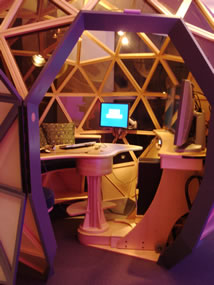
| Besides providing a team space for the analysis of medial X-rays, we believe the mediaPOD will create an ideal environment for Team virtual conferencing and collaborative work, Computer programming, Multimedia creation and editing, Interactive multimedia presentations, Gaming, modeling and simulations, A personal workspace, Technical and scientific data-information display, Designer, architect, artist’s electronic drafting board, Interactive KIOSK for a variety of public settings and uses, a Learning environment for teachers and students and as booths in a “green-garden” organic food eatery. |
| We are presently developing three of these applications and looking for additional client-partners to work with us to specify the interior arrangements for these many uses. |
| The mediaPOD will fit under a nine foot ceiling although the higher the better. Its horizontal footprint is ten foot six inches. It is easily disassembled, and moved in lightweight modules, requiring simple tools and no specialized skills. It will be produced in a variety of finishes, materials and colors and can be adapted to reflect the trade dress of the user’s organizational environment. |
| |
 |
| Taylor workPODs - A History |
|
| |
|
|
| Prototype mediaPOD is installed at UVA to begin testing process. Click on photo to view details. |
| The interior of the UVA mediaPOD prototype was installed on May 23rd. Click on photo to view details and for additional narrative. Perkins Eastman, Architects design the space in which the mediaPOD was installed. |
Dr. James Amato wrote an article on the Reading Room for the December, 2008 issue of Diagnostic Imaging magazine. Photos are by Boris Feldblyum ©2009. The Theatre Photo is by Sarah Medling ©2009.
|
| The New York AIA, mentioned Perkins Eastman design of the space in a recent piece in eOculus, their online magazine. Click on the graphic to go to Boris Feldblyum’s web site. |
|
UniManagement NavCenter Opens |
click on picture for a tour of the Unimanagement NavCenter |
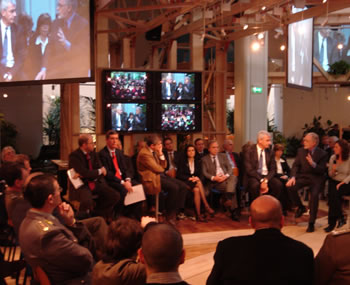
| The UniManagement Development Center was introduced to the city of Torino’s leadership today. This included a roundtable discussion, in the NavCenter, on the subject of leadership and sustainability in which I took part. It was an excellent discussion which revealed the degree that Torino is aware of the challenges ahead and is determined to meet them by transforming the city/region. |
| UniCredit CEO Alessandro Profumo [welcome to the first truly european bank] invited the city to make use of the the UniManagement facilities and the Mayer of Torino said that they would. For my thoughts on the Economics of Replacement Bio Regions go to: [future link]. |
| The NavCenter received many appreciative compliments and this afforded me the opportunity to outline its history and mission while noting how it was the product of intense collaboration across many organizations and why this way of coming to being [link: unicredit nav center - 60 days to realization] exemplified the intended use of the NavCenter and how design solutions to systemic problems can be accomplished to meet 21st Century challenges. |
| A number of articles have been written on the project and they can be found here: [future link]. |
|
Guest House and Studio for Stan Leopard |
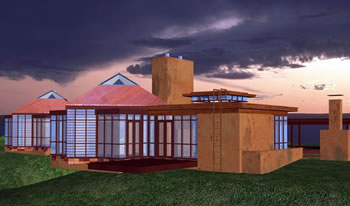
design by: Matt Taylor and Matthais Oppliger
rendering by: Irina Sokolova |
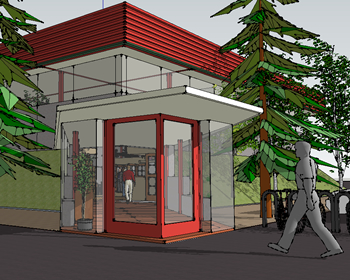
| The Guest House and Studio addition for Stan Leopard has been approved for Design Development with the goal to erect the buildings in the April-May time frame. |
| The 1500 square foot project is a combination of field built and AI prefabricated components with the intention of serving as a prototype for a new post-Usonian grammar. |
| Click on the graphic for a description and drawings of the preliminary plans of the project which were completed last summer. For my articles on the post-Usonian project go to [link: the return of the usonian]. |
| There is no question that the addition will be successful in terms of serving the requirements and aspirations of Stan Leopard - the collaboration and extensive thoughtful dialog insures this. What we are all waiting to see, including Stan, is if this project, at this time and in this market, can be a means to develop a way of building that will make this kind of architecture affordable to those whose income is moderate. If this turns out to be so, and if the work is well received publicly, a small sub-division of 25 is contemplated. |
| On its own, this is a fine project and one I cannot wait to get my hands into. If it does lead to a viable post-Usonian method this will even be better and it will fulfill a quest of mine that goes back to the mid 60s and the un built Three Houses On a Cul-De-Sac project. Of course the times, conditions and requirements of a basic house are much different now than when this quest started. It takes constant reinvention until opportunity, time, conditions market and capability all meet allowing a solution to emerge - perhaps this time it happens. |
|
design: by Bill Blackburn |
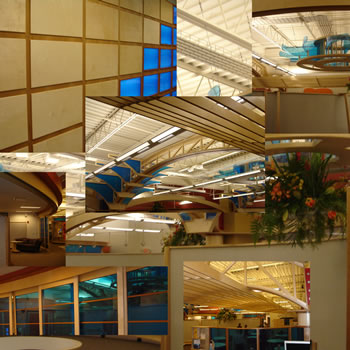
| The VA has opened their third Learning Exchange, this one located in Wade Park, Cleveland. There are several more in the design process. |
| We designed a building for this site [link: Cleveland as architecture] however the VA decided to go with another concept and design/build team. The new Center, designed and furnished by us, is built on most of the second floor of this new building. |
| The space has both office and collaborative capabilities as well as individual work areas. It can be used for a variety of purposes in many combinations. It has several new AI products including a new POD. This work has achieved a level of integration and expressive grammar - of the work options it supports - that we have been working toward for over two decades. |
| The VA has a curious habit of adding members to the design team without telling the other members so, for the second time, we were surprised to find several startling additions to the work by an interior decorator. We never though that our work needed “decoration” and it was an interesting experience to see the result. As near as we can tell, his interpretation of our design philosophy is that we build kindergarten environments for 5 year olds. We are reflecting on this “feedback.” In 1996, the president of TCCC called one of our spaces a Montessori school for Adults but, at the time, we took it as a compliment. |
| In our mind, most architecture that is created for young children is an unhappy adult’s nostalgic memory of a childhood that never was and that this imposed viewpoint is degrading and insulting to the actual intelligence children display when given the opportunity. The young, we have found, do very well in our “adult” environments [link: master’s NavCenter], without the added decoration, as do those of all ages. Playfulness has to be built in - not added on by worn out, stereotypical symbols. |
|
concept: Matt Taylor
design: by Matt Taylor, Bill Blackburn, Tim Siglin
Architects: Franco Maroni, Paolo Zanoncelli, Permisteelisa Interiors
illustration by Irina Sokolova
© 2006 |
| MG Taylor has signed a MOU with UniCredit Bank to build a NavCenter in their UniManagement Center now under construction in Italy. |
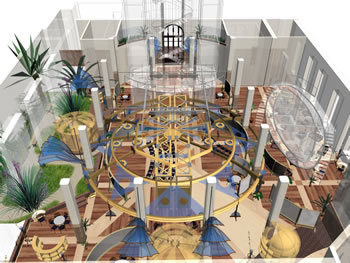
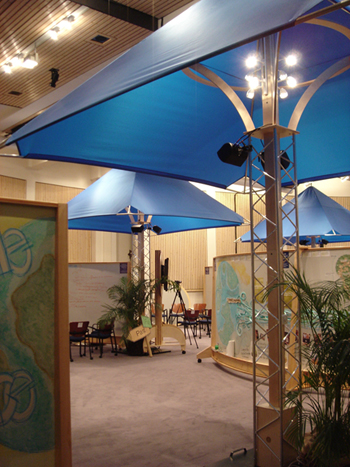
| The 2005 WEF RDS Armature will be employed in this environment for two to three years at which time it will be moved to another space and a cantilevered steel and glass Armature, now in design development, will be installed. This arrangement facilitates a year end opening which would otherwise be impossible and allows the final Armature solution to be the result of an experience-based-design process done in concert with the actual use of the facility as it evolves. |
| Completion will be in December of this year with further development to continue well into 2007. This will be the most sophisticated NavCenter yet built. The NavCenter is one part of a state-of-the-art executive development facility being built in an historic building in Turin. |
| Since January, Matt Taylor has been consulting with UniCredit Real Estate Architects and Permasteelisa Interiors on their design of the restoration and adaptive use of the building while also leading the Taylor Architecture Team in the NavCenter design effort. Last week, a DesignShop® was held in Lesmo, Italy, with Milan-based Architects of Group Genius - a practitioner of the Taylor Method in training - and UniManagement colleagues to further develop the concept of UniManagement. The project will be built by the manufacturing and construction division of Permasteelisa a world class provider of exterior cladding for signature projects all over the world by architects such as Frank Gehry and Renzo Piano. |
|
concept, Matt Taylor
design by Bill Blackburn
illustration by Irina Sokolova
© 2005 |
see: TSM Architecture project #144 |
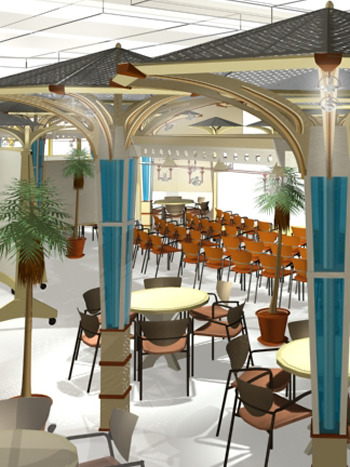
| In September 2005 the development of a new RDS for the World Economic Forum began [rds II]. The next phase of of the Davos WorkPlace is unfolding [link: the next generation rds]. A meeting with the WEF Team and the MGT Team will take pace the first week in December to set the final specifications and determine the design strategy of the the work. |
| The iteration of the RDS will make available the interior environment and the capability conceived of in 1983 [link: rds concept and history index]. The RDS shell, which will complete the capability to deploy to crisis areas is under consideration for prototyping as the structure of the MG Taylor Nashville Compound project. |
| This RDS features light weight, extreme flexibility - the Armature rolls and can be adjusted in real time along with the WorkFurniture - and will be assembled into deployable “kits” that match process to environmental requirements so that just the materials required will be shipped. The WEF intends to us it at the DAVOS Annual Meeting and other meetings throughout the world. |
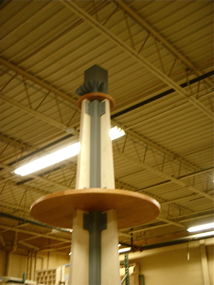
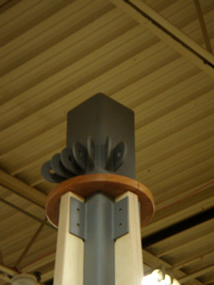
| Time limits made it impossible to create the new Tree Armature for the 06 Annual Meeting and constricted access, prior to the meeting, made it impossible to employ the Armature system used in 05. Publicis, the WEF team and MG Taylor team members met in Nashville in early December and designed a set of four fixed Trees for the meeting. These were manufactured by AI and installed by Publicis in late January [future link]. The idea of this exercise was to prototype the form in order to get feedback for the creation of the more sophisticated, movable application. |
|
|
INDEX of Matt Taylor Papers
2005 |
graphic by Irina Sokolova
© 2005 |
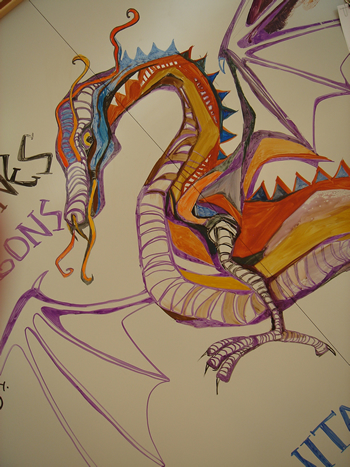
| Over the last year, I have been working on a series of Papers that address both what is going on in my world and how the work of MG Taylor relates to the issues, local and global, of our time. If you click on Irina’s dragon graphic you will go to the annotated INDEX of 12 pieces that range across a wide variety of seemly unrelated subjects that, upon reflection, are related by common issues and themes. These papers also provide a comprehensive window into what has constituted MG Taylor’s 2005 experience. |
| These Papers are still works-in-progress and I will editing and expanding them throughout the rest of 2005 and into 2006. I highlight them today, on September 11, for reasons that should become clear upon their reading. You may find it interesting to check in from time to time over the next three months and see how these ideas are evolving and weaving together. |
| These papers are a new section of my web site and constitute a shift of focus which will continue over the time ahead - a greater emphasis on the world “out there” and the future and away from the autobiographical nature of this site which has been it prime purpose since its launch in 1999. The filling in of the biography will continue, of course, along with this natural migration as the focus on “what’s next” takes place. |
|
|
| Prior “What is New” articles are Archived [link: what is new archive 1]. These highlight the 2005 RDS deployment to Davos [link: davos rds]; MG Taylor work at 2004 year end [link: year end work]; the opening of the Master’s Academy NavCenter in September of 2004 [link: masters collaboration studio]; a “bird call” for the EcoSphere project, March 2004 [link: ecosphere project]; a new WorkWall design from AI in December, 2004 [link: new workwall]: SFIA Architects - Master Builders Poster [link: sfia architects poster] and closing of the PA knOwhere Store, May 2003 [link: pa knowhere closing]; Confort Interior Magazine and ECIFFO Magazine publications featuring the PA knOwhere Store, September 2002 [link: confort and eciffo magazine]; Office for the Joseki Group, May 2002 [link: joseki design-build by sfia students]; Belmont-Redwood Shores School District designs a Performing Arts Center, April 2002 [link: performing arts designshop]; The new AI Anaconda WorkWall debuts, March 2002 [link: double-folding five panel workwall]; the HyperCar Mule comes to knOwhere, December 2001 [link: hypercar mule]; a tour of the PA knOwhere Store, October 2001 [link: pa knowhere offerings]; knOwhere Press publishes the Most Amazing Thing, October 16, 2001 [link: white wolf llc]; Curved, rolling “wall-size” bookcases from AI, October 2001 [link: new bookcase]. |
| Note: When the previous “What is New” articles were archived, certain links to anchors were broken. These anchor links have been directed to this spot. It should be possible to find the desired material by employing the links above. |
|
|
|
|
|
|