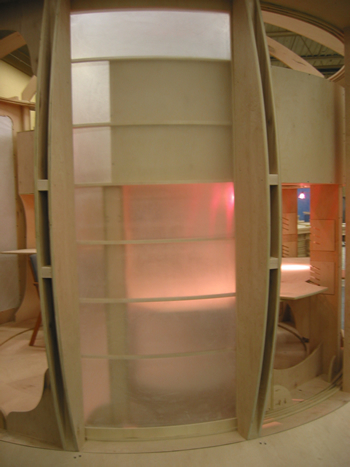
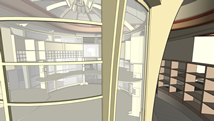
| This INDEX is a guide to the many essays, drawings, photos, notes and links associated with this project. | | Remember, however, that there are a number of further links that are on the pages listed below - you have to go to these pages to find them. To put them all at this URL would defeat its purpose which is to bring a measure of order to the resources. See [link] for further guidance in the use of this document. | | During the active phase of work - October through the completion of construction - all of the material will be updated often. Please check this INDEX, and the subordinate URLs, periodically. | | | link: Most Recent DesignDevelopment Set
posted January 15, 2004 | Project Context and History | 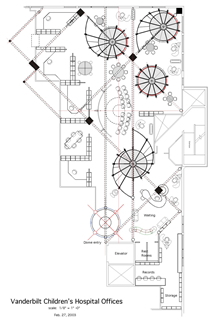 | VCH EXECUTIVE OFFICES This was the first URL of the project posted February 28, 2003. It describes some of the basic concepts of the environment, shows prior work that illustrates certain suggested elements of architectural grammar, introduces the POD design and several iterations of the floor plan. [link] | | 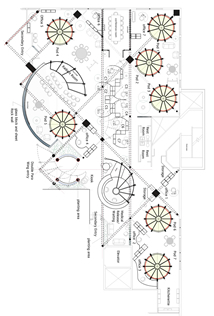 | FIRST MAJOR DESIGN ITERATION Plan ver 5 with Notes: [link] | | 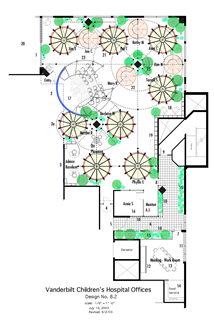 | FINAL POD LAYOUT Plan ver 8.2
with NoteS: [link] Building The Project: [link] | | 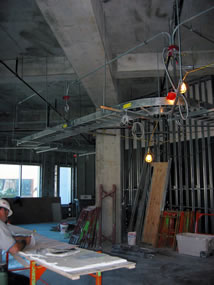 | SECOND TEAM MEETING AND JOB VISIT September Site Visit Photos and Notes [link] | | Note:
This portion will go active about January 19, 2004 | | | 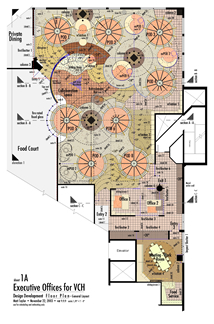 | DESIGN DEVELOPMENT Floor Plan ver 9.9.9 with annotations: [link] pdf print version: [link] | | 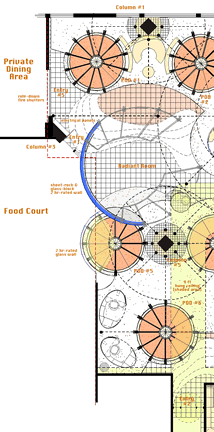 | WORK PACKAGES Definition of work for Packages I, II, III & IV. [link] Details and Notes for the Parameter Walls
| | Note:
This portion will go active about February 2, 2004 | | | | | POD DESIGN AND SPECIFICATIONS DEVELOPMENT [link] | | Note:
This portion will go active about January 28, 2004 | | | Note:
This portion will go active about January 28, 2004 | | | Note:
This portion will go active about January 28, 2004 | | CURRENT CONTRACT DOCUMENTS | | Note:
This portion will go active about January 28, 2004 | | SPECIFICATIONS AND MANUFACTURE’S MATERIALS | | Note:
This portion will go active about January 28, 2004 | | KEY COMMUNICATIONS AND LOG | | | Employing the web for communicating to a Design/Build/Use Team on a complex project is still in its infancy and the tools relatively primitive. | | However, the “reach” that these methods provide, and the speed by which information can be exchanged, is without president and far exceeds conventional methods. Document control is also far better facilitated. For a small and widely disbursed organization like MG Taylor, AI, SFIA Architects-Master Builders, with many projects scattered across the US and Canada, there is no option but the work this way. | | To accomplish this, we use common computing systems and ubiquitous printing methods. Our standard computing tool kit consists of laptops, wireless, cad (which we use as little as possible) and draw programs, portable scanners and photography, web-publishing, data base and mobile text/voice/video conferencing. This is backed up with e-mail and cell phones, of course. While the office server and tools may be more robust in performance, we believe the field kit should be as comprehensive in functionality. We think of the design process as collaborative and the principle means of co-design as dialog - no matter if this be face-to-face or by virtual methods. | | The Permit and Bid Set drawings, for this project, will be done in a standard large sheet format and in CAD. | | Because of present limitations in display technology and printing, we keep documents within an 11x17 inch format as much as possible at least through the Design Development phase. This provides ease of screen viewing and printing. We do, however, use color extensively as it promotes a denser delivery of information on a single document. This necessitates high speed connectivity. | | It is important to become familiar with the layout of the project web-site - this INDEX is designed to assist with this task. At first, this can be disorientating. However, it is really no more difficult than managing paper documents - not as easy to read but a bit easier to manage. The major advantages are that electronic documents can be kept on a server, multiple copes and versions avoided and access and updating can be done from the field as long as there is connectivity. In addition, web-based delivery means that links can to employed to supplement work with philosophical musings to technical details, information and resources. Context as well as data can be combined; collaboration is not truly possible unless this is done. | | The LOG [link] is a key aspect of this system. I see my role as systems integrator of a design-build-use team; the principal way I do this is to make accessible, in as organized as way as possible, the communication artifacts of this team. The LOG is divided into two sections: a chronology of key documents and a posting of the document that is most current and has authority in reference to the actual work being performed. I recommend that you keep a URL of the I and check it often to be sure that you are up to date on the project. | | A final word. The process of building is often contentious and stressful. Traditionally, the various players are often seen in conflict with one anotherand it is assumed that CYA is often necessary for survival. This is expensive and worrisome; it degrades the final result and spoils the experience. I believe that architecture is an art [link] and for that art to be realized the full genius of everyone involved must be facilitated and employed. This does not mean that we all will always agree. Different experiences leads to different viewpoints. What we can do, however, it integrate our various experiences in such a way that the result always gets better. We can also seek to respect one another and protect each other’ interests as our own. | | | Matt Taylor
Elsewhere
October 9, 2003 | 
SolutionBox voice of this document:
ENGINEERING • LOGISTICS • CONSTRUCTION DOCUMENTS |
posted: October 9, 2003 revised: January 15, 2004
• 20031009.459912.mt • 20031019.650091.mt •
• 20031022.555510.mt • 20031028.438766.mt •
• 20031118.398209.mt • 20031128.432190.mt •
• 20031210.238502.mt • 20031212.712314.mt •
• 20031223.989765.mt • 20040104.658301.mt •
• 20040112.679820.mt • 20040115.345100.mt •
(note: this document is about 25% finished) Copyright© Matt Taylor 2003 | |
|