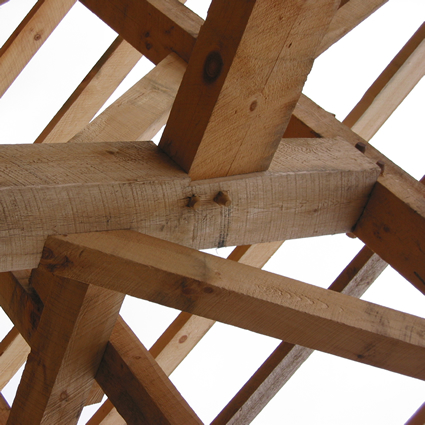
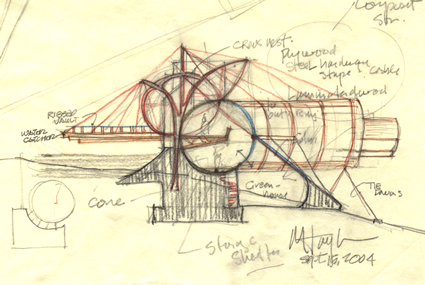
integrating the best of past and future technology options | | It is always a pleasant surprise and an inspirational experience to run into a project that is not only well grounded in philosophy as well as action. The Tillers Project is one such combination of thought and doing. I had the pleasure of a short visit in the late summer of 2003. I encourage you to visit their web site [link]. What follows are my impressions which are by no means comprehensive nor deeply analytical. I did not have a great deal of time there; it was a casual visit not a deep dive into the philosophy and means of Tillers. Nevertheless, I was greatly impressed in many ways. These thoughts are commingled with ideas about the post Usonian Project and how members of our ValueWeb could work with Tillers to combine educational capabilities and augment each other’s programs. An unique educational experience with global reach can be the result of such a collaboration. | | Tillers has a few lots on their property that may be ideal for a small community of postUsonian houses. As I have noted elsewhere [link] it is an open question if the full Usonian ideal can be accomplished with individual projects in isolation of their peers. These lots are for sale but it might be more interesting to explore a community lease arrangement where the houses can be stewarded appropriately over time and Tillers can receive an ongoing revenue rather than a one-time capital gain. A greater commons can be created by defining build-able areas and “natural” zones that will have minimal change to the indigenous landscape. It may to possible to create a prototype project that explores not only the physical building aspects but also community and financial options. Given the totality of the Tillers facilities, this might be an ideal co-housing opportunity. | |  | | When I visited Tillers a timber framed barn was under construction. This is an example of the traditional way of building using the simplest materials, hardware and tools. Strong buildings can be made this way that will last for decades. | | 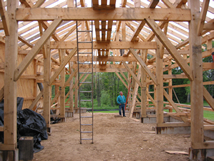 | | Inside the barn. The layout and structure naturally divides the barn into different spaces useful for different purposes. | | 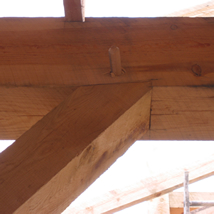 | | This is way that structures used to be built. Eloquent technology. We are told that it is too expensive today - I wonder. Would it be if you accounted all the costs and benefits? Architecture should be a living tradition. This is living. | | 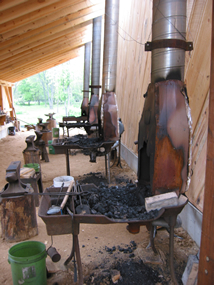 | | The forge. Shaping metal this way is a visceral experience. Nothing wrong with making tons of it by industrial processes, however, the result is different and useful in different situations and for different purposes. In the hand forge, human energy is invested into the result - it lives in the result. Creator and material become one. Learning and design is direct and immediate. | | 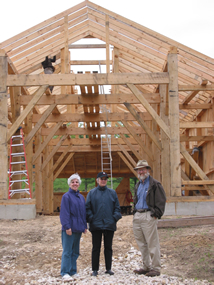 | | Dick Roosenburg, Director of Tillers is on the right. Terry Hluchyj, Dick’s wife and director of the Borgess NavCenter on the left. Lisa Piazza VP of MG Taylor in the middle. The new Barn is the backdrop. Lisa and I had just completed a DesignShop for Motorola, at Terry’s facility, and my reward and time off was getting to see the oxen. | | 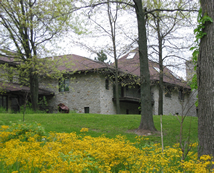 | | The main house on the property. It was built prior to Tillers acquiring the property. It can be used for a variety of purposes to support the project. Well built, natural materials and many spaces of different character. | | 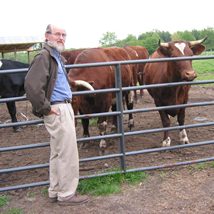 | | Dick with the Oxen. Very impressive animals. They have a strong physical and mental presence. The are a lot smarter than any tractor you are likely to buy any time soon. They are clearly comfortable with people and move at their own pace. | |  | | Meet the Head Ox. He is has a good sense of self. Plowing by oxen is at the heart of the Tillers’ program - he keeps it on a straight track. He also has an irresistible nose. | | 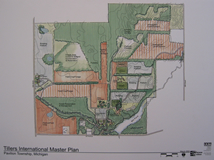 | | Master Plan of the project. A great deal of thinking has gone into how this land will be developed and used - it will, I am sure, will continue to evolve. It is a conscious emergent process. | | 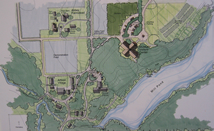 | | Detail view of the project. Tillers has a very attractive piece of land and seems determined to steward it with great craft and care. | | 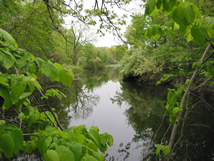 | A view of the pond. A peaceful place. A place to let thoughts wonder and to reconnect with nature - a place to live. | | 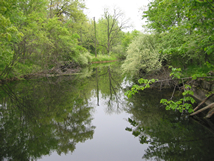 | | It is by this pond that 4 lots are available. A perfect place for a postUsonian prototype [link] and perhaps a small community. Beavers live here. Beavers have good judgment about livability. | | | This brief photo tour, a visit to the Tillers web site [link], review of the postUsonian Project [link] and some of the web sites that it connects to (including Master’s Academy [link], SFIA [link] and SDC [link])- as a sum - reveals a ValueWeb opportunity in regards developing more sustainable approaches to living on the land. From the MG Taylor ValueWeb viewpoint it is easy to imagine SFIA doing summer course at Tillers combining their know-how of green/organic architecture with Tillers knowledge of green building, sustainable agriculture, timber framing among other hands-on skills such as plowing (a good experience for any would be architect as Wright discovered as a youth). Think of how Master’s Academy could use Tillers as an experiential learning place for students while bringing Tillers their teaching methods and PLS System which I believe would be useful for systematically spreading the Tillers growing body-of-knowledge around the world. Imagine SFIA-Master Builders developing some postUsonian homes with SFIA and Tillers students and community members doing the building and simultaneously developing building and fabrication techniques for the new Master’s Campus. Imagine SDC utilizing Tillers for inner city students from their (coming) Charter School to bring them experiences not possible to get in the city. MG Taylor, bring meta systems integration, collaborative methods and the ValueWeb building [link] process. What if the results could be advantageously presented and demonstrated at the World Economic Forum in 2006? And, does this have a connection with what Andy Stricker is proposing for New harmony [link]? What are the synergistic opportunities that would emerge out of this mix of communities and programs? | | Is this a fanciful dream or a practical potential reality? Fair question. It may, from the perspective of a decade or two in the future, be seen as an early example of how a systemic ValueWeb process facilitated several good-by-themselves efforts to achieve something that none had the resources (money, expertise, time) to do by themselves. It might be seen as an effort when a sum greater than the parts actually emerged without compromising the parts themselves. It might be seen as a demonstration that there are ways to positively engage with and steer intrinsic, deeply socially embedded, systemic problems toward a better outcome without pain and violence to human freedom and individual integrity nor to the planet itself. It just might be. | | A Comment on Technology and Culture | Many question the validity of preserving, enhancing and spreading the use of “old” technologies. They often miss several points: | Technology and culture are closely linked. No technology is cognitively neutral. Each has embedded in it an entire view of the word, a set of values and a philosophy of work and leisure. There are experiences that cannot be had without plowing with an animal trained to do it, building a traditional timber frame building, experiencing a productive partnership with nature directly. | | There is a default position that modern technologies are better and more economical traditional methods. This simply is not always true. The true costs of technologies are rarely accounted. The game is to transfer to some other, and usually hidden ledger, costs not directly related to production, distribution and immediate use. Destruction of the soil, pollution, the consequences of out of balance energy systems are not “priced” in the cost of the food you eat. Obesity and bad health are not accounted as a consequence of many of our labor saving technologies nor is the expense of medicines to sooth the disquiet of the modern lifestyle. Hours of action films may titillate but not substitute for real physical experience. We separate work and leisure. We work to earn and then spend great sums on sports and vacations to get back what is missing from our life. We see animals in zoos and pamper our pets. Try getting to know your local Ox. He is alive and makes a comfortable work companion. | | Emerging economies are often encouraged to jump to so-called advanced means. We forget that the Western world evolved their technologies over a few hundred years. Culture, until the last 50 years, has had the opportunity to co-evolve with some measure of balance. Even then, there were often brutal circumstances and wrenching dislocations. Even now, it is not a given that we, in the “advanced” societies have achieved a sustainable situation economically nor ecologically. Yet we push our way on others with an arrogance that is matched only by our own ignorance. It has been found time and again that small steps made with cultural sensitivity can yield quantum improvements with little cost or social disruption. It is also true that personal distributed computing - the most advanced possible - can have startling benefits. This is an example of an advanced tool that has, so far, delivered more benefit more than it has taken away. The key question is “what works here and now” not the imposition of some sweeping, blanket solution from several thousand miles away. This is a design issue - not a propaganda opportunity. Look where and to whom most foreign aid really goes. | | We have a social memory of the “old days” of brutal labor, early death and intransigent poverty. These are not exaggerations. However, to blame these conditions solely on the technologies of a time is to ignore the impact of other circumstances such as the political context and state of knowledge of the times. Life on a 15th to 18th Century warship was often brutal, unhealthy and dangerous. The death rate on a long voyage was often 30 percent or more. Today, traditional sailing ships combined with modern navigational aids, social attitudes, nutrition and knowledge is seen as a once in a lifetime experience of great value. Wooden sailing ships even competed in niche markets well into the 20th Century. My subtitle for this article is “Integrating the Best of past and Future Technology Options.” This is not a Tillers slogan, it is my response to what I saw them doing. Tillers is not a retro damn all modern technolgy movement. An ox, a timber frame structure and a hand forge, combined with modern knowledge and the correct integration of new technologies in the right circumstances, IS both new and approrpriate. | | “Old” technologies are far more “advanced” than usually credited. Modern solutions are often hyped - remember, someone is trying to sell you this stuff. I have had crews of traditionally trained carpenters using only hand tools blow away “modern” crews with electric “labor saving” tools of every kind. Anthropologists have spent extended stays in the wilderness employing stone age tools and have found that it takes about two to three hours a day to “earn a living” - and a good one. Look at the building built in the past and judge the veracity of their means [link]. Add up the total cost of your automobile (all of the costs [link] including foreign policy and military involvements [link]) divide by your hourly earning rate and then figure out your true miles per hour of travel [link]. Am I saying we should give up cars or live in the wilderness using stone age tools? No. I am saying we need to account the full cots of every technology and create the mix that works. I am saying we should continually bring solutions from the past “forward” into the present context and design sustainable, fun, healthy tools to support really productive work and physiologically and psychologically fulfilling experience. | | It is about common sense and good design. It is about balance. It is about taking the best technologies available and combining them to fit specific local circumstances in the most productive and integrated way. It is not about a clash between old and new. The term “appropriate technology” once had meaning. I think it still does and that this meaning needs to be reinvested into our thinking and design efforts. This requires a mature understanding of the meaning of the term “appropriate [link].” These things are not understood by intellectual distinctions made in a vacuum. A media show of what it means to till the earth informs but does not educate. | | | | To educate means “to lead out.” To distort or ignore the past; to over glorify the present; to preempt future solutions by stigmatizing certain approaches is not to educate - it is to engage in propaganda. It is to distort and destroy the design process. To remove the physical aspects of work and life in the misapplied attempt to save labor to be “efficient” is the attempt to remove the visceral from life. This “experience” too often produces overly trained, technically astute but insensitive technocrats who - well meaning as they may be - produce one social, economic, ecological disaster after another. | | We need places where life and work can be experienced another way. It is not that the common way of our Western advanced economies is “wrong.” It is incomplete - a work in progress. And, it is not sustainable as it is. Tillers is one place where practices from the past can be combined with present solutions to create options for the future. We need many such programs to better inform our present social process. We must find ways to combine many of these projects in a way that offers our youth, working designers and decision makers with a far more robust knowledge base than they have and employ today. | From my viewpoint, the future is largely being designed by default. This is the point of the ReBuilding the Future Course [link]. We, as a society, are not addressing what I call Worthy Problems [link]. The future cannot be predicted nor controlled. we can, however, engage in the process of designing far better future outcomes than we are now. This process must anticipate: Weak Signal Research [link]; it has to be collaborative: DesignShops [link] and PatchWorks Processes [link]; is has to be conducted in neutral environments that are properly tooled to support design through implementation: NavCenters [link]; the Planet, and all of its inhabitants, has to be engaged as a single entity: The Gaia Project [link]; and, the design of human infrastructure and habitats has to be organic and local, as well as, global and systemic: The Master Planning Process [link]. For this to happen a new organizational structure has to be put in place: ValueWebs [link]. 1973 through 1975 [link], as I looked at a civilization adrift, I determined to build a means so that an alternative agenda to the default mode of that time - and now - would be practical and open to the full and Creative participation of all. Implementing this has been the work of MG Taylor since 1979. We are now in iteration6 [link] of this process - this is the transition from building the tool to employing it for the purposes for which it was built [link]. This is designed to be an Appropriate Response [link] to a systemic condition. It is not thought to be the only response. It is the result of visioning a different world and setting out to build an example of one. Many other approaches will be necessary for the success of all humanity and life on this planet. What distinguishes the MG Taylor process is that it is a meta-process. It is a systems integration method. The idea of it is to assist and connect many other methods and agendas. It is designed to deal with the true requisite variety of the challenge [link]. | | There are many opportunities to employ our growing ValueWeb in works that meet local conditions and also have global impact. Tillers, combined with other projects such as suggested above, is one such opportunity. It will prove out as a reality only if the autonomy and integrity of each potential payer is protected. If this can be done, and if the natural synergies between the various projects can be developed, one example of this this approach can be realized. | | What actually stands in the way? | | sketch of usonianOne - september 15, 2004 | | | | Return To postUsonian Project Index | | | | | Matt Taylor
in flight: Chicago to Calgary
August 29, 2004 | 
SolutionBox voice of this document:
VISION • PHILOSOPHY • PROGRAM |
August 29, 2004 revised September 17, 2004
• 20040829.660141.mt • 20040831.003410.mt •
• 20040903.672312.mt • 20040904.410749.mt •
• 20040917.561211.mt • (note: this document is about 95% finished) Matt Taylor 615 525 7053 me@matttaylor.com Copyright© Matt Taylor 2003, 2004 | |
|