Hexahedron
from: ARCOLGY The City in the Image of Man
Paolo Soleri - 1969
|
| As
with all the criticisms in my Thesis, I will focus
on one work per individual with references to other
their works and I will follow both Barzon [future link] and
Elliot [future link] in my approach to critique. Also, I will add criticisms from other sourses which seem relavant, some points from which I will comment on. |
|
| Soleri
redefined the role of the architect [link] and
the definition of the city although there are presidents
of his
approach in history [link].
I had sketched
my first megacity concept before becoming aware
of his work but did not develop the idea, seriously,
until after exposure to his ideas in the mid 60s.
Soleri turned his back on conventional building and
started a journey most likely impossible to accomplish
in his lifetime. He went out into the desert to build
a city from nothing - not a conventional city, an
ARCOLOGY [link].
He created many ways of supporting himself and the
project from making highly original
hand crafted bells [link],
to teaching promoting his community-scale
environment for many uses. A
basin of attraction has been created. Time will tell
if it can sustain itself and live beyond its founder.
When I moved to Phoenix in the mid 60s, I moved there
after
buying
several
hundred
acres to do the same kind of thing. I was surprised
and delighted when I saw an article on Soleri who
had recently
won the AIA
Gold Medal and published two books [link].
I was disappointed, however, in reading about his
ideas in regards economics
and ownership. I believed that they would cause him
to fail. I still believe he had - and still does
as far as I know - an inadequate philosophy in regards
these matters. Given the way our economy has developed,
and the political
distortion of the free-enterprise concept, it may
turn out, however, that
he executed the right tactics. His way may have been
the only way to protect the project through the incubation
stage. Time will tell. There remains the questions:
what will happen after Soleri; how will the project
scale, how will ownership and governance work - can
a diverse city evolve from a project? Also, now that
the traditional suburban pattern is encroaching
on the desert context surrounding Arcosonty, how
does
this alter future design and growth of this specific
experiment [link]? |
| I
have said that an architect should integrate and
practice Design/Build/Use - Soleri has done this.
I have said the architect is wise to develop revenue
sources other than just fee-for-service - he
has done this. I have said that an architect
should focus on work and design concepts that are
relevant to the times - he
has done this. I have said that an architect
should build based on a concept of life and work
as an integrated process - Soleri has done this.
I have said that an architect should be able
to relate every project from a room to a city to
GAIA [link: gaia project] as
a system, and a work of art and a Garden for all
life - he
has advocated this to a greater
degree than any architect I am aware of except, perhaps,
than myself. I have said that cites following
Greene's [link: herb green architect] concepts,
should have an Armature that allows diverse
development within a context and ties to amd preserves
history - Soleri has done this in the
vast majority of his designs, and, as new as his
Acology concept is, it is amazing how much of Tuscany
you
can find in it. |
| Also,
I have said that architects have to build a variety
of types, in a variety of places, circumstances and
contexts in
order to
demonstrate, broadly, their philosophy and methods
[link] (soleri
has not); that the architect’s primary
role - with built work - is to advance the state-of-the
art in key projects (soleri
has)
and to transfer this
knowledge (he
has), and, develop means that are scaleable
- here
I have serious questions [link]. These questions in
no way detract from Paolo Soleri’s significance
and achievement. I do not know, from direct experience,
what
his thinking is on these issues nor what he considers
a professional life well lived. I believe, however,
it would be a better world, and that Arcology would
be more advanced (in concept, form, practice and
influence), if Soleri had built more outside of Arcosonti
(even if many of these projects were of far more
modest scale). If he
has not
because
of intent
and
policy or because a world has refused to play - I
do not know. For myself, I do not wish to retreat
to a sanctuary, nor do I want to “fight the
world,”
either. I have chosen to create a new practice model
[link: bay area studio] of
architecture with the intent to create Authentic
Architecture [link] at
a scale sufficient to bring real alternatives to
society. |
| I
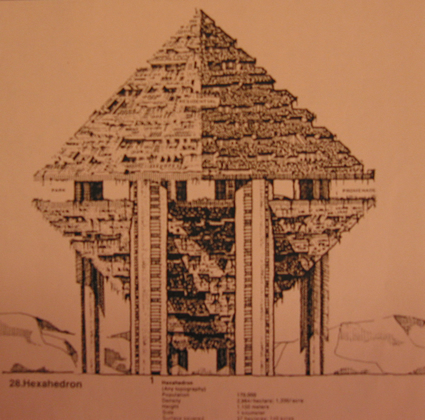
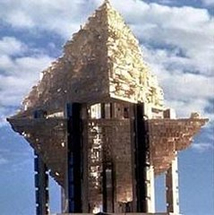
turn now to HEXAHEDRON. Even though there has been
a considerable amount of building at Arcosonti, to
me Hexahedron represents one of the most pure expressions
of Paolo’s ideas. The design has always moved
me. This is a habitat for a 100 thousand people.
The
structure is about 3,000 feet high - a human made
mountain. It is
composed of two offset, inverted, pyramids - simple
forms that, because of their relationship to one
another, create an amazing Armature [link:herb greene arcmature concept] that frames a
great variety of spaces. This Armature - this
mountain - would be encrusted
with landscaping and inside and outside “lots” where
“buildings” for various purposes would
be built. The building would never end with the Armature
providing
services, context and unity, the encrustation of
landscape and specific structures a rich, always
changing diversity.
I would love to build Hexahedron. I think that
it would be one of the great works of all time. |
| It
is important to IMAGINE - to think through
- what amenities a structure like this would provide
that
are nearly impossible to accomplish any other way.
For one, the ability to walk to and have access,
within a few
minutes, to any one (or grouping) of 100,000
people. And, to be able to have this connectivity in an environment which can be much more spacious than a typical city (a point which is almost totally overlooked). The traditional “flat” city cannot
provide this and it fails to do so at great expense.
Because of the shape, configuration
and size of the structure, it creates both landscape
and micro climate. A layered approach to the exposure
to this weather can provide an almost endless variety
of landscape contexts with a minimal amount of mechanical
tempering. The design is essentially a cube on a
bias configured with an offset that creates a large
open
park about 1,500 feet into the air. This is a way
to get the best of the Medieval city [rbtfBook],
combine it with the best of modern technology and
create
a new form. The STREET [rbtfBook],
particularly, can find an expression here that we
have not see in centuries.
A great deal
of the food required by the population would
be grown
in/on the building, as well as, upon the immediate
ground landscape below the structure and that surrounding
the structure.
Major services and transportation are provided
in
the vertical supporting columns of Hexahedron with
the heavy technology below ground under it. Access
to the natural surrounding landscape is a matter
of a few
minutes
for
each citizen - a maximum of 700 steps and a vertical
drop. The size
of the
population equals a comfortable political unit -
a small “city-state” capable of diversity, “replacement”
[rbtfBook] and
self-rule. One could imagine how a city like this,
with some kind of theme and basin-of-attraction would
play out over a couple of hundred years. Imagine Florence with true Enlightenment principles, true democracy, a replacement economy and modern electronics set in a cybernetic forest [link: cybernetc forest]. |
| One
of the great barriers to this kind of solution is
that it is extremely front-end capital intensive.
It is far less capital and costly in maintenance
for infrastructure on the back end of the project
because
of the inherent
efficiencies of this kind of configuration. This
is against the grain of how development is done
today which is based on tax law and extreme capital
leverage and land exploitation [future link].
UpSideDownEconomics does not see the advantage
here [future link].
Another barrier is how cities are thought
of - and built. They are not conceived of as a system.
At the same time, they are over designed
in many critical aspects and do not emerge, organically,
over
a
long period of time - as the great cities of the past did. The wrong things
are
controlled. And, the wrong things are left to random chance.
It is almost perfectly backwards. A systematic method
that
facilitates
both design (intent)
and emergence (learning and feedback) is
required. And, as a further barrier, a city like
this would require an unique approach to public/private
collaboration.
These aspects of economics, life and governance cannot
be seen to be in conflict as they are today. Individual
wealth and commonwealth have to be in balance.
This is the opposite of what happens in our contemporary
over-hyped, thoughtless,
spin-based
approach to the creation and facilitation of the
body politic and the sprawl we call cities. I do
not think that Soleri has
grappled
with
these
barriers, beyond the philosophical level, and approached
them with a transferable, scaleable method engineered
to overcome them. I have the same criticism
of Oneal’s
Space Colonies
[l-5 interview] -
the social architecture is the most critical
aspect of these new city designs on the planet or
off of it. Soleri has evolved a community over nearly
half a
century
and
perhaps
that is his
plan.
The
results are still ambiguous. What is certain is that
today we have the worst of both worlds between the
traditions city [rbtfBook] and
the possible future city - Arcologies remain one
of the best concepts for exploring a viable, sustainable
and socially exciting alternative to the existing
city schema which has reached its point of absurdity. |
| Designing
Hexahedron will not be easy - there are many habits
to break. The mechanical engineering will be challenging.
The
structural
and
physical
building aspects, while massive in scale, do not,
in themselves, present huge challenges except for
one aspect.
Remote Arcologies will present transportation challenges
(during the construction phase, which can take decades)
while those close to existing cities will offer political
and transitional (social as well as technological)
challenges. However, if you look at the annual expansion
of a city like Calgary or Los Vegas is can be seen
that
the scale of localized Urban/suburban building is
not inadequate to that necessary for the making of
Hexahedron.
It
is
just
that these
are two opposed design strategies and the existing
system-in-place (from zoning, politics, economics,
infrastructure, ownership, social conventions, and
power-bases) is tuned to the creation of horizontal
spread. |
| Soleri
deserves to be considered to be more than a personality
on the fringe of alternative architecture. He should
be seen as
a primary form giver and his concepts should be tested at various scales of recursion [future link].
The traditional city will not gracefully evolve from
what it is
today to something that will work in the future. And even if it
can - and in some places does - there needs to exist the pure expression
of an anti-thesis to
challenge
and
stimulate
it. Hexahedron is, in concept and potential, is far closer to the great
cities of the past and far more capable of accomplishing
a full expression of Pattern Language [rbtfBook] than
the so-called modern city. Hexahedron is not impossible to build today and, if properly done, could be a worthy project - and, if the proper governance and social memes were employed as both an experiment in architecture and living. |
| Paolo
Soleri as a life lived, and as an architect,
has added much to Humanity and to the language of
a future sustainable
city. He is first, among contemporary architects to think and speak out strongly for the city
in an ecological context and offering a fundamentally
different alternative to existing habits. He has pursued
his vision. He has employed prototyping
which
is
rare in
architecture. He has lived in and placed his
business in his
own prototype designs. He has invested a lifetime
to his work. However, it seems to me he has trapped
himself in too narrow a world of his own making. I do not
know if
this is true or to what extent nor how this aspect of his life and
work has played out in relationship to his intent.
I leave
this question for the future to answer. |
|
| Click on the model of Hexahedron to read an interesting and important BLOG critic of Arcologies. Serious questions are being asked here in an open and intellectually honest way. My response follows. |
| I agree with many of the points made in this writing as well as made in papers which it links to. I think it stands as an important warning to the entire field of mega-structures. There are two points where I diverge; first, the same things can be said about most modern cities and virtually all “signature” works by “great” architects; secondly, the problems cited are the consequence both of the larger societies’ values and the way architecture is generally practiced today. My conclusion is that the deficiencies and risks cited are not intrinsic to Arcologies they are intrinsic to our culture. If I am correct, this is an important distinction. |
| Here is what I posted to the BLOG: |
(Anonymous) wrote:
Jun. 5th, 2009 05:09 pm (UTC)
Yes and No
All of the comments are well taken, however...
It does not have to be so. A structure like the one shown can function as a Armature (areas, volumes, infrastructure) not unlike the “flat” city as it has been for hundreds of years. The individual buildings within this can actually be more varied and individual than any urban environment we have today.
The principle values to be gained are:
1) volume and space, much more of it than the “peanut butter spread” of a typical city.
2) reduction of transportation and utility runs.
3) efficient prefabricated structure.
4) better energy management (volume to skin ratios), etc.
5) dense urban experience with a few minutes “drop” to farming, recreational and authentic wilderness areas.
And so on.
I believe that Palo’s concept is weakest in terms of the governance and social systems aspects yet I point out that traditional cities are not immune to the darker aspects of Human misconduct. There is not reason that an Arcology or mega-city has to be such. NYC and many other urban spaces are mega-cities - just poorly designed ones - mostly.
It is certainly true that the last 25 years of architecture is not encouraging as human scale has all but been obliterated. It is true that a better result will not be accomplished by a top-down, dictatorial result. This is a process issue much broader than architecture itself, however.
I urge that the concept is not thrown out with the bath water. In a world of growing population, weather change, resource competition, this approach may have a place. If done properly and if not promoted as THE solution as there is no such thing.
You may find the following interesting:
http://www.matttaylor.com/public/4_sf_vertical_housing.htm
http://www.matttaylor.com/public/l_5_interview.htm
http://www.matttaylor.com/public/master_plan.htm
http://www.matttaylor.com/public/xanadu_project.htm
http://www.matttaylor.com/public/monkeyspaw.htm
In any schema for making habitat there are inherent opportunities and risks. The trick is to get the good aspects and eliminate the bad. This is a design process issue. In complex projects (almost everything) this requires an authentic collaborative design process not just among professionals - among all members of a community and society. We do not have this today.
Matt Taylor |
|
| I think that the main points typically missed about this kind of concept are three: The first is the reality of volume in distinction to horizontal spread. There can be much more space in a true three dimensional building. The default image of a huge apartment building of halls and crowed apartments has to give way to the idea of a human made mountain with many different kinds of landscapes to build within. The second is abandoning the notion of a rigid, low variety, flat space full of prescribed units and realizing that the actual structure will be encrusted with a constantly changing composition of living/working units, gardens, public spaces, production facilities, pathways - an organic, evolving variety not seen since the Mediaeval city. This can be arranged in vertical and horizontal belts of similar zones of building types which intersect at “hot” mixed use clusters which provide the benefits of both mixed use and single type zoning without the drawbacks of either [link: mega cities zones]. Third, it is logical to associate Arcologies and mega-city concepts with totalitarian motives (be it the fascist, communist or the “shock” Capitalism variety) because our recent history of large developments certainly have exhibited these attributes. This is a matter, architecturally, of bad design and totally inadequate design processes. In the political, economic, social realm, these work are faithfully reflective of our present situation. There is a lot of chatter about the individual and community yet little practice of it particularly when big dollars (and big egos - actually, the lack of true self awareness and identity) are involved. |
| A link from the BLOG to a paper well worth reading is “Chapter 11 The Trouble With Autocratic Architecture: A Critical and Cocreative Look at Palo Soleri’s Arcosonti.” This is from the experience of someone who was there - an experience which I do not have. In this paper the issue of gender equality, participation and balance is raised. In the leading BLOG piece, the issue of Soreri’s childhood in a Fascist state is raised. Both address the extent that Arcosanti reflects this background and question the extent that Arcologies inherently embed facets of these experiences and philosopies in the intrinsic nature of the concept. No question these are aspects of the making of the man and his work. No questions these issues are systemic to our society and reflective throughout it and can be clearly seen in our architecture. No question that some aspects found in the speific practice of Arconsanti reflect this background. No question (no matter how much the subject may annoy many) these are critical issues in the contemplation of building such structures. |
| Again, however, I offer caution. Something can be true enough yet not complete. We humans are complex and far from single faceted. It is too easy to over generalize. Having just completed three projects in Italy and thereby gaining some experience with the country and its architecture, including the major architects from the 30s on, I have come to realize how the entire Fascist experience and the dominate sexual set of Italy effected this generation of architects which Soleri - despite his long residency in the U.S. - is certainly a member. The experience cannot be denied yet the individual responses to it are quite varied and full of nuance. I will leave the judgment of good and bad to you the reader - from my standpoint some of the responses were toward creative and healthy and other less so. |
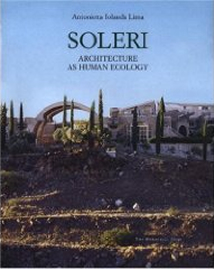
| I think the following book, click on the cover image for information, offers a good overview of Soleri’s ideas and work as well as one viewpoint of how he evolved out of his background. I over it as another aspect of a complex and not yet fully told story. |
| I have not been to Arcosonti and regret this. As I write this Soleri’s 90th birthday is about to be celebrated. Whatever may be in error; whatever, may be missing; whatever may be left undone; whatever opportunities may have been missed; this is an extraordinary man and life well lived. It is a body of work full of potential - a potential which should be explored, developed and built in the most positive and healthy way possible. |
|
|
|
| Go
to Thesis Introduction
and Overview Part Three |
|
|
|
|
| Go
to Thesis Introduction
and Overview Part One |
|
|
|
|
| Architectural
Projects 1952 - 2004 |
|
|
|
|
Matt
Taylor
Elsewhere
October 30, 2004

SolutionBox
voice of this document:
VISION • STRATEGY • DESIGN DEVELOPMENT
|
|
posted
October 30, 2004
revised
November 5, 2004
• 20041030.502090.mt • 20041105.490011.mt •
note:
this document is about 45% finished
me@matttaylor.com
615 720 7390
Copyright© Matt
Taylor 2004, 2009
|
|
|