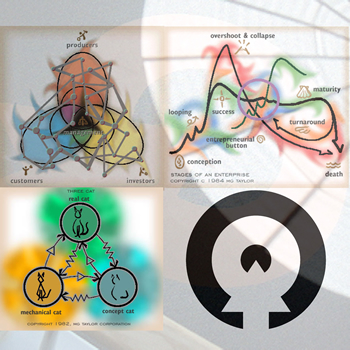
| The
Masthead for this transition is made up of five images
that illustrate some of the many factors, personal
and corporate, that are involved in an organizational
transformation. In the right hand lower corner is
the MG Taylor house mark
which
has been our banner since 1982. In
the upper left hand corner is our basic diagram/logo
of the ValueWeb which is what we seek to become as
we shift our operational capacity from the organizational
level to a greater network capability. In the upper
right hand corner is our Stages of an
Enterprise
Model - on this model, we are in turn-around having
passed the Entrepreneurial Button to the next stage
of our enterprise - forward on the path we are on
leads to death. Not death of our work. Death of the
specific organizational structure that we employ
to support our mission. Getting back into and through
the entrepreneurial window allows us to transform
our
present structure
to one that supports our future. The left hand lower
corner is the 3 Cat Model. This illustrates the dynamic
between the existing reality, a concept and the task
of making something new that is the synthesis of
both. Ghosted over these four images is a picture
of the Palo Alto knOwhere Store Skylight-Atrium reflected
on the first level of that environment. This facility
was the high water mark of our fifth iteration work,
our greatest asset during that time, and our greatest
liability after the .bubble and 9/11 events. These
images frame the story below which I will tell from
my personal perspective. |
| The story I tell here is of what I often refer to as “the world’s longest startup.” We had no idea when we started MG Taylor that this would be so. And, to this day, I do not know if had we avoided the many mistakes we have made along the way if we would have gotten to iteration7 sooner or not. I do not know if it was the unfolding of the global situation and markets which were the constraint and if we would have found ourselves more or less where we are today no matter what we did. It does not matter as this is the story of global transformation from the perspective of my experience. What I can say is this: what the world community of humanity is experiencing today - for good and for bad - it precisely what I outlined in my ReDesigning the Future Course, presented in 1974 and 75, only about one decade later than I estimated. And, I can say that the problem we set out to solve: the need for humanity to develop the ability to deal with complex, systemic conditions, in a collaborative way, in a immensely more compressed time frame, to be requisite with change - change we ourselves are creating - has turned out to be true and is increasingly becoming recognized as the problem behind all problems. Our MISSION was and is to build the tool kit to facilitate large scale systemic complex transformations involving cross boundary organizations with controversial issues and conflicts. We have done this and demonstrated the method’s efficacy beyond any reasonable doubt. We have also demonstrated the ability to transfer this capability scale it to the capacity level needed. |
| What we have not done is to make MG Taylor an economically successful enterprise and sustainable as a member of a globally viable ValueWeb. Although we have been, since the mid 90s, profitable on the project level, and as an enterprise we have had only four years out of nearly 30 with significant losses, we have not - as an enterprise - reached our goal of mission-economic-ecological fitness. |
| Doing so is at the cusp point which the moment between iteration6 and iteration7 of our evolution. As in all transformations, the parts and the whole have to emerge together. With my design and architectural work in the 50s, I was 50 years ahead of the market. With the creation of MG Taylor, Gail and I were 30 years ahead of the market. Now, across the board, from philosophy to task, there is a growing acceptance both in the market of ideas and the market of commerce. If this convergence continues, and if we do the right things in response, MG Taylor will become successful. |
|
The
iterations of MG Taylor |
| iteration1 was
before there was a notion of MG Taylor as a corporation.
Gail and I were living in Kansas City. I was heading
up the Renascence Project [link] and
Gail the Learning
Exchange [link].
This was our incubation period. This was an interesting,
exciting and relatively peaceful period for us.
I was designing a great deal of theoretical architecture
[link],
teaching my ReDesigning the Future course [link] and
thinking about future options. Gail and I were teaching
courses on creativity at various universities: University of Missouri, University of kansas and Lewis and Clarke Collage. We
also did a course for inner-city school children.
Gail, ultimately decided she wanted to move having
lived
all her life in Kansas City. Some of the city leadership
asked what would it take for us to stay. This forced
us to think about what work we thought would be useful in the next decades.
We made a proposal, requiring modest financial support, for a environment and program to facilitate collaborative design and the solution of complex issues. This was the
seed of MG Taylor. We were politely told that we
were crazy,
that “no one would want this nor would they
support it.” I found this strange given the success of the learning Exchange which had become a Kansas City fixture. We subsequently agreed with Barbara
Hubbard, Robert Fuller [link],
Justine and Michael Toms and some others, to create
a “secular monastery” in California at the base of
Yosemite Park. The purpose of which was to incubate transformation leaders. We spent the spent the summer in Washington
DC with Barbara Hubbard [link] planning
for the move to Mariposa in the Fall and I designed
our first (Nav)Center - we called them Management
Centers then - for her garage at her Washington DC
mansion. The concept did not take hold and, in late
summer, the idea of the California venture was shattered
by everybody’s life, except for Gail’s and mine,
taking a radical turn. Here we were in Washington
DC all dressed up with two versions of an idea and
no party to go to. To us, it seemed like the next
logical
step
to create
a
collaborative
workplace where ideas could be taken to fruition.
We ended up moving to
Boulder Colorado because Leif Smith knew of three
projects he thought were compatible with our concept.
These three projects did not pan out either. We know three people
in the entire state including Leif who was one of
the early fathers of network theory [link].
So, we started the venture on our own and with no
money contacts
or clients. We were totally crazy. Boulder, it turned
out, was a perfect place to incubate a totally crazy
idea. |
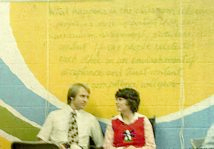 |
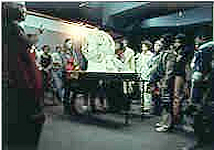
This
is Gail and me at the Leaning exchange just
after we met. One day we were strangers
and the next day were were working together
and cooking
up ways to transform the world. The
second picture is EcoSphere at the
Kansas City Art Institute. If asked at the time, Gail and I would have said that our partnership would focus on the Learning Exchange and the Renascence project. Neither of us would have predicted MG Taylor Corporation so logical in retrospect.
|
|
 |
click
on the Notebook page to get full page view |
|
| I
think that new enterprises are always launched
in a moment of temporary insanity when all the
reasons why something can not happen are swept
away by the flash of a vision that blinds you to
what is commonly called called practical reality.
We had no prospects when we started MG Taylor -
we just did it. I worked as
a landscape
carpenter
while Gail explored what was going on in the City
of Boulder. One dialog lead to the next and soon
we had a project - it was the Boulder Affordable
Housing Project [link]. |
| The
Boulder project required the bringing together
of a large diverse group of citizens, government
people and corporations. We built or first work
environment to have the space to do this, the Anticipatory
Management Center,
and conducted our first DesignShop. Over
a three year period we never had any money and
never knew where the next project or meal was coming
from. We invented the Modeling Language [link],
AndMap, the DesignShop [link],
the RDS [link] and
the NavCenter [link].
One client brought another and within two years
we had clients from the East
coast including the US Army, about $375,000 in
debt and had outgrown our organizational
structure, our
Board of Directors and Boulder which simply did
not have enough work
to sustain us. We were purchased, in late 1983,
by one of our clients, the Acacia Group [link] and
moved to Washington DC in early 1984. This marked
the end of iteration2 [1980-82]. |
 |
We
never knew when the next project would
require. We had
the necessary tools and
methods - or we invented them. We had the
capability - or we built it most often a couple of days before the work with the money we were promised to do the work.
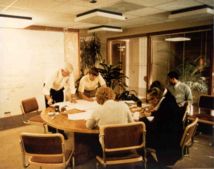
The
top picture was our first environment -
we designed the furniture and the work
walls and built it in two weeks. The second
is of me in the office detached from our
mountain cabin
above
boulder.
The computer at the edge of the picture
was our first - an Apple II with 96k of
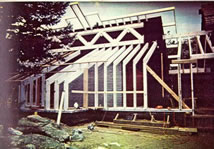
RAM! We
called our home INSTEAD and
designed a Bedroom addition for it which
was never finished - it fell
victim to double digit inflation which
chased away the mortgage and froze the
construction loan.
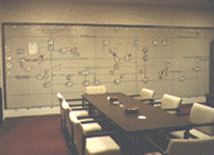
The
Mentor project was our first client NavCenter
and our last Boulder project. |
|
 |
 |
 |
click
on pictures and Notebook page for more |
|
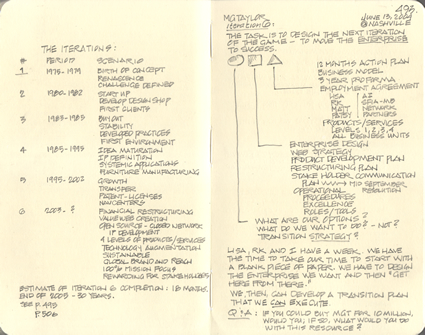
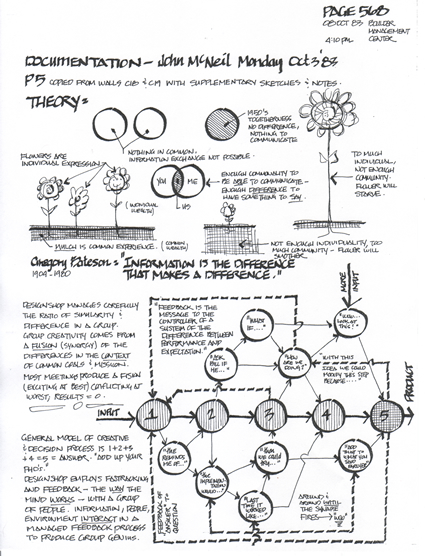
| This
page [above] from
by Boulder era Notebook was made at the time after
our purchase by Acacia was negotiated
but before we moved. It is one of several pages of
notes I made documenting the first RDS [link] which
was deployed for the FAA. Fielding our first RDS
was our last innovation before moving to Washington
DC. In this brief three year period, almost everything
that makes up the MGT tool kit, today, was prototyped.
We left behind a group in Boulder to build the environments.
This became the seed of what is AI [link], today. |
| In a brief three years from late 1979 to early 2003, we imagined, prototyped, tested and took to market virtually every service and product which MG Taylor is offering today. This was a period of intense invention. We had no idea that 30 years later, despite having delivered over 66 million dollars of work and exposure to hundreds of major organizations, globally, this way of working would be considered as amazing, as radical and as dangerous as the day we started. We have been employed and sustained by two business generations of early adaptors. Just now, the idea of it and the practice is moving mainstream. |
|
| The
Acacia years were now and then frustrating and often
fun - they were, in the end, were extremely educational.
They provided three years of stability, experiences
we
would not have gathered in any other way - such as
being corporate officers - and they ended abruptly,
in 1985, in disaster just on the threshold of us
accomplishing a network of 30 NavCenters. In retrospect,
I am very grateful for the time. I can see, however,
that the way this period ended set our course for
years to come. Without warning we were fired one
day, having to this moment enjoyed status, support and cooperation in the enterprise, and
we found ourselves on the street without facilities,
associates and clients. We also were without debt
and we had a clean slate, some money and the ability to choose
our future free of economic duress. This lead to
a ten year period that was, compared to all the
rest, one of relative ease, low fixed overhead, clients
carefully chosen and significant successes. |
| Every
place and every era of your life has a distinct quality
that is never to be repeated. You respond to this
essence in a variety of ways and also hold
the feeling of it in memory [link].
Art [link] is
a medium that helps us tap
into these feelings and remember [link].
In Washington DC, we worked across the street from
the Capital
and
lived about 7 blocks away from it not far from the
Library of Congress. There was an open market not
far from where we lived and we found there, one Sunday,
a kitten - Sunshine - who was to be our companion
for many years [link].
Gail and I used to walk the Mall almost every day
- this is how we debriefed our
experiences and co-designed as we continued the process
of inventing our Method. I took to visiting an old
favorate place of mine, the Natioanl Art Gallery [link] which
had been, in the early 50s, a seminal influence in
my early inpuse to architecture [link]. [more
to come] |
| Acacia
acquired us because they wanted our full attention
for their own corporate transformation. This was
our first project where the transformation of the
entire organization was the stated objective. It
was an outstanding success until a catastrophic incident
at the end. From this experience we were to learn
many key lessons about
this complex
process and about the practical art of being a Transition
Manager [link].
In this case, about what happens when the Transition
Manager becomes caught up in the process itself [link]. An seemingly insignificant clause in our acquisition agreement lead to a sudden unexpected crises. As it was difficult to estimate the value of our company, Acacia took over all obligations and we were granted 10 percent of the profit for ten years, which was generated by our work within the new Acacia of which we were to facilitate coming into being. No one expected it, certainly not us, but the MG Taylor method and environment became the integration piece of the entire Acacia go to market plan and capability. This caused a huge political struggle of which we were unaware of, not involved in, yet resulted in our termination. One day a wonderful CEO woke up and realized he could not implement the plans that several hundred of us had spent three years bringing to launch and tried putting on the brakes. In two weeks we were gone, in four months 40 percent of the field force were gone, and in two years the CEO was gone. A brilliant service offering - one that would astound today 25 years later - was abandoned. |
| The end
can quickly and unexpectedly one day and in a way
that was to mark several people for a long time. After about a week of rather harsh corporate tactics, We were facilitated out by a kindly Executive Vice President with IP and cash in hand with this the final parting “Matt and Gail, we thought we could buy you but we were wrong.” |
| Acacia,
at the time, was the largest financial institution
in Washington DC. After a year there we decided
to buy a house and Acacia co-signed a 20 thousand
dollar loan for us so that we could make the down
payment. Our aqusition paid our startup debts, move us and our team to Washington D.C., and, gave us a small sign on bonus. So, when we wanted to buy, we needed cash. Acaia areaged the note and soon after made this sort of thing a policy and perk for all senior people in the firm. This note lead to an interesting incident
that was my first inside view of how power, influence
and money works in our society. When we were terminated, we were owed bonuses, vacation and medical leave time which summed to an amount far greater than the 20 thousand dollar note. However, Acacia froze our money until we paid off the note which of course we could not. It seems, at least we were told that we were to be punished for something that we never we even accused of. We say a lawyer and it said it was an open and closed case of wrongful termination but of course we rejected any legal action. |
| We went to the bank and laid out the situation ask for a loan which would take Acacia off the note and that we would pay in 30 days upon receipt of our funds. The vice president said no. I asked why and she said “Acacia is a much bigger customer than you are.” This told us, of course that we were getting a little bit of a squeeze. We had our payout notice from personell, the note could easily been securitized for 30 days. Stressful but amusing in a way. Two very large finacial institutions bothering with this? Here were two people who had never received anything but the highest praise, top evaluations, suddenly thrown out with no explanation, after the success of three years of work, and it looked like the our work would become central to Acacia’s strategy and, as a consequence, Gail and I would make several millions dollars over a seven year process by contract terms dictated by Acacia in the first place. Here we saw power and control raise it’s ugly head with a bank clearly playing along. Of course, nothing turned out the way they intended. We have learned over the years that this is how wage slavery [link: wage slavery] in large institutions works. Fur lined handcuffs are still handcuffs. To Gail and myself, this was not even a threat. Our “loss” was that we had sold our enterprise to Acacia and now saw the success of this company as our mission. We were passionate about the plan that had emerged from the efforts of so many. We were concerned about our staff which remained behind. We were naive. We facilitated everyone else through a massive change but did not think to cover our own backs. We didn’t and still don’t play organizational politics. We didn’t realize we needed someone inside who protected the disruptive innovator as Giffort Pinchot describes in Intreprenuing. Subsequently, we have been careful to see that, in organizational transformation projects, that leadership was protected. However, as will be seen in iterations 4 and 5, the Transition Manager always is vulnerable to those who take advantage for narrow gain. |
| Thinking we were headed for financial hard times, after all we had been out of the market for three years, the phone rang and in less than a month the Note was paid, we had our severance and an lucrative project that paid our living expenses for two years. |
| As it turned out, the abrupt change in strategy |
|
| This
was a low-key decade, organizationally, that had buried within it a
not-too-apparent revolution. It is, to date, also the least
documented period of the MG Taylor story. I had, for a time, lost the habit of personal handwritten notebooks and the WWW had not yet brought us the brower and other tools for web publishing. Most of the documentation of this period exists in printed copies of long e-mails now in storage waiting to be mined. This period is also the
least active in terms of number of clients. We had only a few very good ones with interesting demanding challenges which took years to work through. It remains,
to this day, the most successful period in terms
of organizational transformation [link] and in exercising our
ability to successfully deal with large scale, global
systemic problems. Without the work of this decade,
we would not know, today, that we are ready to pursue
our mission, globally. |
| It
was also in this period, in 1988, that CAMELOT came
into our life. This is of greater consequence than
it may first appear. Gail and I were in our 50s, still youthful, and more than any time in our professional work and personal relationship - before or since - able to take a little time to pick the daisies along the side of the road. The restoring and sailing of CAMELOT is both symbol and primary personal experience of this period. It was also in the period we mover to Hilton Head, bought a slip for CAMELOT, purchased and extensively remodeled a Sealoft on Dear Island. We created for ourselves and pleasant, affordable yet eloquent lifestyle. With this base and backdrop I undertook two of the most interesting, rewarding and important projects of MG Taylor’s history: AEDC and Capital Holding. |
| The work of this period was not transformation in term of creating the new economy or society. It was notable for work done to preserve and transform existing organizations. Gail and I have always believed the the existing order will give way to a totally new one - and this is definitely the circumstance today - yet, that a too soon and catastrophic collapse of the old, before new patterns and systems were in place, would lead to an unfortunate outcome. Besides, many of the “old” ways will recreate themselves and be viable in the future just as this has occurred in the past. We did not - and do not - see it as our role to choose. Our task is to facilitate. We, of course promote new ideas and projects we personally believe in - and we make our own environments and processes as much a “future-perfect place as possible - however, we take on all work equally even we organizations we have a level of skepticism about their viability. Our belief is they will make it - or not - on their own. Because we do not compromise our values, ideals or methods - and because to do not advertise or pursue work - the process is that a client or customer selects us and chooses to stay with is or not. We do not try to make them like us. We facilitate the best they can be to come out as they choose to develop it. |
|
| This was a period of great growth, some major defeats and, ultimately, a changing of the guard at MG Taylor. iteration5 was the second (of three, as of the end of 2009) period when MG Taylor started up the rapid growth curve to the critical mass necessary to fulfill it’s mission. Like the first time, we fell short and traveled down the fitness peak to a new valley and beginning. This time we had help from a firm who deliberately put us there. This is a part tragic, part amusing story which will be told elsewhere. It is also a story with a surprising outcome. |
| The great learning - and demonstration - of iteration5 was that of rapid scalling the enterprise and transfer of the METHOD. |
|
| On
the map, there is a big arrow pointing to this
spot saying “you are here!” Around this spot on
the map is a landscape of opportunities. All of
these opportunities can be accessed by a single
road. This road is the infrastructure we have to
(re)build at MG Taylor that will enable us to embrace
the opportunities we now have [links: 05 work retreat & future link].
Originally, I thought that iteration6 might take as little as 18 months, even a few years. As is turned out, the ending of this period and transition to iteration7 took through 2009. Of this period, it took the last three years to begin the process of putting in place the ValueWeb Business Model. It is clear that it will take at least two years for this new model to be fully operational and recognized as such. |
| iteration6 was a remarkable period of stress, innovation and change. It started with MG Taylor financially completely dead in the in water. It ended with MG Taylor in the black, all products and service lines engaged with work and on what may turn out to be our third steep growth curve. It also ended with the iteration5 legacy debt still there and an “elderly” core team, under paid, overworked and worn out. |
demonstration_of_mission_complete |
|
| iteration7 will be a period of scaling to global ubiquity
and the creation of legitimate profit. This will
mark the accomplishment of both aspects of our MISSION [link: mg taylor mission].
This is likely to be a 15 year period. Certainly,
by 2025, the Taylor Method will be a significant
player in many major global transformation projects [link: worthy problems]. If not, it will mean that better means became available or that we have failed to reach a position to facilitate transformation at scale. In this case, I do wonder what will be the state of the world. One can only hope we succeed and/or other alternatives - not apparent now - come into being. Global Humanity making it through this period intact under the sway of contemporary memes and by employing the dominate processes of our time certainly would be cause for believing in miracles. Miracles may happen yet the engineer in me believes in helping them along with the exercise of due diligence, fiduciary duty and by application of collaborative design and right action. |
| Another measure of our transitioning to iteration7 will be MG taylor transforming from a 20th century corporation structure to that of a true fully functioning ValueWeb. This has been our goal since this organizational concept was formulated in the mid 80s. Along with this organizational transformation, my role will evolve from CEO to that of a member of the ValueWeb and a contributor to and user of it. At this point, within the context of the social-economic environment which it implies and the tool kit we have created in hand, I will proceed with building the architecture I dreamed of at the beginning of my work [links: to hold an unchanging youth & what do you want?]. Architecture which started off as my life’s work, will be my “retirement plan.” MG Taylor and the ValueWeb will be free to fulfill their mission as emergent circumstances require it. There is nothing worse than a founder who stays too long unless it is one who leaves with the first cycle of formation undone. Finding the “moment” is not a simple task. My best definition of it is when the “worlds longest startup” is over. |
| We are often asked if MG Taylor, its management and stockholders have an exit strategy. In fact we do. Naturally this is one of the few things we do not talk about. If it comes about, it will be a classic humorous moment when the totally unexpected collides with the completely logical and obvious [future link]. I will leave one hint: go back to the early 1960s concepts which established the technical basis of this enterprise and the answer will be as plain as the sun on a fresh, clean spring morning. |
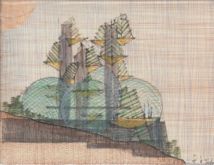 |
| XANADU
is our THERE vision
of the environment-function-hub necessary for a global network of navCenters.
Construction will indicate maturity
of the iteration7 period. What is beyond this is not easy to see - I expect it is our organization dissolving in to ubiquity. |
|
| To
me, personally, I will know that this work is well underway
when I see XANADU coming to life. The
network necessary to justify this work will be
demonstration of the
efficacy of the Method and the reality of the ubiquity of its use.
That a work of this scope and architectural character
is undertaken will be demonstration of a large
scale movement toward the kind of world
we envisioned when we started
this enterprise [link: structure wins].
As a Transition Manager [link: transition manager in two worlds],
I do not seek to make these outcomes in the specific.
In this context,
they are TEMPLATES in the 4 four Step
Model [link: 4 step recreation model].
As a designer an entrepreneur - as a player in
the game - Xanadu, and the world it would exist
in, are my present best effort solutions to a specific
set
of challenges.
We built
MG Taylor
because we saw a social need. My personal motive
has been to create a tool [link: the monley’s paw] with
which I could bring into reality, in a non coercive
manner,
the kind of world I want to LIVE in. The accomplishment
of iteration6 opens
the door for me to transition from a creator of
MGT to a user of it during the
iteration7 period. Building Xanadu will fulfil a dream which goes back a half a century. |
| In this piece, I will not take the description of the iteration7 further than this outline of intent. The documentation of it’s actual unfolding will be done elsewhere. The focus of this document is actually iteration6 which is the transition from all of MG Taylor’s prior history to reaching the mission capable state which has been it’s purpose from the beginning. As of this writing, in the last quarter of 2009, we are seeing the beginning signs of this transition after the most difficult and demanding decade of our history. |
| I remind the reader, as well as myself the writer, of the purpose of this web site [future link] which it to document the consequences of living and examined, purposeful life with the goal of achieving a broad social transformation. This is perhaps the most dangerous occupation there is. What can be learned by this is useful for getting better at the task. No matter the application: the reorganizing of a neighborhood, the creation of a local business, the transformation of a major corporation, a nation or a global society, the same patterns will be seen again and again. Dealing with these patterns has to be be integral to any system and method which will work. Failure to do so will lead only to their relentless repetition until, at one cycle to come, Humanity will do itself in. I would not bother to tell the personal parts of this story except that they cannot be separated from the ideas, content and happenings which make up the rest. |
|
| While this is a personal story, its broader importance is for those individuals and organizations undertaking transformation to better understand what is involved, the committment which is required and the time which it might take. greating a successful enterprise of any kind is demanding enough. To make one whose product is the transformation of systems local and global is certainly tempting the wrath of the gods. There is no reason to undertake it except three: one, the times demand it; two, an opportunity for a much better way compels it; three, one and two together which accurately describes our present circumstance. |
| When we started MG Taylor, Gail and I could point with reasonable confidence to the changes coming in the last quarter of the 20th Century which would launch a sweeping global transformation. We could not, however in most circumstances, say “you need to do this now!” Our motive, was not fear of the future. It was a compelling vision of a better way to live, to work and to run a planet. It was driven by the idea that all life could collaborate in the making of Gaia as a truly spectacular garden of life. To say that this vision was not broadly shared by a society hell bent on exploitation and consumerism is an understatement. Today, Humanity is certainly approaching the abyss [link: leaping the abyss]. It remains my hope that we do not respond to the mess we have created from a fear-based and desperate frame of mind. I think this will lead to a poor transformation at best - remember, a few hundred thousand humans clinging to life in a mostly destroyed landscape as some predict qualifies as a transFORMation. As a species, we now face a great challenge and it of the kind called of “coming of age.” We now, will create a Planet, a Society, a way of being and living which has the open-ended opportunity to become a great work of art. We have the means - means which if abused will destroy the opportunity. All life can be part of this venture and every individual and organization - large and small - can be a part of it. This is the great entrepreneurial opportunity; the making of new civilization. We have arrived at the moment where “Utopia or Oblivion” as Bucky Fuller called it is in our hands. the next quarter of a century will witness the outcome. |
| A generation back, we started a venture to help with this adventure. We stand now older, a lot better prepared, a bit bruised and certainly wiser feeling, perhaps, a day late and a dollar short. The vision is still compelling, the opportunity still there and the world buzzing is with viable alternatives. |
| However the game plays out, the record will show that the outcome was a matter of choice. |
|
|
|
| Return
to: iteration6 on MGT site |
|
|
|
|
|
| GoTo:
Organizational Transformation |
|
|
|
|
Matt
Taylor
Elsewhere
December 26, 2004
|

SolutionBox
voice of this document:
VISION • STRATEGY • DESIGN DEVELOPMENT
|
posted
December 26, 2004
revised
October 24, 2009
• 20041226.181980.mt • 20050630.123409.mt •
• 20050701.211234.mt • 20050702.654181.mt •
• 20050703.343497.mt • 20091018.211209.mt •
• 20091024.719112.mt •
note:
this document is about 70% finished
me@matttaylor.com
Copyright© Matt
Taylor 2004, 2005, 2009 |
|
|