Matt Taylor Notebook
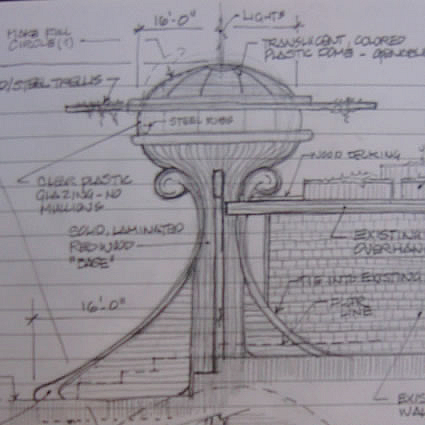
page 312 October 3, 2002 @ Elsewhere | Design Development Elevation
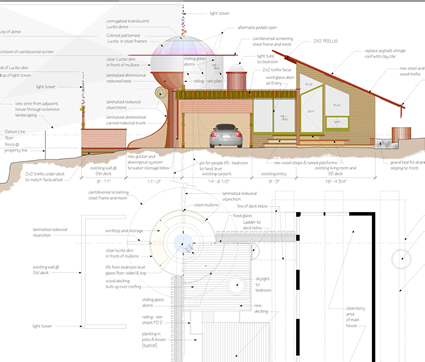
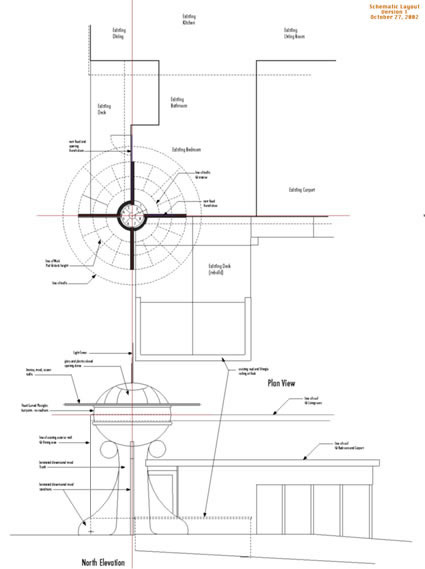
May 30, 2005 @ Elsewhere | Gail’s Writing Nest - Part Two | | Part 1 [link] of 3 covered Setting; Metaphor, Theme and Symbolism; Function; and, Antecedents. Part 2, Description; Grammar; Integration (with other structures); the Design/Build Method; Schedule/Costs; Schematics (design); and, Philosophy. Part 3 [link] documents the Design Development phase of the project which started in the first quarter of 2005. PD 1 [link] shows the front elevation, the plan at the deck level and provides further description. | | | The only way to describe this concept is to imagine a day in the environment. It will have to be a 24 hour day, one with rain, fog, sunshine and moonlight. A day of reading, gardening, thinking, writing and quite dialog. Maybe an evening meal on the roof deck watching the sun go down. | | The first thing that someone would experience is that this is a structure of many moods. It both reflects and project feelings. It has personality but is does not dominate. It is a patient edifice. It is very much a creature of light - light in all it’s forms including the absence of it. Gaudi had a great deal to say about light and how the sun in various places influenced the cognitive processes of people. I imagine this coast line to be be lit much like the Barcelona he so loved and built great environments to capture. Northern California is a light of inspiration and creativity. You only see a building, it’s shape, color, texture, by the reflection of light. A building should embrace light, take joy in it - and change it. | 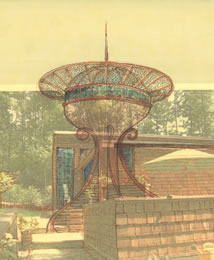 | | A very fast, very rough sketch superimposed over a photo - drawn October 14, 2002 while I was on a business call. The photo is at high light and the Nest would be mostly in the shadow of its trellis at this time of day (not indicated by the sketch). | | | The dome will be made of colored glass and plastic with a pattern-on-pattern design of several layers; like a Tiffany lamp. It will glow inward during the day and outward at night. The light tower in the center will project variable (user choice) light. The “peddles” of this “flower” will open in alternate sections letting cool breezes in. The trellis is made of light cast bronze and wood with adjustable horizontal screening; it will float off the base of the dome and over the fixed clear plexiglas window band projecting into the interior about 2 feet; more an idea than a heavy presence. Its function is to shield the interior from a too bright sun and to extend the horizontal sight-line of the room. It is a “hat brim.” Detailing is very important here as the whole “top” of this structure creates an extremely intimate relationship with anyone sitting in the space. | | The BASE of the structure is experienced from several distinctly different aspects. From the outside it is a strong, Druid hand-carved tree-trunk that defines the building edge and patios which are very different in feel and viewpoint and use. From the inside, the Base is a vertical opening “horn” that becomes the floor of the workspace above. Inside this is a steel and glass Lift that brings you up to the Nest floor. “Randomly,” the Trunk is pierced with small pinpoints of colored glass that casts light into the interior. Inside there are also carvings - lighter and more refined - that tell the story. Moving through the the Trunk is like some ancient ritual, steeped in the long forgotten memory of our race, before one then reaches the light and open 360 degree view. This is a continuous 20 foot vertical experience and this scale and proportion is critical to the mission of the building. | | | The Grammar of this piece is both complex and simple. Complex, because a number elements are converging with this design. Simple, because the detailing has to be extremely transparent. The piece is all art, however, the art of the piece cannot get between the user(s) and the experience. | | The material palette is simple: wood (several kinds naturally finished with some stained highlights), plastic/glass (clear, colored and patterned), bronze, tile, simple fabrics; the palette of a traditional wooden boat. | | The geometric grammar is basic and complex; the Nest employs round forms not found in the exiting building nor in the proposed Guest/Studio addition. This make a certain point regarding cannon, style and “rightness.” Some schools of though would argue for rectilinear forms for this work. It would have been possible to meet the surface of the requirements this way except it would have resulted in a space totally unsuited for Gail. To meet the program requirements with rectilinear forms, the geometry would by necessity be complex syncopated and dramatic. A very nice solution but far too intense for Gail’s persona and purpose; the wrong expression. This reality drove the basic geometry of the work. How then, will the necessary integration be accomplished given the geometries? | | Wood materials and landscape form the basic Armature of the project. In addition, the one piece of consistent detailing that will be shared among all three buildings will be the trellis elements. This element, in horizontal and vertical forms, will also connect all three buildings. Properly executed, these common aspects are sufficient for achieving appropriate diversity/unity balance. | | Integration with Other Structures | Upon completion, Elsewhere will have three distinct structures - all different in time and “style” yet all integrated in their total functionality and architectural result. | The original house is an example of “Sea Ranch” [link] Idiom. This has already been modified, somewhat by the previous owner with the change of the roof material from wood shingle (a “bent plane” with the back wall) to a composite roof. The future Guest-Studio addition (there are two options, at present: [link] [link]) introduces another geometry and balance in the material mix. With the Nest (and when the Guest-Studio is built), there will be three basic geometries at play. This can be a determent or asset depending on execution. Bad if it leads to visual confusion and discontinuity; good if it provides variety and visual interest too often lost when a complex of buildings is executed at once and with one “hand.” | | Integration will be helped by the landscape which is the major outdoor armature [link] of the complex. In addition, the major use of WOOD construction is a major factor both reinforcing and creating continuity. It will be the TRELLIS system that will unify the three components in geometric terms. The material, basic geometry and detailing of the trellis will be the same for all buildings as individual pieces and the buildings will be tied together, at various places, by trellises. These trellises will function as sunscreens and plant harbors further making us of the landscaping as a major element of the whole. | | This will be a barn raising in the full sense of the meaning and it will integrate a number of individual artistic “gifts” from various artist friends of Gail. Both the design, as developed here, and the design/build method acts as an ARMATURE to incorporate these various individual contributions. The design creates a problem; the work that follows makes the solution. | There are three phases of this process: Phase I is design, engineering and prefabracation; Phase II is the actual erection of the structure to-move-in - a process that is expected to take 10 days; phase III is the post move-in work, final carving of the structure, landscapinging and minute adjustments. | | This process combines the best of rapid-prototyping, FasTracking, Design/Build/Use and the Timeless Way of Building. | | The Phase I work actually is divided into two distinct pieces of work; getting ready to build and fabricating the major elements of the structure. The getting ready work is Design Development, engineering, organizing the build process and team, financing and permitting. | | Design Development will be done by SFIA Architects-MasterBuilders and Taylor Architects members and myself utilizing our design/build work package method of drawing/documentation. We do not yet have an engineer. Basically, I will size the engineering elements and then have an independent eyeball check things out. The structure will be built like a boat and, essentially, will be one continuous structure of glued and screwed wood and bronze strapping. The 3 Wood Stanchions will provide lateral stability and will be extensively tied to new footings and the existing Bedroom walls and roof deck (which will be reinforced for sheer). | | The entire structure will be shop fabricated. The Stanchions in their entirety (two will have inside and outside pieces where they integrate with the Bedroom walls); the Trunk in three full height sections; The dome structure and trellis in 8 sections respectively. The clear horizontal plexiglas window will be cut and heat molded (curved vertically and horizontally) in 1/16 circumference sections; the stairway in three horizontal sections. The dome "peddles" will be cast as operational sections. All told, this will make about 50 pieces which will be trucked to the site for erection. The assembly will be erected in the shop first to ensure fit. Some of the shaping and hand caring to the Trunk and Stanchions will take place here while the piece is waiting shipment. | | Phase II is the barn raising. The work schedule is: Day 1 - Demolition, run electrical and water lines; Days 2 & 3 - Place foundations, finish electrical and plumbing rough-in; Day 4 - Place major prefabricated Base sections (including stairway); Day 5 - Tie Base together and set major dome/trellis sections; Day 6 - Fit windows and doors at Bedroom walls; Day 7 - Fit dome window “peddles” and replace Bedroom wall shingles, fit Skylight, complete shaping of Trunk and Stanchions; Day 8 - Place horizontal clear plexiglas, repair and replace decking sections and steps, replace and repair Bedroom interior wall sheeting and trim, prepare roof deck for planter boxes and solar collectors; Day 9 - Set roof planter boxes and solar collectors; Day 10 - Turn on solar system; exterior clean-up, Gail moves in. All materials will be staged off-site and brought to the work area just-in-time; the will placed by a small crane from the front driveway. Minimal impact to the site will be allowed and the entire construction area will be broom-cleaned at the end of each work day. | | | Post move-in, the the final hand carving will take place, planting of the roof garden and other finish items. Furnishings and refinements will be approached at a leisurely pace based on user-experience. | | The out of pocket cost of this project is expected to be $100,000. This was arrived at by an item-by-item costing confirmed by a volume estimate of cost of 10 dollars a cubic foot. The value will be much greater but of an indeterminate nature - at least in the short run. Other projects related to the existing house will be an additional $75,000. | Move in is targeted for mid July 2003. This is Gail’s birthday and our anniversary. This project will take priority over all other personal design projects. | Note: this schedule was never met. The capital requirements of MG Taylor took prescience. These financial requirements may ease off in 2005 and there may be enough equity in Elsewhere by mid 2006 to do the project. The long lead time item is likely to be the amount of air-cured dimensional lumber necessary to do the project. In May, 2005, I found a lead to a good source. | | As previously described, the major pieces will be prefabricated off site. The time from opening the site with foundation work to move-in will be ten days. After this there will be finish touches such as carving, staining, fine detail work and roof garden planting and so on. The prefabrication process will take, at least 90 days and will require an indoor environment. A shop set up for small wooden boat building will be adequate, however, a vertical space of 40 feet is required. Working backwards, permits will have to be filed in March; this means drawings and engineering calculations have to be completed during the first quarter of 2003. This leaves the fourth quarter of 2002 for concept drawing and the assembly of the design-build team of artist/craft-persons. | Note: Design Development work started the first quarter of 2005. See drawing below and Part Three of this Article. Engineering can begin in the second quarter. A late summer 2006 install time is now the earliest possible time. Gail started her book in March of 2005 - it is now a race to see if the Nest or the book will be completed first. | | | | The schematic drawings define the problem. They break the project up into discrete tasks, NASA style [link]. The initial design is a context; it is basis from which the actual artifact can evolve through a rigorous Design/Build/Use process. | | Schematic Plan and Elevation
October 26, 2002 | | The proportions of this schematic are different than the first sketch from my Notebook. This work scales the design to the actual building dimensions. The entire unit is scaled down somewhat; the biggest change being the narrowing of the 4 stanchions. In three dimension this will “read” like the the sketch yet will fit the building and its massing correctly. | Note: the proportions were altered once again with the may Design Development drawing. This is getting close but may not yet be the final solution. | | | | The scaled schematic drawings demonstrate the geometry of the piece and that the design will work. The function can be accomplished; both utility and expression. | | It should be clear that I hold a distinct philosophy of architecture and employ this philosophy in the creation of designs and the building processes necessary to realize them. | Philosophy is not design. It informs design and can guide the process. It is necessary to a satisfactory result. The existence of so much design talent run amuck in our work today without any philosophical guidance is testament to this observation. One can also see the converse. Situations where philosophy - good philosophy - is imposed on design. This produces dogmatic buildings. Often “correct” - but dull. The design process employs philosophy, as well as, many other disciplines and processes to make a result. Good design often challenges the very philosophy that informs it. This is one way that philosophy improves. All that said, the following is an outline of some aspects of my philosophy of architecture with emphases on those most applicable to this project. | Architecture is art as distinct from mere building. Buildings can be extraordinary (and esthetic) and still not meet this condition of art. There is nothing the matter with this. It is not feasible for every building to be high art. I am not even sure if this would make a superior environment. All of the built environment is architecture by category. Individual pieces are architecture, in my definition [link] of it, only when they take on the challenge of being art. The essence of art is that a work creates a distinct point of view - expresses a specific aspect of and way of seeing and experiencing reality. The degree of this is determined by circumstance and the intended use of the environment. There exists no hard line between well done building - which can be called Indigenousness Architecture - and ARCHITECTURE as I have defined it. One is not innately superior to the other - they are different. | It follows, then, that Art architecture pushes boundaries. This is what what art does. It leads. It challenges. This may be on the level of client and individual users, it may be on a social level. Thus, it will be uncomfortable for some. Indigenousness Architecture can be, and often is, of very high quality. It is an expression of the culture from which it comes, and by definition, within the norms of that culture. Industrial societies can produce Indigenous Architecture the same as non-industrial ones. The technology level, nor the social process/structure, per se, is not the issue. | As an example of what I am saying, it is possible to take all of Alexander’s Pattern Language and produce an environment that emerges from a “traditional” idiom that is satisfactory in every way, beautiful and comfortable. It will fit in the present social definition of what a house “should be.” It is created by the standard work processes of the society. It is “indigenousness” to that society. The same Pattern Language can be used to create a building that is far more forceful and provocative - an art piece - that may take 50 years [link] to be considered “the way a house should be.” Both can can have identical basic requirements with very similar values at their root. One fits into the present social landscape, the other creates a new social landscape. One presents an already pervasive world view, one creates (or focuses on) a new world view. Both are legitimate. Both are important. Both are distinct from careless, non-crafted junk building. Both, to be successful, have to be the right project for the right time and place and fit the true requirements of their client-users. The art architecture will be more intense, and perhaps, this is an argument for more rare. This approach to architecture is R&D, rapid prototyping and, in my view, should reach across the entire spectrum of architectural concerns: design, building processes and methods, financing means, structural and technical systems, patterns of use - and expression (metaphysics made explicit and physical). | The way that IDEA is made manifest in Architecture is by means of denotation and connotation. A thing being what it is carries a denotative message. It is a direct reference. The “honest” use of material and forms is the employment of denotative means. Fine indigenousness works rest heavily on this device. | All forms, textures, colors, rhythms provoke in humans (and at least some animals) a response. They have meaning. This connotative attribution is species specific, modified by cultural membership with further nuance provided by each individual. Connotative devices can be quite subtitle and abstract or explicit as in the use of symbol. All building and all architectures employ connotation (consciously or not) - it cannot be avoided. Music employees it as the major means for creating feeling. Expressive, or art, Architecture employees it as a deliberate and finely crafted means. | With skillful use, connotation can make a work become an “essay in stone” or “frozen music” to employ two popular sayings. It can be a textbook as are many Egyptian Temples [link] and European Cathedrals. | Ayn Rand employed denotation and connotation brilliantly in her work. Her scene, from The Fountainhead, of the young man [link] on a bicycle seeing Roark’s resort is an example of integration, on many levels, of ideas, perceptions, emotions and esthetic forms and how they can be effectively conveyed while remaining open to individual imagination. | The traditional role of the professional is one that I have long questioned. I believe the professional should focus on education and transfer and the production of leading-edge profession-defining work and less on the daily production of “boilerplate” activities well within the state-of-the-art. Once an art is canonized, a disciplined defined and transferred to broader population, it becomes the norm of a society. It becomes indigenousness. Even in a (over?) specialized society such as ours where almost every task is “outsourced" for pay, this is, at volume, mostly a “para-legal” level of professional work. When the highly trained and experienced professional focuses too much time on the trailing edge practice areas, society suffers and the professional suffers by losing interest, stimulation and challenge. The art is lost. And, in time, the skill and discipline of making it atrophies. | | The practice of extending the state-of-the-art by the productions of leading art-pieces and teaching what is learned to a broad segment of the population (perhaps support by para-professionals which is what most “professionals” really are) is the highest duty [link] of an architect (and any true practicing professional). This work pushes “the envelop” of the field and creates an ever expanding field of safe practice for the culture at large. Patronage by individuals and corporations commissioning new work takes on a new meaning within this context. It can be argued that this is the process now. I would like to see it made explicit and practiced with far more clarity. I believe that this will remove much tragic human experience from the process. Today, it is the mundane work which is the standard and those who go too “far out” do so at considerable risk. The opposite should be true. The encouragement should be for innovation and the development of new art. I will point out that not only esthetically, but technically, architecture and building lags far behind other fields in our society. The field of architecture has no real R&D. | | | Design Development began in early 2005 and will be documented in Part Three of this Article. Sheet PD 1 was finished at the end of May. | | GOTO Part Three of this Article | | | | Part Three of this Article | | | Matt Taylor
Elsewhere
October 2, 2002 
SolutionBox voice of this document:
• VISION • PHILOSOPHY•
• PROGRAM • |
posted: October 3, 2002 revised: May 31, 2005
• 20021003.469801.mt • 20021005.123400.mt •
• 20021006.770943.mt • 20021009.333300.mt •
• 20021010.283391.mt • 20021015.628872.mt •
• 20021016.299701.mt • 20021017.333300.mt •
• 20021027.388610.mt • 20050424.231200.mt •
• 20050531.768210.mt • (note: this document is about 98% finished) Matt Taylor 615 525 7053 me@matttaylor.com Copyright© Matt Taylor 2002, 2004, 2005 | |
|