| Columbia School of Education | Notes in support of
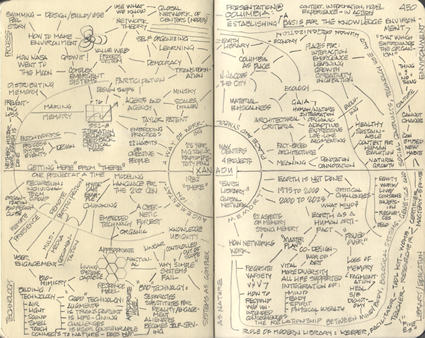
December 15, 2003 Presentation and Dialogs | | For me, libraries have always represented the epitome of the idea of civilization [link]. They are, at the least of it, the warehouse of the accumulated knowledge of humankind. They are where this knowledge can be organized, researched and made into greater knowledge than the parts alone possess. They can become the neutral places [link] - hubs [link] in a global network - where the great creative dialog, that determines our world to come, takes place. They are the keepers of our commonwealth - past, present and future. | | Some argue that the role of the library in modern times is lessened. That the general distribution of information, the virtual world of the World Wide Web make them no longer relevant. You have clearly rejected this notion. I agree. I will argue, however, that those same conditions and considerations that gave rise to the discussion, in the first place, have to be incorporated into the concept the library going forward; and that, while the physical aspect of the library as a place is more important than ever, each physical library that exists now has to become an active agent [link] in a greater network [link] that spans a globe. | | Further, in a world of knowledge-work [link], the old distinctions between class room, library and work-place no longer hold. Learning and creativity - the entire cycle of concept to use - has to be seen and practiced as a single integrated process. | | In theory this can seem reasonable and easy enough. In practice, it means an entirely new approach to how the environment, work processes and tool-set [link] of the library are configured. It is about the extreme integration and inner-operability of these three elements in environments dedicated to learning, designing, rapid prototyping [link], planning, incubation and project management - as a single enterprise that I am here to talk to you about today. Environments that augment individual and, what we call, GroupGenius [link] thereby creating ValueWebs [link] capable of dealing with complex systemic problems and opportunities and that can execute projects in radically reduced time frames. What I have to say is based on 25 years of designing, building and operating - and transferring to other organizations - these kinds of environments. We call them NavCenters implying a heuristic approach to the future as is appropriate for the facilitation of complex, emergent systems [link]. Our ValueWeb members call them by many names, as example: the Learning Zone (Detroit Edison) [link], the General Gossick Leadership Center (Arnold Engineering and Development Center - USAF) [link], the Learning Exchange (VA with several under development) [link], the Innovation Center (Vanderbilt Center For Better Health - Vanderbilt University) [link] and the 20 Accelerated Solution Centers (CapGemini-EY) [link]. NASA [link] and the Borgess Health Care system [link] calls them NavCenters. Over thirty of these environments are working today and over a quarter of a million people from education, government, industry, research, high tech, the military, financial services and social institutions of all kinds have employed them. This user-base is global representing almost every nation in the world. The experiencewe have gathered for these Centers provides clear design criteria for the creation and management of environments for learning and innovation - and, for sustainable project execution. | | The may factors that go into the making of these environments are outlined on the MindMap, below. | | | click on MindMap for larger version | p 450 - November 7, 3003
Matt Taylor Notebook [series started 9-11-01] | | This MindMap diagrams what I want to say to you in regards making a viable 21st Century Library for the School of Education at a major University. I may be able to cover this material in 12 hours or so. Given that we do not have that kind of time, instead, I will cover key aspects and leave time for dialog to take us where it will. Over the next two weeks, I will continue to add to this documentation, annotate it with references and link it to other areas of my web site, as well as, other sites. These links will reference thousands of pages describing experiences, experiments, designs, built environments, research, models and speculations about possible futures. I am reporting over 46 years of work product of my own and how that relates to the work of many others. You can use this as a resource to further explore the many ramifications of what we talk about here today. | | As always, I add this caveat: while I am passionate about this work and committed to its fulfillment; and while I have carefully researched the work of others to reinforce the validity of these findings, this presentation is not about conclusions - it is about an ongoing program of Design/Build/Use [link]; it is about systematically boot-strapping our way to remarkably better environments - each one that works while providing key insights to guide the development of the next. I am not trying to convince you of anything. I am doing my best to challenge hidden design assumptions and to stimulate your thinking - I am hoping to significantly raise the bar of your ambitions in the realm of making environments fit for humans [link]. If I am successful, when we are done your level-of-ambition in regards what your library can be will be significantly raised. At the same time, I hope that your confidence that you achieve an extraordinary result will be equally enhanced. | | The genius to do this already exists at your institution and in its ValueWeb. At the core of what I have to say is to help you define the principles of the 21st Century Library - the specifics cannot be determined outside of a design process - and to point out a path - a process - for accomplishing such a result. The result is the consequence of the process and cannot be separated from it. | | What follows is a basic overview of the MG Taylor, method and system, built work, the components that make up our environments, projects that did not make to to completion and some ongoing projects that will be realized in the next year. From this body of work a set of principles are offered for your consideration as you develop your project. | | Basic Threads of MG Taylor System | 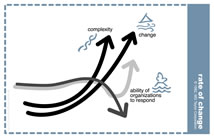 | Rate of Change and Complexity link | | | Our work began when we started exploring the nature of complex, systemic problems in the mid 70s and discovered that, while there were many solutions available to society, society had few processes in place for creatively applying them. Many voices have to be heard in order to understand a systemic problem let alone solve it in a way that leads to a sustainable result not over-burdened with unintended consequences. The collaborative processes in place back then thwarted what we call GroupGenius. We decided that an integrated approach to environment, tooling and work processes was necessary if solutions were to be found and if the time to actualizing designs was to be radically reduced. Really large systemic problems that rely of dynamic, complex emergent solutions will, of course, require an effective network of these environments. So... building a global ValueWeb of what today we call NavCenters became our plan in 1982. We have been at it ever since. | | | 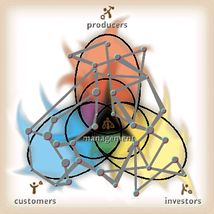 | ValueWeb Architecture link | | | In the traditional Business Model, the relationship between the Investor, Producer, Customer, Manager is passive-aggressive; their interests do not line up and never can. Good management works hard to ease these inherent conflicts but structure wins in the end. This is a major reason why businesses are perpetually being reorganized. The ValueWeb architecture is a completely different way to organize these constituencies. The ValueWeb architecture puts the Stakeholders of an enterprise into a fundamentally new kind of relationship governed by a different set of rules. This architecture supplants inherent conflict with a natural synergy. Technically, it is also sophisticated enough to deal with the variety and complexities of modern organizations the many different kinds of relationships that make up the extended enterprise that must both compete and cooperate can be administered. | | | 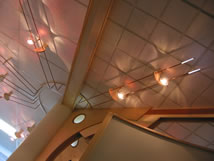 | | | NavCenters are neutral places where rigorous and open-ended work processes support Group Genius. They are places of systematic collaboration, innovation, incubation and project management. They are the lab in which an organization can experiment, prototype and take measured risks that do not disrupt the larger enterprise while they are in incubation. NavCenters contain many traditional resources: library, leaning center, knowledge-work production capabilities and so on - they are based on a new way od working, and while representing a focused resource to these capacities, navCenters are a means to systematically introduce new method in the organization and its greater network. NavCenters also function as a ValueWeb Integrator weaving an organization’s usually ad-hoc network into a community of greatly enhanced power. | | | 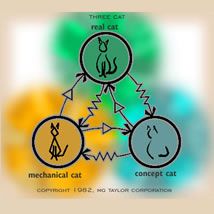 | | | In order to understand this work and communicate accurately when doing it, we had to create a new language because what existed did not accurately define what we were seeing; we call this a Modeling Language and it is one of six layers of language necessary for fully describing the system. This Language now consists of about two dozen Models and nearly ninety “words” that are represented by Glyphs. In total, these words address key elements of systems behavior, organizational processes and group interaction. The Modeling Language provides a “chunked” shorthand that facilitates stating a complex situation in a brief statement, connecting the situation to a body-of-knowledge that offers diagnostics, and the ability to communicate alternative courses of action to co-workers in precise terms. Glyphs from one model and be transported to other contexts by employing visual language techniques, thereby making connections not supported by traditional language means. This is a step towards the “Glass Bead Game” [link] and the representation of complex relationship in simpler formats. | | | 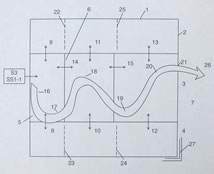 | Process Architecture link | | | At the root of it the MG Taylor process is multiple levels of iteration, recursion and feedback within a set of prescribed boundaries resulting in emergence. This “container” is the total environment: physical, mental, informational, emotional, technical, that is deliberately created (by using the process itself) for each exercise that takes place within it. Emergence cannot be predicted, controlled or caused - it cannot, in the moment, be understood. It is possible, however, to create an environment in which emergence is what happens far more often than not. How to do this, systematically, is the basis of our system and method and patent. While others focused on trying to find out what intelligence, creativity and emergent behavior was, we focused on finding out what environmental factors consistently give rise to these desired attributes. While not simple, this was the easier path - it is an engineering approach to to the subject: built it, test it, use it, evaluate it, rebuild it. There is a great deal of art to the managing of these environments and this art is highly congruent with the science and engineering. | | | 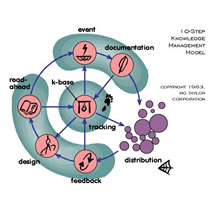 | | | The making of StrongMemory is at the heart of the process. The mind is organized in paths of association. We remember something in context of many similar and connected memories which evoke emotions, physiological responses, and if stimulated, other cascading strings of memories. This experience can be rich or impoverished. An example of impoverishment is adults sitting in a darkened room looking at a Power Point presentation with a voice that drones on at a bit rate about 5% of everyone's capacity; of richness is these same people, moving around in a stimulating environment full of art, toys, information objects and tools, while engaging in multifaceted, rich dialogs with their peers - learning while in the process of solving real-word problems. The first experience conjures up dull days at school being told what to believe and think; the second, real life engagement with the freedom to be and to act - a combination of sports, hobbles and productive work. Which of the two would you like your Annual Report information to be associated? It is memory that stays after an event; it is memory that leaves a NavCenter. The “NET” that makes up the neurons in a single human mind, or the common shared experience of a group, the transactional pathways of a ValueWeb, can be considered as similar systems; this can be “acted upon” in ways that build effective memory across organizational barriers. | | | 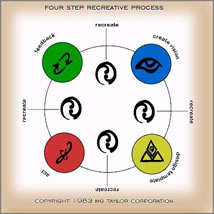 | | | Every action taken while facilitating a group process is an intervention into their natural process. Every intervention has consequences - often negative one. Ours are limited to making the habits of creative people the dominate operating system of the group. This makes it possible to balance the requisite variety equation while minimizing negative unintended consequences. What we get is emergence - not controlled, not predictable but overwhelmingly positive in result. Studying what creative people do - not what they say they do - or what the myths of creativity insist that they must or should do - we discovered that across, time, cultures, arts and sciences and educational experiences there are a number of remarkably consistent habits shared by most of those generally regarded as genius class people. We do not talk about these. We embed them into the operation of the environment - they become just how people interact and work. These habits, then, are the bias of the NavCenter environment and its processes and make up the total “container” in which the work is done and memory is created.. | | | 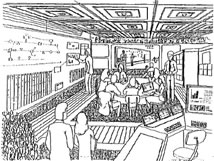 | “There to Here” - Rapid Prototyping link | | | In 1982 we illustrated our “THERE” environment. It is made up of large electronic read write walls that are connected to the knowledge-base system and individual team member’s wireless laptops and PDAs; in the background there is an electronic wall that is connect to a remote team; the team shown in the picture is working together and in small sub-groups - they are interacting with each other, the remote team and the knowledge-base; when they are finished working, their documentation will be complete in real-time and communicated per the “Ten Step Process” Model [link]. In the foreground is “CyberCon” the knowledge augmentation tool. It can be operated by a human or run by its own routines. In this rendering, it is “self-directed” and “engaged” with the teams doing searches by visual patterns, word patterns and by concept patterns (the three small screens to the left). The larger screen is reflecting the automatic documentation of the dialog, which is being sent to the the remote team, with each person’s individual contribution going into the knowledge-base searchable by person, time, keywords and content. The synthesis of all this is directed by the interaction between CybeCon and the team members with each individual free to select, use and publish as they see fit. Everyday, with every project, we work to bring this “There” to the “Here” made possible by the project. This is systematic rapid prototyping which is an integral part of our process. Today, 20 years after this picture was drawn, nearly everything featured in it is possible. | | | 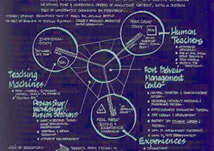 | | | We believe that, in an knowledge-economy, the place of work and the place of learning have to be the same place; that learning and creativity are, essentially, the same process. Creativity is learning aimed outward - at the making of something or idea; learning is creativity aimed inward - at the transformation of the self. Just as individual wealth and commonwealth, in the economy, are co-dependent, what are called creativity and learning are co-dependent - one cannot exist without the other. By employing what we call the CapacityGuide, the NavCenter can be a means of integrating three modes of learning that are too often separated: computer-aided learning; peer-to-peer learning; and, learning through work. These three have to be integrated by a curriculum that is focused on the 21st Century citizen and implemented by the development of individualized year-to-year study guides collaboratively developed by student and teacher. This process has to involve - as an integrated experience - what we call the “5 Es of Education:” Experience; Example; Expectation; Explanation and Exploration [link]. Clearly, this now is a life-long habit not just something that happens during a period of life dedicated to schooling. | | | 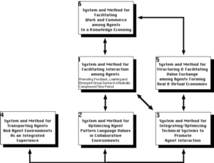 | | | The patent is presented in 6 sub-systems which describe the interaction of AGENTS and the use of AGENCY in environments with emphasis on: work processes, the physical environment, technical systems augmentation; the transporting of Agents; the economy of Agent exchanges; and, the facilitation of Agents within a knowledge-economy. Agents, in this context can be any entity that makes up the environment or is brought into it, transformed by it and leaves it. The patent describes the technical means by which Agents of all type, and who exist on multiple levels of recursion, are facilitated and augmented in the process of creating knowledge and employing it in a knowledge economy which is assumed to be essentially different than an industrial economy. People participating in a collaborative process in a NavCenter have to know nothing of all this to be highly successful. It is a weak process that has to teach first before it can be used. And, those providing the environment can be successful in their work without deep knowledge of the core system and method that underlies the design and work processes of any given environment. To recreate these environments, however, does require the deeper knowledge and this is accomplished by a combination of experience and study. The body-of-knowledge involved is equal to a degree program in several fields. The emphasis is on the synthesis and integration of these fields which is unusual in today’s academic environment and another reason why NavCenters are important for dealing with complexity. | | | | Joseki Offices were built in 2002 by SFIA student architects as a design/build exercise. | | | | The Acacaia Center was built, in 1982, on the 7th floor of their home office building across the street from the Capital Building in Washington DC. | | | 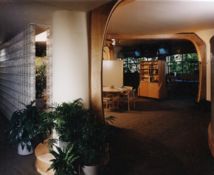 | Cambridge knOwhere Store
1997 link | | | The Cambridge environment was built in 30 days over Christmas and New years 1996. | | | 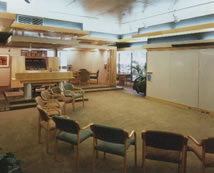 | Orlando Management Center
1985 link | | | The Orlando Management Center was considered to be outrageously expensive when it was built in 1985. 15 years and three lease cycles later, three entirely different corporations employed the space successfully without modification. The environment was painted once and looked and worked great. Adaptability and high quality materials proved to be the best economy over the long haul. | | | 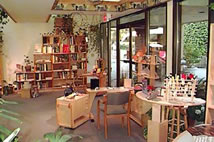 | Hilton Head knOwhere Store
1996 link | | | Hilton Head was the first of the three knOwhere Stores which operated between 1996 and 2003. | | | 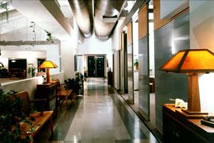 | Gossic Leadership Center AEDC
1992 link | | | The Gossic leadership Center was built for the Air Force at Arnold Engineering and Development Center in Tennessee. | | | 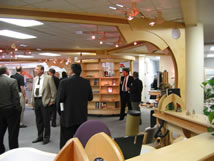 | Vanderbilt Inovation Center
2002 link | | | The Vanderbilt Innovation Center is part of the Vanderbilt Center for Better health. The time from contract to first use was just over three weeks. | | | 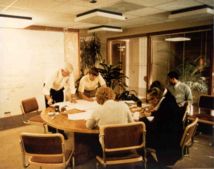 | Boulder Management Center
1980 link | | | Our first enviornment built in 1980. | | | 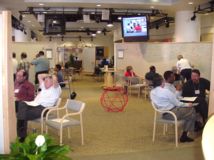 | The Learning Zone
Detroit Edison
Michigan
2000 link | | | Built off the Lobby of Detroit Edison’s home office, the Learning Zone is dedicated to employee development. | | | 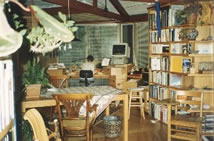 | Studio for Gaill and Matt Taylor
South Carolina
1990 link | | 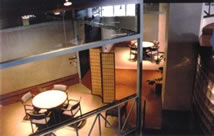 | Capital Holding Management Center
1992 link | | 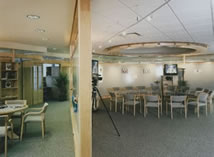 | Continium NavCenter
1997 link | | 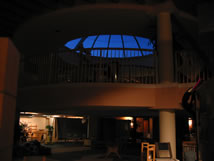 | Palo Alto knOwhere Store
1997 link | | | The Palo Alto knOwhere Store, a 20,000 square foot mix use environment, incorporated retail, group process areas, offices and incubation spaces all supported by a core technology. It also served as MG Taylor’s home office environment for several years until mid 2003 [link]. | | | 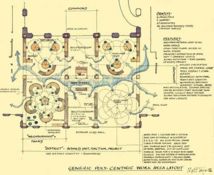 | Armature, Pods, Domes WorkWalls Cubes, Workstations and pieces
1990 link | | | This drawing, a study for the Capital Holding - Agency Group home office environment, showed the Armature, Pods, Cube Office systems in the metaphor of a landscape with transportation corridors. This started the the design quest that is reaching full expression in the the VCH Executive Offices [link] to be finished in early 2004. | | | 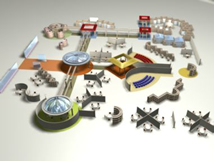 | AI System and Landscape
1997 link | | | This diagram shows all the elements that make up a floor-to-ceiling, wall-to-wall “furniture” solution that radically cuts building time, promotes flexibility and reuse, while accommodating the variety of work spaces made necessary by the new learning and work demands of the 21st Century. The components are: Armature pieces, Pods, Cub Office System, WorkWalls, Domes and miscellaneous WorkFurniture pieces. These are designed make a complete architectural space with minimal built-in-place construction. While the core of the system is universal, the variety of materials and details are endless allowing each project to have a high degree of individual signature. The entire system is conceived to be re-configurable and movable with minimum tooling and expertise. The goal is to make an environment that the users can completely own, set up and operate. Each project we bring more of that THERE to HERE. | | | 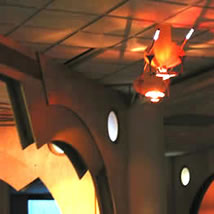 | Vanderbilt Center for Better Health Armature
Tennessee
2002 link | | | The Armature defines sub-spaces within a larger integrated space. It serves an a conduit for wiring. It brings symbolism and personal character to a space. Augmented with truly flexible lighting, as shown here, it turns the ceiling - the largest unobstructed plane in the the environment - into an active expression of the environment and its meaning in contrast to the plain, dull surfaces, with glaring light and bellowing HVAC that have become so ubiquitous. Each project can have an Armature designed to meet its own unique requirements be they those of utility or expression. | | | 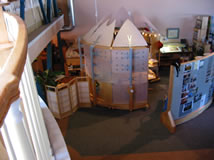 | POD
1999 - Present
Palo Alto knOwhere Store
California link | | 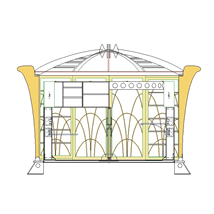 | New Pod
Vanederbilt University
Tennessee
2003-2004 link | | 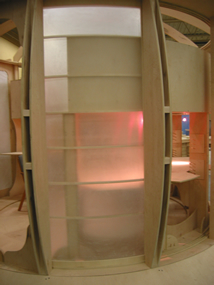 | New Pod
Prototype
2004 link | | 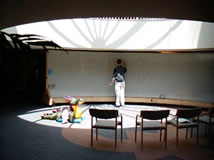 | Dome
PA knOwhere Store
California
1997 link | | 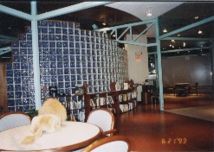 | Transition Areas
Capital Holding Management Center
Kentucky
1992 link | | 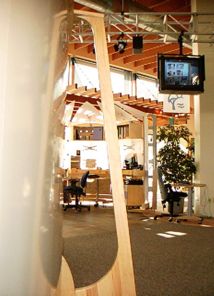 | WorkWall Armature and Pods
Palo Alto knOwhere Store
California
1997 link | | 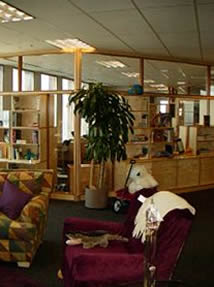 | User Movable StorageWall
Atlanta ASE Cube/Wall
Georgia
1999 link | | 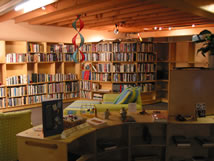 | User Movable Storage Wall
Palo Aloto knOwhere
California
1997 link | | 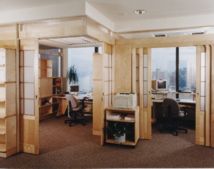 | Cube-Office System
Continuum Health Care
1999 link | | 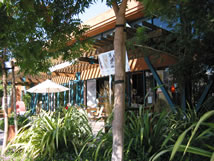 | Indoor-Outdoor Interface
Palo Alto knOwhere Store
California
1997 link | | | This is a front sidewalk landscaped patio that travels a far inside the building as the distance from the building to the street which is the second busiest in Palo Alto. Folding back glass walls and an opening skylight, in the center of the 20,000 square foot space, allows cool breezes to circulate during the milder parts of the day reducing HVAC use and costs and the isolation so common today in the workplace. the landscaping filtered the south-west light and mediated the busy street providing a sense of activity without disruption. Entry into the environment was modulated not the abrupt “in-out” which has become the default mode. Architecture is full of interfaces - mostly ignored. Every move from one space to another - is an interface. Every door, light switch, sign, change of material involves interface. We pay attention to this with our software - why not our buildings? | | | 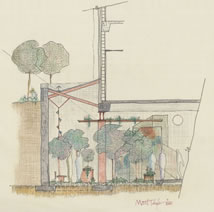 | Light Wells
Giovanni Commons
Notre Dame University
Indiana
2001 link | | | Light is important to human health and productivity. In the modern workplace natural light is too often ignored. In this case, the floor to be developed was underground with a multistory building sitting on top of it - this arrangement offered no natural light. The solution was to add a series of light wells that provided added benefit of indoor green courtyards and the charm of light coming from an unusual direction. With this detail [see the floor plan below] natural light would be coming into various parts of the space during all hours of the day with no one more than a few paces away from it. We provide full spectrum lighting, made up of natural and human-made lighting, every chance we get, as well as, windows and doors that open to semi-protected areas for natural ventilation and outdoor access. the habit of sealing people up in artificial boxes is not economical, necessary nor productive and it certainly not mentally and physically healthy. Unfortunately, this aspect of the design caused the client problems, and along with delays caused by 9/11 we never executed the work. | | | 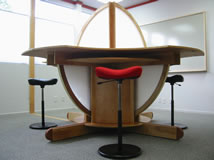 | Joseki Workstaion/conference Table
2002 link | | 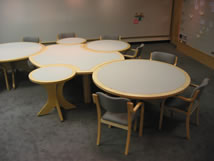 | Vanderbilt Project Room Table Cluster
2002 link | | Environments that “Got Away” | 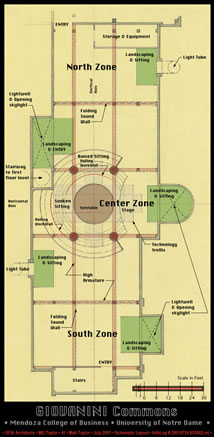 | Giovanni Commons
Notre Dame University
Indiana
2001 link | | 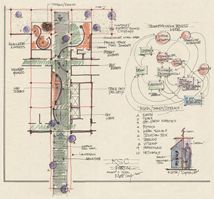 | Cape Kennedy Headquarters
Hallway
NASA
2000 link | | | The challenge here was to do something with a hallway and reception area and make it represent the spirit of NASA. | | | 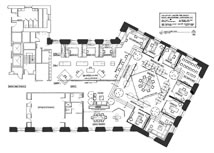 | Acacia Management Team Ofices
Washington DC
1983 link | | | This was our first Executive environment in which an entire senior team would work. | | | 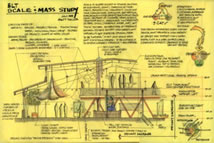 | Herman Miller Exectutive Offices
Michigan
1999 link | | | In the summer of 2000, I worked with Bill Stump on the Agile Office Concept for Herman Miller. At the time, they were preparing a new space for their senior executive team. The design was well along but I had criticisms of some of its features including the vertical scale of the space while having only one floor level. | | | 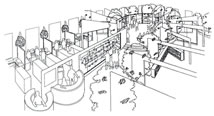 | Acacia Management Center
Washington DC
1983 link | | | Architect Jim Toohey worked with us on this design. We had completed the PDPM Center for Acacia which was located on the 7th floor of their home office building across the street from the Capital Building. This design was to be the permanent facility - politics turned this idea into a very posh conventional conference center. | | | 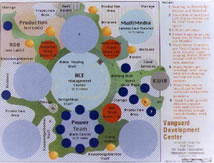 | Vanguard NavCenter
Pennsylvania
1995 link | | | Of all NavCenters, built and un-built, this one is based on the fullest program incorporating all the ramifications of knowledge-work and the support systems that augment it. This Center was to be the factory in which new financial services were to be built. | | | 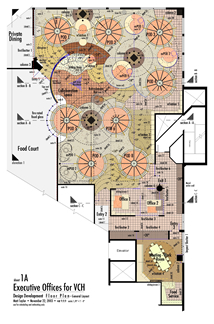 | VCH Executive Office Landscape
2003-2004 link | | | When built, in early 2004, these offices will be the fullest expression of what we have been striving to accomplished inthe everyday work environment. | | |  | VA Cincinnati NavCenter
2003 - 2004 link | | 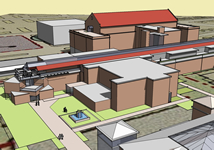 | SDC Campus
2002 - 2005 link | | 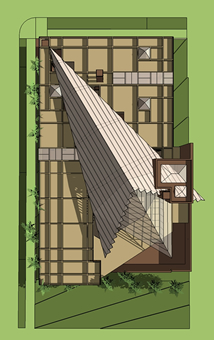 | VA Cleveland NavCenter
2003 - 2004 link | | 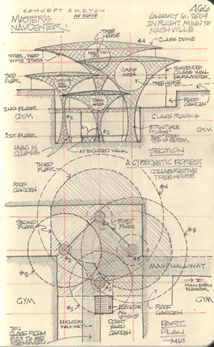 | Master’s Academy NavCenter
2003 - 2004 link | | | The Master’s Academy NavCenter will be built in their existing school complex and used to design their new campus - the mission of which is to build the “school of the future.” | | | 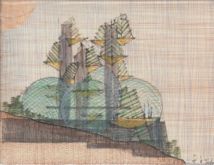 | | | At this time, Xanadu is our “THERE” for a 24/7/365 living and work environment augmented with the full expression of the Taylor System and Method. Xanadu supports collaboration and knowledge augmentation on a social scale. I estimate it will take an active network of over a 100 NavCenters, dispersed globally, before the economic and operational basis for a Xanadu is in place. This ValueWeb, sharing non-proprietary information, will be capable of marshaling the resources necessary for solving large scale systemic problems and opportunities. Xanadu is an enviornment for 2,000 people creating a market place of possible synergies. The many navCenter nods that make up the extended network will transport Xanadu all over the globe. Dialogs not possible today will become commonplace. Resounce leverage will go up orders of magnitude. What happens when several thousand people can participate in a design process the results of which are important to the future of our planet? This is Earth Library, distributed and centralized at the same time: archiving, researching, teaching, distributing, facilitating the design of future options. | | | 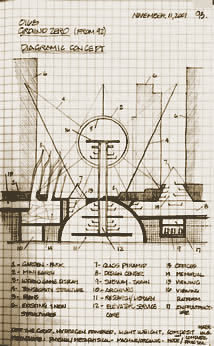 | | | I do not believe our response to 9/11 is appropriate [link]. Present plans express monumental architecture, exaggerated real estate values and social defiance. We are building back a bigger, stronger version of what failed before. This will be a monument to the 20th century if we had been smart enough to have built it that way. It does not address the issues of the 21st Century nor the circumstances that lead to this atrocity.What is required is a place that brings focus to the full context of this event and plays an active part in making the future story different then today’s and what tomorrow’s is very likely to become.This place will be open, accessible, collaborative, inviting - it will remember what was and what happened and it will provide the resources to change the cycle of repeating history. Of course, now, this concept will not be built at the World Trade Center. The idea, however, it still an important one and cuts to the heart of a number of issues: What is the new economy and what form of architecture will be needed to support it functionally? What is the true function of a public building in the 21st Century global economy and what expression and symbolism does this require? In a knowledge economy, that draws on resources from all over the world, how is access to this knowledge handled and what new forms of ownership and stewardship are required? | | | 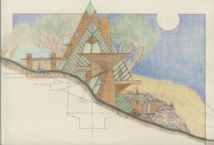 | | | In this ValueWeb of NavCenters there will be smaller, private work-spaces that will be active nodes in the network. My Bay Area Studio is designed as a prototype of the many professional studios of writers, designers, artists scientists - thinkers of all kinds - that will be active members of the“Earth Library” ValueWeb. Perhaps not since the Renaissance will this kind of intellectual density and interaction have existed. The Bay Area Studio is designed to be largely prefabricated. The on sight building time is expected to be about 30 days - prefabricated works do not have to look like they came from a cookie cutter. Just the opposite; the technique offers the means to economical mass-customization. This is something we are prototyping, now, on the scale of our interiors - many of which are larger than this project. | | | Distilled Principles Applicable to this Project | | Build environments that easily adjust to the work, requirements and desires of the users thereby not forcing human conformity to the building. | | Develop these environments by employing a Design/Build/Use process involving many iterations of work. Don’t bet the farm on one theoretical design - instead, facilitate the emergence of the final result by an interactive design and testing process. | | Even in a dense Urban environment, seek indoor outdoor integration by the cultivation of green spaces. Integrate these spaces into the work program of the Library so that they are not mere decoration. | | Make use of vertical spaces as well as horizontal ones. Develop the materiality of the Library giving the interior the same sense of building as the shell. | | Create the greater context in which your project fits. Design the project whole in itself and as a means to your long term vision. The work will be enriched by this context and the result will “go somewhere” - otherwise the project may just wander along with no legitimate means of feedback. | | Do not try to exclusively “think within your own walls” in the building of such a project. Reach out from the beginning of the process to those who have traveled a similar path and recruit them into your design process - they will gain from it and add much to your own thinking. | | Use projects like this to push the state of the art and to export new combinations of learning/work processes and technology. This is the proper scale to do this and the proper venue. Keep the scale of these initiatives small and the prototyping cycles tight - this way big mistakes are avoided and learnings can be immediately applied to the larger project. | | | | These notes, to this point, provide a brief overview of what I wish to discuss with you, some background as to why we at MG Taylor built the system and method that we did, and, a pictorial review of interactive, collaborative, innovation and incubation environments we have built, failed to accomplish, are building, and expect to build over the next decade. This total THERE to HERE experience provides the basis for the Distilled Principles highlighted above. Part Two of these notes will dive deeper into the implications of all these principles and offer a beginning prescription for how the Columbia stake-holders may actualize the full potential of their Library restoration project. Part Three will explore some aspects of the Library building’s physical spaces and offer some ideas of what can be done with this marvelous building. | | The two floors of the library that are now designated for interactive, collaborative, incubation uses can augment the entire Library and School of Education greatly leveraging their capabilities and results. This relatively small investment can multiply prior and future investments creating a much greater financial and intellectual return from the “sum of the whole.” This is the promise of the strategy of using what you want to become as the means for becoming it. The strategy I will outline in Parts Two and Three will be to build a RDS level NavCenter and install it now in the unfinished space in which the greater Phase II Library project will be designed and its building/actualization process managed. This way, there will be immediate benefits from the use of the RDS and the designs for the total project will geminate from experience - not theory. In addition, by installing the RDS now, the Library staff and students can begin to build the links to the NavCenter ValueWeb thereby starting the network effect sooner not later. This approach to Design/Build/Use, through multiple iterations, is consistent with the kind of end result desired by the Building Committee. | | go: to part two of these notes | | | | NavCenters - What, Why, How | | | | | | | 4 Projects - 2003 SFIA Presentation | | | | | | | Syntopical Reading 500 - One of Ten | | | | Matt Taylor
Nashville
November 7, 2003 | 
SolutionBox voice of this document:
INSIGHT • POLICY • PROGRAM |
posted: November 7, 2003 revised: Decenber 23, 2003
• 20031107.220071.mt.• 20031118.292290.mt •
• 20031221.355190.mt • 20031224.001200.mt •
• 20031215.401942.mt • 20031223.309981.mt •
• 20031224.609123.mt • 20031226.246801.mt •
• 20031228.398876.mt • 20040202.548810.mt •
(note: this document is about 62% finished) Copyright© Matt Taylor 2003, 2004 | |
|