Design • Build • Use
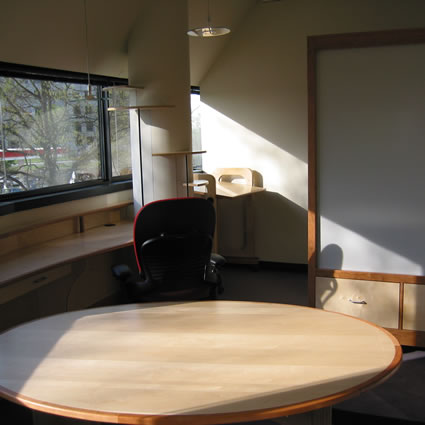
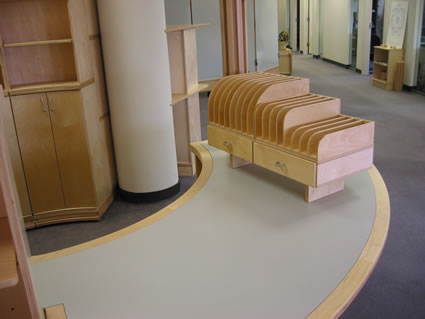
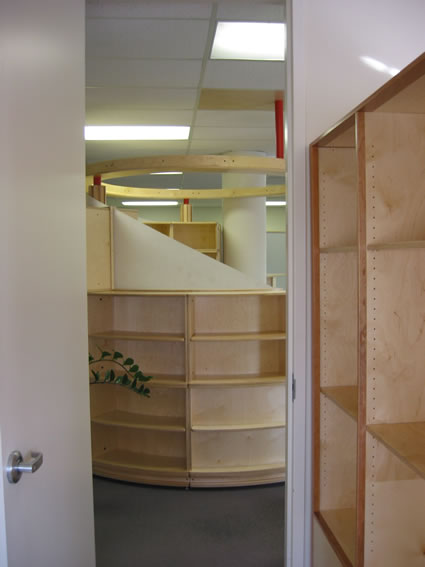
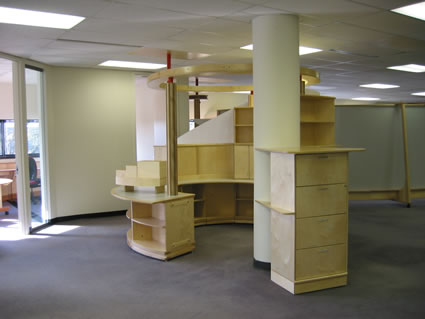
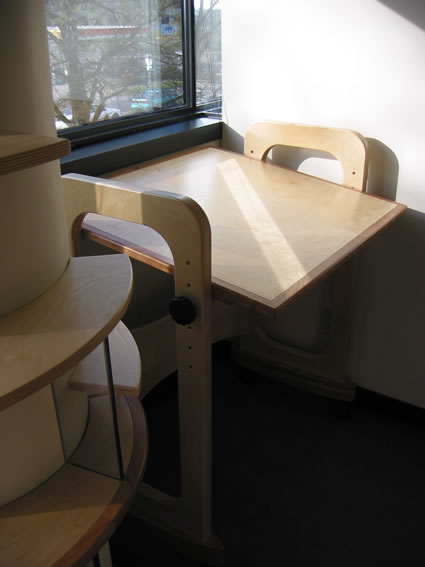
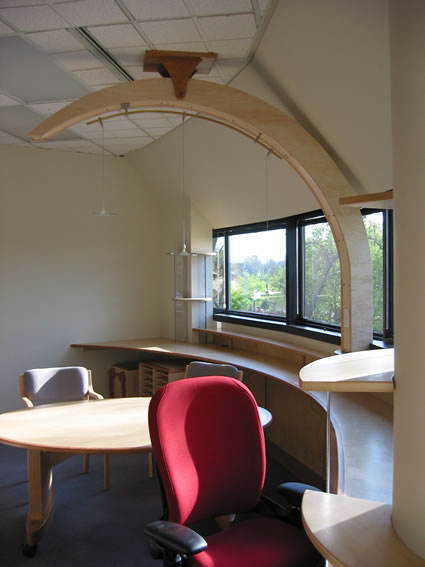
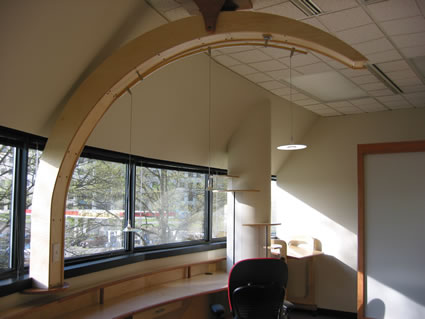
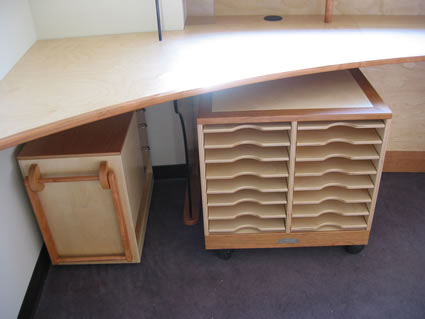
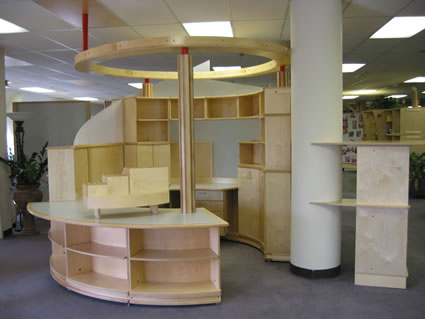
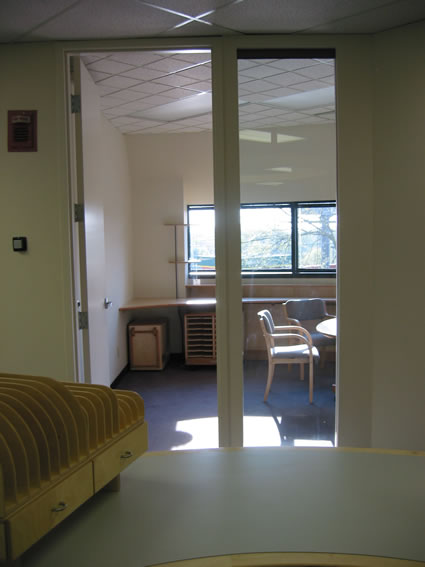
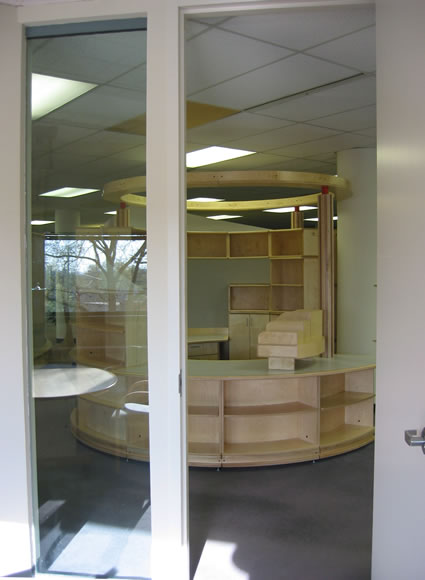
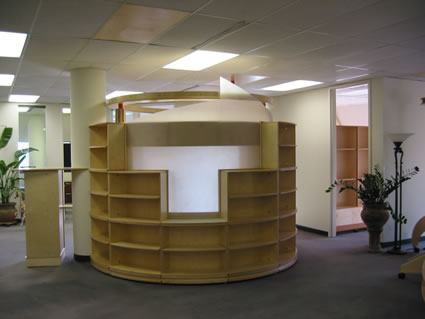
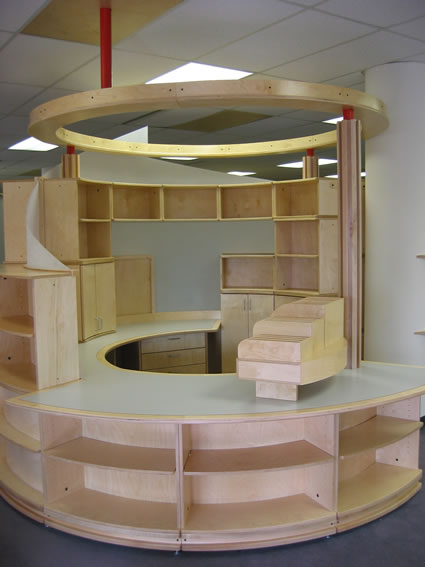
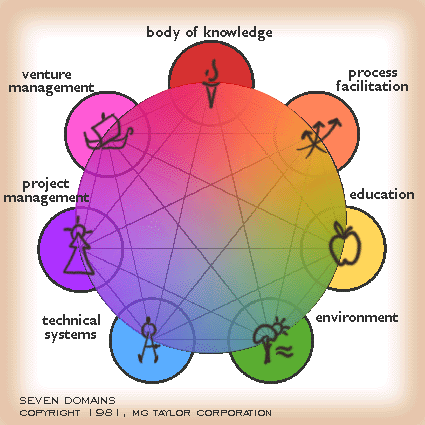
a 7 Domains Analysis | | Bill Stead [link] is one of those rare individuals to which the rubric of genius can be comfortably and honestly applied. He has been a pioneer of Medical Informatics for over 30 years and a leader in the transformation of the care giver’s educational processes. The Vanderbilt Center for Better Health (VCBH) [link] is an expression of these two pursuits. | | His old office was what you would expect: piled high with papers, maunscripts, books and pieces of old computers. His schedule is what you may expect also - full. How he interacts with Judy Privett, who supports him, the many teams he directs, is part of or make up the network of enterprises he is engaged with, is critical. | | When Bill decided to move his office and some staff to the VCBH environment we talked about how to configure the space that was available to him. Cyril Stewart, who have designed the building years before and now heads up the Vanderbilt facilities office and Karin Smith, combined two small existing rooms, on the rounded corner of the building, into a space of suitable size. Bill, who did not want a big office argued to use one of the rooms but the three of us, having experienced his existing one, prevailed with the idea of a somewhat larger but still modest space. | | Bill’s point was that he wanted to fully employ the capabilities of the VCBH Innovation Center - and be an exemplar of their use - and that he, therefore, did not need a large space. Cyril, Karin and I agreed with this but pointed to the stacks of materials, Bill’s multi-tasking work-style and the fact that he would have to have some meetings in his personal environment for a variety of reasons. We also believed that, although Bill is not disposed to “show” and neither is the VCBH, that he, as leader of this effort, had to be housed in an environment that made an appropriate statement. The theme chosen expresses the innovative leader/knowledge-worker workplace. Certainly what Bill is about, the VCBH is about and the future of work is about. We had a few meetings over a few months and finally arrived at a concept which I sketched on a WorkWall and Bill approved. On January 29th, Bill Blackburn put these ideas to paper and the installation was completed April 10th. | | This process resulted in the development a few new pieces of furniture and the final design intimately supports Bill’s work style (while augmenting it and “pushing” it to new dimensions), his interactions with Judy and his intentions of employing the full CBCH capacity. | | Now, the USE part of Design/Build/Use begins. This is the real adventure and challenge. What follows is a description of our beginning point and a documentation of what results. The pictures below were taken minutes after the AI crew finished their work. You will have to imagine plants, books, computers, papers and people - all interacting agents in the creation of knowledge. | | | Judy’s POD work top which is oriented away from the large group areas of the VCBH and towards Bill’s office. The organizer is movable. | | | | There are two doors into Bill’s Office - this is his backdoor which opens from an alcove where he has access to one side of hisrolling “travel-trunk.” This side, as it is placed today, provides book shelves as does the exterior “wall” of Judy’s POD seen through the doorway. | | | | Standing back a ways provides a full view of Judy’s workPOD. The doorway on the left is the front door into Bill’s Office. Attached to the column is a four door lateral file accessible to Judy, Bill and his co-workers who will be working at the Center. There is a row of offices off camera to the left for Center staff, researchers and VCBH administration people. To the right of the POD are breakout areas that lead to the main VCBH large group work areas. | | | | Back in Bill’s alcove is the parking place for his rolling stand-up workstation. This has an adjustable top and deploys in his office or out in the Center as he needs it. We tend to sit too much when working. At stand up alternative is better for health and useful when working on the Center WorkWalls. | | | | This is Bill’s main office area. You can see the stand-up workstation in the background, To the right is the other side of his rolling “travel trunk.” The trunk has bookshelves on one side, deep storage behind sliding WorkWalls over three lateral files on the other. It can be place anywhere in the room to configure the space into areas as desired. In the foreground is Bill’s oval work table. It has two leaves that tuck under so that it can roll through doors, can be parked against a wall or opened to sit a number of people seminar-style. To the left, under the continuous band of windows, is a curved work top. The computer will go here to the right of the drawer with a phone that can rest either on the top of table. | | | | With our backs to the alcove, we can see the length of the office. The work top frames the window and view (to the north west) provides project work spaces and makes a dock for Bill’s two support caddies. the table can tuck under the work top or roll and pivot into the center of the room conference style. At each end of the work top are semi-circular shelves for objects. The curved Armature element provides 12 volt task lighting over the work-table. The computer screen is oriented so that the west afternoon sun will not reflect on the screen or have Bill looking into it when he is working on his computer. Framing the windows and utilizing them as a major source of light is a significant consideration of the design. | | | Here is the Armature and lighting. This divide the space in two bringing definition to what otherwise would have been a long an narrow visual metaphor. Notice, as Bill move back into his space it becomes progressively more private and expressive of refuge - a necessary circumstance for some kinds of work. The 12 volt lighting over Bill’s work-table will allow him to turn off the overhead lights and change the light signature in the room particularly in the “off-work” hours when he does a great deal of his “alone” work. | | | | Bill’s caddies in their “docked” position. On the left is a traditional AI rolling“dog” with file space, drawers and “leash.” On the right is a rolling projects organizer. Both sides provide shelves so that up to 28 projects can be readily accessible. Both these units are designed to work in the office, as well as, out in the larger Center where Bill often spends extended time. The also will dock partially under his table for easy access and to provide an additional work-top surface. These caddies, with the work table and work top, provide numerous ways to organize the workplace for specific tasks; and, they provide instant storage when Bill has to go from work-work mode to meeting-with-people mode. | | | | Judy’s POD also provides a number of cabinets, shelves, files and work surfaces. The round configuration allows access to a variety of these within arm easy reach. | | | | The view from Judy’s POD into Bill’s office. Work for him to pick up and leave can be organized in the organizer to the left. The drawers provide storage for all the things necessary to office work - paper clips, staplers, scissors, pens, pencils, and so on. | | | | And, the other way around. Bill can orient his work-table so that eye-sight is maintained or he can position it so that he has visual privacy. Judy can come in the “front” door or the “back” as is appropriate to his actual work modality. | | | | This is Judy’s POD from the rest of the VCBH group work spaces. The door on the right leads to Bill’s alcove. Between his “travel trunk” and the outside of Judy’s POD a great deal of storage/display space is provides for Bill’s books, periodicals, objects and so on. This is both for convenience and for making place and identity. The “message” the POD has to send from this point of view has to be both protective of privacy and appropriately inviting. It has to convey that one is entering a different function of the VCBH Innovation Center. | | | | Judy’s POD is feed from the ceiling with power, LAN and phone. This way, the POD can be moved and reconfigured as required. The cubePOD provides a significant amount of storage for books, periodicals, project files and so on. Far more than is usually found in the standard office. | | | The USE phase of a project is often not considered to be as creative as the design and make phases. This is an impoverished perception of the creative process. Building Bill’s and Judy’s workplace is just the opening gambit. The Four Step Re-Creation Model [link] describes how feedback works between phases of the entire creative process which includes The entire life cycle of, in this case, a work environment. The 7 Domains analysis, which follows, is a systemic way to think about designing, building and operating a human environment - and, in this case, a specific environment for an unique individual. It is a mental architecture that allows the sensing and appropriate [link] responding to an individual executive/ knowledge-worker. It will take a year to move beyond the virgin environment photographed above to the making of a rich, effective system of knowledge-augmentation and support. | | 7 Domains Analysis of the Stead Environment | The 7 Domains are those attributes that make up the work environment of an individual that, if properly constituted, augment his/her’ personal creative capacity and capability of exercising GROUP GENIUS in teams and ValueWebs [link]. The Domains have to be understood and managed on several levels of recursion [link]. The attributes of a system are those things, processes and characteristics, without which, the system ceases to be what it is. An environment is that which forms and makes up the circumstances of an organism. Humans do not need to be managed. On occasion, it is useful that they be facilitated (to make easy) and educated (to lead out). Sometimes training (to drag behind) is appropriate as training is essentially the creation of new, useful habits [link]. The 7 Domains, properly designed and managed, create a natural, organic [link] environment that can be made fit for each individual and for augmenting their interactions with others. These 7 Domains cannot be seen as isolated or independent phenomena. The separation into domains is an intellectual convenience. These have to operated as a system - it is the lines in the diagram that are of foremost importance - not the nodes in isolation. | | BODY OF KNOWLEDGE An individual’s and an enterprise’s body of knowledge remains the most under utilized resource in our society. Most of what is hyped as knowledge-management does not function - this is because it does not understand what knowledge is or how it is created nor what it is that has to be managed. Bill has accumulated a vast body of knowledge. It is questionable, however, if this is sufficiently leveraged across the enterprise of his focus and concern. It is also an open question if his knowledge acquiring process, outside his direct field of concern, is optimal for his purposes. co | | PROCESS DESIGN and FACILITATION Most work processes are a social default left over from an earlier and much simpler era - they are hopelessly inadequate for today’s world. Facilitation is regarded too often in terms of what happens in the front of the room which is the least predominate or important aspect of the practice. | | TRAINING, EDUCATION and LEARNING These three concepts, and their related practices, are often confused to the determent of each and the confusion of both individual and society. And, unfortunately, adult humans rarely considers themselves to be a student and learning is consequently separated from what is erroneously still considered to be the legitimate work environment [link]. This is, of course, a significant anomaly in this so-called era of the knowledge-economy [link]. Our societies environments and work processes are still predominately industrial-age in their deep structures. This contradiction would be amusing if it where not so deadly in its consequence. | | PHYSICAL ENVIRONMENT and TOOLING In our society, the physical environment is rarely understood in terms of the impact it has on the cognitive functioning of the human brain/mind. The work environment is too often seen as a utility - the cost of which is to managed and kept in control. It is rarely regarded in human terms and even more rarely as a knowledge-factory that can yield huge return business results, let alone, in intellectual capital. Our work environments simply do not work well [link]. Typically, they support but a few of the executive and knowledge-creation and sharing processes [link]. They are almost never seen as the expressive and influential social art that they in fact are. | | TECHNICAL SYSTEMS Most technical systems we have today do a brilliant job of augmenting the practices of the 19th century [link]. They are not designed from the premise of a Knowledge-base era. This, however, is changing. New tools are becoming available, that if used appropriately, can transform the executive routine [link] and the process of knowledge work [link]. | | PROJECT MANAGEMENT Project management means, literally, the hand before the throw. It is generally practiced as the control function after a game has actually been played out. Effective project management is anticipatory. This means it has to be based on a model of possible futures and practiced as a preemptive and systemic, feedback-driven response to multidimensional emergent events. Most project management methods are far too linear to do this - they are trapped in the industrial era assumptions from which they came. They attempt to control people and circumstances (which is like trying to herd cats) rather than practicing the art of anticipatory design [link]; for this reason, they tend to cut down innovation and effective local action - and, for this reason project management is experience too often as an instrument of repression. | | VENTURE MANAGEMENT There are both individual and corporate venture(s) involved here and it is important to understand them in both their separate and integrated realities. | | The most significant aspect of architecture [link] is its ability to be a vehicle of human transformation [link]. This is the high ART [link] of architecture at its best. There are multiple criteria [link] necessary to the making of organic, sustainable, transforming environments. Every work, no matter how vast or modest in scope, must strive to accomplish both the pragmatic and the sublime in the making of habitat for every human [link]. When fully understood, this is an exciting and daunting task. It is a task that cannot be accomplished without the active participation of the environment’s user. The space must be inhabited not merely occupied. The VCBH is still a nascent environment. One intent of Bill’s presence in the VCBH environment is to be an exemplar of its full use and to systematically explore the interface [link] between his individual work, his collaborative work and the work of the Center as a whole. Therefore his “office” is not an office - it is an environment and there is a world of difference between the two concepts and their practices. His environment, in this context, includes the functioning of Judy’s - even as hers has to be fit for her while reaching out and including Bill’s. The relationship between Bill’s personal space and his part of the VCBH commons is critical to the success of the entire endeavor. | It is rare privilege to design an environment - a knowledge-making engine - for a person such as Bill Stead. It is both a challenge and an opportunity to see if this can help him become even more creative and organizationally effective. The story of how this “experiment” plays out will be documented over the year to come. | | | | | VCH Executive Offices - Why Do It? | | | Matt Taylor
Nashville VCBH
April 9, 2004 | | 
SolutionBox voice of this document:
INSIGHT • POLICY • PROGRAM |
posted April 9, 2004 revised April 14, 2004
• 20040409.226201.mt • 20040410.351196.mt•
• 20040414.999900.mt • (note: this document is about 15% finished) Copyright© 2004 Matt Taylor |
|