Taylor Glyphs are used in this document as fonts
In order to not get strange letters
Download and install the Taylor fonts
Windows [ink]
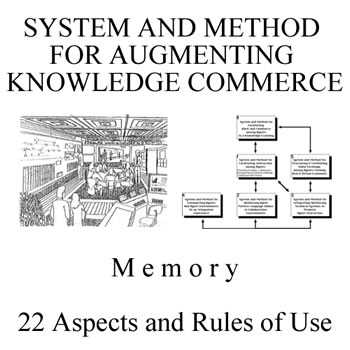
Mac [ink] | Requirements and Capacities | | This Article is in four parts. The first establishes the context for understanding and using this material. Part Two, covers the first 11 Aspects of Memory. Part Three, the final 11 Aspects. Part Four, outlines the required capacities, that applying this Method to the creation of dynamic systems, are necessary in order to accomplish the aim of this System and Method. It also addresses some aspects, in terms of this Method, that memory is not. | | The techniques, processes, augmentation tools, artifacts and system components that compose the memory providing, building and employing aspects of this System and Method, address the following required capacities: The ability to make, now disparate components of a system, “act” in “mind-like” ways wherein the various components: document their experience and “inform” one another of their status and state and record the informing act; Encode and translate various “experiences” so that various components and users of a subsystem (or the System) can “read” the embodied information and employ it - making a functional memory - that relates to and ties the “experience” of one system component to others - across time, activity and work iterations and levels of recursion; | The ability to... | Memory ToA is misunderstood. It is confused with storage which is only a technical requirement, and which, in many systems does not occur, literally, at all. It is confused with other cognitive processes. The memory function is rarely used as an active design element in the creation of Human artifacts and systems. Consequently, both component and system performance is compromised. This leads to ineffective systems. Beyond these consequences, however, is an even more limiting result. There are whole categories of artifacts and systems that cannot function without intact, dynamic memory. This Method is concerned with both these situations - one can be called “traditional” context and, the other, “lifelike” context. The Human species is approaching a level of complexity, in organizational, technical and socials systems, that exceeds the capacity of the kind (traditional) of systems they employ. If there is not to be breakdown and a “limits to growth” consequence, more complex (lifelike) systems have to be built. These systems will have to have embedded memory of the kind I have outlined in this Article. | | Much of what makes inefficient, high maintenance systems can be addressed by building in, and employing, more sophisticated memory. This facilitates cybernetic performance. Complex systems require multiple levels of recursion of feedback; this requires multiple autonomous memory components. Engineering these kinds of systems will require the employment, as design assumptions, of multiple combinations of the 22 memory functions I have described in this brief outline of this sub-system. | | Matt Taylor
Palo Alto
May 12, 2000 
SolutionBox voice of this document:
INSIGHT • STRATEGY • CONTRACT DOCUMENTS | |
posted May 12, 2000 revised June 14, 2005
• 20000512.847422.mt • 20010928.105759.mt •
• 20050302.459801.mt • 20050614.391100.mt • note: this document is about 20% finished Matt Taylor 615 525 7053 matt Taylor e-mail [link]Taylor IP Statement and Policy [link] | |
|