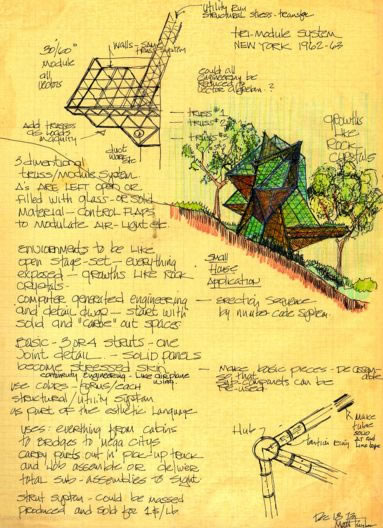
EarthShip™ Concept
circa early 60’s
this
version drawn December ‘73 - Kansas City
For an updated version of this concept,
see: Bay Area Studio drawings [link] |
| During
the 1960s I spent most of my professional time building.
I worked for a variety of contractors and developers
on the East Coast and the South West. In addition,
I did design/build of small additions and custom
landscaping and swimming pools projects (outdoor
environments), as well as, sub contracting. While
I executed a number of my own designs - all remodels
and additions - the focus of my work was on building
practices and how greater precision of component
fit could be accomplished while removing great chunks
of time and cost from the process. |
| I
found that, by working with what today we would call
the supply
chain [link],
that over half the time and more than 40% of the
cost of a project can be consistently eliminated. |
| My
conceptual architectural work was, therefore, free
to explore a variety of ideas - all of which depended
on a greatly improved building process. These two
aspects of my work were closely coupled in my mind.
On one hand, I was being paid to
build [link] conventionally designed buildings, while
on the other, I was using this work as a lab to discover
better ways of conducting an integrated design-build
process. During the week, I ran construction projects.
Evenings and weekends my design work explored the
kind of environments such improved manufacturing/construction
processes would make possible. |
| In
many respect these were the best of times. I was
able to get in “two weeks” of work every
week. One week of building and one week (end) of
designing, studying and thinking. A few hours every
night plus the coveted Friday night through Sunday
work period allowed for great productivity. The
day-to-day building provided a sense of achievement
and grounded the more theretical work done during
the “after hours.” |
| The
only problem was that this combination actually allowed
me to discover - and prove out building methods -
that to this day - remain largely unused. Why this
is remains a mystery to me. |
|
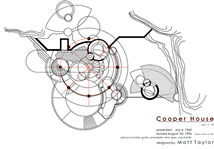 |
| The
Cooper House and the American Pool Building were
designed while I worked a a foreman on a gunite crew
- this allowed an integration of design and construction
methods. |
|
| The
decade started with the Cooper house and the American
Pool Building projects - both circular studies to
be built from gunite (sprayed concrete). These two
works were actually not typical of most of my work
during this decade which explored a different modular
system that combined all of the basic geometrical
forms (As illustrated below). This is why I include them in my 1950s work [link: matt tatylor - 1950s architectural concepts]. The more pure circular
forms were explored and utilized in some swimming
pool projects [link],
the dome
projects [link] of
the 70s and and our WorkFurniture
systems [link] of
the 90s. Circular forms provide great amenity in
the the space, ambiance and setting of
an environment. They bring with them certain challenges
chief among them the fact that circular layouts will
(all things being equal) drive square footage upward
and there are certain fabrication and construction
challenges intrinsic to the form. In addition, the
esthetic is sometimes tricky - the resolution between
the plan, elevations and masses in specific presents design challenges which have to be carefully met. This
make the circular building one of the most difficult
to create - and, one of the most rewarding when done
well as rare as that is. |
|
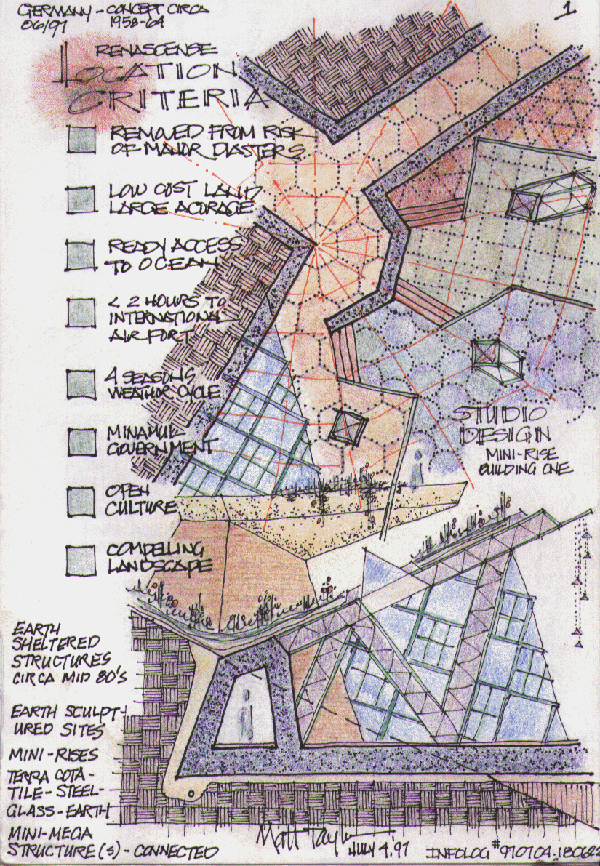
Renascense
III Concept Sketch - 1997 |
| This
sketch was actually drawn while I was on vacation
with Gail, Jeff and Sheri in Germany and Holland
during the summer of 1997. It is was a multi-faceted
exercise: First and foremost, it was vacation fun.
I do not get the time, very often, to just “play” with
ideas and colored pencils. Second, it was an exercise
to re-think the site criteria, modular schema and
materials pallet for Renascense III. Third, I was
revisiting certain architectural ideas that I had
developed-explored in the 1960s. It is for this reason
that I use it here. It is archetypical of my work
at that time many of the drawings of which have been
lost [link]. A version of this project was developed for the Laura Powers Residence in the early 1980’s. |
| First,
a few things about the sketch itself. This is how
I often approach a concept sketch. The idea is not
to express a solution to a specific building problem
but to express a grammar - a meta pattern
language [link] that contains a number
of problem-solution possibilities. This sketch is
a
superimposed Plan,
Section and Elevation - all of which, establish a
schema from which a number of specific architectural
pieces can be generated. |
| There
are a number of features that this schema facilitates:
a module system that incorporates rectangles, squares,
triangles, diamonds and hexagons into a single system. |
| This
module is employed in three dimensions - not just
the horizontal plane. In addition to allowing great
variety of shapes and forms, it facilities great
precision and control of component placement and
piece cutting. It is possible, using this system,
to describe a building, all it’s pieces, their
location in space and their sequence of erection
in strictly numerical terms. This eliminates most
conventional drawings and a great deal of “cut
and fit” in the field - it facilitates “shipping
information, manufacturing on site” processes.
[February 17, 2005 Note: this process is now part
of our Patent and patent pending materials]. |
| A
later development of this module is my Bay
Area Studio [link] project. |
| As
in music, where a certain scale and orchestration
can be used to create a near infinite variety of
pieces, this modular method and process promotes
the same results. It also facilities the integration
of
craft and industrial methods - both technically
and aesthetically. Replaceable components, be they conceptual or physical, can be re-used with near infinite variety. |
| It is
by such methods that Lean Construction can
be accomplished. I prototyped these methods over
30 years ago by doing this work on my own drawings
and in the field for my crews. Doing the field layout
and feeding them the right information and materials
flow in the right time and sequence, eliminated a
great deal of wasted time on the job. It also freed
their minds to concentrate on their work. It is so
easy. However, almost never done because it is considered
expensive! I ran a construction site, in the 60s,
much like we conduct a DesignShop process today.
It was in this design-build context that I started
thinking about computer augmentation [link: as we may re think]. |
| Much
of what we do today and is in our Patent [link] was conceived in the application
environment of building - what today would be called lean production.
My R&D lab was the swimming pool industry which
was ideal for this kind of experimentation and development [link: swimming pool story]. |
| In
addition to these modular technical innovations,
my 60s work explored a number of other unique architectural
features. As the sketch indicates, this was a “domestic” scale
architecture that employed vertical “high rise” forms
and “earth-sculpting” methods that sometimes,
in recent years, are found in large scale commercial
projects. This provides the occupant a completely
different orientation to the site than typical
(except under the happy circumstances associated
with very unique lots). The verticality allowed placing
each room in just the right position (sun, wind orientation
and view) for the specific function of that
room. Traditional layouts simply cannot do this.
The earth burming allows the creation of micro-climates,
best use of prevailing winds and maximum development
of sight lines. It also reduces maintenance and utility
bills by using “earth-sheltered-building” means.
These methods allow greater density of land use
while providing a greater sense of space and privacy
- along with - significant energy and materials economy. |
| In
addition, this vertical organizational schema, facilitates
a small foot print. It allows for engineered footings
where bearing and foundation can be carefully matched.
This resolves many settlement problems and exposes
the structure less to certain stresses caused by
earth movements. |
| Using
these methods, it is possible to build an entire
subdivision that “disappears” into the
landscape. You will not see it until you are upon
it [link].
I believe that this technique will be used when old
work is rebuilt and the land has to
be reclaimed
from abusive development practices [link]. On the
scale of a subdivision, “cluster housing” plot
planning can be used leaving the vast majority of
the land open while providing privacy to each unit
and open views to all. |
| In
sum, this schema provides the architect a far greater
variety of concrete design options, compared to conventional
methods, while facilitating an economy of execution
by taking waste out of the building process and accomplishing
minimal cost for maximum result. Each house is composed
of elements, the specific shape of which, is what
is required on the mico-scale of each part of the
building. No waste, eloquent design. |
| I
have not, yet, built a major work based on this schema,
however, I did explore a number of these aspects
in landscape designs (and their support structures)
that I executed during this period. This provided
enough experience to, basically, establish the feasibility
of the ideas. People loved the resulting designs
once built yet tended to be wary of them “on
paper.”
This is still true today. This module is now becoming
ever more present in the production of our NavCenters
[link]. |
| If
truly affordable housing is to be accomplished, many
of these methods will be brought into play - this
will be especially true in the transition period
between today's antiquated practices and true construction
sophistication [link]. |
| Due
to an unfortunate incident, in 1971, I lost possession
of the drawings documenting my design work of the
50s and 60s. This was about 40 built and unbuilt
projects. |
| To
document this period will require recreating a number
of these works. This is a worth while exercise because
the opportunity for this “style” of architecture
is just now coming about. This is so for a number
of reasons. One is the technology - both manufacturing
and computer. What I was exploring with this work
was a hybrid architecture that employed a mix of
traditional field and what we now call “lean” manufacturing
methods. Another is customer “taste.” The “grip” of
traditional forms is just now starting to loosen
- creating, admittedly, a large number of grotesque
examples with a few scattered jewels. The greatest
driver, however, is new land-use standards and cost
of building economics. The affordability of traditional
housing is evaporating. |
| What
I was driving at, with this architecture, was a new
mix of technology, space utilization combined in
a package of high quality and small size. Houses
then - and more so today - are overgrown, wasteful,
non-economical, high maintenance abortions. With
this work, I was seeking the return to, continuation
and new expression of the 30s, 40s and early 50s
work [link] of
Wright, Eichler, Drake, Ames and others - small,
affordable, eloquent habitats |
| Unfortunately,
the average architect does not participate intimately
in the build process. This breaks the Design-Build-Use
chain. Feedback to design options by construction
opportunities, and visa versa, is mostly eliminated.
The relationship between designer and builder is
often adversarial and dominated by UpSideDown
economics [link].
This need not be. Architecture is a practical art
that demands total integration between idea and doing...
and using. The best
work being done, today, is being done by design-build
firms. The Jersey Devils organization (which is a
virtual network) is an outstanding example of a more
integrated approach [link]. |
| In
January, 2000 I returned to some of these concepts
with the design of a Studio [link] for
the San Francisco Bay Area as part of a Course [link] I
teach at SFIA [link].
On a square footage basis - as a one off - and built
in the Bay Area, this will not be an inexpensive
project. It will hardly be called affordable housing.
However, it will prototype methods that can be
with some refinement and steady production. It will demonstrate
that a lot of functional space can be gotten into
a small footprint. And, that all this can be done
along with making exciting architecture. |
Un Built Phoenix Projects |
| In my Phoenix years I made a serious effort to establish a practice of custom homes. Several client projects were taken through the Preliminary Design Stage. For various reasons, all remained un built. As a body of work, these were among my best efforts and reflected my accumulated practical ability to build. The drawings are lost in a too hasty and chaos filled move and are now being reproduced in 3d Sketch Up models from memory. At the time, I believed that the realization of these design would change the world and launch a successful career. In retrospect I realize that the entire movement of this kind of architecture was dying. I was on the losing end of an era and did not know it. Many skillful architects with careers far in advance of mine were to see their work options dry up over the succeeding decades. This remains, to me, one of the most curious times in the history of American architecture. It has taken until the turn of the 21st Century for the works which were produced in this period to be understood and lovingly restored and for numerous - if relatively obscure - practices of high quality to emerge based on, and extending, this kind of work. |
Designs from the Fountainhood - Work 19 |
| In 1961, inspired by my move to New York City, I turned back to the descriptions of the many buildings designed by Howard Roark in Ayn Rand’s The Fountainhead. I have never completed this task nor published any of the these concepts to the extent that I have developed them. These design challenges have remained an ongoing personal thought experiment from my reading of the book in 1956 - as of this edit in December of 2009 - for over 54 years. At one point I almost gathered the time and energy to put the designs into a portfolio for Rand but unfortunately she died in the 80s before I accomplished this. I have always regretted this mistiming. |
| Wright designed a house to be built in Connecticut for Rand in the 1940s and it is clearly based on the house which Roark designed for Wyand and Dominique in the book. I found all of the buildings described in the book interesting yet two of them have had the greatest impact on me and have found their way into projects I have proposed and built. The first is the Enright House, a marvelous concept, which has become the basis of my “multi-module” which I have used in numerous works. The most explicit of these is my Bay Area Studio project. Her description of evolving faceted forms never repeating yet forming a unified and inevitable whole is still one of the most original architectural ideas ever stated. |
| The second one is the mountain retreat rendered in circles spilling down a terraced hillside. While less radical in concept and easily imagined my Wrights work from the late 30s to his death in 1959, this concept still has a unique an intimate sense of the quality of personal living space which has been rarely accomplished and is almost totally absent from architecture today. Her interlocking and cascading circular forms have been the frame work of many of my designs from the Cooper House of 1958, to an actual proposal for a resort I made in 1962 and inclusive of numerous navCenter designs built and un built from the mid 90s to today. |
| I learned several things from the Rand-Wright-Art Pundits debates. One is that all sides had a point yet points too often driven to extremes thus nullifying their value. Rand’s word-pictures of the several buildings in The Fountainhead remain some of the most provocative architectural concepts ever put on paper. They were recreations: an artful combining of built work and pure imagination of works yet to be realized. A whole year of design studios could be built around advanced architectural students grappling with turning these literary images into practical, build-able projects. They would probably fail yet, in this, learn a great deal. |
| Mr. Wright stressed that one should conceive of the building completely in the mind before committing to paper. I eventually learned to do this. A tool I use to do so I learned from Rand. The written description in the Program Statement provides exact performance specifications while leaving the actual design freedom to emerge. How this is done is illustrated by my Bay Area Studio project and which happen to inspired, at least in terms of the shape dynamics of the design, by the Enright House from the Fountainhead. In my language, illustrated in the Solution Box, Rand presented her architectural concepts as VISION in the Creative Process model, PROGRAM in the Design Formation Model, and PHILOSOPHY to STRATEGY in the Vantage Points model. As I stress in the 4 STEP RECREATION model, each transition point along this path has to be a recreation of the concept. To “copy” Rand’s building concepts would produce a dogmatic result and a dry well. To ignore them because they do not exactly describe a practical, billable building is discount her accomplishment and to blindly pass on an opportunity. |
| When Rabbi Mortimer Cohen commissioned Wright to design the Beth Sholom Synagogue he presented Wright with the concept of a “traveling Mt. Sinai” to create a new and uniquely American expression of Jewish Architecture. Wright was so seduced and inspired by the Rabbi’s concept of the building that he listed his name on the drawings as co-designer - something I believe Wright had never done before. This clearly shows the importance of the concept of a building and its distinction from the rendering of it. This is emphasized by the two halves of the Creative Process model. The Rabbi’s concept of the building was a literal manifestation of the Bible, Jewish traditions and faith as well as the rituals of the Synagogue. This combined with Mr. Wright’s concept of organic architecture and his belief in democracy produced one of the most unique works of art of the 20th Century. It took thousands of years of tradition, two men at the peak of their creative powers and 7 years of arduous design and building to make this environment. What was “new” and what was “old?” These questions become superfluous when inspiring ideas, great minds and disciplined work processes intersect. If you want to facilitate innovation and fine art, this is all you really need to do. |
|
| The 1960s were, as I think of my experiences in retrospect, a seminal decade for me. In these ten years, I honed all the skills and developed the knowledge I needed to forge a practice of architecture as I envisioned it. I did not realize that what I was preparing myself to to do was a rapidly declining market. The decade ended with a catastrophic experience which destroyed everything I had been working for and had gained in the 15 years of professional work. The full telling of this, which has partially been documented by others without knowledge of my involvement, will wait for another time - a time when the major players are no longer with us and the innocent will be free from risk. This event catapulted me to an entirely different track - a track I lamented for several decades as taking me away from the goal of creating Authentic Architecture. Yet, I was to find late in the 90s that it has become perhaps the only way to achieving what I set out to do. Only time will tell this but I have come to a measure of peace with any of the more likely outcomes. |
| In the 60s I experienced some of my greatest achievement and defeats. The decade was one compressed time of 18 hour, 7 days a week, 52 weeks a year of study and work. I lived and worked in California, New York and Arizona. I worked as a chief draftsman, a laborer, construction superintendent, field engineer, graphic designer, sub contractor, work process consultant and started a design-build business. It was in this period that I got deeply into cybernetic and systems theory and designed the basis of what was to become the technical aspects of a patent filed in 1998 and issued in 2001. I learned how to consistently take 75 percent of the time and 50 percent of the cost off of standard construction and to build true architecture within these same time-cost parameters. I also learned that most people did not give a damn about this and that it would be decades before many would. That it was all blown away at the end is without doubt the worst and best thing which ever happened to me. |
| In this period, I also left a body of un built work which still burns in my mind demanding release. Ideas like these do not go away quietly. It is impossible for the mind to let them go until they are build and have a life of their own somewhere, someplace. They lurk in the back of the mind waiting... |
| I am happy to have lived this decade and equally grateful I do not have to relive it. I am looking forward to putting it to rest by documenting it, build the un built works still relevant to new times and seeing the work processes developed then finally applied on a broad scale in the service of affordable and sustainable architecture. |
| At the time with the move to NYC in 1961, to Kansas City in 1971 and Boulder in 1979, it seemed that the 50s, 60s and 70s were radically different and disconnected phases of my development and work. In reality, they - with all their differences - were remarkably consistent and provided a smooth learning and professional continuity. From 1980 on, a period matching in time these three decades, I have been on one track, with one mission - a mission which has pulled all of the disparate parts into an integrated whole. The 60s were the meat in the Sandwich between the 50s and 70s which made this possible. |
|
Matt
Taylor
Palo Alto
March 3, 1999

SolutionBox
voice of this document:
VISION • STRATEGY • SCHEMATIC
|
|
click on graphic for explanation of SolutionBox |
|
posted:
March 3, 1999
revised:
December 24, 2009
• 20000107.142571.mt • 20050217.411120.mt •
• 20050225.565410.mt • 20060130.722100.mt •
• 20091224.893929.mt •
Copyright© Matt Taylor 1999,
2000, 2005, 2006, 2009 , 2009
(note:
this document is about 65% finished)
|
|
|